


Ikeda Eisen [aka Keisei Eisen]. [Shinpan Edo no Hana Gofukuya Sugoroku] [Tokyo], Yamashiroya Matabe [1820 - 1850?]. Woodblock print 67x46cm, printed in black, blue and pink; folded. Smudges and soiling, a couple of small chips from the top edge. A pretty decent copy. Au$1250
Another lesson, if we need it, that the Japanese had connected and mastered the important stuff of life long before the rest of us: advertising, fun and shopping. In this sugoroku - a racing game - Eisen takes us through the most prestigious dry goods stores and drapers - ie high fashion - of Edo (Tokyo) until we reach Ebisu and Daikokuten - gods, respectively, of merchants and wealth. In other words, who isn't this game for?
Every working Edo inhabitant with a speck of ambition will want a place among the great merchants, rubbing shoulders with such gods while their wealthy patrons have confirmed that their shopping habits are blessed by the gods. The titans of fashionable commerce here include Echigoya (now Mitsukoshi), Shirokiya (which lasted some three hundred years, its ghost is a department store in Honolulu), Iwaki Sotoya, Matsuzakaya (still going), Ebisuya, Daimaru (still going), Shimaya, Sawanoi and Izukura.
Eisen did more than one sugoroku: this; one of more prosaic sights of Edo; one of the Tokaido road; and an elaborate sort of fourth one - the set of courtesan prints which together form a game - are the ones I've traced. I've found two other copies of this shopping adventure, in the UC Berkeley library and in the fabulous sugoroku collection of the Edo Tokyo Museum. They are printed in yellow rather than blue.
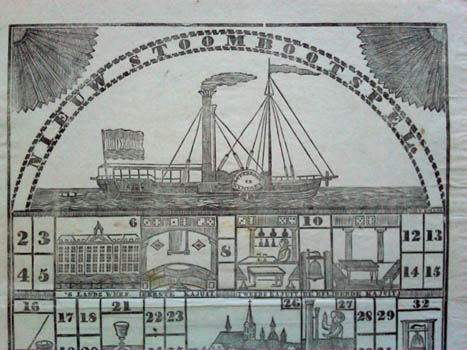
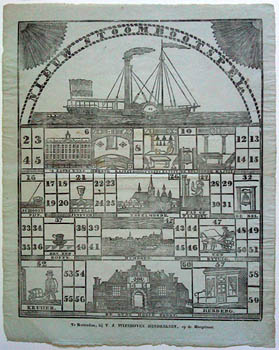
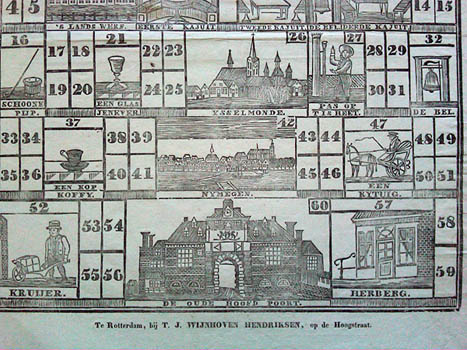
Paper Game. Nieuw Stoombootspel. Rotterdam, T.J. Wijnhoven Hendriksen [c1835]. Woodcut broadside (41x33cm). A horizontal fold, an outstanding copy. Au$750
Racing games like this often celebrate the new, the noteworthy, the latest craze. The steamboat might have been around for a few years but it hadn't lost its gloss judging by the games that re-appeared through the 1830s. This game, signed P. Emans, seems to have been printed at least four or five times through the twenties and thirties judging by the various colophons. All but one I've found are Hendriksen's; the exception is a Delft printing dated 1832 which, if this printing is from around 1835 as the experts say, indicates that the block was lent or rented.
Buijnsters and Buijnsters-Smets (Papertoys p272-3 - illustrating this copy) suggest this boat may be the 'Dutchman', built in 1823.

Paper Game. Het Vermakelijk Harlekijnspel. Amsterdam, J. Viegler [188-?]. 57x43cm colour litho game on paper. A rather good copy. Au$75
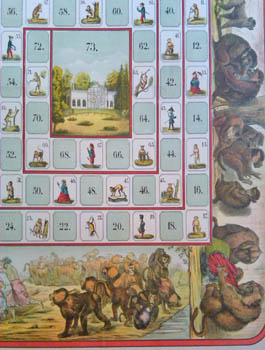

Monkey Game. Het Apenspel. n.p. [188-?]. 61x46cm colour litho game on paper. Edges a bit ragged and some repaired clean tears. Au$150
A Dutch racing game for devotees of monkeys - and who isn't? It seems counter intuitive these days but the object is to get into the zoo.


Yamanaka Eijiro. [Mankoku Shuyu Sugoroku]. Tokyo, Yamanaka Eijiro 1887 (Meiji 20). Colour woodcut map 50x71cm, folding into modern patterned paper cover with paper label. Some worming expertly repaired; all, including the covers, a triumph of sympathetic craft. A handsome copy. Au$1200
This rare world tour game tells us all the important stuff we need to know about the world. Thanks to the modern wonder of other people putting in the effort I can tell you that in 1888 this was advertised in newspapers and the womens' magazine Iratsume as an educational game for family and schools for two sen.
Worldcat finds no copies; CiNii finds two locations.


Boer War paper game. SCHLETTE, E.G. Boer-en Rooinekspel. Amsterdam, Koster [190-?]. 56x79cm colour lithograph. Creasing and a couple of short tears repaired in the margin. Au$150
A bright and cheery racing game.


Hikifuda & Sugoroku. [Nichiro Kinen Sugoroku]. n.p. [1905?]. Colour lithograph 26x37cm. A bit smudged and rumpled, pretty good. Au$300
I have seen a few hikifuda made as sugoroku but they have been staid affairs featuring birds, flowers and graceful women in flowing kimonos. This exuberant advertisement game celebrates the Russo-Japanese war victory.
These hikifuda - small posters or handbills - were usually produced with the text panel blank. The customer, usually a retailer, had their own details over printed.


Otake Kokkan. [Shin'an Sei-Ro Senkyoku Sugoroku]. Tokyo, Hakubunkan 1905 (Meiji 38). Colour broadside 55x79cm. A few pinholes; rather good. Au$300
The new year gift from the magazine Shashin Gaho. This may be muted and delicate at first glance but there is plenty of turmoil on land and sea. And it looks to me you could learn all you really need to know about the Russo-Japanese war. There's a lot packed in.
Otake was a well regarded, prize winning, Nihonga painter who was firm about maintaining Japanese tradition but like many such artists was a busy producer of prints and illustrator of magazines, books and advertisements.
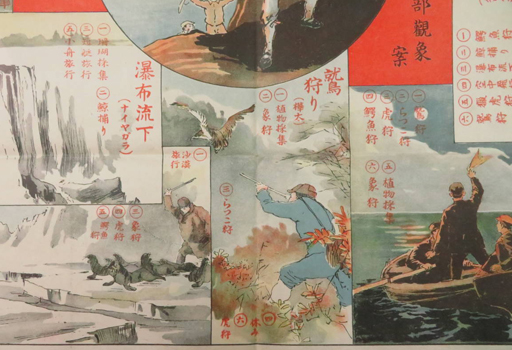

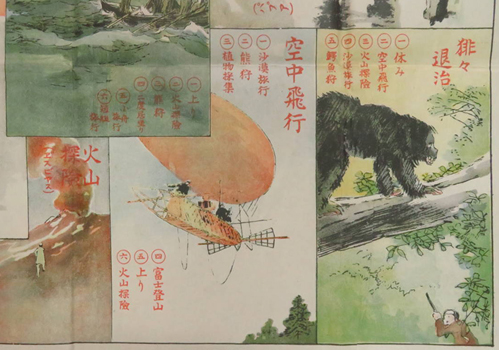
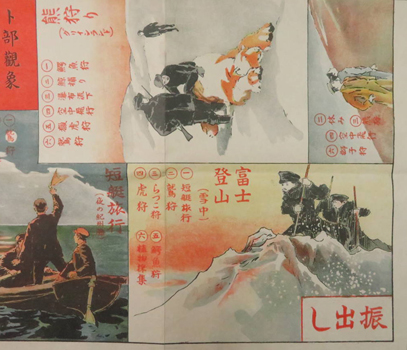
Kaburagi Kiyokata & Miyagawa Haru? [Boken Sugoroku]. Shonenkai 1906 (Meiji 39). Colour broadside 47x63cm. Folded as issued, rather good. Au$300
Don't be fooled by the elegant and delicate artwork. This new year gift from the boy's magazine Shonenkai is filled with adventure, peril and slaughter. Nothing with fur, fin or feather - if large enough - is safe from these boys on their jaunt round the world. When they aren't shooting eagles they are clubbing seals.
No artist is named but a 2016 exhibition at the Shinjuku Historical Museum attributed this game to Kaburagi and Miyagawa.


Nakazawa Hiromitsu, Kobayashi Shokichi & Okano Sakae. [Toyo Mirai Sugoroku]. Tokyo, Hakubunkan 1907 (Meiji 40). Colour printed broadside, 55x78cm. Minor flaws and signs of use, some ink splodges on the back. Au$650
A view, or a panoply of views, of a future Asia. Some of these vignettes of what's to come are obvious enough - schoolgirls at rifle drill and sumo wrestlers in striped bathers - but a few seem fairly recondite to me. I'm not sure how much is optimistic, how much is dire warning and how much is wearily stoic.
Nakazawa, Kobayashi and Okano, still young, had been fellow students at the Tokyo School of Fine Arts, and of Kuroda Seiki, and collaborated on the five volume Nihon Meisho Shasei Kiko, issued over several years.


Nakazawa Hiromitsu, Kobayashi Shokichi & Okano Sakae. [Toyo Mirai Sugoroku]. Tokyo, Hakubunkan 1907 (Meiji 40). Colour printed broadside, 55x78cm. Edges nibbled, a small ink splodge, a bit browned; quite good. Au$425
A view, or a panoply of views, of a future Asia. Some of these vignettes of what's to come are obvious enough - schoolgirls at rifle drill and sumo wrestlers in striped bathers - but a few seem fairly recondite to me. I'm not sure how much is optimistic, how much is dire warning and how much is wearily stoic.
Nakazawa, Kobayashi and Okano, still young, had been fellow students at the Tokyo School of Fine Arts, and of Kuroda Seiki, and collaborated on the five volume Nihon Meisho Shasei Kiko, issued over several years.


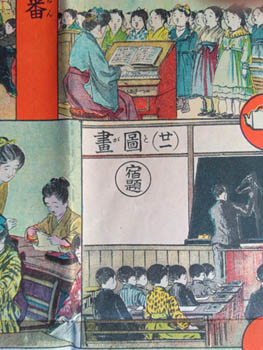
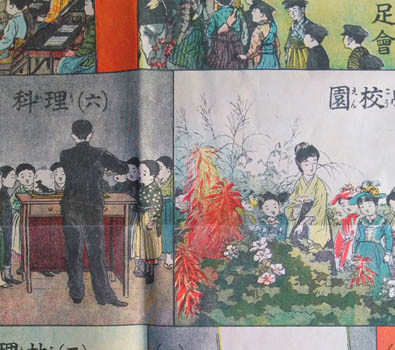
Otake Kokkan. [Shogaku Kyoka Sugoroku]. Tokyo, Shonen Sekei 1907 (Meiji 40). Colour broadside 78x54cm. Quite a nice copy. Au$385
School life for small boys and girls; this was the new year gift from the boys' magazine Shonen Sekai. Boys and girls learn to read but then their ways seem to part: boys learn about rats while girls do flowers, boys learn to count while girls sew, boys write while girls fold paper.
Otake by 1907 was a well regarded, prize winning, Nihonga painter who was firm about maintaining Japanese tradition but like many such artists was a busy producer of prints and illustrator of magazines, books and advertisements.


Kosugi Misai. [Boken Soyu Sugoroku]. Tokyo, Hakubunkan 1908 (Meiji 41). 54x80cm colour printed broadside. Mild signs of use, rather good with the playing pieces in the top margin. Au$450
This stylish adventure sugoroku was the new year gift from the magazine Boken Sekai (Adventure World). A thrill seeking family jaunt around the world meeting sea serpents, sirens and ghouls of some sort, killing all sorts of large beasts on the way. Only father and the older son get to kill things but mother does get to drive a car, radical enough.
Kosugi Misai was another of those painters who started by studying western art and discovered Japanese art outside Japan; in his case in Paris in 1913.


Aviation Game. Helder's Vlieg-Spel. Zwolle, Helder's Biscuits [1909?]. 44x64cm colour litho game on paper. Folded and a touch rumpled; rather good. With a list of the biscuit range down the right side. Au$450
A splendid race game featuring plenty of bumps, crashes and engine failures and the earliest forms of the monoplane. Did the monoplane in the centre panel exist?
1909 was the big year for air shows and game makers weren't slow so 1909 is a sensible date to put on this. I can find only one record of another copy of this - in the Seville collection - and this, he said humbly, is a much better copy.


Sugoroku. ' ' [Sugoruku Oyo Otogi Ebanashi 'Ganjitsu no Asa']. Tokyo, Shonen 1909 (Meiji 42). 54x39cm colour printed broadside. A nice copy. Au$250
In this charming dream sugoroku, the new year gift from the magazine Shonen (Youth), we follow a boy's adventures in a kingdom of chickens.
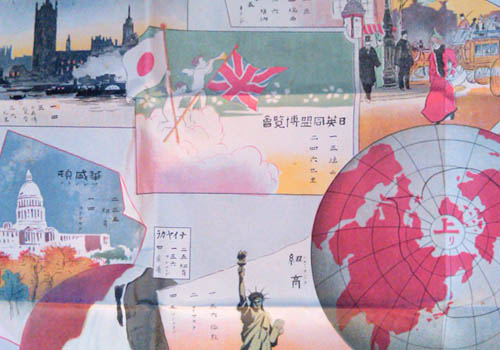
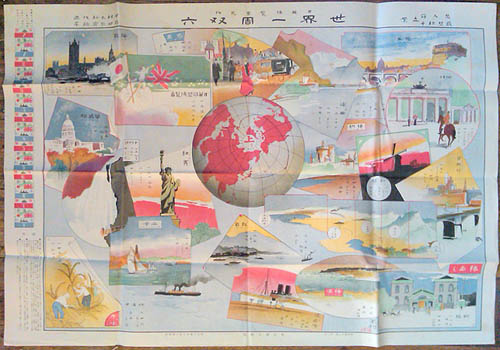
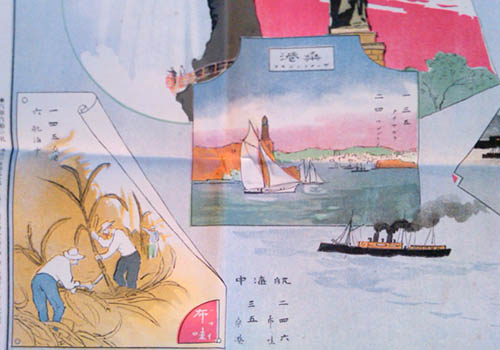
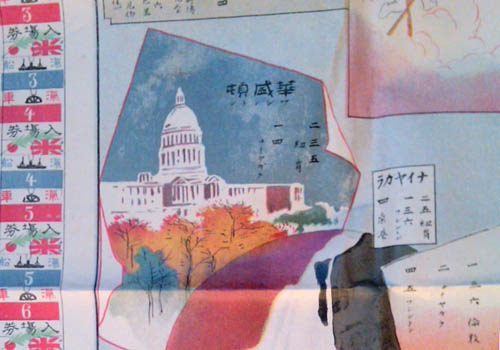
Nakamura Fusetsu. [Sekai Isshu Sugoroku]. Tokyo, Asahi Shimbun 1910 (Meiji 47). Colour printed broadside 55x78cm. Folded as issued, mild browning and signs of use. With the playing pieces intact in the margin. Au$450
An elegant sugoroku - racing game - issued by the newspaper Asahi Shimbun to celebrate the 1910 Anglo-Japanese Exhibition in London. Nakamura was a star of the generation that studied western painting and went on to forge a new style of Japanese painting, enlivening magazine work and book illustration.
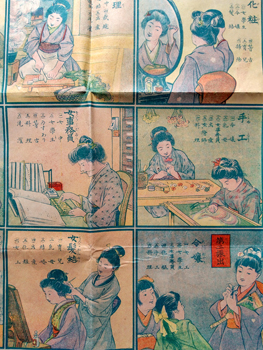

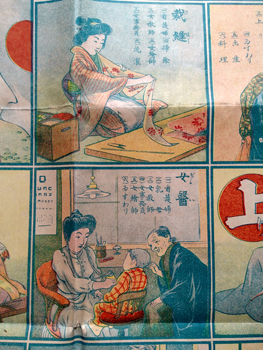
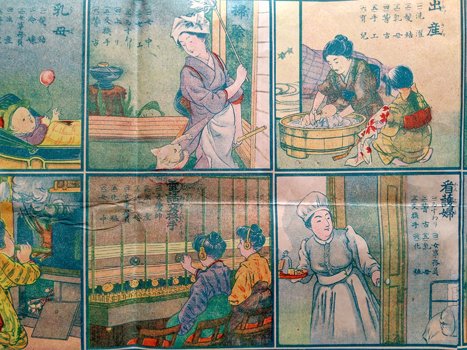
Kimoto Motoo. [Shin'an Meiji Fujin Sugoroku]. Tokyo, Fujin Sekai 1910 (Meiji 43). Colour lithograph 51x79cm. A couple of pinholes in folds, rather good. Au$300
An aspirational record of the life of the modern Meiji woman. Women do work, as telephonists, as teachers, typesetters, maybe even as a doctor. All can be balanced with a satisfying family life. This was the new year gift from the magazine, Fujin Sekai: Woman's World.


Paper toys. A gathering of eleven Taisho period cheap and flimsy paper games and booklets. n.p. 1910s to 20s. Sizes range from 8x5cm to 17x11cm closed. Obviously never used. Au$400
These look very much like they were gifts that accompanied something else or were rewards for coupons or suchlike. Five, including the origami-like soldier, fold out to be 'board' games with playing pieces inside; two are cinema like thrillers on accordian leaves and the two smallest are puzzling envelopes containing blank sheets and what looks like talcum; finally are the two booklets, smaller illustrated in black and white, larger in colour, telling the story of the Tongue Cut Sparrow.
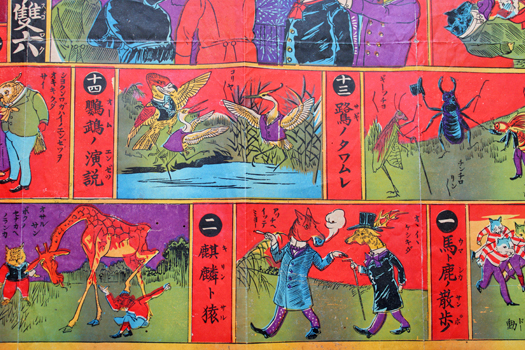

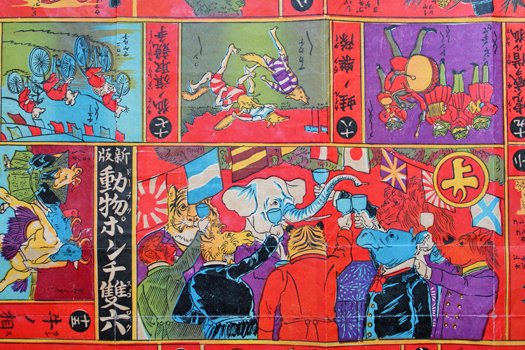
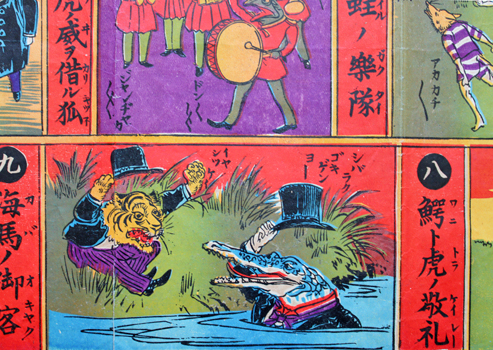
Sugoroku. [Shinpan Dobutsu Ponchi Sugoroku]. Tokyo, Tsunashima Kamekichi 1911 (Meiji 44). 49x67cm colour broadside. Rumpled with repairs to folds, still acceptable. Au$350
This is called a new edition of the Animal Punch Sugoroku but I don't know whether that means a new printing or a new version of an older game. I can't find a record of any version, including this one. In either case it does seem a bit old fashioned for 1911. 'Ponchi' outlived the original Japan Punch (1862 to 1887), was used in other titles and became more or less a generic term for cartoon social satire.
Kamekichi was a busy two generation publisher of prints that are politely described as tending towards the popular end of the cultural scale; ie cheap and lurid.
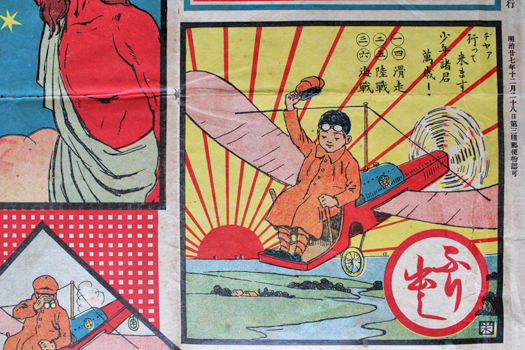

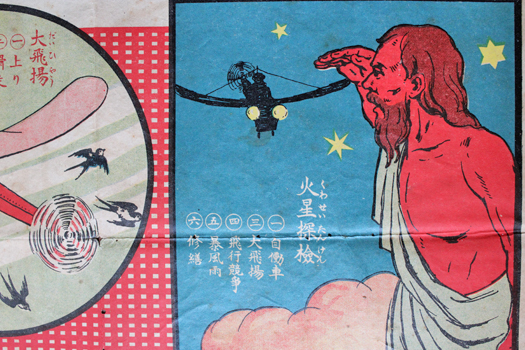
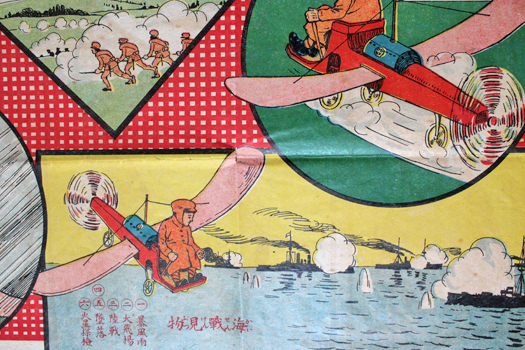
Okano Sakae [Shonen Hiko Sugoroku]. Tokyo, Shonen Sekai 1912 (Meiji 45). Colour broadside 55x79cm. Rumpled with several short tears around edges and along folds repaired. Au$250
This delightful illustrated journal of a boy's flying adventures was the new year gift from the boy's magazine Shonen Sekai. It's on a waxy paper that may have seemed a good idea when new but does not handle handling so well. This is the second best copy I've seen so far and I'm still looking.
Okano Sakae was one of the generation of artists who came through the western painting department of the Tokyo School of Fine Arts at the beginning of the century, later a pupil of Kuroda Seiki, and collaborator with fellow Hakubakai students on the five volume Nihon Meisho Shasei Kiko.
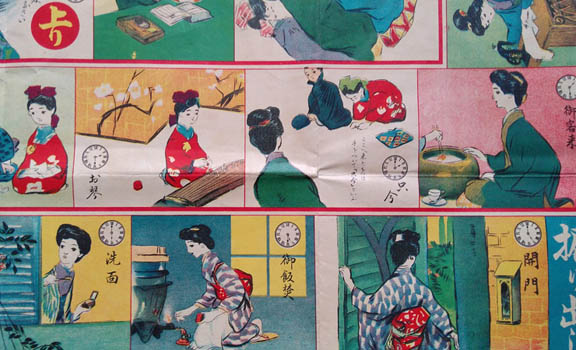

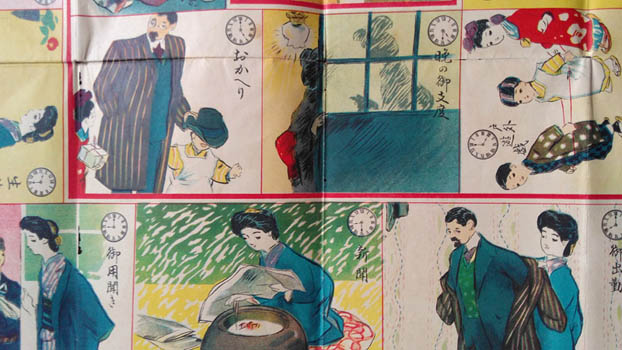
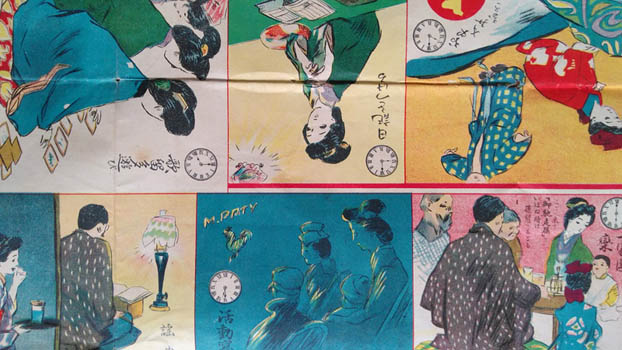
Kawabata Ryushi [Nijuyon Toki Katei]. Tokyo, Fujin Sekai 1912 (Meiji 45). Colour broadside 54x78cm. A bit used, a few small holes in folds. Au$400
The new year gift from the magazine Fujin Sekai - Woman's World - charting the day in the busy but calm and most decorative life of the successful woman - wife and mother.
Kawabata's career took a curious turn during a 1913 stay in America to study western painting. Apparently he was so impressed with the Japanese art he saw in Boston he switched to being a Nihonga painter. Still, he remained being an illustrator for magazines for quite some time. As did most of the early to mid 20th century artists now revered.
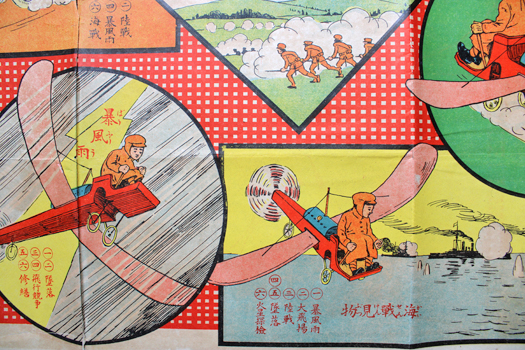

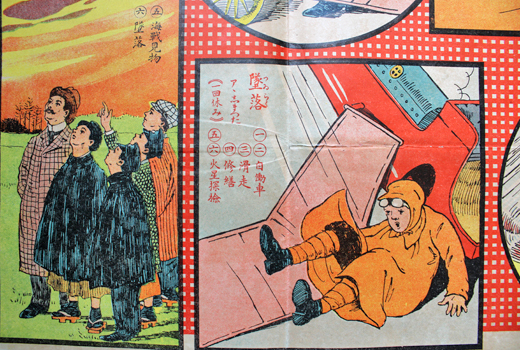
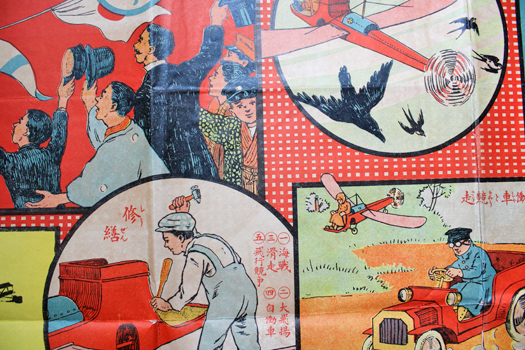
Okano Sakae [Shonen Hiko Sugoroku]. Tokyo, Shonen Sekai 1912 (Meiji 45). Colour broadside 55x79cm. With some short tears around edges and along folds repaired. Pretty good. Au$400
This delightful illustrated journal of a boy's flying adventures was the new year gift from the boy's magazine Shonen Sekai. It's on a waxy paper that may have seemed a good idea when new but does not handle handling so well. This is very much the best copy I've seen so far, not that I've seen many.
Okano Sakae was one of the generation of artists who came through the western painting department of the Tokyo School of Fine Arts at the beginning of the century, later a pupil of Kuroda Seiki, and collaborator with fellow Hakubakai students on the five volume Nihon Meisho Shasei Kiko.
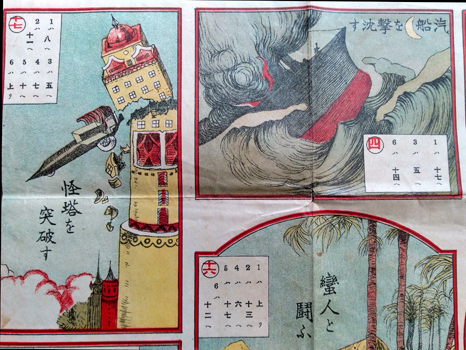

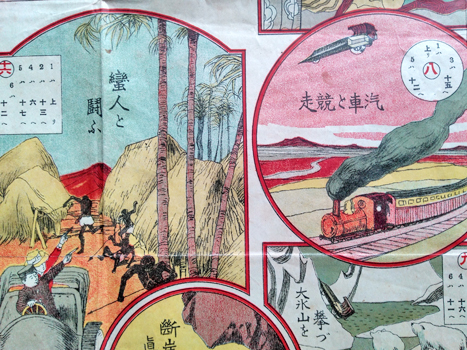
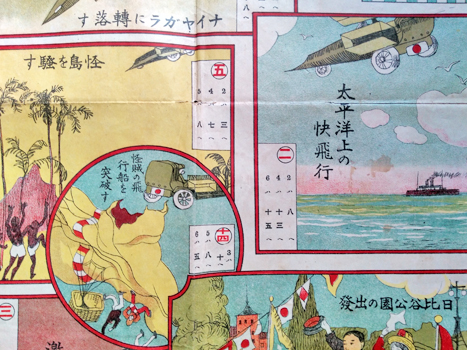
Kurata Hakuyo. [Hiko Jidosha Sugoroku]. Tokyo, Bukyo Sekai Sha 1913 (Taisho 2). Colour broadside 55x78cm. Used, with some small holes in folds and a repaired tear; quite acceptable. Au$400
This rare and captivating game was the new year gift from the magazine Bukyo Sekai. We follow two kids as they wreak havoc round the world in their flying car. Like all well prepared kids they packed their revolvers, handy when a lion attacks from one side and tigers from the other; likewise unfriendly black folk and what I take to be a roc.


Kawabata Ryushi. [Boken Shosetsu Sugoroku]. Tokyo, Nihon Shonen 1913 (Taisho 2). Colour broadside 79x54cm. A few small holes in the folds; pretty good. Au$300
The new year gift from the boys' magazine Nihon Shonen is called an adventure novel and so it is: action packed and perilous from start to finish.
Kawabata's career took a curious turn during a 1913 stay in America to study western painting. Apparently he was so impressed with the Japanese art he saw in Boston he switched to being a Nihonga painter. Still, he remained being an illustrator for magazines for quite some time. As did most of the early to mid 20th century artists now revered.


Kobayashi Eijiro. [Taisho Shonen Sugoroku]. Tokyo, Shonen Sekai 1915 (Taisho 4). Colour broadside 54x79cm. A touch browned and minor signs of use; pretty good. Au$250
A gift from the boys' magazine Shonen Sekai and, as always with boys' sugoroku, packed with excitement and adventure. Girls sometimes get to watch in awe.
[1] 2 3 4   |

