
[CUFFE, William Ulick O'Connor]. The Earl of Desart. The Raid of the "Detrimental". Being the true history of the great disappearance of 1862; related by several of those implicated ... London, Pearson 1897. Octavo publisher's decorated cloth blocked in gilt and white. A hint of browning; quite good. Au$300
Only edition of this lively high society/South Seas/feminist/lost race fantasia which sees a clutch of England's finest damsels kidnapped by well bred wastrels and yachted away to a South Sea island. Soon they come across the less necessary half of a race, seemingly of Mediterranean origin, whose women leave all men between childhood and dotage on another island and visit once a year. Our aristocratic bandits discover that being British and useless is useless when young women can have their choice of good looking capable men. It's only short step to a polygamous queendom.
This seems to result in a mulitude of children. I suspect that Desart didn't think through the mechanics of woman run polygamy but perhaps I misjudge him. Without the usual British infant mortality rate there might not be an impossible number of kids.
This was, I think, Desart's last novel. I couldn't find much in the way of reviews but I am pleased to report that the Launceston Examiner thought it "a medley of puerilities." With a tough editor Desart might be still read today. He could write fluently and entertainingly but he did get side tracked easily, sometimes forgetting what novel he was writing. His Lord and Lady Piccadilly was racing into the last bend before the home straight when he abruptly introduced a horde of new characters and turned a tragedy into a social satire for a couple of hundred pages. And he is prone to letting his cynical authorial asides overwhelm a page.

TAYLOR, William Alexander. Intermere. Columbus, XX. Century Pub. Co. 1901-1902. Octavo publisher's grey cloth; 148pp, frontispiece portrait. An inserted publisher's card advertising the book has made a faint brown patch on the title but this copy is pretty well as new. Au$250
First edition. An Antarctic lost race race utopian thriller. Again a ship, or in this case yacht, is enveloped in fog; comes a mighty storm and the narrator finds himself in an unknown land. Intermere is populated by a physically, mentally, scientifically and socially advanced race.
The book exists in a plethora of different coloured cloths but I don't know of any, and don't see any reason to look for, issue points.

NISBET, Hume. A Dream of Freedom: romance of South America. London, F.V. White 1902. Octavo publisher's illustrated cloth blocked in ochre, white and black; xii,318pp, frontispiece. Some minor browning and signs of use but rather a good copy. Tipped in the front opening is an original photo of Nisbet dated 1901 and a notice of this book. Au$850
Only edition and rare. And rare in more than one sense. It is the only novel that I know of set in the William Lane led utopia of New Australia and Cosme in Paraguay; in fact it is one of very few contemporary books on the settlement (the only other that I know of is the vitriolic 'Where Socialism Failed'; 1912). Likewise it is one of very few novels set in an actual utopia - or at least an attempt at one.
Nisbet's preface is a mildly petulant jab at his critics and sounds a weary note about having written more than forty novels without repeating himself. As his first novel (set in New Guinea) appeared only 14 years earlier it's a not unimpressive achievement on some level. The author of the newspaper notice inserted at the front was alarmed at the implied threat that this could be his last novel and must have been relieved as more novels appeared later the same year. But there weren't many more novels - and they petered out in 1905. In the same month (January 1902) that the freshly widowed Nisbet dates his preface he married a 73 year old widow - 20 years his senior. I wonder whether he was writing with the exhaustion of a new burden undertaken or the release from financial strain.

CHAMBLESS, Edgar. Roadtown. NY, Roadtown Press [1910]. Octavo publisher's cloth blocked in white with an onlaid colour illustration; [6],172pp. A little flaking of the white blocking, an excellent copy. Au$750
The deluxe issue: for an extra ten cents ($1.35 against $1.25 for plain) you could buy this with the cover illustration hand coloured. Now one of the more arcane and elusive utopian schemes for a new kind of city, leading to a new society. Roadtown is a ribbon, the extreme lineal city. At the bottom, underground, is the railway - noiseless and smokeless - above come housing, work and communal areas - each home with its own plot of land - and at the top is a promenade. In short the perfect blend of the virtues of city and country.
What surprises from this distance is how much apparently sensible support Chambless garnered. Construction was to be prefabricated concrete and Edison donated his patents; transport was by monorail and Boyes donated his patents; there was a pretty impressive list of people lending their efforts, both practical and rhetorical. Ten mile stretches of experimental or exhibition Roadtown seemed likely, even imminent, for years but Chambless beavered away at Roadtown for almost forty years, until his death in 1936, to wind up virtually forgotten.


New Australia. GRAHAME, Stewart. Where Socialism Failed. An actual experiment. London, Murray 1913 [1912]. Octavo publisher's cloth; xii,266pp & publisher's list, photo illustrations & map. A rather good copy in what seems to be the original glassine wrapper. Au$125
Second printing; in Murray's Imperial Library. I'm not sure why Grahame (ie Graeme Williams) was quite so bitter about William Lane and his utopian emigration to Paraguay. In this, his most extended revilement (he had already published a couple of pamphlets), Grahame assured his readers that he spent 'over five hundred nights in a mud hut at 'New Australia'' and its easy to conclude that he was a disillusioned settler, but I'm not sure whether that explains the depth of his hatred for any communistic or socialist behavior.

SLADEN, Douglas. Fair Inez. A romance of Australia. London, Hutchinson [1918]. Octavo publisher's cloth; 16 page publisher's list for spring 1918 at the end. Minor signs of use and some spotting or browning, a pretty good copy. Inscribed affectionately and signed by Sladen in June 1935 to "Dorothy ... another English soul who married an Australian." A small pencil note on the front paste down suggests that Sladen paid 2/6 for this copy in April 1935. If so, he's not the only author to buy their own books to give away. Au$400
First edition of this futuristic fantasy which opens in the year 2000 with the great airship Murrumbidgee from London coming into land at Melbourne. Returning home is Pat Lindsay Gordon, son of Adam Lindsay Gordon IV and great-grandson of Adam Lindsay Gordon II, in turn the grandson of a cousin of the revered poet. The Gordons obviously breed hard and fast. His sister Inez will doubtless be the femme fatale of the book. Read on yourself.

SLADEN, Douglas. Fair Inez. A romance of Australia. London, Hutchinson [1918]. Octavo contemporary brown cloth (spine lettered and decorated in gilt); 16 page publisher's list for spring 1918 at the end. Front fly removed and inner hinge cracked. Mild natural browning of the paper. Not a bad copy. Au$50
First edition of this futuristic fantasy which opens in the year 2000 with the great airship Murrumbidgee from London coming into land at Melbourne. Returning home is Pat Lindsay Gordon, great-grandson of Adam Lindsay Gordon II, in turn the grandson of a cousin of the revered poet. The Gordons obviously breed hard and fast. His sister Inez will doubtless be the femme fatale of the book. Read on yourself.
Was this published in wrappers? I see no other reason for replacing the binding when it must have still been new but I can't find a reference to wrappered copies.
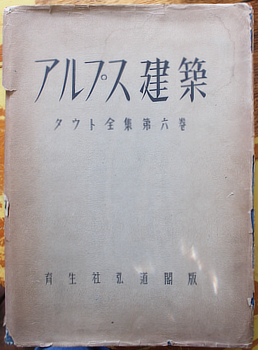
TAUT, Bruno. アルプス建築 [Arupusu Kenchiku] Alpine Architektur. Hagen, Folkwang 1919 [ie Tokyo, 1944]. 36x26cm publisher's flexible cloth and dustwrapper; title page in Japanese and 37 leaves consisting of 29 monochrome mounted leaves (title and contents leaves, five section titles and 22 plates) and eight colour lithographs. Covers chewed around the edges and along the spine, dustwrapper torn but pretty much all there. Usual browning of the uncoloured leaves. With the booklet containing the Japanese translation. Au$700
This might be the most curious Japanese book on western architecture. It's officially part of the collected works of Taut in Japanese (Tauto Zenshu) but while his other works were translated and collected into four solid sensible octavo volumes, here the original has been followed faithfully, lavishly. A translation was provided as an inserted booklet.
It has been sorted out thanks to the generous diligence of a librarian at the Art Institute of Chicago (the only library I could trace that had both versions) who, twice, compared them side by side and sent me a list of seven plates that vary in image size, that this isn't a re-issue of original sheets - once a common claim. So this is no photographic process reprint; the colour plates are proper colour lithographs that match the originals. While there's no doubt that elaborate and fine printing could be and was done in war time it still doesn't make sense. The flimsy translation booklet is what we expect from wartime printing - why not do a better job with that? The binding is war time, the printing is not.
So when were these plates produced? Were they prepared with Taut when he was in Japan - by 1936? The whole business of a collected edition of Taut in the middle of the war becomes something of a circular puzzle. Japan's ties with Germany are clear enough and the Japanese showed their appreciation of radical German modernists, or expressionists, like Taut and Mendelsohn pretty much even before Germany did, and Taut had spent years in Japan. But he was part of the exodus from Germany in 1933 and had died in Turkey in 1938. Still, a devoted band of fans did manage what seems unimaginable and got the job done.
Visionary, the term mostly used to describe this book, is often just another word for lunatic and Taut's utopian scheme for these monumental crystal structures marching across the mountain ranges of the world is captivatingly nutty. If this were to be judged on its own we would have just another eccentric, if endearing, relic of a dead end dream. But, in place in a cohesive group of theoretical writing and extensive design, both built and unbuilt, possible and impossible, this book wielded influence beyond its limited circulation in advancing the notion that, for the architect, principle, theory and social concern were tools as important as a T-square.
  1 [2] |

