
Kon Wajiro & Yoshida Kenkichi. 考現学採集 (モデルノロヂオ). [Kogengaku Saishu (Moderunorojio)]. Tokyo, Shunyodo 1931 (Showa 6). Quarto publisher's cloth blocked in red and white (spine a little rubbed), rather browned but solid illustrated slipcase; [2],323pp, photo illustrations, hundreds of line drawings and diagrams (one with colours added), endpaper map. A few blotches and small flaws, quite good. Au$750
First edition of the companion to the 'Modernologio' of the previous year - together they are the gospel of Modernology. Kon and Yoshida here collect data to extend their extraordinary encyclopaedia of the people of modern Tokyo. Their thesis was that those who do the planning, designing and building know nothing of what people actually do, what they own and how they use those things - how they live and who they are. I can't imagine anything you might ever think about and a lot you would never think about that isn't collected here. How you walk, where you walk, what you carry, how you carry it, where you dance, how you dance, how you sit, where your shelves are and what's on them, in your cupboards ...

働く婦人 [Hataraku Fujin]. No. 1 to no. 5: no. 8: no. 11 and Vol. 2 no 1 and no 3/4. Tokyo, Nihon Puroretaria Bunka, Jan - Nov 1932, April 1933 (Showa 7, 8). Nine issues in colour illustrated publisher's wrappers 22x15cm; contents range from about 140pp to about 70pp but the numbering of some issues is alarmingly erratic, b/w illustrations, monochrome photo illustrations. No.8 must have been a troubled issue; it is particularly humble and seems to have been assembled in careless haste. Expected browning of the cheap paper, signs of use but all rather good. Au$1650
Maybe nine elevenths - or nine thirteenths, or not - of the whole run of this trouble making left wing magazine for the Working Woman. It's hard to untangle. I can't find any complete set of these original copies. A reprint, probably not complete, was made in 1980 which seems to include eleven issues running from January 1932 to a March/April 1933 double issue - eight for 1932 and three for 1933. I found a mention that no issues appeared some months. The issues here are numbered by the month they appeared - which may mean there are gaps in the numbering of a complete run or that there are issues no-one has found. The holdings of 13 university libraries in Japan put together seem to add up to v1(1 -10) for 1932 and v2(1-3) for 1933 but the numbering is iffy even then.
Being a communist in Japan in the thirties was a fraught business and the foundation of the Nihon Puroretaria Bunka Renmei - Japanese Proletarian Culture Federation - late 1931 and the flourish of Proletarian books and magazines in 1932 and early 1933 was a last stand of the left. Being gaoled was one thing, being tortured and killed another. In her novel '1932 no Haru' (Spring 1932) writer Miyamoto Yuriko incorporated her editorship of early issues of this magazine, arrest after the April 1932 issue (on the right in the picture here), and the torture and death of poet Konno Dairiki. This wasn't her last arrest and Konno's wasn't the last death.
Virtually nothing written in the last few decades on Japanese culture in the twentieth century doesn't mention 'Working Woman' while no-one, it seems, has read or even seen all of them.
Hakkin Hon (Banned Books) I p.117 & III p.41

Itagaki Takao. 藝術界の基調と時潮 [Geijutsukai no Kicho to Jicho]. Tokyo, Rokubunkan 1932 (Showa 7). 22x16cm, publisher's cloth with onlaid colour illustration, mildly used printed card slipcase; 428pp including 36 pages of photo illustrations. Rather good. Au$650
First edition. Itagaki was seemingly indefatigable as a champion of modernity and modernism in the late twenties and early thirties. Between 1929 and 1933 he worried at the relationship of the machine to art, design, architecture, photography and film, propounding his concept of "machine realism" in a small bundle of books like this. Come the deadly government crackdown on Itagaki's natural disputants - the "proletarian realists" - he apparently retreated into conservative didactic writing on western art and film.


City Planning. Xinjing or Shinkyo (Changchun) - Manchukuo. 國都新京建設の全貌 [Kokuto Shinkyo Kensetsu no Zenbo]. Shinkyo, Manshukoku Kokumuin Kokuto Kensetsukyoku 1936. Colour printed sheet 54x78cm with colour bird's eye view and panorama on one side; colour plan, smaller b/w photo illustrations and text on the other. Folded as issued, a small knick in a margin, minor signs of use. Au$750
In many ways the new capital of Manchukuo was - is - a planner's dream. Here was an empire building militaristic government wanting to both experiment with all that had been learned about city planning and show the west that not only could they do it, but do it better.
Changchun, a hybrid Chinese-Russian-Japanese railway town, was appointed the new capital, it was renamed, a five year plan for a new city was drawn up under the guidance of Professor Riki (or Toshikata) Sano in 1932, a quick compromise with a competing plan was made, and building was underway in early 1933.
Local interests (ie the Chinese and Manchu population) and business were allowed notional input but the brief was clear: social theory, technology and architecture that made for an efficient colonial capital could be put into place, local self-interest could not. Of course it was not so simple. This was to be a pan-Asian showcase, superior to western, especially colonial western, models - not equal. Confucianism, traditional ritual and Asian racial harmony were to be a central part of the city. What more could any urbanist ask for?
Students of the plan might like to start with Yishi Liu's 2011 doctoral thesis, 'Competing Visions of the Modern;' where Griffin's Canberra plan and Griffin's diagrams for road classification are illustrated beside Xinjing's. By 1936 - when our view of the future city was produced - a lot was still dust and open space but, by the gods, whatever else they learnt from Burley Griffin's Canberra - and it was a lot - about planning a city, they certainly learnt how not to build a city.
What they already knew is what all architects know - by instinct? - to redraw plans to fit what has been built and what is likely to be built. This is, I think, the third or fourth of such views of the new city. There were similar prints in 1933, maybe in 34, and 35. The city was declared open in 1937. I'm yet to see the first but the changes between 1935 and 1936 are noteworthy. The plan is much the same, mildy shrunk, and some buildings in our imaginary bird's eye view may reflect actual building but what becomes clear is that ambition has been scaled back to come closer to what they thought could exist next year. City blocks of large scale housing are now more sparse clumps of bungalows; elaborate Sino-Japanese modernism is plain modernism.

Yamashita Ken'ichi (illustrator). 小学科学絵本 : 石油 [Shogaku Kagaku Ehon : Sekiyu] . Tokyo, Mitsukoshi 1937 (Showa 12). 215x195mm, publisher's boards with mounted illustration, dustwrapper (this used: browned and a bit chipped); colour and b/w illustrations by Yamashita throughout. Some browning here and there. Au$150
This is volume 10 of the 12 volumes series Shogaku Kagaku Ehon - elementary science - devoted to oil. This is a quite exciting and vivid series hidden under dreary dustwrappers so it is natural to discard the dustwrappers immediately. They seemed inexplicable to me until I realised that many of these artists were in disgrace with officials and neither high modernism nor the fanciful were suitable for anyone let alone an impressionable child. The dustwrappers are the book equivalent of thick rimmed glasses and a false moustache. Proof that communists and such troublemaking artistic riff-raff can't be trusted.

Yamashita Ken'ichi (illustrator). 小学科学絵本 : 石炭 [Shogaku Kagaku Ehon : Sekitan] . Tokyo, Mitsukoshi 1937 (Showa 12). 215x195mm, publisher's boards with mounted illustration, dustwrapper (this used: browned and a bit frayed); colour and b/w illustrations by Yamashita throughout. Some browning here and there. Au$125
This is volume 9 of the 12 volumes series Shogaku Kagaku Ehon - elementary science - devoted to coal. This is a quite exciting and vivid series hidden under dreary dustwrappers so it is natural to discard the dustwrappers immediately. They seemed inexplicable to me until I realised that many of these artists were in disgrace with officials and neither high modernism nor the fanciful were suitable for anyone let alone an impressionable child. The dustwrappers are the book equivalent of thick rimmed glasses and a false moustache. Proof that communists and such troublemaking artistic riff-raff can't be trusted.

Yamashita Ken'ichi (illustrator). 小学科学絵本 : 家 [Shogaku Kagaku Ehon : Ie] . Tokyo, Mitsukoshi 1937 (Showa 12). 215x195mm, publisher's boards with mounted illustration, dustwrapper (this used: smudged and a bit frayed); colour and b/w illustrations by Yamashita throughout. Some browning here and there. Au$100
This is volume 8 of the 12 volumes series Shogaku Kagaku Ehon - elementary science - devoted to housing. This is a quite exciting and vivid series hidden under dreary dustwrappers so it is natural to discard the dustwrappers immediately. They seemed inexplicable to me until I realised that many of these artists were in disgrace with officials and neither high modernism nor the fanciful were suitable for anyone let alone an impressionable child. The dustwrappers are the book equivalent of thick rimmed glasses and a false moustache. Proof that communists and such troublemaking artistic riff-raff can't be trusted.

Exhibition - Toyama 1936. 富山市主催日満産業大博覧会協賛会誌 [Toyamashi Shusai Nichiman Sangyo Daihakurankai Kyosankai Shi]. Toyama 1938 (Showa 13). 23x16cm publisher's cloth and card box; numerous photo illustrations, colour plates, folding plans and elevations. A nice copy. Au$650
The official report on the 1936 Japan-Manchuria Great Industrial Exhibition. Though blemished by too many portraits of personages, this is still an excellent record of thirties Japanese expo architecture and design with coloured pictures of posters, advertising, tickets and so on, plans and elevations of buildings, lighting, and photo views. There is also the obligatory Hatsusaburo colour folding birds-eye panorama.
Worldcat finds two copies outside Japan, both in California.
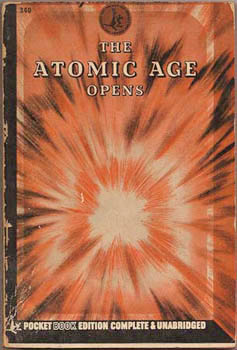
GEDDES, WENDT &c. The Atomic Age Opens: prepared by the editors of Pocket Books. NY, Pocket Books August 1945. Octavo publisher's illustrated wrapper; 256pp, photo illustrations and diagrams. A touch rubbed but a very good copy. Au$60
First printing of the first book on the atomic bomb; the published edition of the Smyth Report did not appear until September. There was a hardcover edition of this but it didn't appear for another couple of months. Pocket Books have gathered every scrap of available information and canvassed opinion, rabid and reasonable both for and against, coming to the conclusion that the ownership of the bomb belongs to mankind and that the "only answer to this kind of world power is a new kind of world society".


医学カード : 性のデザイン篇 Medical Card for Sexual Design [Igaku Kado : Sei no Dezain hen]. Tokyo, Sansheisha Shobo 1965. 19x13cm, glossy card wallet case with 64 glossy cards. Fifty two cards printed both sides with photo illustrations of a young woman in black bodysuit on the front, one with sketches of hairstyles and the rest with diagrams and tables of reproductive organs and menstruation cycles; text and/or illustrations on the back of all. The last card is a diy rhythm calculator. All in excellent shape. Au$150
Even after deciphering the rules I'm still be baffled by this triumph of sixties sexual revolution kitsch. The first sixteen cards are blue, the rest pink; the 52 playing cards have a king's or queen's crown and one or two suit symbols - clubs, hearts &c - most have two but one has an A. The rules tell us there is only one ace but not what it's good for. Is the odd card out, the hairstyles, the joker? So the loser at Old Maid would, instead of having sex, get a new hairstyle? The gender symbols are graphic hints and must have been fun for the designer; the text on both sides is poetry; and hygiene is important. The point of the game and the rhythm calculator seems to be to give women some control in the new era of liberation; not something often evident, east or west.
  3 4 5 [6] |

