


Paper. Toyosha? 新発明 軽便紙 [Shin Hatsumei Keibenshi]. n.p. [Osaka?] [188-?]. 75x28cm woodcut with added colours. Piece from the top margin well away from the printing, a repaired tear; Quite good for a cheap, vulnerable bit of production. Au$150
I believe this to be an announcement for a new invention of a lightweight paper. I hope not the paper this is printed on which seems heavy and coarse to me. Probably not considering the easy grasp of our newspaper addict. I suspect the cigarettes will stay on that side of his mouth until his left eye looks as sore as the right does now. Then he will switch back.

Sada Kaiseki. 冨国歩ミ初メ [Fukoku Ayumi Hajime]. Tokyo, Sada 1880 (Meiji 13). Woodcut broadside 36x52cm, stencil coloured? Some small holes and separation along folds; pretty good, the colour bright. Au$950
This captivating woodcut which looks like an advertisement for imported treasures is instead a strident protest and attack on these gewgaws. Sada was a troublesome priest but no reactionary flat-earther, not quite. He wasn't simple. He developed complex theories of science, culture and economics and saw the opening of Japan to this slew of imports as the cause of inflation and hardship for the lower classes. This woodcut was produced to promote the boycott of foreign goods and lists specific targets. Sada spent the last years of his life organising boycott societies and died - in 1882 - on a lecture tour.
This was issued with an outer wrapper which suggests to me this was not given away, it was sold. Waseda University illustrates two copies, one in better shape but carelessly coloured compared to this. The other is fairly worm eaten. They do have a wrapper, which, according to the provenance, belongs to their better copy but it is separately catalogued without any mention of Sada. Worldcat finds the NLA copy.


Public health, quarantine & sanitation. A collection of sixteen reports on vaccination: quarantine: disease and sanitation in Sydney. Sydney, Govt printer 1881-84. Foolscap, together in modern cloth. Signs of use, a few short tears, a couple of plans with repairs, minor but for the plan of the Little Bay Sanatorium (with report 12 - a revised version of that with report 6) which is in pieces but all there. Au$950
A modern binding but not a modern gathering: there is a contemporary handwritten list of contents at the front. This has every sign of being compiled by a body like the Board of Health. The Report of the Board on the small-pox epidemic has been extensively marked up and corrected by hand. Each of these is worth its own long maundering note, but. All these papers come in some way out of the small-pox outbreak of 1881-82 and you may not be surprised that it become political real fast. It was a debacle. First among the blameworthy were the Chinese, blamed for introducing the disease, then rightly came the officials, disorganisation, unreadiness and general incompetence top to bottom. The vaccination paper records the lengthy opinions of fifteen esteemed medicos and largely concerns small-pox - still the only vaccination there was. All but John Le Gay Brereton were in favour. He regarded vaccination an evil worse than disease.
Sixteen pages on schools versus 66 pages on wood pavements may seem unbalanced until you read the board's report and the evidence and realise that given how many roads were paved with wood it's a wonder that anyone was alive - not swept away by yellow fever. Thank heaven for Australian hardwoods. The Fijian representative to the 1884 conference couldn't make it - the steamer bringing the invitation was placed in quarantine.
(1) Compulsory Vaccination. Opinions of ... ; 55pp; (2) Report of the Royal Commission ... upon the management of the Quarantine Station, North Head, and the Hulk "Faraway"; (xiv),118pp; (3) Second Report ... Quarantine Station ... ; 13pp and folding plan; (4) Instructions to the Assistant Health Officer, stationed at Watson's Bay. 3pp; (5) Quarantine Station, North Head. (Report of Health Officer upon state and conditions ... ; 14pp and five plans, three folding; (6) Report of the Board of Health Upon the Late Epidemic of Small Pox, 1881-1882; 20pp and two large folding plans; (7) Quarantining of Steamship "Gunga"; 52pp; (8) Quarantine of Mail-Steamer "Rome" (Correspondence); 8pp; (9) Board of Health (Attendance of Members of, and Subjects ... ; 2pp; (10) Mortality on Board Immigrant Ships. (Report by Medical Officer ...); 2pp; (11) Management of the Sydney Hospital (Report of Committee of Inquiry into Certain Complaints); 27pp; (12) Hospital Accomodation and Position for the City of Sydney; 10pp and large folding plan; (13) Report of Dr. Clark on the Sanitary Condition of the Public Schools in the City of Sydney, and Suburbs; 16pp; (14) Wood Pavement Board. Report, minutes of proceedings, and appendix; 66pp; (15) The Australasian Sanitary Conference of Sydney ... 1884. Report, minutes of proceedings, and appendix. 70pp and five large folding maps and plans; (16) Ad Interim Report Upon Recent Cases of Small-Pox. 6pp.

HANDS, Joseph. Beauty: and the Laws Governing its Development; with suggestions on education: relative to the attainment of beauty. London, E.W. Allen [1882?]. Slender octavo, very good in publisher's decorated ochre cloth blocked in black and gilt; 88pp. Au$475
Only edition and elusive, just like describing Hands' writings in a simple and clear way. Hands was a London physician cum homeopath, apparently still respectable - viz his membership of the Royal College of Surgeons presuming his claim is true - and wrote works best, or most easily, described as thoroughly Victorian lunatic fringe: on will-ability and mind-energy, on the laws of matter and motion, and here, on aesthetics.
Hands begins with seven aphorisms, one of which was Hogarth's, all sensible enough; the last is quite noble. But from there he leaps from the ideal human form (5'10" tall for man; 5'6'' for woman) to electro-polar action to colour to the lapse of time like an ibex in the high alps and following him leaves us breathless and bewildered.

HANDS, Joseph. Beauty: and the Laws Governing its Development; with suggestions on education: relative to the attainment of beauty. London, E.W. Allen [1882?] with overlaid ticket of the Chicago National Institute of Science. Slender octavo, publisher's decorated red cloth blocked in black and gilt; 88pp. A couple of minor flaws to the cloth, rather good. Au$300
Only edition and elusive; just like describing Hands' writings in a simple and clear way. Hands was a London physician cum homeopath, apparently still respectable - viz his membership of the Royal College of Surgeons presuming his claim is true - and wrote works best, or most easily, described as thoroughly Victorian lunatic fringe: on will-ability and mind-energy, on the laws of matter and motion, and here, on aesthetics.
Hands begins with seven aphorisms, one of which was Hogarth's, all sensible enough; the last is quite noble. But from there he leaps from the ideal human form (5'10" tall for man; 5'6'' for woman) to electro-polar action to colour to the lapse of time like an ibex in the high alps and following him leaves us breathless and bewildered.
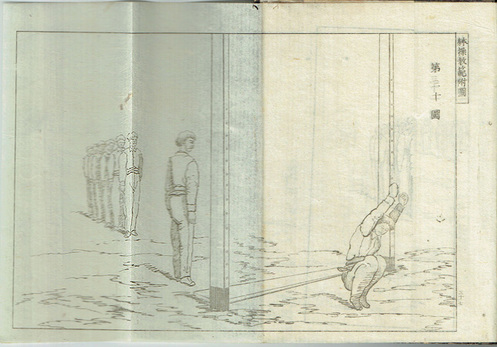

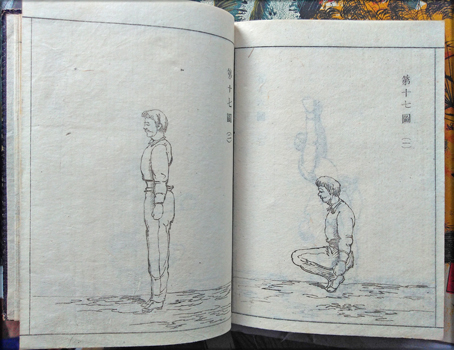
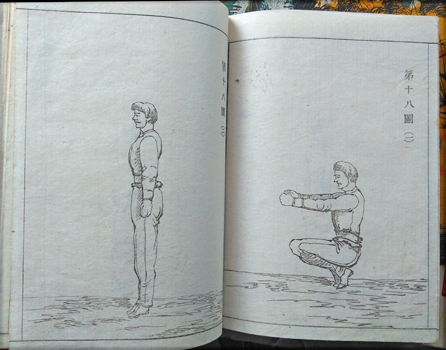
Gymnastics. 体操教範 [Taiso Kyohan]. Ministry of War, 1884 (Meiji 17). 15x11cm in what appear to be original cloth backed boards (spine a touch nibbled); 37 double folded leaves (ie 74pp) and 73 full page illustrations (5 folding) numbered to 32 with several bis. A little worming, nothing notable, and a couple of small stains; a quite good fresh copy. Au$300
The Japanese first got in French experts on military physical training in the late 1860s and the first Japanese book I've been able to trace was a translation of part of an 1847 manual the French visitors brought with them. That is I've traced mention of it, not the book itself. This manual also has the look of coming from a French manual but, being light on in French gymnastic manuals of the mid nineteenth century here, I don't know which one. Certainly it models the fine mustachios that became de rigueur for dashing Japanese officers.
The Taiso Kyohan apparently also became the model for gymnastics in secondary schools as the idea of physical education was introduced into Japan. There were many editions of the Taiso Kyohan, presumably updated and changed as the decades went on but I'm unable to trace any copy this early in a library catalogue.

Dokufu. Hanai Oume? Set of proof wood engraved illustrations for a Japanese serial story. n.p. n.d. [c 1887?] 19x26cm, contemporary plain wrapper; 41 wood engravings on 21 double folded leaves. A little browning. Au$475
A prime example of the strange casserole of Meiji Japan. In form, in technique, in content and in production these hold all the paradoxes of Japan embracing western modernisation while hanging fast to tradition. These are the illustrations for what seems a rollicking sword and sash thriller but ... it is set in a modern metropolis; bowler hats, suits and dashing mustachios are not out of place, neither is what looks like a railway station. And these are not ukiyo-e woodcuts for a popular novel, these are western wood engravings for a long serial - there are 41 after all - in a newspaper or broadsheet magazine; an illustration of such a paper helpfully holds a bough of blossoms in one illustration. The subject apart, the glaring difference between these and any western illustrations is the skill of artist and engraver, all but a few western counterparts are put to shame.
I'm convinced that these relate to Hanai Oume the celebrated Tokyo geisha-teahouse owner who, in 1887, stabbed her employee who, apparently in concert with her father, was trying to muscle her out of the business. The first illustration here shows two men holding umbrellas that, I'm told, advertise a restaurant or 'licenced pleasure quarter' remarkably similar to hers: Suigetsu. The umbrella was part of her claim of self defence: Minekichi attacked her with the knife, she disarmed him with her umbrella and then stabbed him.
Oume or O-ume - her professional name - was celebrity manifest, one of the three most famous dokufu (poisonous women) of the Meiji. Her murder trial was public and, though crowds unable to get in became irate, every moment was covered in the press; books were published within minutes, kabuki plays and novels performed and published, and the newspapers made rich. Yoshitoshi produced a famous print of the murder as a supplement for the Yamato Shimbun but while there is plenty of violence in these pictures there is no murder. Spin-off or fanciful concoction, there's a good story here.
There is an owner's (maybe artist's?) seal which I make out to be 春耕慢虫 - I'm sure I'm wrong.


Yamamoto G.S. [Tadashi]. 英和文章會話篇 The Conversations for Officers and Merchants: of the Japanese and English. [Eiwa Bunsho Kaiwahen]. Osaka, S.H. Okajima 1887. Small octavo (16x12cm) publisher's roan backed decorated boards (rubbed); [10],173,[1],[2 colophon]pp. Title page printed in red and black within a gold frame. Rear endpaper removed, rather good and fresh inside. Au$600
A pleasing little book with the usual amount of baffling and useless conversational gambits plus an emphasis on social niceties - dinners, drinking, dancing and so forth - and business. Worldcat finds only the NDL copy and so can I.

Suzuki Kinjiro. Meig. Dokufuden - 新編明治毒婦伝 [Shinpen Meiji Dokufuden]. Tokyo, Kinsendo 1887 [Meiji 20]. 18x13cm publisher's cloth backed illustrated boards (edges worn); one single page and several double page illustrations. Inner front hinge separated, inner back hinge cracked; maybe missing the front endpaper and the first two leaves (illustrations) are creased; two leaves sprung. A read copy I'm sorry to say, but for one of these flimsy board books made to be read to pieces, still acceptable. Au$150
Second edition? But how many were there? First published in December 1886 this copy is dated November 1887 but is a different book from the copy of the same date illustrated by the NDL. Starting at the front: the cover has been redrawn, the contents are a different printing with different pagination, in a different order and the illustrations are not all the same. The pagination is a nightmare; it starts, stops, jumps forward and back and nowhere meets the NDL November 1887 copy until we get to the last page.
One the prizes of the dokufu craze of the early Meiji. dokufu - poisonous women - are nothing new of course but the happy conjunction at the advent of mass circulation newspapers of a beautifully timed series of murders by unvirtuous young women set the sensation mongers and their readers all of a fever. Newspaper to book, lurid print to kabuki and back again, dokufu were all the rage for a couple of decades. Along the way crime fiction was born and, in a way, modern Japanese literature.
This went to press too soon for Hanai Oume - 1887's murderess of choice - but I don't doubt her case sparked this new edition; she was sentenced in November. Takahashi Oden, Yoarashi Okinu, Torioi Omatsu, Gonsai Otatsu, Ibaraki Otaki and Kaminari Oshin provide plenty to go on with.
Worldcat finds no copies of any but a modern reprint outside the NDL and it was some consolation to see that this copy is a lot better than one reproduced online by the NDL.


Hanai Oume. Shuyotei Sofu. 花井於梅 粹月奇聞 [or 花井お梅 酔月奇聞] [Hanai Oume Suigetsu Kibun]. Tokyo, Ishikawa Denkichi December 1887 (Meiji 20). Two volumes stitched together 18x12cm, colour wood covers by Utagawa Kunimatsu (the first a bit used with a small hole); two double page, two single illustrations at the front, four large illustrations through the text. Browning of the preliminary pages of volume one, a stain in the gutter at the bottom, still rather good. Au$350
One of the prizes of the dokufu craze of the early Meiji. dokufu - poisonous women - are nothing new of course but the happy conjunction at the advent of mass circulation newspapers of a beautifully timed series of murders by unvirtuous young women set the sensation mongers and their readers all of a fever. Newspaper to book, lurid print to kabuki and back again, dokufu were all the rage for a couple of decades. Along the way crime fiction was born and, in a way, modern Japanese literature.
Hanai Oume earned her place as one on the trinity of great dokufu for the murder of her employee for helping her sponging father muscle her out of her business - the teahouse Suigetsu. The famous umbrella was part of her defence.
Of course nothing about cheap popular trash like this is going to be straightforward. The colophon here tells us this is a reprint but lists the first as November 1887 which must be a newspaper appearance. Keio university's copy which uses the same covers is a different printing from a different publisher (Mizuno Ikutaro) with a colophon listing nothing before December while Yamanashi University's copy, published by Yamazaki Matasaburo and dated the same day as Keio's, is yet another different printing with a different cover. None of this is helped by the book being titled by both variants in the same copy.
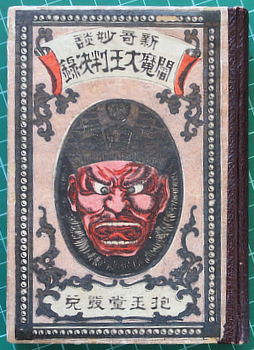
Shinkei Takashei (or Shiho Takase or Shizuka Kikusuitei). 新奇妙談 : 閻魔大王判決録 [Shin Kimyodan : Enma Daio Hanketsuroku]. Osaka, Hogyokudo 1887 (Meiji 20). 14x10cm publisher's colour illustrated boards; 94pp, numerous engraved illustrations throughout. Double folded leaves with an extra sheet inside for added durability. These extra leaves are recycled from some other work. A few insignificant flaws; a pleasing copy. Au$450
King Enma is the Japanese version of Yama, the king of hell and this is, the title tells us, a gathering of his judgments but who is that man in the top hat?
Leaving aside what is probably the first edition of this, published in 1883 in two volumes, it's easy to get lost in the 1887 printings of this intriguing little book. The other editions are not so little, they are the typical 46 size - 18 to 19cm high. The edition by Kikusuitei Shizukaetsu has a different cover and a frontispiece similar to ours but no sign of that sinister western gentleman. The edition by Kinsendo has an almost identical cover, a frontispiece without that sinister gentleman and no other illustrations. I don't know what the Suzuki Kinjiro edition looks like.
Also. It seems the 1883 edition has 17 chapters; the Kinsendo edition 18 chapters and ours 19 chapters. The extra chapter comes between four and five of the other version and seems to involve three men including our mystery man being savaged by a fox spiirit. The chapters leap from the present to the past and back again with what seems to be a lot of corruption and malfeasance on the part of the rich and powerful. I found a list of chapter headings and now I really want to be able to read it. So, to sum up: this is the best edition to have, with all those illustrations and the extra tale.
Takase was a troublemaking journalist and reformer who used a squillion pen names and did a couple of spells in prison. Later he turned to prison reform and founded Japan's first reformatory. This he turned into quite a large affair and apparently Kuroiwa Ruiko publicly damned him as a hypocrite with a lavish lifestyle and a string of ex-wives.
Worldcat finds no copy outside Japan.
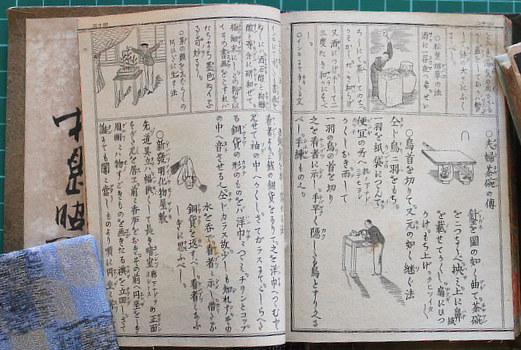
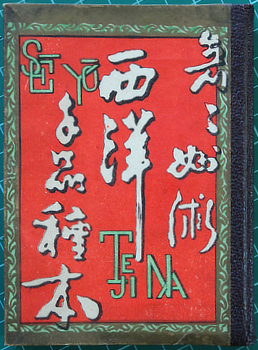
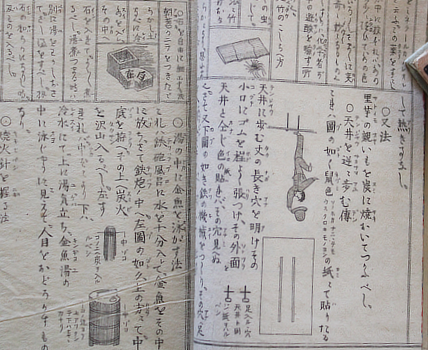
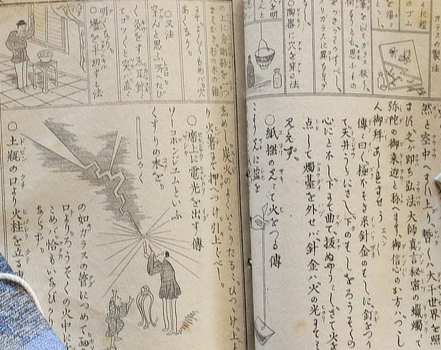
西洋手品種本 : 奇々妙術 [Seiyo Tejina Tanehon : Kiki Myojutsu]. Osaka, Odate Riichi 1887 (Meiji 20). 13x10cm publisher's colour illustrated boards; 48pp, numerous engraved illustrations thoughout. Double folded leaves with an extra sheet inside for added durability. These extra leaves are recycled from some other work. This copy has somehow escaped the plain paper applied to the back cover; it is as issued and an excellent copy. Au$425
First edition of this treasury of western pastimes, crafts, tricks and useful secrets though it's hard to see how some of them are western, judging from a crude translation of the contents. I guess washing tatami and heating sake without fire are adapted for the local market. Walking across the ceiling must be a secret everyone needs to know. With some, a crude literal translation makes them even more baffling to me.
Worldcat finds no copies outside Japan.
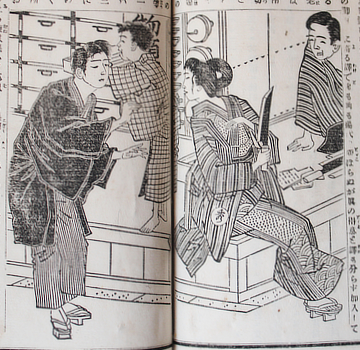
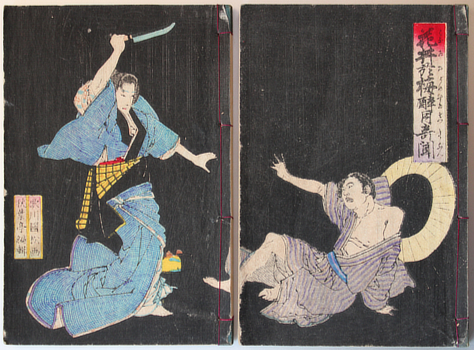
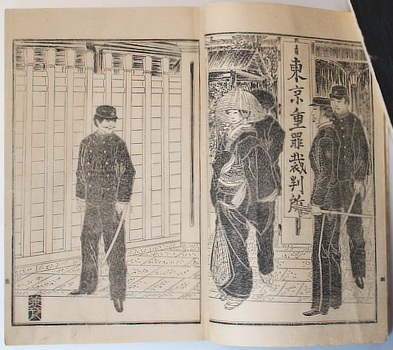
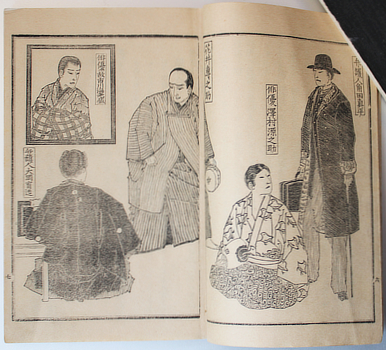
Hanai Oume. Shuyotei Sofu. 花井於梅 粹月奇聞 [or 花井お梅 酔月奇聞] [Hanai Oume Suigetsu Kibun]. Tokyo, Ishikawa Denkichi December 1887 (Meiji 20). Two volumes 18x12cm, colour wood covers by Utagawa Kunimatsu; two double page, two single illustrations at the front, four large illustrations through the text. A pleasing copy. Au$500
One of the prizes of the dokufu craze of the early Meiji. Dokufu - poisonous women - are nothing new of course but the happy conjunction at the advent of mass circulation newspapers of a beautifully timed series of murders by unvirtuous young women set the sensation mongers and their readers all of a fever. Newspaper to book, lurid print to kabuki and back again, dokufu were all the rage for a couple of decades. Along the way crime fiction was born and, in a way, modern Japanese literature.
Hanai Oume earned her place as one on the trinity of great dokufu for the murder of her employee for helping her sponging father muscle her out of her business - the teahouse Suigetsu. The famous umbrella was part of her defence.
Of course nothing about cheap popular trash like this is going to be straightforward. The colophon here tells us this is a reprint but lists the first as November 1887 which must be a newspaper appearance. Keio university's copy which uses the same covers is a different printing from a different publisher (Mizuno Ikutaro) with a colophon listing nothing before December while Yamanashi University's copy, published by Yamazaki Matasaburo and dated the same day as Keio's, is yet another different printing with a different cover. None of this is helped by the book being titled by both variants in the same copy.
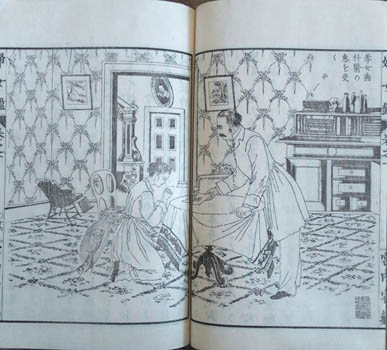
Nishimura Shigeki and others. 婦女鑑 [Fujo Kagami]. Tokyo, Kunaisho 1887 (Meiji 20). Six volumes 23x16cm, publisher's wrappers with title labels; double page page woodcut illustrations. An excellent set. Au$375
First edition of this official piece of moral education for women: the lives of inspiring women around the world. It was republished well into the 20th century. Moral philosopher and scholar of things western, Nishimura tutored emperor Meiji on the West. Apparently this book had some influence on the choice of Nishimura to head the Peeress's School the following year.
It is a monument to self denial and sacrifice on the part of women - clear enough from the illustrations - not much different from similar books for girls anywhere in the world but that it is deeply Confucian. Looking at the remarkable likeness of descriptions of this book by modern historians I wonder who read it and who just read each other.


Baido Kunimasa [Utagawa Kunimasa IV]. 明治貴顕鑑 [Meiji Kiken Kagami]. Tokyo, Hoeidi 1888 (Meiji 21). 12x9cm publisher's wrapper with title label (ink inscription on the back cover); 15 double folded leaves giving one single page, one gatefold quadruple page, and 15 double page engravings. Actually all but a couple of leaves are quadruple folded - the printed leaves around double folded leaves of heavier paper making the book tougher, made to be handled often. Au$300
A nifty little book, a portrait gallery of eminent figures of the Meiji. But captured in action, not the studio poses of so many 'Eminent Men' galleries.
Worldcat finds only the NDL entry.

Muneaki Mihara. 自在教育法図解 [Jizai Kyoikuho Kuzai]. The Teaching by Pictures the Way of Impraving Freely am Easely the Natural Constitution of Man [sic]. Ritsuma Akiko, 1888 (Meiji 21). Broadside 70x53cm, woodblock printed, folding into publisher's limp cloth covers 17x13cm with printed label. Covers browned with a splodge on the back; a nice copy Au$450
An enchanting and self evident exposition on the value of pictures in learning. Seemingly as simple as a phrenology chart but judging by the amount of text worked into all those different parts of the brain perhaps a lot more complex. From the little, as an illiterate, I can glean on brain function as outlined here this might sit somewhere between phrenology and neurophysics. The open area at the very centre of the brain is labelled 未詳 - unknown.


Kobayashi Ikuhide. 東京名所之内吾妻橋 ... [Tokyo Meisho no Uchi Ashumabashi ... Tokyo 1888 (Meiji 21). Colour woodcut 36x24cm. A couple of tiny holes, a nice bright copy. Au$175
Every artist and publisher in Tokyo had a go at the newly opened Azumabashi - the pioneer iron bridge opened in December 1887. Kobayashi produced more than one. Here the focus is not the bridge but the bustle of people; it's clear that near everyone in Tokyo wanted to look, to cross it.


Hanai Oume. Shuyotei Sofu. 花井お梅 酔月奇聞 [or 花井於梅 粹月奇聞] [Hanai Oume Suigetsu Kibun]. Tokyo, Mori Senkichi 1888 (Meiji 21). 18x13cm, publisher's cloth backed illustrated boards; one double page and two full page illustrations; 72pp. The cheap paper browned; a rather good copy of a book made to be read to death. Au$250
One of the prizes of the dokufu craze of the early Meiji. dokufu - poisonous women - are nothing new of course but the happy conjunction at the advent of mass circulation newspapers of a beautifully timed series of murders by unvirtuous young women set the sensation mongers and their readers all of a fever. Newspaper to book, lurid print to kabuki and back again, dokufu were all the rage for a couple of decades. Along the way crime fiction was born and, in a way, modern Japanese literature.
Hanai earned her place as one on the trinity of great dokufu for the murder of her employee for helping her sponging father muscle her out of her business - the teahouse Suigetsu. The famous umbrella was part of her defence.
Of course nothing about cheap popular trash like this is going to be straightforward. The Strange Story of Hanai Oume at Suigetsu was first published in December 1887, just after her murder trial in November, in two volumes. Our edition appeared in December 1888 and who knows how many came in between. NDL records the December 1887 and a November 1888 printing and nothing else and I can't find anything elsewhere.


THOMPSON, Sir H. Modern Cremation. Its history and practice .. recently improved arrangements made by the Cremation Society of England. Second edition revised and greatly enlarged. London, Kegan Paul 1891. Octavo publisher's cloth; xii,163pp and publisher's catalogue; frontispiece and 11 illustrations (five being full page plans or elevations). A nice copy. Au$225
By the funereal reformer, founder and president of the Society. Cremation, for the modern westerner, is a materialistic, utilitarian question. Public health is the main spur for the cremationist and the spiritual barely touched upon - the body is being desanctified; which may or may not explain why Italy was the pioneer of modern cremation. There the subject was first raised in the 1860's and by the mid 1880's several hundred people had been burnt. In England Thompson caused the first storm with an article in the Contemporary Review in 1874, the year his Society was founded. His improvements to this edition include reprinting this 1874 paper and a subsequent answer to the critics.
The first human cremations to occur in England, and test the law, were private affairs in privately built crematoria and this book was first published two years earlier as laws and codes were being formulated. This edition includes instructions for arranging cremation at the Society's crematorium (the only one in use in England) near Woking and descriptions of the crematorium, the furnace, and offers suggestions for cinerary urns. The frontispiece is the architect's rendering of their chapel and crematoria, a fine bit of 13th century English church architecture, unremarkable in any tasteful parish - except for the 13th century industrial chimney sprouting from the middle of the building.

[LANE, William]. The Workingman's Paradise: an Australian Labour Novel. By John Miller. Sydney, printed by Edwards Dunlop for the Worker Board of Trustees 1892. Octavo publisher's red cloth blocked in blind. Title browned by the endpaper as usual; there was no half title or blank between them. A rather good copy. Au$850
First edition of this influental if fairly impenetrable socialist anarchist novel by the Messiah of the working class. The 1948 edition was on the shelf of every thoughtful Australian in the second half of the 20th century but I've only ever met one person who insisted he read the whole thing. He made many improbable claims. I think an earlier generation were more thorough: copies of this in good shape have always been hard to find.
Lane's preface admits that it's a bit of an unresolved mess but those who want a happy end - like his wife - and those who want Nellie dead of a broken heart - like an unnamed friend - will have to wait for the next book. I dozed off so I'm not sure when the action switched from Nellie to Ned alone and don't know where we left her.


MURPHY, G. [George] Read. Beyond the Ice. Being a story of the newly discovered region round the north pole. Edited from Dr. Frank Farleigh's diary. London, Sampson Low & Melbourne, Hutchinson [1894]. Octavo publisher's illustrated blue cloth (two small blobs of wax on the front cover, marks on the back). Somewhat canted, not a bad copy of a book guaranteed to respond badly to handling. A signed presentation, dated March 1894, from Murphy to Geelong lawyer Aurel Just, "gentleman, Dremanist and possessor of other titles," with a quote from his character Vernon Dreman. Au$950
Only edition of this polar utopia and dystopia which Geelong author Murphy - I suspect simple perversity - took to the opposite end of the world in defiance of the usual Australian practice of heading south. Heaps of scientific advances and flying machines as expected but reform and enlightened progress can only go so far: adult women are enfranchised until they marry, then the possible conflict between husband and wife is not worth the candle.
"The chief characters seem to spend a deal of unnecessary time in consuming oysters and brown bread" warned the North Melbourne Courier and West Melbourne Advertiser in an otherwise warm review while suggesting it would be commercially more canny to set the book in central Australia.

Exhibition, Kyoto 1895. Yoshiwara Takeo. 第四回勧業博覧会太極殿図 [Daiyonkai Kangyo Hakurankai Taikyoku Zenzu?]. Kyoto, Ide Shozo 1895 (Meiji 28) Lithograph 42x56, folded. A scattering of small wormholes and signs of use; not bad. Au$125
A bird's-eye view of the 4th National Industrial Exhibition held in Kyoto from April to the end of July 1895. Five of these national exhibitions were held between 1877 and 1903; the first three in Tokyo and, after some provincial agitation, this in Kyoto and the fifth in Osaka. Each was bigger, better and more crowded than their predecessor.

JENNINGS, J. Ellis. Color-Vision and Color-Blindness. A practical manual for railroad surgeons. Philadelphia, F.A. Davis 1896. Octavo, excellent in publisher's cloth; x,115pp and publisher's list, colour frontispiece and 21 illustrations through the text. Au$185
First edition and pretty much the ideal copy as it belonged to a railway surgeon who wrote on colour blindness: D. Emmett Welsh - then formulating tests for workers at the Grand Rapids and Indiana Rail Road. Jennings' intent here is to effect universal reform and adoption of testing - it is astonishing that by 1896 railway companies and other industries where colour blindness could and did cause disaster still ignored the problem - by offering a system of simple and efficient measures.


Banking. 株式会社島原貯金銀行 : 支店開業広告 [Kabushikigaisha Shimabara Chokinginko : Shiten Kaigyo Kokoku]. n.p. [c1898] Colour lithograph 26x39cm. A nice copy. Au$300
This gentle, charming advertisement - hikifuda - announcing branch openings of the Shimabara Savings Bank is illustrated by two reassuring stories of rags to riches - or solid comfort at least. The Shimabara Bank was founded in 1891 and the Shimabara Savings Bank in 1897 but didn't live long thanks to some investment decisions by the Nakayama family - three Nakayamas including president Fumiko are listed among the directors.
Shimabara is in the Nagasaki prefecture and the two branches advertised are Arie - a town that was engulfed by Minamitakaki City - and Taira - which I can only trace as a railway station in a desolate looking area of Unzen, Nagasaki. Dates for month and day have been left blank.

Hikifuda. 後藤商會 [Goto Shokai]. n.p. [c1900] 26x38cm colour woodcut. Small knick from a top corner; a nice copy. Au$135
Bustling modern Japan is celebrated in this advertisement for the Japanese and western liquor merchants Goto Shokai. I presume it's the trademarks of the brands they handle that are displayed.
These hikifuda - small posters or handbills - were usually produced with the text panel blank. The customer, usually a retailer, had their own details over printed, so the same image might sell fine silk or soy sauce.
  1 2 3 [4] 5 6   |

