
PRIDEAUX, T. Syme. Dishonesty Exposed. Report on Experiments Made on Board H.M.S. 'Imperieuse' in June 1856: with Prideaux's Self-Closing Furnace-Valve-Door: and the Common Door. [London, privately printed] 1857. Octavo disbound; 16pp. Inscribed 'With the Author's Compts.' Au$65
This is not, as one might hope, the rant of a thwarted crackpot. Prideaux was a well established and well regarded engineer but there is no less bile and fury here for all that. This close account of the scurrilous and fraudulent behavior of those controlling the tests and their inexplicable loyalty to the current equipment is unweighted by too much technical data fortunately and we can read it as an entertaining and telling example of frustrating intransigence in the way of progress. Prideaux ends by offering to equip the navy with his invention without charge and take two years saving in costs as renumeration for the cost of fitting and as payment for the patent.
At the end are testimonies including one by the Captain of the Imperieuse (who was not part of the conspiracy) and a couple of engineering heavyweights - Charles May and William Fairbairn.


HOWARD, Thomas. On the Loss of the Teeth; and on the best means of restoring them. London, Simpkin & Marshall 1859. Small slender octavo publisher's blindstamped cloth; 62,[1]pp and a charming frontispiece printed in blue with a before and after overlay. An over possessive medico's bookplate and blindstamp on the front endpapers, rather a good copy. Au$200
A successful little book it seems, there were several printings between 1852 and 1862 (the publishers claim 27 by 1857). Howard, surgeon dentist to the Archbishop of Canterbury, at first seems to approve of artificial teeth made of hippo tusk but later points out that they don't last long. There are similar problems with ivory, gold and natural teeth (recycled from other mouths) which understandably disturb persons of "extreme sensibility and delicacy of feeling". He has, though, invented a "new description of composition teeth" which are "perfectly incorruptible" - their "durability is unbounded".
By 1863 Howard had moved from Hanover Square to Fleet Street and extended his hours from 11 till 4 to 10 till 5. Whether this means a thriving business or desperate decline I can't tell.

[PHILP, Robert Kemp]. Life Doubled by the Economy of Time. London, Houlston & Wright [1859?]. Octavo publisher's decorated cloth blocked in blind and gilt; 160pp, frontispiece. A bit rubbed and the green cloth somewhat faded but quite a good copy with a distinguished provenance: the signature of E.P. Senhouse of Netherhall and in pencil he (she?) notes that it was lent on the 3rd September 1862. Probably just as well, the quite ancient Netherhall and much of its contents were lost through neglect forty to fifty years ago. I see from a tiny note inside the back cover it had reached Steve Finer in Massachusetts by 1996 and it was recently in Michigan but the rest of its history is still blank. Au$95
Philp was a prodigious compiler of self help and useful books so clearly his system for redeeming time must work. His frontispiece diagram is a template, not a ready made. It must be impressed into the memory and adapted. Philp himself sees it as a sort of large projection slide which he can "mentally throw ... upon the wall", which seems intrusive. "My Diagram is constantly before me, appealing to me for action."
That action can be associated with simple memory prompts; thus the hour 4 (presumably after breakfast?) entry "A - B -'s, Error, Fenning's" would sort out problems in what seems a problematic life - what with this damn wheel following him around - call at A - B -, order more stock and point out the error in their last account; then to Fenning's Wharf to ascertain the delay in delivery of goods. Added to the Diagram are The Tablet, The Diary and The Bioscope. I leave you to figure them out.


MURRAY, Lindley. 英吉利小文典 [Igirisu Shobunten] Abridgment of Murray's English Grammar. n.p. n.d [186-?]. 18x12cm publisher's wrapper with title label (rubbed). Quite good. Au$300
This is the first part and I know a second part exists because Waseda has a copy - but not this first part. Worldcat finds neither and a hunt through Japanese libraries doesn't help much. No-one seems clear on when this appeared but it is likely to be with the beginning of government schools and is a good partner for the version of Murray's spelling book published by the Tokugawa Kaiseidzio school in 1866.

Urine. Carlo Magnani-Riccoti. Il Sindaco della Citta di Novara - Manifesto. Novara, Miglio 1862. Broadside 56x39cm tipped on card. Old folds, a nice copy. Au$200
Magnani-Roccoti, first mayor of modern Novara, warns the citizens of Novara that the piss sodden streets of the city will be tolerated no more and that police will prosecute with utmost rigour anyone sploshing urine around the place. I wonder whether the urine issue was related to the recent invention of a beverage by Signor Campari of Novara. And I wonder why the existence of a manifesto against piss strikes me as irresistible.

Rough Nights' Quarters. By one of the people who have roughed it. Edinburgh, Edmonston and Douglas 1866. Octavo disbound; 32pp, title vignette. A mild darker stripe along the front edge where it must have been bound with something smaller. Au$100
This is a spluttering response to an expose in the Pall Mall Gazette for which an undercover reporter spent 'A Night in a Workhouse'. There is more to it but I finished this pamphlet with the notion that the upright British homeless are a tougher breed than the milksop reporter and any that weren't just needed a decent public school education followed by a hunting expedition to toughen them up.

Lindley Murray. 英語階梯 [Eigo Kaitei] An English Spelling-Book: with reading lessons: for beginners at the school Kaiseidzio in Yedo. First edition. (Tokyo, 1866) Yedo. The 2. year of Kei-ou. 18x12cm publisher's wrapper, without title label. Thoroughly annotated by a bored student on the covers, inside and out, the first blank and half title, at the very end and the back blank; clean from the title page on. What a canny colleague called evocative and still rather good. Au$500
The first English spelling book published in Japan according to Ishihara Chisato who announced in 1980 (『英 語 階 梯 』と Lindley Murray のス ペ リ ン グ ブ ッ ク に つ い て [Eigo Kaitei and Lindley Murray's Spelling Book] ) that it is a slightly modified version of Part I of Murray's 'An English Spelling Book' from a copy of the 45th edition (Baudry, Paris 1839) then owned by the Tokugawa government school.
With all of these handy lessons for beginners in a new language I wonder how any Japanese learnt enough English to hold a sensible conversation about anything.
Worldcat only found, for me, Kyoto U's 1867 reprint without the name of the school.
Note that the book opens right to left.

Oil. Petroleum. (Correspondence &c. Respecting Existence of in New South Wales.) Sydney, Govt Printer 1867. Foolscap folio sewn as issued (a bit used); 22pp, litho map & 2 plates, illustrations through the text. Au$750
The first publication of any note on petroleum in Australia, or at least the possibility of it, and necessary investigations, results of examinations, and so on. The search seems to have been kicked off in 1866 by William Fane de Salis sending out a copy of Lesley's 1865 paper on the Kentucky petroleum basin, "the only paper as yet published giving any reliable scientific account of the strata," in the hopes that comparative work could be done. That paper is reprinted here, from the copy kindly given by Murchison.
What is not in this paper but is in the columns of The Empire is that the Minister for Lands ignored the offer of de Salis and that a Lands Department clerk responded, "the Minister for Lands does not consider it advisable to republish Mr Lesley's pamphlet as proposed by you". Neither would the Lands Department, 'this incubus,' release Lesley's paper for The Empire to print, prompting the outraged columnist of The Empire to mutter darkly about the ''little games played some time ago in the matter of certain mineral lands at Illawarra.'' ''Is there a disinterested and intelligent man in the colony who does not believe in his heart that the blowing of the Lands Office into perdition, with all its accumulated stores of red tape, useless maps, and sickening arrears of correspondence, would be one of the best things that could happen for the welfare of the community?"
All this is not quite true, the correspondence in this paper tells a slightly different story but still, in all this is an education in the power of print, most obvious in the ability of the press to push along a recalcitrant bureaucracy. But more interesting is the potency held by what was considered the sole copy of an otherwise unobtainable pamphlet. Lesley's paper itself is rare, certainly it was missed by Swanson's bibliography of oil and gas. It's almost unnecessary to add that this Australian paper also doesn't appear.


Les premiers pas de l'enfance. Orthgraphe Francaise: a l'usage de l'ecole quai-sei-zio. Premier edition. Yedo ... (1867). [sic]. Yedo (Tokyo), 1867 (Keio 3). 18x13cm publisher's wrappers with printed label (marked, stitching broken); 32pp including 10 pages of alphabets. Pretty good. The red stamp on the title is the school's. Au$300
The Kaiseijo (quai-sei-zio or Kaisezio or Kaiseizyo or Kaiseidzio or Kaiceizio depending on who wrote it) was the Bakumatsu school for barbarian studies, founded in 1857 and re-named in 1863. In 1865 the military joined in with this maybe unwelcome but necessary education and, I've read, quadrupled the number of students with 300 learning English and 100 learning French. It seems they began printing their own texts in 1866. Come Meiji it became the Kaisei gakko and eventually part of the conglomerate that became Tokyo University.
It's easy for blinkered anglophones like me to forget that the Japanese were busily digesting the whole planet, not just learning fractured English from absurd phrase books. They learnt many fractured languages from absurd texts and still somehow leapt into the modern world.
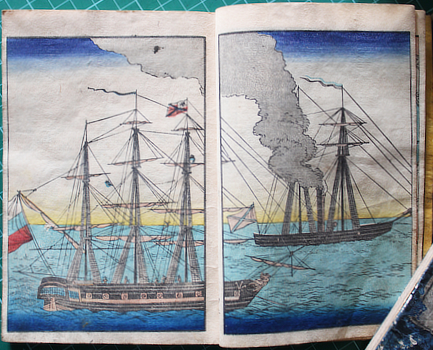
Fukuzawa Yukichi (but not). 西洋各國事情 [Seiyo Kakkoku Jijo]. (First series & two thirds of the second). Naniwa (Osaka), Nishobo [1868?]. Five volumes 18x13cm, publisher's wrappers with printed title labels (cover surfaces somewhat nibbled but not chewed); 26 colour woodcuts including two double page and one four page views. Signs of use, a marginal stain in the bottom margins of early pages in the third volume of the first series; pretty good. Au$1850
Fukazawa was a member of the first Japanese embassies to the United States, in 1859, and Europe, in 1862, and his 'Seiyo Jijo' (Things Western), the most important and influential Japanese study of western nations of the period, was published in parts betweeen 1866 and 1870. It was such a best seller that piracies, fakes and spin-offs soon appeared. This is one of those fakes but it is, thanks to the illustrations, far more appealing than the original.
The foreign ships and Russians are charming but not so remarkable, the flags are flags whether or not they actually exist, but the western handwriting is mysterious and intriguing and the four panel view of a massive canal towering high over a port city must be one of the best imagined architecture renderings of all time.
The first title page claims Fukuzawa Sensei as author. Highly malicious and fraudulent says the introduction to Keio University's online version of the real Fukuzawa book. There we're told this was pillaged wholesale from an 1845 book,' Seiyo Jin Senjutsu Yakuhon', writer unknown. This is at least partly true. From the fragmentary records of that book I can find I confirm that it's likely flags come directly from there and I found sections of text that seemed the same, though recut. But flags were constantly copied from one book to another and as for the good pictures ... I haven't found that city anywhere else.
A note in the Union Catalogue entry says the text is from Mitsukuri Shogo's 'Kon'yo Zushiki' (1847) but looking through Waseda's online copy of that left me baffled.
This is the second copy to come through here but until I found this copy (a 13 years search) I had no clue there was a second series. It seems pretty definite that six volumes were produced but I can't find a record of anything in Japan but the first three volumes. That is the Kobe University copy illustrated in the Union Catalogue. What we have here is the presumed first series: upper, middle and lower volumes, which are divided into five parts; and two volumes of the second: heaven and people, which have parts one, four and five. So there should be a middle - earth - volume with parts two and three. An early owner, as was common, has written a short title on the bottom edges with volume numbers one to six, no five of course.
Fukuzawa asked the government in 1868 to uphold the law, ban the counterfeit editions and frauds - he listed this book among them - seize the blocks, confiscate their profits, and hand them over to him. I doubt this happened but it does seem to mark the first concept of copyright in Japan.

YOUNG, Rev. W. Report on the Condition of the Chinese Population in Victoria. Melbourne, Govt Printer 1868. Foolscap folio, stitched as issued; 30pp. Au$850
By 1868 the Chinese population of Victoria was on the wane - estimated at less than half of its peak at the height of the goldrush - but "vicious practices"were seemingly on the rise. Chief among these were, of course, gambling and opium but their by-products, larceny and robberies, were a growing threat. Young suggested that the decline or disbandment of Chinese Associations had a directly negative effect on crime and has provided a translation of the rules of an association to illustrate to the government the benefit of these associations to the community.
The first part of his report is both valuable and touching in that Chinese translators have provided statistics for each of the areas with Chinese communities; these statistics then are personal and idiosyncratic in their focus, providing the closest thing we have to a Chinese view of themselves at the time. Young includes a report by Dr Clendenning on the condition of Chinese lepers at Ballarat, and then finishes with his own report and suggestions for improvements, including the restitution of 'Headmen', the improvement of interpreters, education in English, Chinese police officers and so on. However, given the "abnormal condition of the great mass" (ie no women), in present circumstances it was best to encourage them to all go home.
Young was an LMS missionary to the Chinese, apparently of Scottish-Malay descent, who had served in Amoy before coming to Victoria in the mid fifties. The impression given by this report and other documents of the period is that he was one of very few non-Chinese in the colony that had any grasp of any Chinese language.

Tatsunosuke Hori et al. 英和対訳袖珍辞書 A Pocket Dictionary of the English and Japanese Language. Second and revised edition. At Yedo 1867. Tokyo, Kuradaya Seiemon 1869 (Meiji 2). Two volumes 15x22cm contemporary limp boards (battered, stitching broken but all solid enough). Stains, mostly at each end and some fairly mild worming at the very end. Sensibly divided into two volumes toward the end of N. Used but comparatively handsome copy of a book usually found as an incomplete wreck. Inscription in red on the back of the title: "This Book belongs to Miyake" and Miyake ownership seals and inscription at the end. Au$1100
Actually a new printing of the 1867 edition as, I suspect, are several of the copies catalogued by folk who haven't looked properly at the very end of the book. Tatsunoske's first edition appeared in 1862; apparently 200 copies were printed. A second revised edition arrived in 1866 and the 1867 printing has the English type newly made into wood blocks. Then comes our 1869 printing with the notice of approval (1869) on the last page and Kuradaya's name inside the back cover. And the Kaiseisho - the Bakumatsa school - seal on the tile and/or at the end has been changed for the Tokugawa seal. If you want to get fussy: this is type B of the colophon designated by Tomo Endo in his census of copies in Eigakushi Kenkyu (2006).
It seems accepted that this was the first English-Japanese dictionary. The Angeriagorian Taisei was compiled in 1814 but that has been dismissed as a word book - a mere 6000 words - and was only circulated in manuscript among the chosen few. A Japanese-English dictionary followed ours a few years later.


Woogaroo lunatic asylum. Report from the Joint Select Committee on the Woogaroo Lunatic Asylum: together with the proceedings ... and minutes of evidence. Brisbane, Govt printer 1869. Foolscap disbound; [4],73pp and nine litho plates: plans and elevations. Au$450
Woogaro, Queensland's first lunatic asylum, was opened in 1865 and was a disaster: built in the wrong place, badly staffed, badly managed, with woefully inadequate buildings. Two inquiries were held in 1869, one by public servants and this one by a parliamentary committee. The focus here is on the buildings, the general plan and proper management. From this inquiry came the 1869 Lunacy Act. The committee recommend buildings on the "cottage" system and given the choice between plans by Tiffin and Suter - illustrated here - chose Suter's. He crammed twice the number of patients into each building at a saving of £18 per head.

SWINBURNE, Algernon Charles. Ode on the Proclamation of the French Republic. September 4th: 1870. London, Ellis 1870. Octavo publisher's printed wrapper; 24pp. A few minor signs of use but a pretty good copy. Au$60
First edition of Swinburne's tormented and fairly blood-thirsty paean to the Republic.


Kawaraban. 流通新貨幣位付早見 [Ryutsu Shin Kahei-i-tsuki Hayami]. n.p.n.d. [c1870]. 32x41cm wood cut. A couple of small blotches, rather good. Au$165
A quick guide to the new coins in circulation. Added to the mass of new things for Japanese to learn and new ways of thinking, with the Meiji restoration, was the new yen based currency.
Kawaraban - illicit illustrated news sheets for the streets - were produced by the million for a couple of hundred years so of course few survive. They were produced for anything more interesting than the drop of a hat.


横文字いろは - 早けい古 [Yokomoji Iroha - Haya Keiko]. Yokohama? Sanoya Tomigoro [c1870?]. Woodcut on four joined sheets that folds from 15x7cm out to 130cm. Decorated title panel printed in blue and black, last blank panel with several small red stamps reading Naga (長) and one Nagata (長田). An outstanding copy of something pretty well guaranteed not to survive second or third uses. Au$600
A captivating pocket or sleeve guide to horizontal writing with some numbers thrown in - Roman numerals for reading clocks - the latest of what must have seemed an endless array of challenges to life in Meiji Japan. Iroha might be translated into English as ABC.
Sanoya Tomigiri was a print publisher who moved from Tokyo (Edo) to Yokohama when it opened to the west and where he also became a singer. He is known as the publisher of prints by Yoshitoshi and at least four of the Utagawas, maps, guides and handy educational things like this.
I found a reference to something with almost this title printed by him at the beginning of the Meiji but it isn't the same thing, not even close. There may be another copy of this somewhere but I haven't found it.

BEALE, Lionel S. Life Theories: their influence upon religious thought. London, Churchill 1871. Octavo publisher's brown cloth; xii,97,[2]pp and six coloured plates. Spotting of the endpapers but a nice, bright copy. Au$75
A good example of the weight of authority arrayed against wrong-headed fashion. Beale was no lightweight in the medical establishment and Churchill were authoritive publishers of medical books. Beale stood firm against the germ theory and here he stands firm against physical theories of nature. The coloured plates are from microscope studies - which Beale is possibly now best known for - evidence that this is no mere theological argument.


掌中 : 新貨定規略 [Shochu : Shinka Jogi Ryaku]. Kagoshima Prefecture, Dajokan 1871 (Meiji 4). 36x49cm folding into 12x6cm publisher's wrapper with title label (a bit grubby); woodcut illustrations of coins in colours. Rather good. Au$200
A palm size guide - until it's unfolded - to the new currency issued by the Ministry of Finance. Added to the mass of new things for Japanese to learn and new ways of thinking, with the Meiji restoration, was the new yen based currency. 1871 must have been a tough year for the slower thinking Japanese - I'm still hazy about metrification - and 1871 bought a new calendar, new system of time keeping, new currency, a new education system, new haircuts ...
I can only find mention of this in two provincial museums in Japan, nowhere else.

Hashizume Kan'ichi. 六大洲國盡 [Rokudaishu Kuni Zukushi] Name of the Land on the Globe. VI. Daishiu Kuni Dzkushi [sic]. Tokyo, Wan'ya Kehei 1871 (Meiji 4). 18x13cm publisher's wrapper with title label (covers mottled); [32]pp, doubled page colour world map in two hemispheres and two folding colour maps (Asia and Europe). A touch of worming, pretty insignificant; quite a good copy. Au$350
Just when I thought I must have seen all of Hashizume's handy little guides to English, up pops another. This guide to place names in the three forms: upper, lower case and long hand, is titled as complete but, as this covers Asia and Europe, now I have to look for a companion volume for the rest of the world.
Hashizume, the translator, produced quantities of handy guides to English and useful translations, most of which are idiosyncratic in their choices of what is considered essential to any Japanese setting out to work in English.
Worldcat finds only the NDL entry.

Hashizume Kan'ichi. 大日本國盡 英字三體 [Dai Nihon Kunizukushi - Eiji Santai]. Tokyo, Wan'ya Keihe 1871 [Meiji 4]. 18x13cm publisher's wrapper (a bit used, label missing); 36pp on 18 double folded leaves; opening right to left. Au$300
A writing guide teaching how to read and write the English alphabet in its three guises but not in English. One of the earlier attempts at formulating what is now Romaji; Hashizume here standardizes Japanese place names into phonetic transliteration. The Portugese missionaries had formulated a romanised system so that missionaries could instruct their Japanese victims without having to learn how to read Japanese but once they were tossed out of Japan such a system was quickly forgotten. It was only with the Meiji restoration and orders from the top that modernisation must follow that making Japanese intelligible to westerners became a desirable skill. Worldcat finds a couple of copies in Japan, none outside.


和西十體以呂波 [Wasei Jutai Iroha]. Tokyo, Yoshidaya Bunzaburo 1871 [Meiji 4]. 165x63mm, publisher's wrapper with title label (rumpled and forgivably grubby); 30pp accordian folding. Used but a more than decent copy. Au$475
A nifty little pocket or sleeve book - that opens right to left like western books - teaching how to write English letters but not in English. This teaches how to write Japanese phonetically with the English or romanised alphabet - what was to become romaji. The Portugese missionaries had formulated a romanised system so that missionaries could instruct their Japanese victims without having to learn how to read Japanese but once they were tossed out of Japan such a system was quickly forgotten. It was only with the Meiji restoration and orders from the top that modernisation must follow that making Japanese intelligible to westerners became a desirable skill. At the end are numbers, the twelve animals of the zodiac - more or less, unfamiliar characters and spelling defeated the writer or block cutter on a few - and the seasons and points of the compass.
This seems rare, both in and outside Japan. OCLC finds no copies and my searches of Japanese libraries finds only one copy - in the Tokyo University of Foreign Studies.


英字訓蒙図解 [Eiji Kunmo Zukai or Ei Kuno Zukai depending on the transcriber]. Kyoto, Ogawa Kinsuke 1871 (Meiji 4). 225x155mm publisher's wrapper with title label; woodblock illustrations throughout. Some worming and a marginal stain, neat repairs to the first few margins. A very decent copy with its colour illustrated outer wrapper, this smudged and rumpled but complete and untorn. Au$750
A rare and most appealing illustrated introduction to English. To an extent unseen in any other non-western culture faced with the colonial ambitions of the west the Japanese controlled their own re-education. They were not showered with unwanted primers by missionaries and other pious businessmen. They produced, printed and determinedly digested their own, using whatever sources they could find, the occasional hired expert and their imagination.
The more I look at books like these, which were assiduously studied, the more I wonder how anyone learnt any English. How many Japanese went to their graves calling a camera a desk and hoping for an opportunity to introduce 'pluckant' into conversation? Leaving aside errors, books like these make no sense as tools to me but tens, hundreds of thousands of Japanese students set out with these as guides on the road of bunmei kaika - government sponsored enlightenment and civilization - and got there way faster than anyone should have. In fact the more I think about it the more I wonder how anyone learns any language.


Hashizume Kan'ichi. 世界商売往来 [Sekai Shobai Orai - literally World Trade Traffic]. Tokyo 1871? 180x120mm publisher's wrapper (title label with a small chip); 26 double folded leaves; one full page colour and numerous small colour illustrations throughout, a half-page plain illustration inside the front cover. Clearly a read copy, with some small blotches and smudges but still rather good. Au$750
First edition it seems of this delightful and handy bilingual vocabulary of world trade giving the English, with Japanese explanations, of a wide range of terms, place names, goods, and so on. I've seen a couple of copies of the second edition, 1873, not in colour. Neither can I find a record of a colour copy of any edition. Waseda University illustrates a copy of the 1871 edition with the half page illustration inside the front cover in colour but not anything else. Clearly even workaday Japanese books like this can be intricate enough to please any French bibliophile.
Hashizume, who specialised in handbooks on trade and on foreign languages, produced, I think, three of these guides for merchants with similar titles. This is the first and the next two supplement this.


Hashizume Kan'ichi. 世界商売往来 [Sekai Shobai Orai - literally World Trade Traffic]. Tokyo, Seikichi 1871 [Meiji 4]. 180x120mm publisher's wrapper (a bit rumpled); 26 double folded leaves; one full page and numerous small illustrations throughout. Title page on yellow with a man operating some mysterious, to me, mechanism. Au$200
First edition of this handy bilingual vocabulary of world trade giving the English, with Japanese explanations, of a wide range of terms, quantities, goods, professions, and so on. I used to think the bibliography of Hashizume's handbooks on foreign trade was straightforward: three, this, the first in 1871 following it up with two more in 1873. Since then I've discovered variants and variants of variants. There are some of the expected amusing errors in spelling and typography but far fewer than in the later books.


Yanagawa Shunsan. 西洋時計便覧 [Seiyo Tokei Benran]. Tokyo, Yamatoya Kihee 1872 [Meiji 5]. 185x80mm publisher's stiff wrapper with title label (marked), accordian folding to form 34pp with woodblock illustrations throughout. Rather good. Au$500
An introduction to the western watch and its workings and - more important - western time and how to tell it. Roman numerals and the hour, minute and seconds hands are explained and a series of watch faces guide us through the rest of the intricacies of measuring time in the western style. Obviously for the sleeve or pocket, this could be hauled out with the new gizmo when its fledgling owner was stumped. Or even by a non-watch owner faced with a public clock. At the end the thermometer is illustrated and explained too.
This is not to say that the Japanese hadn't already mastered the clock. Since the Jesuits introduced clocks in the 16th century Japanese clockmakers had developed complex weight and spring driven mechanisms to run timekeepers according to the unequal hours of day and night, varying according to season. But in 1872 the government switched from the lunar calendar to the solar calendar and abolished traditional timekeeping and a whole nation had to start again from scratch.
Makes sense to me that daylight hours are longer and night hours shorter in summer and the reverse in winter. We all know that despite what the clock says all hours are not created equal. Bring back traditional Japanese timekeeping I say.
  1 [2] 3 4 5   |

