

Hikifuda. 和洋酒各種 ... 甘利英太郎商店 [Wayo Sake Kakushu ... Amari Eitaro Shoten]. n.p. [c1930?]. Colour lithograph 26x38cm. Quite good. Au$300
These blooming infants are scampering into battle for Japanese and foreign liquors. These hikifuda - small posters or handbills - were often produced with a blank text panel and the customer, usually a retailer, had their own details over printed. The patriotic youngsters may well advertise something more suitable on other examples.


Catalogue - watches. Yoshida Watch Company. 計時腕形變 ... Fancy Smart ... Yoshida Watch Company [from the cover]. [Tokyo? 193-?]. 15x22cm publisher's illustrated wrapper; 18pp, illustrated throughout. Pencil inscription on the front, staples disintegrated but rather good with a couple of special offer inserts and a four page illustrated clock leaflet dated 1929 inserted. Au$150
There were two Yoshida watch companies in Tokyo at this time. One, founded in 1920, still exists as a high class salon in Shibuya, and the other, which began as a wholesaler in 1901 started manufacturing watches in the 1930s. They morphed over the decades into Orient watches, a subsidiary of Seiko. This seems the more likely if we have to choose between the two. One inserted slip offers a 50% wholesale discount.
Quite smart, a lot of deco, mostly for men with a few women's watches at the end. A couple of these seem very expensive: 370 yen against a man's watch for less than 20 yen.
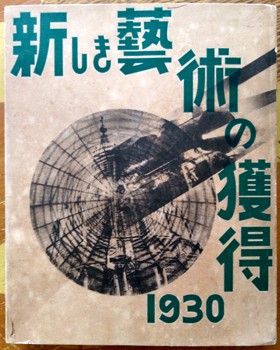

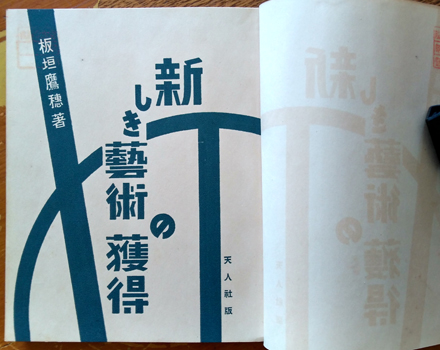
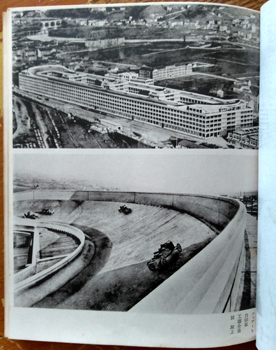

Itagaki Takao. 新しき芸術の獲得 [Atarashiki Geijutsu no Kakutoku]. Tokyo, Tenjinsha 1930. 20x15cm publisher's illustrated wrapper and printed card case; 10,246pp including photo illustrations on 16 plates. Covers mottled as with every copy I've seen that stayed safe in its box, some browning and minor signs of use; quite good. Au$500
First edition of this essay by the champion of modernism in Japan on the machine and new architecture and design, propounding his concept of "machine realism". This was a theme Itagaki pursued through a few books between 1929 and 1933.
I think the cover shows a locomotive bursting out of some old world construction but it all reminds me of a crashing zeppelin. I can't find a designer's name. I read somewhere a mention of a magazine appearance of a collaboration between Itagaki and photographer Horino Masao with layout designed by Itagaki. So, perhaps Itagaki designed his own covers.


Japanese textiles. A gathering of 15 original designs for textile designs. n.p. [1930s]. 15 sheets in gouche and inks; all about 40cm in one direction and ranging from 20 to 32cm in the other. One with a short clean tear. Short notes on the back of three, numbers on two. Au$650
Pretty lurid, huh? As the thirties pressed on and the avant garde was in disgrace - communist and anarchist scum that they were - textile design became less adventurous in form but brighter, so much brighter, and woodcut pattern books from Kyoto with designs like this proliferated. Something of a Kano school revival.
These flower designs are so highly finished I'm convinced they were made for a pattern book - probably spring or summer; autumn and winter were more restrained. Working drawing are usually much more ... well, working.


Poster. 理研チャック [Riken Chakku]. n.p. [c1930?]. Colour lithograph poster 93x59cm. Small chomps from the top right edge and the very bottom; with metal hanging strips and loop at the top. Au$450
Have you seen any movie as dynamic and thrilling as a Riken chuck at work? Me neither.


Smoca Toothpowder Poster. タバコのみの歯磨スモカ [Tabako Nomi no Hamigaki Sumoka]. n.p. [c1930?]. Colour poster 42x31cm. A hint of browning, a nice copy with metal strips at top and bottom and hanging loop at the top. Au$600
One of the more sinister of Smoca's transfixing and sometimes disturbing series of face or head and white teeth posters. I know of ten - of varying impact; a couple I've never seen for sale in decent shape and while the rest are easier to find, it's not so easy to find them in this sort of condition.
Smoca's success - they are still going - was through clever advertising. From the start, in 1925, the company's founder, advertising man Kataoka Toshiro, hired the best artists and cartoonists. Book compilations of Smoca's newspaper advertising made regular appearances from the late twenties on.


Smoca Toothpowder Poster. タバコのみの歯磨スモカ [Tabako Nomi no Hamigaki Sumoka]. n.p. [c1930?]. Colour poster 42x31cm. Some browning at the edges, a rather good copy with metal strips at top and bottom and hanging loop at the top. Au$450
A more cheerful and straightforward racist poster compared to a couple that are disturbing among the Smoca series of face or head and white teeth posters. Except that it's a woman with a cheroot clenched between smiling white teeth. I know of ten posters - of varying impact; a couple I've never seen for sale in decent shape and while the rest are easier to find, it's not so easy to find them in this sort of condition
Smoca's success - they are still going - was through clever advertising. From the start, in 1925, the company's founder, advertising man Kataoka Toshiro, hired the best artists and cartoonists. Book compilations of Smoca's newspaper advertising made regular appearances from the late twenties on.


Kitazawa Rakuten. 楽天全集 [Rakuten Zenshu]. 1-3: 5-7: 9 [all published]. Tokyo, Atoriesha (Atelier) 1930-31 (Showa 5 - 6). Seven volumes 27x20cm publisher's colour illustrated cloth, illustrated card cases; each 144pp, hundreds of colour, tri- and duo-tone illustrations. An excellent set. Au$1100
The complete works, such as it is, of the king of magazine cartoons and/or manga - Rakuten. It took me a while to figure out why I could never find a complete set of all nine volumes - such a thing doesn't exist - and even longer to find a good set of what does exist. I put a fair bit of that down to decades of Japanese booksellers, also unaware, deciding they have incomplete sets and selling them piecemeal. Add to that these are books that are usually thumbed into grimy exhaustion and you can see why I'm smug about this set.
I'm yet to find an explanation for the two gaps but these weren't published in order; some later volumes appeared before the first. The Mayan(?) on the covers is reading a manga. On the back he is laughing so hard he has dropped his book.


Borraginol poster. ボラギノール : ぢ痔に [Borraginal : Dji Ji Ni]. Osaka? Takeda (c1930?). Colour printed poster on light cotton (muslin? calico?), 117x86cm. Rumpled and some marks but rather fresh and bright. Au$200
As made clear, piles need make no inroads on a man's life, habits and comforts. Borraginol, a still made hemorrhoid treatment, was Japan's first scientific/chemical treatment developed in 1921 at Kyoto University. Posters printed on fabric - rather than banners or flags - must be pretty uncommon, no? So what was the purpose?


Advertising fan sample books. 優美団扇見本帖 + 優美団扇新画帳 [Yubi Uchiwa Mihon Jo] + [Yubi Uchiwa Shin Gacho] + six actual advertising uchiwa - fans. n.p. c1930. The first: 23x25cm publisher's colour illustrated wrappers, ribbon tied; title leaf, 81 leaves (four of these form two designs with one of each being a layer with cutouts over the other). Covers ragged, a few leaves with closed tears near the beginning; the album has been damp at some time and colours drifted to nearby leaves in places but all acceptable enough. The second: 25x25cm colour printed wrapper; ribbon tied; 42 leaves. Used and well thumbed but solid and decent enough. The fans each about 40cm top to tail. Au$2100
Two (but not a pair) of these rare sample books of elegant (yubi translates as elegant) uchiwa - non folding fans - used for advertising; messages were on the back. Now, pattern books of properly elegant fan designs have a long history and are a dime, well, a few thousand dollars, a dozen. It would be hard to get together a dozen of these crass commercial sample books, for much the same reasons as their sister hikifuda books: any that did survive are usually dismembered and sold page by page.
The accompanying fans do not actually appear in either book but that is a matter of variation on a theme. The family likeness is unmistakable. As is the likeness to hikifuda (large handbills or small posters) of the period: the artwork, printing and colours come from the same people. The designs range from revolting to most smart. Luckily few are truly revolting.


Moga illustrations. 家出娘のヌウちゃん [Iede Musume no Nu-chan]. n.p. c1930? Four ink and wash drawings on light card from about 10x22cm to 22x18cm. The first titled in pencil (Iede Musume no Nu-chan dai 5 kai translates as Runaway Daughter Nu-chan part 5). One to three are numbered in pencil; number three includes some embossing. Au$200
Four engaging and stylish small drawings which I take to be magazine illustrations for chapter five of a jazz age story all too familiar - the corruption and downfall of an innocent young woman. All very much ero-guro-nansensu (erotic grotesque nonsense) fashion of the late Taisho and early Showa period. The story of Nu-chan and where it might have appeared remains a mystery to me but I really want to see it all. Could it be there was a happy ending?
Moga = modern girl.


School posters. 姿勢圖 - 教室常備用 [Shiseizu - Kyoshitsu Jobi-yo]. Osaka, Teikoku Kyoiku Shiryo Henzan Kyokai [1930s?]. Four colour litho posters 79x55cm. A little browning, a couple of small nibbles; an excellent complete set in the original cardboard tube with printed title label. Au$250
Now this is education from first principles. Girls and boys learn how to stand and how to sit and it's easy to see the difference. From here we can go on to reading, writing and arithmetic. These were produced by the imperial education body who certainly knew what's what.


Fusuma design album. 君が代印御襖集 [Kimigayo Shirushi Ofusumashu]. n.p. [193-?]. 29x23cm publisher's cloth with paper label; 34 card leaves with colour patterns, mostly double page. At the end are two cloth samples with designs from the album in different colours. One small mounted stripe sample might be missing. Au$600
This is volume six of a series of catalogues cum pattern books of fusuma - paper for sliding screens. Since I can't find a mention of any other copies I have no clue how many there were, nor whether they appeared over a number of years. Kimigayo is the national anthem - the range or the maker's name I don't know.
Fusuma catalogues are usually pretty blah; postwar catalogues should be avoided by all but sturdy cultural archaeologists. Seems makers didn't have a high opinion of the tastes of someone who would buy their screens ready made. This one is the only exception I've seen so far. Some is bland but a lot is high class and chic in the neo-neo-rimpa style, ie the reworking of tasteful luxurious antiquity inspired by the turn of the century work of neo-rimpa designers like Korin, Sekka, Nosaburo et al.
The printing is outstanding and as usual with such stuff, hard to photograph: the aged gold and silver, heavy raised textures, overprinting, embosssing ... need to be seen in the right light. Very Kyoto and far from the brazen tizz of Tokyo and Osaka. Until we find, at the very end, the stamp of the Yamaguchi Hyoguten of Shibuya, Tokyo. Hyoguten usually translates as mounting store - a business that makes scrolls, screens and sliding screens. There are now Yamaguchi Hyoguten everywhere except Shibuya it seems. I don't know whether any of them are related. Still, I insist the desig n and printing belong to Kyoto.
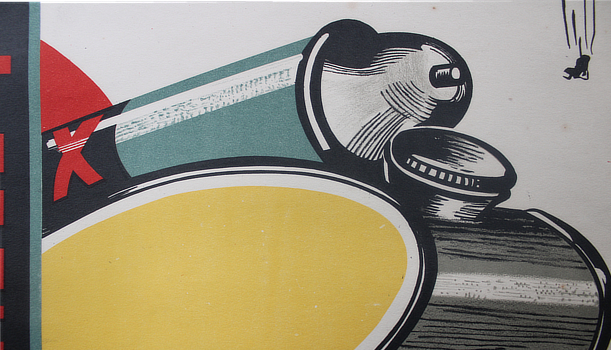
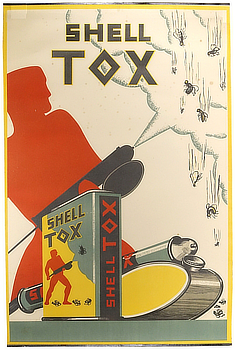
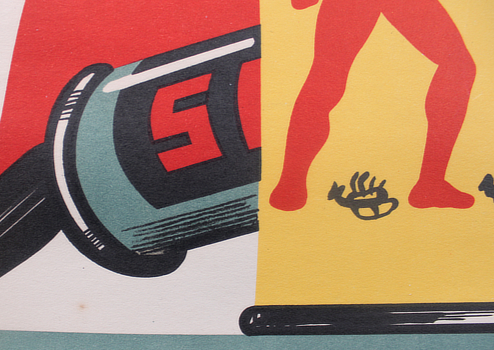
Japanese Shell Tox poster. Shell Tox. n.p. 193-? 77x50cm colour lithograph with metal strips top and bottom and hanging loop at the top. A nice copy. Au$475
Heavy weaponry has been brought in for Japan's war with bugs: that spray pump is no longer a gun, it's a tank. The stalwart armed figure appears everywhere in Shell Tox advertising around the world but that rampant tank seems peculiar to Japan. This is a shop poster with hanging strips. It's on better paper than usual: many Japanese lithograph posters are on heavy paper like this but are liable to become brown and brittle.
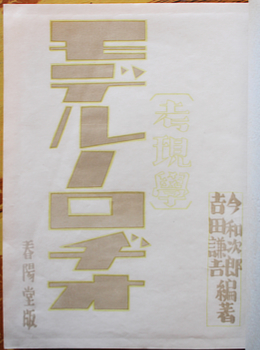
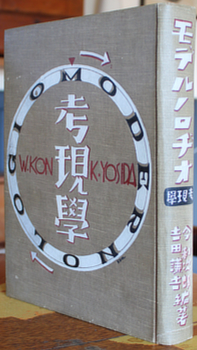
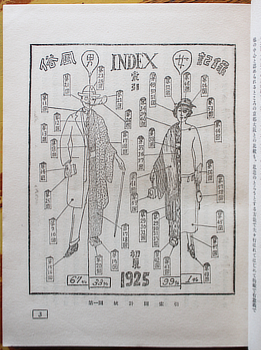
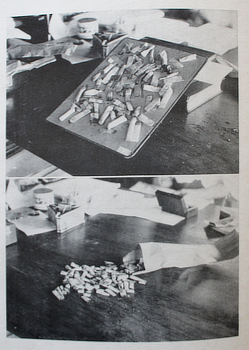
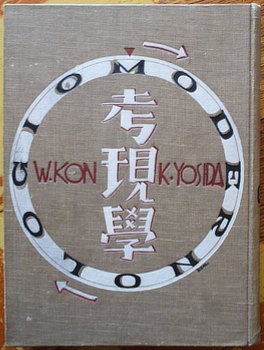
Kon Wajiro & Yoshida Kenkichi. モデルノロヂオ : 考現学 [Moderunorojio - Kogengaku]. (Modernologio on the cover). Tokyo, Shun'yudo 1930 (Showa 5). 26x20cm, publisher's decorated cloth blocked in white, red and black; 361pp, profusely illustrated throughout, a few photo or colour plates. Endpapers and edges browned as usual; a rather good copy, the cover bright, of a book that invites thumbing. Au$850
First printing. This is an extraordinary book; the gospel of Modernology. Kon and Yoshida have compiled an encyclopaedia, surely unsurpassed, of the apparently ordinary, of the people of Tokyo, fit to provoke unseemly enthusiasm in theoreticians and urban planners ever since. I gather that their thesis - born out of watching the people of Tokyo begin to rebuild after the 1923 earthquake and fire - is that those who do the planning, designing and building know nothing of what people actually do, what they own and how they use those things ... how they live and who they are.
The cover, signed Ken, and a lot of the illustrations are by Yoshida who has re-spelled his name on the cover for the sake of the design. The more I find out about Yoshida the more interesting he gets. I'm starting to think he was, to Kon, what Braque was to Picasso.
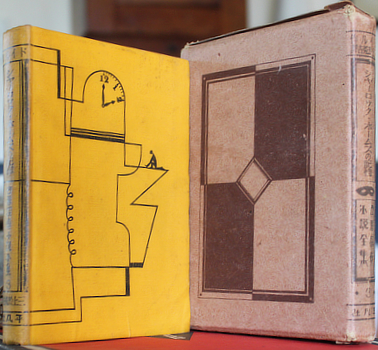
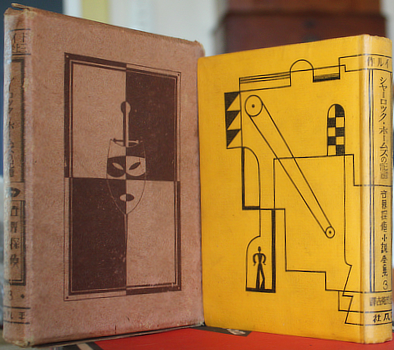
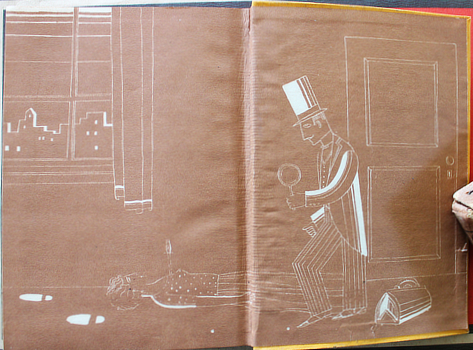
DOYLE, Arthur Conan & Mikami Otokichi. シャーロック ホームズの記憶 [Sharokku Homuzu no Kioku]. Tokyo, Heibonsha 1930 (Showa 9). 15x12cm publisher's illustrated flexible yellow cloth printed in black, printed card slipcase; frontispiece. Minor signs of use; edges browned, quite good for a pocket detective novel bound in bright yellow; seldom found with its box. The frontispiece is drab, the endpapers - which are common to the series - delightful. Au$350
First Japanese edition of the 'Memoirs of Sherlock Holmes'. Mikami was a phenomenally busy and succesful novelist who apparently worked best in brothels. His partner, novelist Hasegawa Shigure, said it was the only way he could write. When he couldn't write she filled in.
This is volume 3 in the Complete Collection of World Detective Novels which I think ran to 20 volumes and was published in no particular order in 1929 and 1930. Volume 4 was Mikami's translation of 'The Return of Sherlock Holmes' which I think beat this into print. I can tell you that volume 18 also beat this. Don't confuse this with the Complete Collection of World Detective Novels published by Hakubunkan at the same time.
The binding has a strong family resemblance to one by Onchi Koshiro for an Ars photography book the same year but this isn't any guarantee of anything.
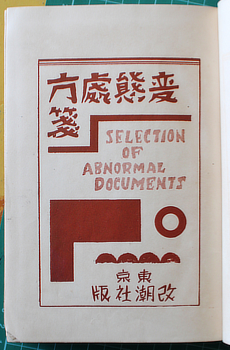
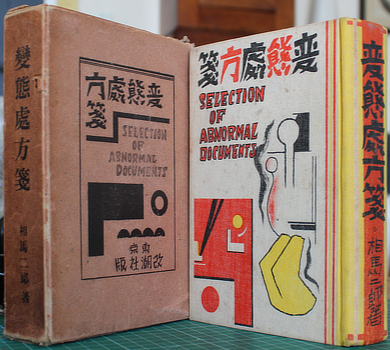
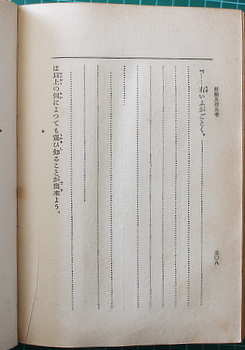
Soma Jiro. 変態処方箋 [Hentai Shohosen] Selection of Abnormal Documents. Tokyo, Kaichosha 1930 (Showa 5). 19x14cm publisher's illustrated fawn cloth printed in red, yellow and black, printed card slipcase ( a bit torn). Browning and smudging of the cloth, edges browned and scattered light browning through the text. A read copy, I'm sorry, but pretty good for this book. Au$150
Maybe the first printing of this substantial classic of the ero-guro-nansensu (erotic grotesque nonsense). The colophon is dated 24th and 29th of June but the cloth and paper are different from another copy I've seen with the same dates.
According to Hakkin Hon (banned books): Bessatsu Taiyo, the book was banned four days before publication and 295 of the 1000 copies produced were seized.
And I found another note on this book that tells us that 38 printings appeared within four months - with 25% of the text blanked out and at least one all blank page. That must be page 508, which in an August printing is columns of dots. But this is all a muddle. This copy is partly censored: page 508 is also columns of dots while the other pages I compared to that August 'first edition' are untouched here. I haven't done a page by page comparison.
I have traced, but not seen, a claimed 38th edition but nothing between one and 38. It makes sense now; they are all, however many there are, first editions without mention of earlier printings.
Hentai Shohosen might translate as 'A Prescription for Perverts'. Drugs, sex toys, punishment, cannibalism and a list of everyday items used by foreign women for masturbation appear among the chapters. So I'm told. Thank goodness I can't read it.
What I really want to know is who did the cheerful cover - one that could double for a book on Japanese motherhood - and box/title page. Designer's names are often tucked away in dim corners but I can't find it.


Hiroshi Hara [?]. 港々の猟奇街 [Minatominato no Ryokigai]. Tokyo, Fuzoko Shiryo 1931 [Showa 6]. Octavo publisher's illustrated wrapper (a bit used); photo illustrations on ten pages, 167pp and three page publisher's list. Part of the series Dekameron Sosho. Au$200
A modest but characteristic contribution to the ero-guro-nansensu (erotic - grotesque - nonsense) fashion of late Taisho and early Showa Japan: jaunts among the strange denizens of ports. The small grainy photos are a gathering of the expected seamy misfits, outcasts and dock lowlife in the ports of the world mixed with a couple of baffling innocuous views and bar scenes from films. It will probably make sense to those who can read the book: the chapter headings - there are ten chapters of course - do seem to connect to the photos.
Hakkin Hon (Banned Books) I p.91.


Specimen hikifuda. Hikifuda of women and children shopping. n.p. [1931]. colour broadside 53x38cm. Folded, with stab holes indicating it was once in an album. Au$125
A vivid and heart warming portrait of the urban well-to-do and the rewards of being well-to-do: modernity and shopping. It can be seen as mother daughter life lessons. Many such images in Japan are moral lessons, showing girls and young women their compensation for being good.
These hikifuda - small posters or handbills - were usually produced with a blank text panel. The customer, usually a retailer, had their own details over printed. The handy calendar is for 1932.


Kon Wajiro & Yoshida Kenkichi. 考現学採集 (モデルノロヂオ). [Kogengaku Saishu (Moderunorojio)]. Tokyo, Shunyodo 1931 (Showa 6). Quarto publisher's cloth blocked in red and white (spine a little rubbed), rather browned but solid illustrated slipcase; [2],323pp, photo illustrations, hundreds of line drawings and diagrams (one with colours added), endpaper map. A few blotches and small flaws, quite good. Au$750
First edition of the companion to the 'Modernologio' of the previous year - together they are the gospel of Modernology. Kon and Yoshida here collect data to extend their extraordinary encyclopaedia of the people of modern Tokyo. Their thesis was that those who do the planning, designing and building know nothing of what people actually do, what they own and how they use those things - how they live and who they are. I can't imagine anything you might ever think about and a lot you would never think about that isn't collected here. How you walk, where you walk, what you carry, how you carry it, where you dance, how you dance, how you sit, where your shelves are and what's on them, in your cupboards ...
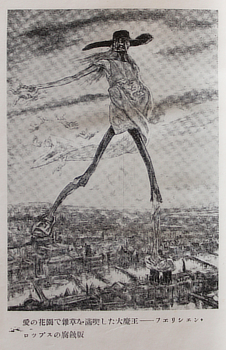
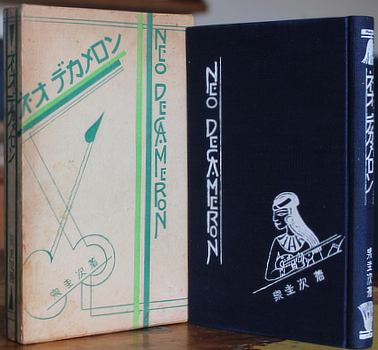
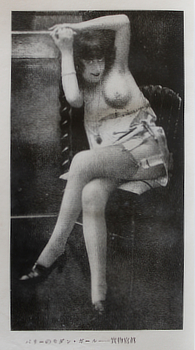
Izumi Keiji [ed]. ネオ デカメロン [Neo Dekameron] Neo Decameron on the cover. Tokyo, Bunshodo 1931 (Showa 6). 18x11cm publisher's decorated cloth blocked in white, printed card slipcase; 49 plates (one colour) from various sources. A nice copy. Au$200
First edition. A pleasing example of the ero-guro-nansu (erotic-grotesque-nonsense) craze of the early showa period. This is a stylish gathering of salacious pieces that would normally appear in pulp magazines. What caught my eye is the piece which sort of translates as 'The Electric Artificial Maiden's Secret Room' which sums up the whole notion of ero-garu-nansu. This jostles with sex murder in the Shanghai British Concession and plenty more. The illustrations are pinched from louche sources, mostly European I'd say.
Neo Decameron it may be but there are 21 stories, not ten. Worldcat finds no copy.
Hakkin Hon (Banned Books) I p.170
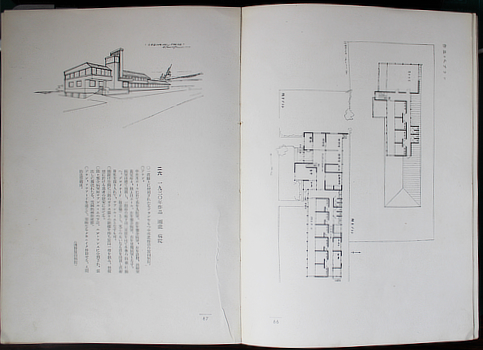
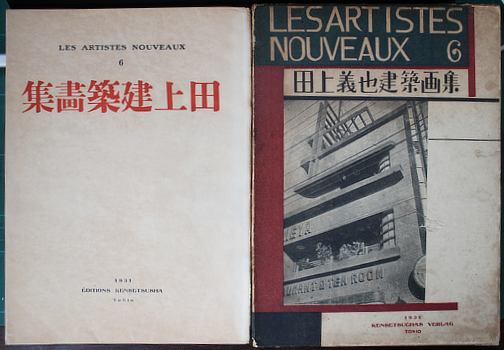
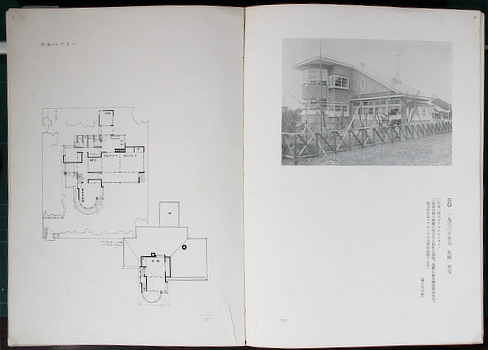
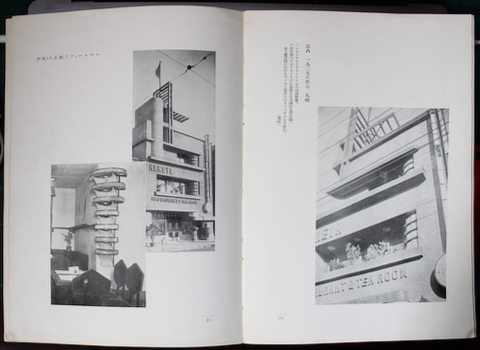
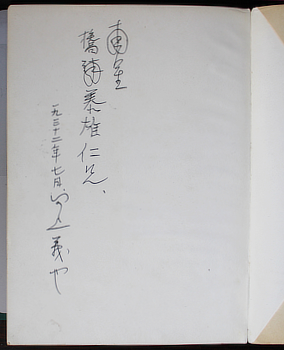
Tanoe [or Tanoue or Tanouye] Yoshiya. 田上義也建築画集 [Tanoe Yoshiya Kenchiku Gashu]. Tokyo, Kensetsusha 1931. 27x19cm publisher's printed wrapper, illustrated card slipcase (this marked and a bit worn but solid); 110pp, photo illustrations, renderings and plans. Rather good. Inscribed and signed by Tanoe to artist, later folklorist, and dogged communist Hashiura Yasuo who gets a passing mention in the book. Au$1850
Tanoe began his career working for Wright on the Imperial Hotel - from 1919 to 1923. He then headed off to Hokkaido and is now an architectural hero of the island, even while many of his buildings have vanished. The prairie style is evident in some of these early houses but no more than Japan is evident in the prairie style. I read somewhere that for one of the buildings in this book he kept his original plan rather than the compacted plan that was actually built. This was so that his sense of space was preserved.
I think the rest of this Artistes Nouveaux series - maybe seven titles in all - are all painters including three Europeans: Matisse, Vlaminck and Chagall.
Worldcat finds no copies outside Japan and it's not common in Japan.
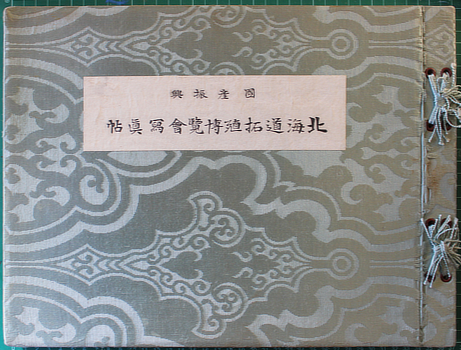
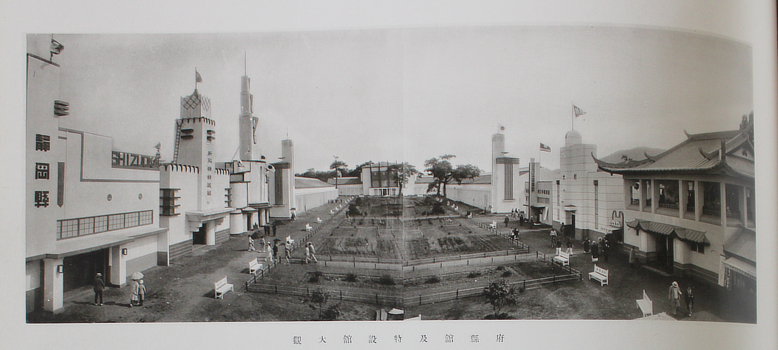
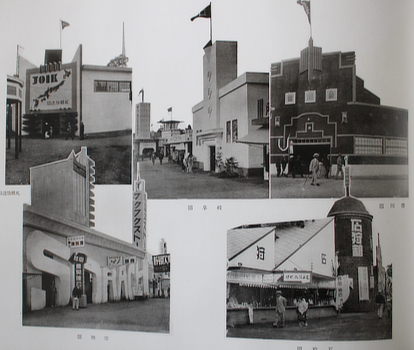
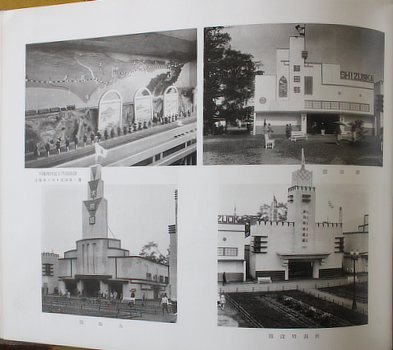
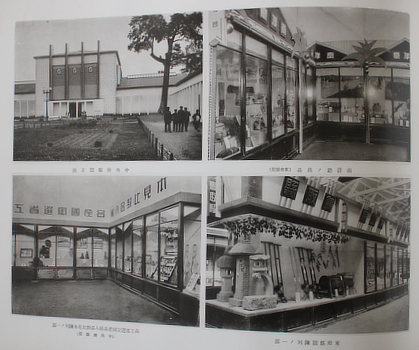
Exposition - Hokkaido 1931. 国産振興北海道拓殖博覧会記念写真帖 [Kokusan Shinko Hokkaido Takushoku Hakurankai Kinen Shashin Jo]. Hokkaido Takushoku Hakurankai, 1931 (Showa 6). 27x37cm publisher's patterned silk, cord ties; title page, photo illustrations on 35 leaves of heavy gloss paper, 12 pages of text and a plan. A nice copy. Au$600
A luxurous celebration, with exemplary printing, of the 1931 Hokkaido Colonization Exposition. Had you heard of it? Me neither. Thankfully the important old men who always head such books don't take up too much space and it gets more interesting the further we go in. What's wonderful is the number of pavilions that might have come straight out of the pages of the exposition volume of the Gendai Shogyo Bijutsu Zenshu - the Complete Commercial Artist - of 1928-30. Either the same designers were at work or the organisers handed out copies of the book and said, "go for your life."
At the very end we find what seem to have been the big draws for the 600,000 plus visitors: the human cannonball, the world's fattest woman, and dancing girls.
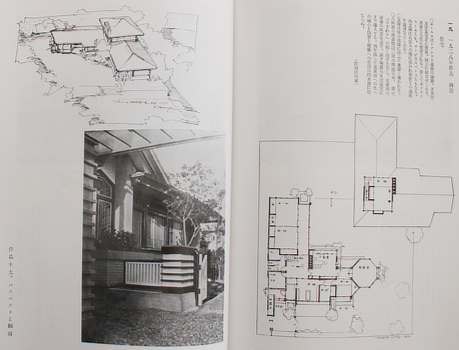
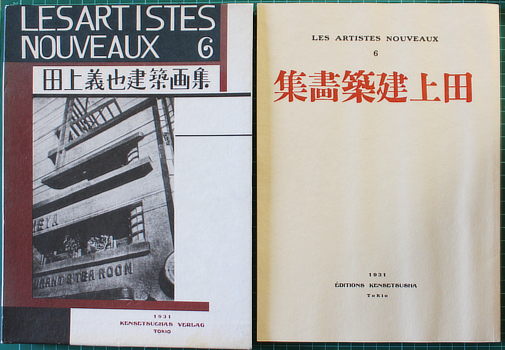
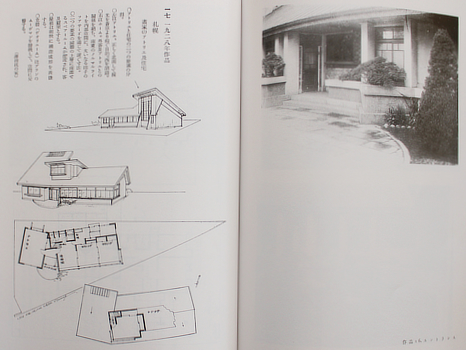
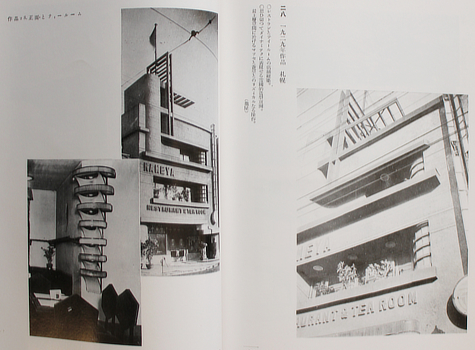
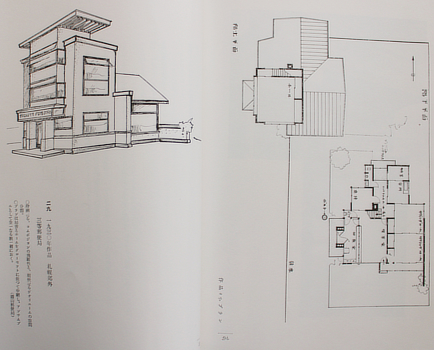
Tanoe [or Tanoue or Tanouye] Yoshiya. 田上義也建築画集 [Tanoe Yoshiya Kenchiku Gashu]. Tokyo, Kensetsusha 1931 (but Raifushuppansha 1987). 27x19cm publisher's printed wrapper, illustrated card slipcase; 110pp, photo illustrations, renderings and plans. At cost price. Au$250
Not the great bargain I hoped for. This is not the first edition, it's a facsimile I didn't know existed until I unwrapped this. It's a good facsimile, very good, and it's more obscure than the original. It's a local production by a Hokkaido publisher - not to be confused with current Tokyo 'Life Publishing' which deals in puerile self help stuff.
Tanoe began his career working for Wright on the Imperial Hotel - from 1919 to 1923. He then headed off to Hokkaido and is now an architectural hero of the island, even while many of his buildings have vanished. The prairie style is evident in some of these early houses but no more than Japan is evident in the prairie style. I read somewhere that for one of the buildings in this book he kept his original plan rather than the compacted plan that was actually built. This was so that his sense of space was preserved.
I think the rest of this Artistes Nouveaux series - maybe seven titles in all - are all painters including three Europeans: Matisse, Vlaminck and Chagall. They weren't reprinted of course.
Worldcat finds no copies outside Japan and it's not common in Japan, neither the original nor this reprint.


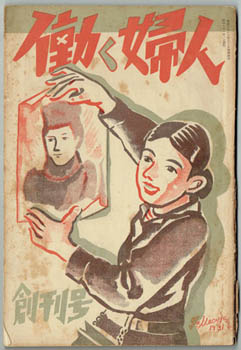
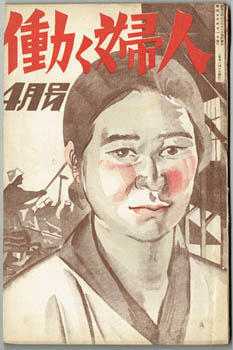
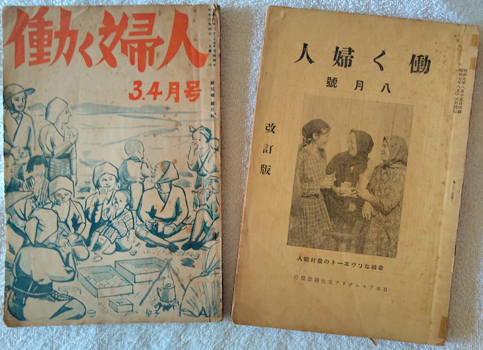
働く婦人 [Hataraku Fujin]. No. 1 to no. 5: no. 8: no. 11 and Vol. 2 no 1 and no 3/4. Tokyo, Nihon Puroretaria Bunka, Jan - Nov 1932, April 1933 (Showa 7, 8). Nine issues in colour illustrated publisher's wrappers 22x15cm; contents range from about 140pp to about 70pp but the numbering of some issues is alarmingly erratic, b/w illustrations, monochrome photo illustrations. No.8 must have been a troubled issue; it is particularly humble and seems to have been assembled in careless haste. Expected browning of the cheap paper, signs of use but all rather good. Au$1650
Maybe nine elevenths - or nine thirteenths, or not - of the whole run of this trouble making left wing magazine for the Working Woman. It's hard to untangle. I can't find any complete set of these original copies. A reprint, probably not complete, was made in 1980 which seems to include eleven issues running from January 1932 to a March/April 1933 double issue - eight for 1932 and three for 1933. I found a mention that no issues appeared some months. The issues here are numbered by the month they appeared - which may mean there are gaps in the numbering of a complete run or that there are issues no-one has found. The holdings of 13 university libraries in Japan put together seem to add up to v1(1 -10) for 1932 and v2(1-3) for 1933 but the numbering is iffy even then.
Being a communist in Japan in the thirties was a fraught business and the foundation of the Nihon Puroretaria Bunka Renmei - Japanese Proletarian Culture Federation - late 1931 and the flourish of Proletarian books and magazines in 1932 and early 1933 was a last stand of the left. Being gaoled was one thing, being tortured and killed another. In her novel '1932 no Haru' (Spring 1932) writer Miyamoto Yuriko incorporated her editorship of early issues of this magazine, arrest after the April 1932 issue (on the right in the picture here), and the torture and death of poet Konno Dairiki. This wasn't her last arrest and Konno's wasn't the last death.
Virtually nothing written in the last few decades on Japanese culture in the twentieth century doesn't mention 'Working Woman' while no-one, it seems, has read or even seen all of them.
Hakkin Hon (Banned Books) I p.117 & III p.41
  3 4 5 [6] 7   |

