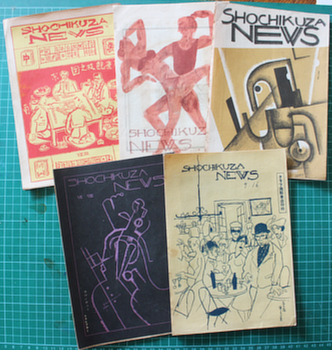
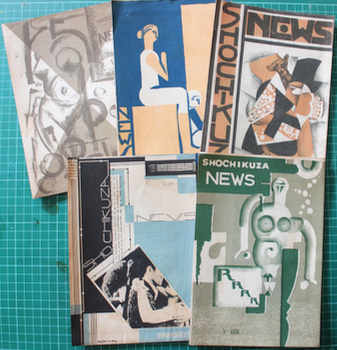
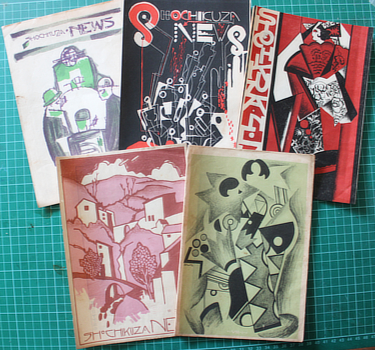
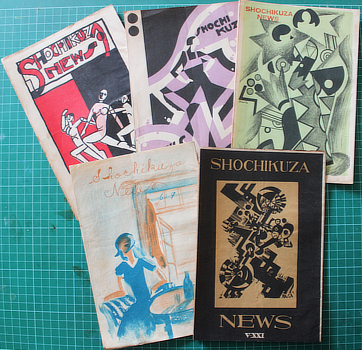
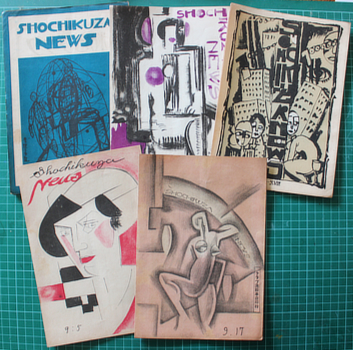
Shochikuza. Shochikuza News. Osaka, Shochikuza 1925-1929. 38 issues 22x15cm publisher's colour illustrated wrappers; mostly four pages and covers. Minor signs of use. Au$2300
A well chosen group. Shochiku, now part of the megafauna of the entertainment industry, spread into film from Kabuki in 1920, built Japan's first western theatre in Osaka in 1923, and soon had a chain of cinemas showing foreign movies. This was their weekly news letter. I think the cover was shared but the contents were printed for each theatre. Inspired and aspiring young designers presumably worked on the usual terms: no credit and less money. There is quite a bit of remarkable anonymous graphic art of the twenties and early thirties with the Shochikuza banner. Not all of it is good but what is can be fabulous. As the thirties progressed the adventurousness evaporated and by the mid-late thirties they looked like film magazines from anywhere.
Here we can identify the artist of some. Those signed Shin or 伸吉 are by Yamada Shinkichi who started in Shochikuza's publicity department in 1922 and worked his way up to set and costume designer. There are ten here.
What's remarkabe about Shochikuza and their artists is that while it's clear they studied and stole a lot, mostly from Europe, they didn't copy advertising. They studied art and design movements, graphic art, theatre and film design. It's no coincidence that a lot of covers were really set designs. They weren't selling film stars, they were selling the modern world. And showing that Japan - and Shochikuza of course - was a vital part of the modern world.
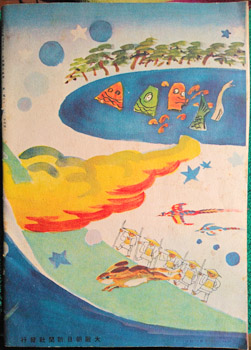

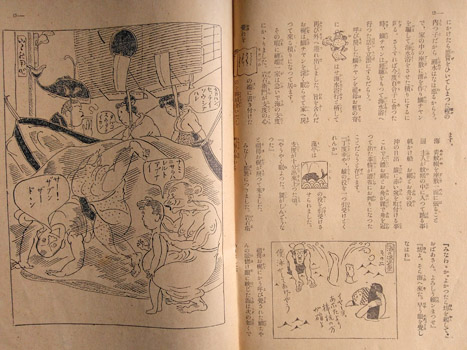
Okamoto Ippei. 山と海 [Yama to Umi] (Mountain & Sea). Osaka, Asahi Shimbun 1926 [Taisho 15]. Quarto publisher's colour illustrated wrapper; 40pp, b/w illustrations throughout. Natural browning of the paper; a rather good copy. Au$100
A comic commentary on the Japanese out and about on holiday and I suspect many other things beyond me. There is a cast of recurring characters and it's evident from the cover that class wars are at play - there is a drawing inside of a plutocrat mugging a beggar - but there's a lot going on in these busy pages that are fun to look at but incomprehensible to me.
Ippei, radical and scallywag, was the king of newspaper cartooning as Rakuten ruled the magazines in Taisho and early Showa Japan. It was Ippei that brought the American comic strip to Japan and he heads, with Rakuten, the lists of idols and inspiration of many modern manga artists.

Hotels. The Stevens. The World's Greatest Hotel. Chicago. Chicago, the company [1927]. Quarto publisher's printed wrapper; 32pp, profusely illustrated. Au$75
A celebratory promotion marking the opening of this massive and opulent pile. Built at a cost of over thirty million dollars, as proclaimed in the first sentence, the building still exists but the Stevens family went up in smoke wihin five years. By 1932 the hotel was bankrupt and the trio of father and two sons were soon after indicted for financial corruption. The father had a permanently crippling stroke, the elder son blew his brains out and the younger went to prison.


Shogakusei Zenshu. Murayama Tomoyoshi. 音楽の話と唱歌集 [Ongaku no Hanashi to Syokashu]. Tokyo, Kobunsha 1927 [Showa 2]. Octavo, cloth backed publisher's illustrated card wrapper; one colour plate, b/w illustrations throughout. Some browning and mild signs of use; a rather good copy. Shogakusei Zenshu no.67. Covers - front and back - by Murayama Tomoyoshi. Au$125
The Shogakusei Zenshu, or Complete Works for Elementary Schools, runs to some 88 volumes of educational texts and literature - much of this in translation; few of them seem elementary. This one covers music. Murayama maybe leads the list of avant-garde heros of interwar Japan. Founder of MAVO and communist troublemaker he had books and plays banned, ended up in prison and produced lively, humourous illustrations for children.


Okamoto Ippei. 児童漫画集 [Jido Mangashu]. Tokyo, Kobunsha 1927 [Showa 2]. 22x15cm cloth backed publisher's colour illustrated card wrapper; cover, illustrated title in red and black and one colour plate by Ippei, seven full page illustrations in colour, profusely illustrated in b/w by any number of artists. An uncommonly good copy. Shogakusei Zenshu no.23. Au$150
The Shogakusei Zenshu, or Complete Works for Elementary Schools, runs to some 88 volumes of educational texts and literature - much of this in translation - few of them seem elementary, and how many publishers of such series would include manga?
Ippei, radical and scallywag, was the king of newspaper cartooning as Rakuten ruled the magazines in Taisho and early Showa Japan. It was Ippei that brought the American comic strip to Japan and he heads, with Rakuten, the lists of idols and inspiration of many modern manga artists.
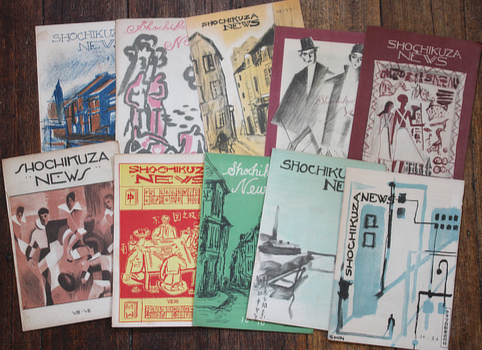
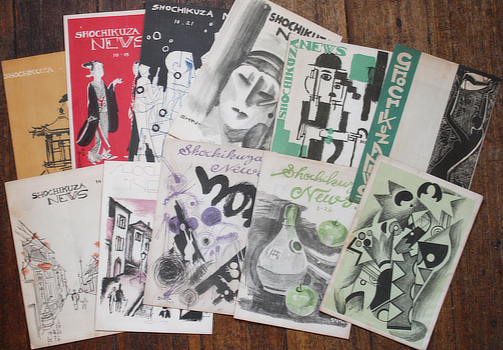
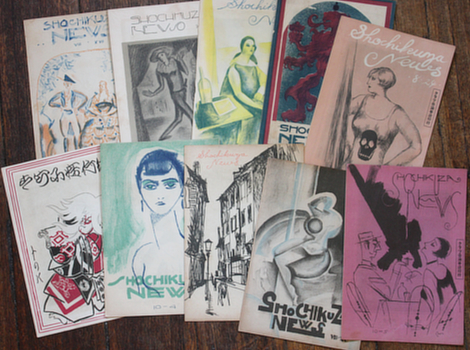
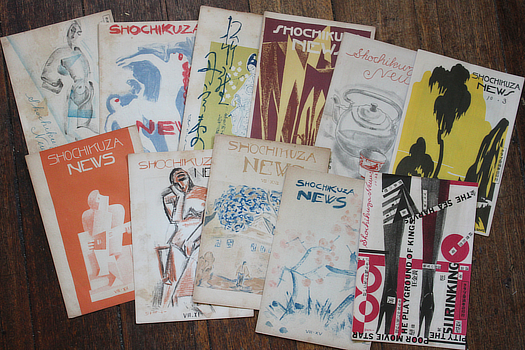
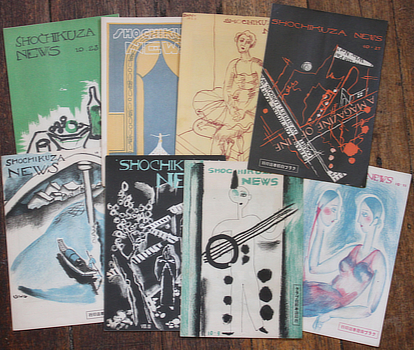
Shochikuza. Shochikuza News. Osaka, Shochikuza 1927-1929. 50 issues 22x15cm publisher's colour illustrated wrappers; mostly four pages and covers. Some browning and minor signs of use. Added are three duplicates, one quite scruffy, and a couple of similar items from other companies. Au$1750
A pretty good gathering, there are a few half hearted issues. There might be a complete run of these out there somewhere but anyone mad enough to want them all would have to buy a lot of dull stuff, especially as the thirties went on.
Shochiku, now part of the megafauna of the entertainment industry, spread into film from Kabuki in 1920, built Japan's first western theatre in Osaka in 1923, and soon had a chain of cinemas showing foreign movies. This was their weekly news letter. I think the cover was shared but the contents were printed for each theatre. Inspired and aspiring young designers presumably worked on the usual terms: no credit and less money. There is quite a bit of remarkable anonymous graphic art of the twenties and early thirties with the Shochikuza banner. Not all of it is good but what is can be fabulous. As the thirties progressed the adventurousness evaporated and by the mid thirties they looked like film magazines from anywhere.
Here we can identify the artist of many. Those signed Shin or 伸吉 are by Yamada Shinkichi who started in Shochikuza's publicity department in 1922 and worked his way up to set and costume designer. What's remarkabe about Shochikuza and their artists is that while it's clear they studied and stole a lot, mostly from Europe, they didn't copy advertising. They studied art and design movements, graphic art, theatre and film design. It's no coincidence that a lot of covers were really set designs. They weren't selling film stars, they were selling the modern world. And showing that Japan - and Shochikuza of course - was a vital part of the modern world.


Shogakusei Zenshu. 児童物理化学物語 [Jido Butsuru Kagaku Monogatari]. Tokyo, Kobunsha 1928 [Showa 3]. Octavo, cloth backed publisher's illustrated card wrapper; illustrated title, two colour plates, photo and b/w illustrations through the text. Some browning and mild signs of use; a rather good copy. Shogakusei Zenshu no.61. Cover by Michioka Toshi. Au$90
The Shogakusei Zenshu, or Complete Works for Elementary Schools, runs to some 88 volumes of educational texts and literature - much of this in translation; few of them seem elementary. This one is physics and chemistry.


Shogakusei Zenshu. 子供生理衛生物語 [Kodomo Seiri Eisei Monogatari]. Tokyo, Kobunsha 1928 [Showa 3]. Octavo, cloth backed publisher's illustrated card wrapper; one colour plate, photo and b/w illustrations. Some browning and mild signs of use; a rather good copy. Shogakusei Zenshu no.69. Colour frontispiece by Unno Seiko, other illustrations by Hosokibara Seiki. Au$85
The Shogakusei Zenshu, or Complete Works for Elementary Schools, runs to some 88 volumes of educational texts and literature - much of this in translation; few of them seem elementary. This one covers health. Seiki's illustrations aren't so well printed but they are lively and amusing.


Murayama Tomoyoshi. プロレタリア映画入門 [Puroretaria Eiga Nyumon]. Tokyo, Zen'ei Shobo 1928 (Showa 3), 19x13cm publisher's red wrapper with mounted label (wrapper colour patchy); [8],276pp, photo frontispiece loose, photo illustrations through the text. A nice copy in the original card slipcase. Au$600
First, only contemporary I'm sure, edition of Murayama's introduction to proletarian film - a literal translation of the title. By 1928 Mavo founder Murayama had already had one play banned and soon enough began the first of a series of arrests for troublemaking. Mavo, a determined regrounding of constructivism - which Murayama had brought back from Germany - in the concerns of real life, was both progenitor and, for a while, companion of specifically proletarian branches of the avant-garde: the Proletarian Art Academy and the Proletarian Art Federation, the Proletarian Film League ... . You will find Murayama's name in the histories of them all. He made films of course; infuriated architects by designing buildings; designed, wrote and directed plays; wrote novels, theory and criticism like this; painted and made collage constructions; and like many radical, or just outstanding, artists of his generation, made his living illustrating children's books and magazines.
It may seem trivial but even the title of this book, using the phonetic transcription of 'proletarian' was a modern typographic departure from the usual three character Kanji - musansha. Worldcat finds no copy of this outside Japan.


Exhibition - Tokyo 東京博覧会第一会場第二会場夜の美観 [Tokyo Hakurankai Dai Ichi Kaijo Dai Ni Kaijo Bayoru No Bikan]. Tokyo, Urashimado? 1928 (Showa 3). Colour lithograph 37x78cm. Creased and crumpled but still worthwhile. Au$150
This is the Dairei Memorial Expo of 1928 - held to celebrate the coronation of Hirohito - by night. This is how the world looked when I was a child. Trying to recover this vision with varied hallucinogens and psychotropics only works for so long so it's good to have a permanent souvenir.
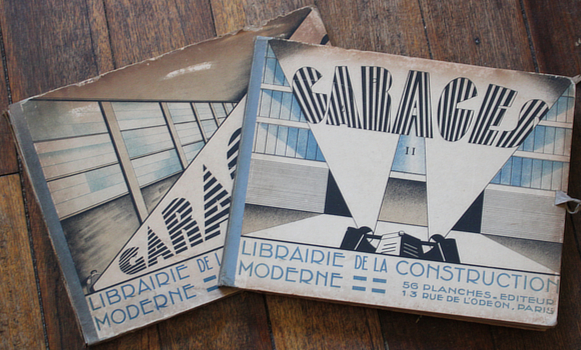
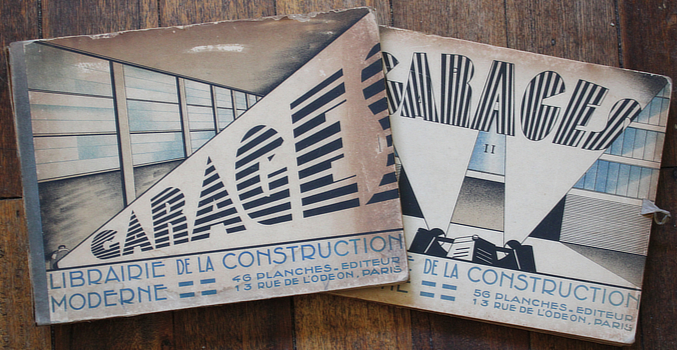
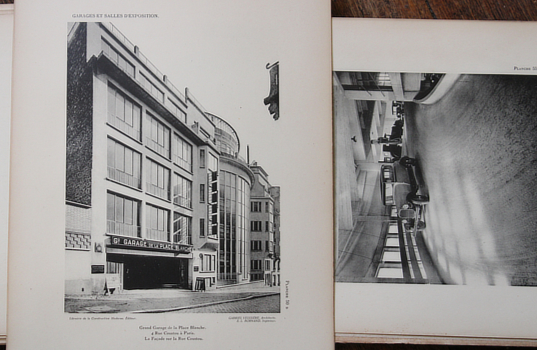
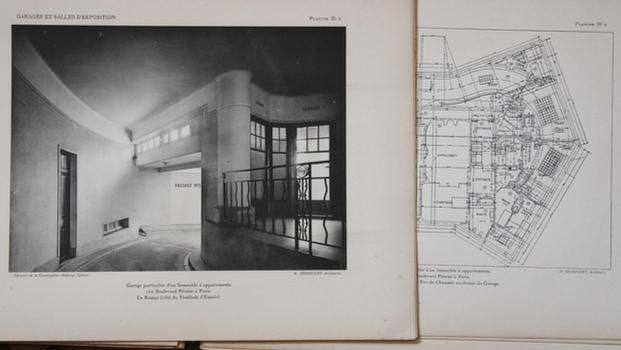
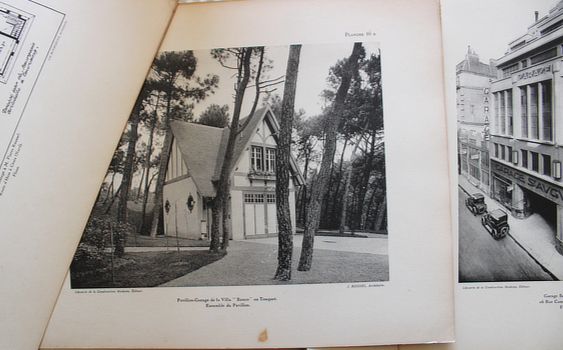
Architecture. GOISSAUD, Antony [introductions]. Garages et Salles d'Exposition. Paris, Librairie de la Construction [1928 & 30?]. Two volumes 25x33cm publisher's cloth backed colour illustrated boards (wear and rubbing); 16pp introductory text in each volume, 102 plates: photo illustrations, plans and elevations; loose as issued. A used copy, I'm sorry to say, with some browning, smudges, and occasional frayed edges; a thoroughly acceptable, complete, I repeat complete, set. With the embossed bookshop labels of Meiji-Shobo, Kanda, Tokyo; an stylish bit of deco design in itself. Au$1000
Royalty among books on automobile architecture: garages, parking stations and automobile show rooms - a small kingdom - and hard to find complete.
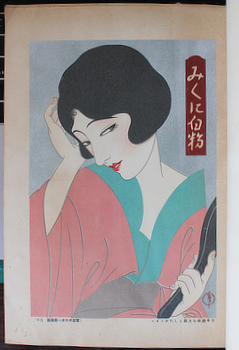
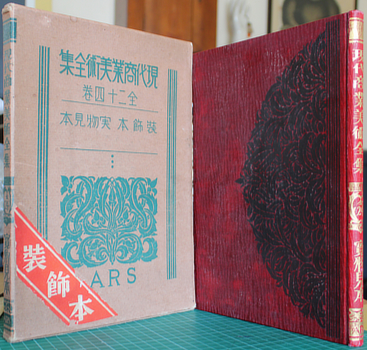
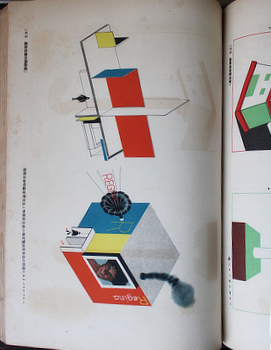
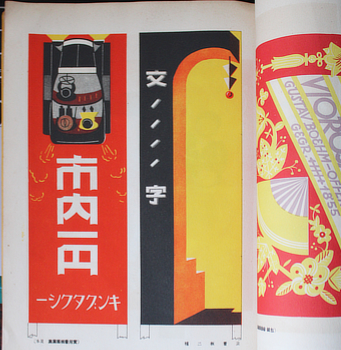
Hamada Masuji, Sugiura Hisui and others. 現代商業美術全集 : 装飾本 : 内容見本 [Gendai Shogyo Bijutsu Zenshu : Soshokuhon : Naiyo Mihon] [The Complete Commercial Artist (publisher's sample)]. Tokyo, Ars c1928. 26x20cm publisher's cloth and printed card slipcase; [2],8pp, 62 pages of illustrations and plates, most in colour, 16pp of text. The blank leaves used to bulk out the binding have been removed, odd in a copy that looks like it has barely been opened. Au$800
I didn't know this existed until quite recently. This is the publisher's sample book for the Gendai Shogyo Bijutsu, one of the great monuments of Japanese modernism, published by subscription in 24 volumes. It contains a sample range of illustrations from the work and explanatory text. The set was issued in wrappers or this, presumably more expensive, cloth binding.
Largely the work of Hamada Masuji - credited with the invention of design as a profession in Japan - the Shogyo Bijutsu is an encyclopaedic gathering of all that is new and exciting in Russia, Europe, Britain and America from art nouveau to bauhaus and constructivism, with futurism, expressionism, dada and everything else along the way lavishly mixed with Japanese responses to, and digestion of, these western ideas. Any number of exciting artists and designers contributed. Except to the binding.

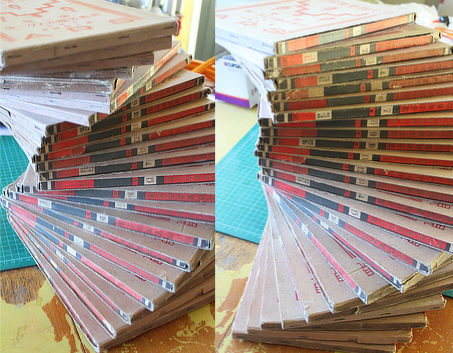


Hamada Masuji, Sugiura Hisui and others. 現代商業美術全集 [Gendai Shogyo Bijutsu Zenshu - The Complete Commercial Artist]. Tokyo, Ars 1928-30 (Showa 3 - 5). 24 volumes quarto, publisher's wrappers & printed card slipcases; thousands of illustrations, most colour. A rather good set, small chips from a few spines. With: the publisher's sample book: publisher's wrapper; [2],8pp, 62 pages of illustrations and plates, most in colour, 16pp of text and a quanity of blank leaves to bulk out the book. Endpapers mostly cut out. And: a scruffy copy of the prospectus which unfolds to 39x54cm with details on one side and a colour collage on the other. Au$6500
A better than complete set of the Shogyo Bijutsu, one of the great monuments of Japanese modernism, of modernism anywhere and everywhere. Thanks to its scope there is nothing else quite like this.
Largely the work of Hamada Masuji - credited with the invention of design as a profession in Japan - it is an encyclopaedic gathering of all that is new and exciting in Russia, Europe, Britain and America from art nouveau to bauhaus and constructivism, with futurism, expressionism, dada and everything else along the way lavishly mixed with Japanese responses to, and digestion of, these western ideas. Any number of exciting artists and designers contributed.
Each volume is devoted to a topic or related topics and commercial design here means more than it does to us. So as well as volumes on posters, advertisements, billboards, typography, and similar graphic arts (like bookbindings, magazine, brochure and catalogue covers, packaging, labels, trademarks and placards), there are volumes devoted to the architecture of the shop from the mightiest department store to the most chic Parisian shop window and the display within. Exterior and interior design, showcases and fittings - shops, restaurants, cinemas, even a barber shop or beauty parlour is laid out. One volume is devoted to lighting: neon lights, the lighting of commercial spaces and illuminated signs. Another volume is devoted to kiosks, pavilions and floats, festive decoration, facades, gateways and entrances, while the following volume continues into international exhibitions. Volume 22 is devoted to traditional Japanese shop signs and banners, a treat in itself, while volume 14 explores photography and humour in graphic art - so German photo-montage and French caricature share a volume.
*Rather than do any work I've re-used old photos of the contents of these. The outside is new, the inside not so much.
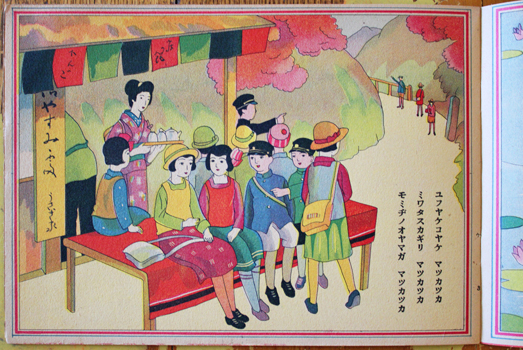

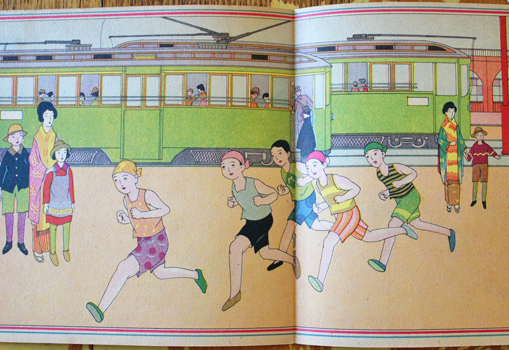

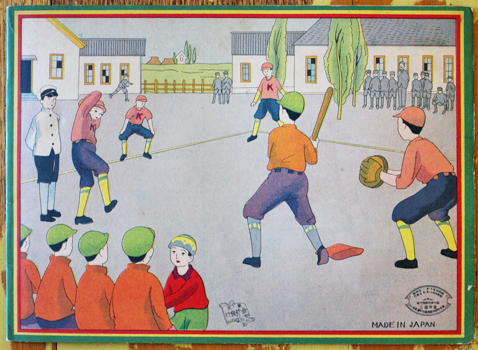
Kanai Naozo. 運動会 [Undokai]. Tokyo, Kanai Naozo 1929 (Showa 4). 19x27cm colour illustrated wrapper; 12pp including covers, colour illustration on every page. A nice copy. Au$175
Sports day; No. 117 in this particular series of picture books by Kanai. There seem to be several indistinguishable series or Kanai picked the numbers out of a hat. These are children who are putting all their effort into being decorative. I'd say the whole day passed in near silence, maybe the occasional gentle puff at the end of an extended pose. The books from the twenties and beginning of the thirties, though, are a lot less revolting than those of later years.
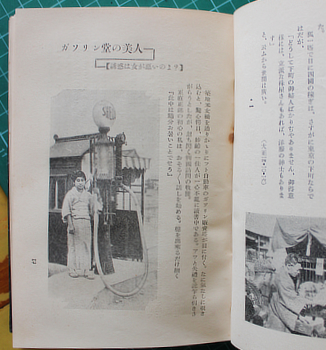
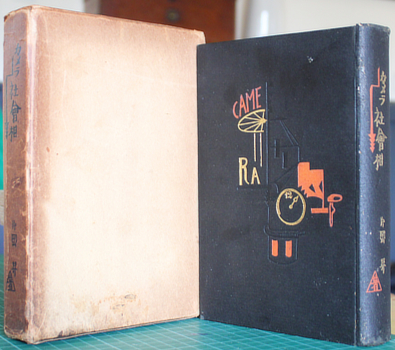
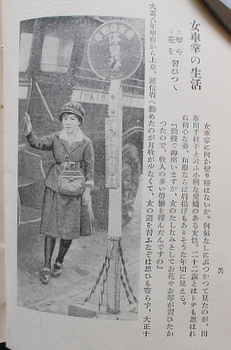
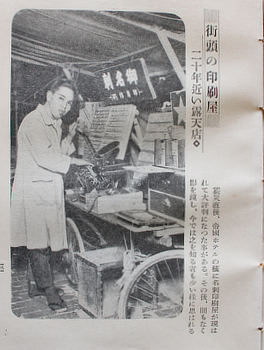
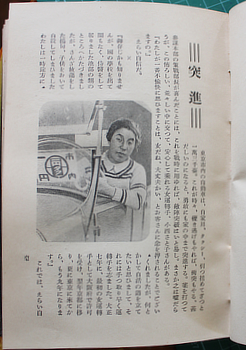
Kataoka Noboru. カメラ社会相 [Kamera Shakaiso]. Tokyo, Bungei Shijosha 1929 (Showa 4). 20x14cm publisher's cloth blocked in blind, red and gilt, card slipcase (some holes in the back hinge have been touched up by some wrong-headed owner; the box is quite browned); photo illustrations throughout. First and last couple of pages browned. An unnumbered copy of an edition of 500 copies. Au$200
I found a reference somewhere calling this a work of modernology, ie the study of ordinary people, their daily lives, what they do, what they use ... but I don't know that Kataoka had any connection to modernologist Kon Wajiro. I think it was a similar impulse from a different direction that sent Kataoka out on the street with his camera. He wrote, "I have a weapon called a camera. I snap a picture, and when I ask them to talk, most of them are soft-spoken and start talking about their lives, which is a real perk of being a photographer" (a crude translation). The first part photographs and interviews 93 people at work, including a woman bus conductor and gas pump attendant. After that it's not so interesting: celebrated worthies.
This was issued as an edition of 500 copies in a leather binding which might have been smart when new but the leather fell to pieces pretty fast. So it's not hard to find copies in ruin but not so easy to find a cloth binding in reasonable shape. My guess is that a few extra copies were put out in cloth.
The binding design is by Sakai Kiyoshi, I presume the writer credited with kick starting the ero-guro-nansu fad. Some of his books came from the same publisher.
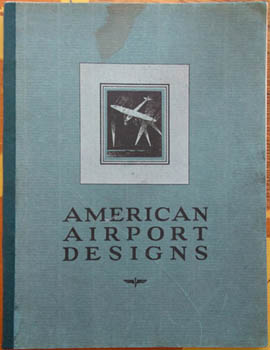

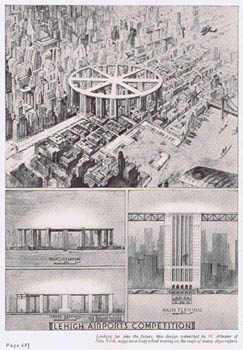
BLACK, Archibald et al. American Airport Designs - containing 44 prize winning and other drawings from the Lehigh Airports Competition ... NY, for the Lehigh Portland Cement Company 1930. Quarto publisher's illustrated heavy wrapper (a stain on the front, later cloth spine); 96pp, mostly plates. A more than decent copy. Au$250
This is, I believe, the first American book on airport architecture, gathering designs submitted to the country's first such competition. The compiler is confident that there are plenty of new ideas never used in Europe and the schemes range from token crackpot visionary - a circular runway running around the tops of skyscrapers - to beaux-arts, with the bulk falling into classical moderne.
Common to all designs chosen for inclusion is a formal layout, with runways, often circular, that range from something like parterre gardens to complex occult symbols; surely evidence that a good beaux-arts education still prevailed. Two designs that have some flashy distinction are by Los Angeles and Florida architects, naturally, with a film set skyscraper and a modernist tower respectively. Both are condemned as unsafe. Maybe interesting now would be tracking down the entries that didn't make the cut - neither Wright's nor Neutra's made the book.


Sunday Chewing Gum. サンデーチウィンガム [Sande Chiuingamu]. Yamazaki Seika Kenkyujo [193-?]. Colour lithograph poster 56x19cm. Some minor creasing and natural browning of the paper, rather good with the original metal strips and loop. Au$85
A shop poster for Sunday Chewing Gam (sic) against an unexpected wintery background. I guess chewing gum really has no season.


Catalogue - Photo albums. Seiundo Co. Tokyo. Catalogue of Album. Tokyo [193-?]. 16x10.5cm publisher's colour illustrated wrapper with metal pin; 18 leaves printed one side, b/w photo illustrations. Au$50
A neat little catalogue of photo and other albums in a varitey of styles, available in different sizes. Japan was by the thirties camera crazy as well having a large population of avid ephemera collectors. A good time to be in the album business.


Hirai Fusando. 糊の友 - 繊維のホルモン [Nori no tomo - sen'i no horumon]. n.p. [193-?]. Colour poster 54x19cm. Au$100
A cheery shop poster advertising ... I'm not sure what. I can't figure out whether you swallow this stuff or use it with your laundry. Actually, I'm pretty sure it's laundry but the mention of hormones was confusing. I'm pretty definite this is by the cartoonist and illustrator Hirai Fusando, it's definitely his character - the housewife who knows everything.


Sunday Chewing Gum. サンデーチウィンガム [Sande Chiuingamu]. Yamazaki Seika Kenkyujo [193-?]. Colour lithograph poster 56x19cm. Rather good with the original metal strips and loop. Au$125
A shop poster for Sunday Chewing Gam (sic) against an unexpected wintery background. I guess chewing gum really has no season.

Advertising. 女神丸 [Megamimaru?]. [193-?]. Three colour poster 47x28cm, horizontal fold in the middle. Au$125
This elegant modern woman graciously advertises a complete treatment for women's uterine problems.


Fire Safety Poster. 火防 - 秩父消防組 [Hifuse - Chichibu Shobogume]. Chichibu Fire Prevention Publicity Department [c1930?]. Colour litho poster 39x27cm. Horizontal fold and creased in a top corner. Au$150
The Chichibu Fire Prevention department produced a series of these fire safety poster. I think they were the result of a school competition. So far I've seen three. One makes the fire department more threatening than a fire, one seems a lesson in how to burn down the city and this one takes a more theological approach: fire is neither an accidental nor deliberate act of people, it is a demonic being.


Soap. 美活石鹸 [Bikatsu Sekken]. Osaka? c1930? Colour lithograph poster 108x35cm. A couple of short tears in the bottom margin repaired, still a nice bright copy with metal strip and hanging loop at the top. Au$250
I have the feeling that the dancer originally cast to dance the pas de deux with this bar of Bikatsu soap was unable to appear and a frightened understudy from the corps was stuffed into the prima ballerina's costume and pushed out on stage at the last minute.


Poster - dye. 私達の家庭染料 - すみれ染 [Watashitachi no Katei Senryo : Sumire Zome]. [Tokyo? 193-?]. Colour poster 52x36cm. In excellent shape. Au$150
Sumire dye was the home dye of choice for modern vamps.


Poster. 簡易換算器 [Kani Kansanki?] n.p. [193-?]. Colour lithograph poster 53x25cm. Folded but still quite good. Au$100
It's tempting to see this now as an ominous warning that Australia was under threat from a patent Japanese conversion ruler. Maybe that was the intent - only the Japanese empire glows bright under the shadow of that forbidding ruler.
  2 3 4 [5] 6 7   |

