
Sada Kaiseki. 冨国歩ミ初メ [Fukoku Ayumi Hajime]. Tokyo, Sada 1880 (Meiji 13). Woodcut broadside 36x52cm, stencil coloured? Expert repairs to the folds at each side and in the centre, some stains. Folded as issued with the outer wrapper woodcut mounted on old paper. Au$950
This captivating woodcut which looks like an advertisement for imported treasures is instead a strident protest and attack on these gewgaws. Sada was a troublesome priest but no reactionary flat-earther, not quite. He wasn't simple. He developed complex theories of science, culture and economics and saw the opening of Japan to this slew of imports as the cause of inflation and hardship for the lower classes. This woodcut was produced to promote the boycott of foreign goods and lists specific targets. Sada spent the last years of his life organising boycott societies and died - in 1882 - on a lecture tour.
The presence of a wrapper with this print suggests to me this was not given away, it was sold. Waseda University illustrates two copies, one in better shape but carelessly coloured compared to this. The other is fairly worm eaten. They do have a wrapper, which, according to the provenance, belongs to their better copy but it is separately catalogued without any mention of Sada. Worldcat finds the NLA copy.


新撰唱歌のふきよせ [Shinsen Shoka no Fukiyose]. n.p. n.d. [c1880?] 18x12cm publisher's colour woodcut wrapper; 10 double leaves (20pp); b/w woodcut illustrations throughout. Rather good. Au$125
A rare and charming songbook, apparently for children, which has a look of long tradition. But if these are proper shoka then it is a form of school song that began with Meiji reformation of education. The subjects are in any case thoroughly up to date: balloons, steamships and photographs.
None of these songbooks are going to be common. I found an entry for what might be the same book in the Ryukyu University catalogue; nothing else.


Hikifuda. Bookshop. 書林 [Shorin]. n.p. n.d. [c1880 to 1900?]. Colour woodcut 24x30cm. Rumpled with an old vertical fold. Au$150
From what I can figure out - which is not much with my complete illiteracy when it comes to handwritten text - this advertises a Fukuoka bookshop that stocks Japanese, Chinese and Western books. The westerner is the fat bastard sitting down. That red labelled tube holds Japanese school charts.
Hikifuda are large handbills or small posters, often handed out as gifts for special occasions. Later they were mass produced with the details left blank for the merchant to fill in and the same image could advertise any number of things. Not so in this case.


Albumen photograph of a young Japanese woman dressed as a man. n.p. c1880? Albumen print mounted on card, 6x10cm, with red border, printed on the back. Edges of the print a touch nibbled. Au$650
Inscribed on the back is, I'm told, 吉原江戸町 大文字楼 半太夫 - Yoshiwara Edomachi Daimonjiro Handayu. The Daimonji was one of the grandest of pleasure palaces in the Yoshiwara.
I'm not convinced by this inscription. Another photograph from the same source had a similar inscription on the back in a different, possibly earlier, hand: 大文字 ??太夫 - Diaimonji _ _Tayu. Tayu can mean a high ranking courtesan and certainly that photo is of a completely frocked out woman in a frocked out setting. But our photo is in a different setting on a different mount.
This could be a portrait of a woman dressed to suit the taste of some clients. But that coat, waistcoat and maybe shirt collar seem too large for a properly tailored suit and it is a gentleman's outfit, from hat to watch chain. Or the inscription could be a decision made by an owner of both photos that this was a courtesan of that brothel. It seems to be a common decision that any woman dressed as a man was a prostitute.
They both look like they were taken in photographers' studios. The undoubted courtesan has some props: an overwhelming robe is on the wall behind her, she has a charcoal brazier and kettle, a dish of snacks and a long pipe. They are both on western looking carpets, not the same one.
*In Chinese 半太夫 can be an unmarried woman or it could be a woman who is not afraid of the enemy.


Yokohama. 横浜実測図 [Yokohama Jissokuzu] Map of Yokohama. Tokyo, Naimusho Chirikyoku 1881 (Meiji 14). 117x181cm engraving on four joined sheets; folded. An excellent copy. Au$650
An impressive survey map, a bit larger than a tatami, so not to be unfolded in your average worker's boarding house room. I don't know why that average worker wanted this map, nor how they got it, but they would have to explore Yokohama fold by fold.
The bureau of geography was established in 1874 and mapping of the Kanagawa prefecture began. It all stopped as departments were abolished, merged and renamed. Mapping was completed and this map published in February 1881. I don't know about other maps. This one is uncommon enough, Worldcat finds only an 1883 printing with none outside Japan.

End of the world. 世界不転覆諭 [Sekai fu Tenpuku Satoshi]. Tokyo Hasegawa Tokusaburo, October 1881 (Meiji 14). Colour woodcut 50x36cm. Old folds and signs of use; pretty good. Au$1250
Mother Shipton in Japan and the end of world over 15 days. Word somehow spread, at the time of a series of natural disasters, that some 15th century westerner had prophesised the end of the world in 1881 and it looked very much like it was happening. I can't find any indication that Mother Shipton has been identified in Japan but she must be our culprit. Or rather, since Mother Shipton's prophecies only began appearing a century or so after her death, supposing that she did exist, in this case the blame lies with Charles Hindley, hack antiquarian and bibliographer, who published an authentic version of her prophecies in 1862 which included the 1881 prophecy and, in 1873, confessed that he made it up.
A chilling sort of butterfly effect, in that an amusing jape in Brighton, England ends up apparently causing despair and suicides in Japan twenty years later. What is curious is that these prints and pamphlets are labelled a 'delusion' of the end of the world but this did not stop despair and it certainly didn't affect the sales of all these prints. Fujimoto* quotes from a 1925 interview with someone who remembered the fuss and spoke of crowds in the print shops every day and the rising number of suicides. I gather the authorities lost patience and cracked down pretty quick. Naturally all those books and prints have pretty much vanished.
Now, this may not meet the strict definition of a kawaraban - illicit sheets issued anonymously - but I think that's nitpicking. In spirit this is a kawaraban: the latest news, more importantly the latest bad news, cheaply printed for the common folk and it made the authorities unhappy.
*This intriguing, to me puzzling, large print is no.19 in a deduced list of 19 items put together by Naoki Fujimoto for an article on the delusion in a 2010 NDL newsletter. Quite a few of those were listed as unseen. This is one of them.

Takeda Korai. 倭洋妾横濱美談 [Yamato Rasha Yokohama Bidan]. Tokyo? Kinjudo 1881 (Meiji 14). Three volumes 18x12cm, publisher's colour woodblock wrappers; 18 pages in each volume, illustrated by Chikanobu throughout with three frontispieces, a single page and a double page plate in colour in the first volume. Understandable thumbing but rather good with a laid down, chewed but mostly complete colour woodcut outer wrapper (fukuro). Au$1350
Slight maybe but there's a novel, or a play at least, just in those front covers. Yamato Rasha is, I'm told, a soap of women's lives with western men in Yokohama. Even I can tell, from the pictures, that they were lives filled with conflict, devious schemes, jealousy, violence by footwear ... busy indeed.
There is a modern reprint but I find only one entry in worldcat for the original outside Japan.


Exhibition - Tokyo 1881. Utagawa Kunitoshi. 第二回内国勧業博覧会 [Dai Nikai Naikoku Kangyo Hakurankai]. Tokyo, Shimizu Kahei 1881 (Meiji 14). 38x26cm colour woodcut (a bit rumpled). Au$300
A useful birds-eye view of the second national industrial exhibition, held in Ueno Park in 1881. It, despite hard times, quadrupled in size and almost doubled the attendance of the first, 1877, exhibition. Centre stage is the clock tower by Kaneda Ichibei.

End of the world. 世界転覆奇談 [Sekai Tenpuku Kidan]. Fukutaro, 1881 October 2nd (Meiji 14) Colour woodcut on two sheets 36x49cm. Some splodges, professional repairs to wormholes, not bad. Au$1200
Mother Shipton in Japan and the end of world over 15 days. Word somehow spread, at the time of a series of natural disasters, that some 15th century westerner had prophesised the end of the world in 1881 and it looked very much like it was happening. I can't find any indication that Mother Shipton has been identified in Japan but she must be our culprit. Or rather, since Mother Shipton's prophecies only began appearing a century or so after her death, supposing that she did exist, in this case the blame lies with Charles Hindley, hack antiquarian and bibliographer, who published an authentic version of her prophecies in 1862 which included the 1881 prophecy and, in 1873, confessed that he made it up.
A chilling sort of butterfly effect, in that an amusing jape in Brighton, England ends up apparently causing despair and suicides in Japan twenty years later. What is curious is that these prints and pamphlets are labelled a 'delusion' of the end of the world but this did not stop despair and it certainly didn't affect the sales of all these prints. Fujimoto* quotes from a 1925 interview with someone who remembered the fuss and spoke of crowds in the print shops every day and the rising number of suicides. I gather the authorities lost patience and cracked down pretty quick. Naturally all those books and prints have pretty much vanished.
Now, this may not meet the strict definition of a kawaraban - illicit sheets issued anonymously - but I think that's nitpicking. In spirit this is a kawaraban: the latest news, more importantly the latest bad news, cheaply printed for the common folk and it made the authorities unhappy.
*This print is no.8 in a deduced list of 19 items put together by Naoki Fujimoto for an article on the delusion in a 2010 NDL newsletter. Quite a few of those were listed as unseen. He locates a copy of this print at Tokyo University and Tokyo Museum has a copy. That's all I could find. Waseda has a similar print but in a different format published by Hirano Denkichi a few days earlier.
I gather the balloon is carrying a couple of English balloonists fleeing the country but I'm not clear which country.


Elephant advertisement. 天竺渡り : 生大象 [Tenjiku Watari : Nama Daizo]. Osaka, Tamaki Seishichi 1883 (Meiji 16) Woodcut broadside 37x55cm. Rather good. Au$650
A kawaraban style advertisement for the great elephant show and a higher class - and grander - bit of art than the ones produced in Yokohama that I've seen, one dated 1875 and one 1883.
1863 was the year of the elephant in Japan, the great Indian elephant drew squillions of spectators and artists and printmakers went crazy. It wasn't the first elephant to arrive in Japan but it had been near 150 years since the last one. Apparently Raffles sent one in 1808 as a deal sweetener but it was refused and expelled - with a hundred bales of wheat from the shogun for the return journey. Just as well, while elephants had been celebrated in art for centuries, elephants in person didn't have long happy lives in Japan.
The 1863 elephant went on tour after a spell in Tokyo but is our elephant the same one? Is it the same elephant who starred in Yokohama which, according to the unreliable and incongruent ages given on different prints, was too young? Certainly our elephant has progressed from being a drawcard by merely existing to being the star of a theatrical show.


Police. Murakami Yoshitomo. 現行法規 : 巡査心得 [Genko Hoki : Junsa Kokoroe]. Osaka, Bunkeido 1883 (Meiji 16). 15x11cm publisher's cloth; 286pp, line illustrations of uniforms and equipment. A tear in one leaf; a rather good copy. Au$200
A charming little book in its quiet way, this is a complete handbook with everything a police officer needs to know. Worldcat finds only the NDL entry.
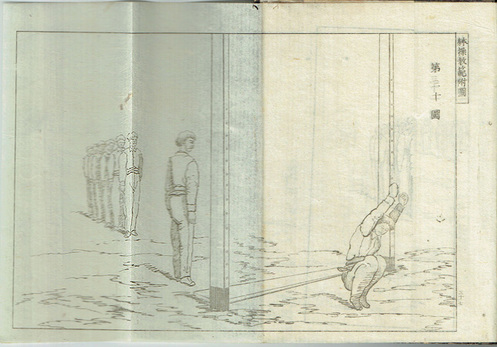

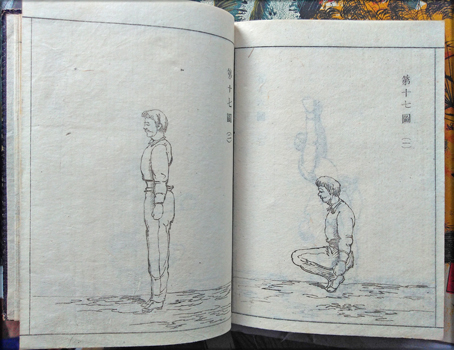
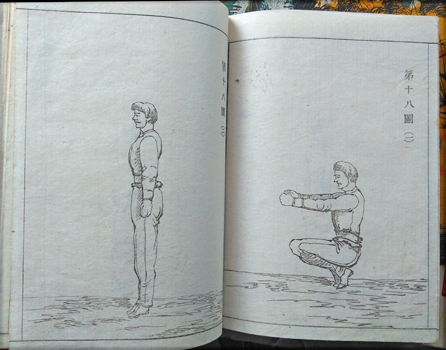
Gymnastics. 体操教範 [Taiso Kyohan]. Ministry of War, 1884 (Meiji 17). 15x11cm in what appear to be original cloth backed boards (spine a touch nibbled); 37 double folded leaves (ie 74pp) and 73 full page illustrations (5 folding) numbered to 32 with several bis. A little worming, nothing notable, and a couple of small stains; a quite good fresh copy. Au$300
The Japanese first got in French experts on military physical training in the late 1860s and the first Japanese book I've been able to trace was a translation of part of an 1847 manual the French visitors brought with them. That is I've traced mention of it, not the book itself. This manual also has the look of coming from a French manual but, being light on in French gymnastic manuals of the mid nineteenth century here, I don't know which one. Certainly it models the fine mustachios that became de rigueur for dashing Japanese officers.
The Taiso Kyohan apparently also became the model for gymnastics in secondary schools as the idea of physical education was introduced into Japan. There were many editions of the Taiso Kyohan, presumably updated and changed as the decades went on but I'm unable to trace any copy this early in a library catalogue.

Yoshida Isojiro. 生徒必携 : 新撰小学体操術 [Seito Hikkei : Shinsen Shogaku Taisojutsu]. Tokyo, Shueido 1885 (Meiji 18). Two volumes 13x19cm publisher's wrappers with title labels; a folding plate and small illustrations throughout. A nice copy. Au$125
And a nice little book, a self proclaimed essential set of physical exercises for school kids. The boys are the ones in western clothes, the girls swaddled in traditional dress. Worldcat finds no copy outside Japan.


正則 英語獨案内 Strait Gate to the Kingdom of Westen Knowledge. [Seisoku Eigo Hitoriannai]. Osaka, Aoki Suzando 1886 (Meiji 19). 19x13cm publisher's printed boards and cloth spine; with an illustrated section on the mouth and sounds of speech. Outer pages browned, some blotches and marks but pretty good for such a vulnerable book. Au$125
Third edition, revised and expanded according to the overprinting at the top of the cover and title page; it first appeared the year before. Standard English based on Webster; so of course, to the properly educated, this is not standard English but American.
This is a 'ball cover' (boru hyoshi) book - a signal of modernity and the Japanese equivalent of a yellowback: flimsy western style bindings with lithograph covers that rarely survive in decent shape. Note that it opens right to left.

Ito Kyoto. 鳴渡雷於新 [Naruto Kaminari Oshin ?]. Tokyo, Kinsendo 1886 (Meiji 19). 18x12cm publisher's colour illustrated boards with cloth spine; four illustrations, three double page. A fabulous copy in a chic case by binder, writer and fastidious collector Ikuta Atsuo. At first I thought this had somehow been recased with new endpapers but the whole book is on the same almost translucent paper and it all matches exactly a shabby copy I found illustrated. Au$500
This might appear to be the first edition but it turns out that an edition appeared in 1883 from a different publisher with different illustrations. This is the story of the tattooed woman desperado Kaminari (or Rai?) Oshin - Naruto Kaminari might translate as roaring or raging thunder.
This immediately reminds us of Benten Kozo Kikunosuke - the tattooed woman outlaw who was outed as a man when a glimpse of her tattoos was seen; Benten was the star of kabuki plays and novels. That story hinged on the premise that no woman would be tattooed like that.
Of course this is the true story of a real person and there's no question that our heroine is a heroine. Nor that she's tattooed. On her back is Keisai Eisen's Hojo Tokimasa; on her buttocks is a dragon; on her thighs is a picture of Iwami Jujiro slaying a giant snake; on her stomach is one of the heroes from "Suikoden", Kumonryu Shijin; on her right arm is Kintaro; and on her left arm is a portrait of four people. A photo exists of what is supposed to be her skin which, in accord with her will, was tanned. It was exhibited in the Taisho period but has since been lost.
She was supposedly still alive and maybe in prison when this book appeared. She had been sentenced to life imprisonment in 1874, escaped in 1882 (see the explosive illustration), was arrested again and pardoned in 1889. She died, probably of TB, the next year, age about 40.
Worldcat finds no copies of this book. Cinii finds four entries for the 1883 edition in Japanese university libraries but not this.

Jonathan Swift, Katayama Heisaburo and Okube Tsunekichi. 鵞瓈皤児回島記 [and] 大人國旅行 : 南洋漂流 [Garibarusu Shimameguri] and [Daijinkoku Ryoko : Nan'yo Hyoryu]. Tokyo, Inada Sahei & Shinkodo 1887 (Meiji 20). Two volumes, 19x13cm publisher's cloth backed illustrated boards; (a) seven lithograph plates. Minor signs of use, rather good. (b) four lithograph plates, one double page, one folding. Some nibbling from the paper on the front, no paper at all on the back. Still a remarkably good copy of a flimsy book made to be read to pieces. Au$3200
Second edition of the first book, first edition of the second. Gulliver's Travels, or the important bits of it. The adventures in Lilliput appeared in a Japanese version in 1880 with the vague promise of the next part. The second, the Brobdingnagian, came from a different translater in 1887, some six or seven months after the second edition of the first book. I don't think anything like a complete Gulliver appeared for a fair while after that, so the Japanese audience had to wait to read about Gulliver's trip to Japan. Which is usually a good thing. What Australian wants to watch the Simpson's Australian episode?
The illustrations to the Lilliputian adventures are copied from Thomas Morten's which first appeared in a Cassell edition in 1866 but though Morten provided heaps of models the Brobdingnagian illustrator went elsewhere. Where I'm not sure. I'd say the continent but I'm pretty sure these are not Grandville's, nor Gavarni's, nor Poirson's. The Japanese artist/lithographer is pretty good though.
Koon-ki Ho's 1991 essay on the utopian tradition in Japan (Japanese in Search of Happiness) suggests that Swift's "portrayal of the moral Brobdingnagians was influenced by the reports of China and Chinese available." and Yoko Inagi's 2014 well meaning if over egged thesis (The Evolution of Japanese Utopianism and How Akutagawa’s Dystopian Novella, Kappa ...) makes the point that Gulliver's Travels along with More's Utopia began life in Japan as political novels rather than fantastic adventures or satires. Gulliver followed much the same arc in Japan as it had in the west and by the 1920s was a children's book.
These are 'ball cover' (boru hyoshi, apparently a corruption of 'board') books - a signal of modernity and the Japanese equivalent of a yellowback: flimsy western style bindings with lithograph covers that rarely survive in such good shape.
I traced no copies of either edition of the first part outside Japan and one copy of the second part: UC Berkeley.


Gomeiro Tamasuke & Ito Senzo 開明奇談写真廼仇討 [Kaimei Kidan Shashin no Adauchi]. Tokyo?, Hiyoshido 1887 (Meiji 20). 19x12cm publisher's cloth backed colour illustrated boards; 100pp, one double page, four full page illustrations. Smudges and minor signs of use, rather good. Au$750
A murder mystery revenge tale in which a photograph both identifies the killer and can curse that killer. Stabbing portraits has a long history in the west but usually in fury, for wish fullfilment and, in a few cases, as practice for the real thing. Witchcraft didn't come into it. As far as I'm aware using a portrait to curse someone was not much of a thing in Japan, there were plenty of other ways. And photographs? Is there any earlier use of photos to curse someone? The authority on early Japanese photography, Ozawa Takeshi, said this is the first Japanese novel about photography and I'm not going to argue with him.
This is a reprint; it first appeared, I think, in maybe 1883-84 in two parts. Another expert, Uchibayashi Shun, who unravelled some of the tangle of editions wrote in 2020 that after 15 years search he had managed to get his hands on volume one of the original edition. It is a sokkibon, a stenographic book, from a story told by Gomeiro transcribed by Ito. And it's a 'ball cover' (boru hyoshi) book - a symbol of modernity and the Japanese equivalent of a yellowback: flimsy western style bindings with lithograph covers that rarely survive in decent shape. Worldcat finds no copies of any edition outside Japan.


Jonathan Swift & Katayama Heisaburo. 鵞瓈皤児回島記 [Garibarusu Shimameguri]. Tokyo, Inada Sahei 1887 (Meiji 20). 19x13cm publisher's cloth backed illustrated boards; seven lithograph plates. A dash of each of the many flaws these flimsy books are liable to: some insect nibbling of the spine and back cover, browning of the paper, a few leaves a bit proud of the front edge (not a sprung signature since these books don't have signatures). The inner front hinge was taped at some time but it's not clear why: it hasn't separated. Not a great copy but by no means a bad copy, not even an average copy of one of these board books. Au$750
Second edition of the first translation of Gulliver's Travels, or the important bit of it. These adventures in Lilliput appeared in a Japanese version in 1880 with the vague promise of the next part. The second, the Brobdingnagian, came from a different translater in 1887, some six or seven months after this second edition of the first book. I don't think anything like a complete Gulliver appeared for a fair while after that, so the Japanese audience had to wait decades to read about Gulliver's trip to Japan. The illustrations here are copied from Thomas Morten's which first appeared in a Cassell edition in 1866.
Yoko Inagi's 2014 well meaning if over egged thesis (The Evolution of Japanese Utopianism and How Akutagawa’s Dystopian Novella, Kappa ...) makes the point that Gulliver's Travels along with More's Utopia began life in Japan as political novels rather than fantastic adventures or satires. Gulliver followed much the same arc in Japan as it had in the west and by the 1920s was a children's book.
This is a 'ball cover' (boru hyoshi, apparently a corruption of 'board') book - a signal of modernity and the Japanese equivalent of a yellowback: flimsy western style bindings with lithograph covers that rarely survive in such good shape.
I traced no copies of either edition of this outside Japan.


Hanai Oume. Shuyotei Sofu. 花井於梅 粹月奇聞 [or 花井お梅 酔月奇聞] [Hanai Oume Suigetsu Kibun]. Tokyo, Ishikawa Denkichi December 1887 (Meiji 20). Two volumes stitched together 18x12cm, colour wood covers by Utagawa Kunimatsu (the first a bit used with a small hole); two double page, two single illustrations at the front, four large illustrations through the text. Browning of the preliminary pages of volume one, a stain in the gutter at the bottom, still rather good. Au$350
One of the prizes of the dokufu craze of the early Meiji. dokufu - poisonous women - are nothing new of course but the happy conjunction at the advent of mass circulation newspapers of a beautifully timed series of murders by unvirtuous young women set the sensation mongers and their readers all of a fever. Newspaper to book, lurid print to kabuki and back again, dokufu were all the rage for a couple of decades. Along the way crime fiction was born and, in a way, modern Japanese literature.
Hanai Oume earned her place as one on the trinity of great dokufu for the murder of her employee for helping her sponging father muscle her out of her business - the teahouse Suigetsu. The famous umbrella was part of her defence.
Of course nothing about cheap popular trash like this is going to be straightforward. The colophon here tells us this is a reprint but lists the first as November 1887 which must be a newspaper appearance. Keio university's copy which uses the same covers is a different printing from a different publisher (Mizuno Ikutaro) with a colophon listing nothing before December while Yamanashi University's copy, published by Yamazaki Matasaburo and dated the same day as Keio's, is yet another different printing with a different cover. None of this is helped by the book being titled by both variants in the same copy.


SWINBURNE, Alfred James. 通俗論理談 上 ... 中卷 [Tsuzoku Ronridan]. [Cover title: The Grave Made Gay]. Tokyo, Kochokaku 1887 (Meiji 20). Two volumes 19x13cm, publisher's illustrated wrappers; illustrations by Kobayashi Kiyochika. Some browning or spotting of the cheap paper; quite good. Au$300
Parts one and two - part three never appeared - of an an adaptation of Swinburne's Picture Logic or The Grave Made Gay; an attempt to popularise the science of reason ... first published in 1875. The 'Grave Made Gay' seems to have been dropped from the English title with the fourth edition of 1881.
The illustrations are mostly copies or adaptations of Swinburne's originals but Kiyochika has drawn a few new, specifically Japanese, illustrations.
Swinburne was wealthy, a school inspector by trade, and proper example of an eccentric (ie a pain to know) English gentleman; the sort that carried a revolver to visit schools in Irish catholic areas. I haven't read his self published memoir but you can find a charming precis of it online.
Worldcat finds copies at Berkeley and in the Diet library.

VERNE, Jules and Inoue Tsutomu. 学術妙用 : 造物者驚愕試験 [Gakujutsu myoyo : Zobutsusha kyogaku shiken]. Tokyo, Kochisha 1887 (Meiji 20). 18x12cm, publisher's cloth backed colour illustrated boards; [6],142pp, four litho plates. A touch of surface nibbling to the front edge of the front cover, some natural browning of the paper; an outstanding, obviously unread copy. Au$850
First edition. A translation from Dr. Ox's Experiment - the English version of Fantaisie du Docteur Ox. Inoue was a busy translator with a specialty in Jules Verne and I wonder how he handled Verne's extended mockery of the Flemish. Not that the Japanese haven't mastered regional insult, but how aware was he that this is pretty much the whole novel? Did he give his characters a Kansai accent?

英和対訳新体運動歌 New of Pom and Song The English and Japanese. [Eiwa Taiyaku Shintai Undoka]. Tokyo, 1887 [Meiji 20]. Small octavo publisher's illustrated wrapper; [2],32,[2]pp. A bit used, rather good copy for such a vulnerable thing. A christmas gift inscription on the front to 'Father' dated Dec 16, 1887. Au$600
A pioneering Japanese foray into English poetry and poetry in English which I can't find anywhere but the National Diet Library. Elsewhere I found two references to this. One is Basil Chamberlain's Things Japanese, the other Japan for a Week by Alexander M. Thompson who clearly never saw this booklet but, misreading Chamberlain, requotes a poem from Things Japanese which isn't in this. Chamberlain, in the chapter English as She is Japped quotes two poems without explicitly stating they are from this; they aren't. Did he see the book?
What is here is a mix of what seem to be poems by English and Japanese writers, things that are more aphorisms and morals than poems and an intriguing excerpt from Tennyson's Charge of the Light Brigade. This isn't a production for western tourists or export of the pretty sort that became popular through the 1890's. This is a modest first step of the Japanese setting out - as they did with all things western - to learn, encompass and digest a new form.

Dokufu. Hanai Oume? Set of proof wood engraved illustrations for a Japanese serial story. n.p. n.d. [c 1887?] 19x26cm, contemporary plain wrapper; 41 wood engravings on 21 double folded leaves. A little browning. Au$475
A prime example of the strange casserole of Meiji Japan. In form, in technique, in content and in production these hold all the paradoxes of Japan embracing western modernisation while hanging fast to tradition. These are the illustrations for what seems a rollicking sword and sash thriller but ... it is set in a modern metropolis; bowler hats, suits and dashing mustachios are not out of place, neither is what looks like a railway station. And these are not ukiyo-e woodcuts for a popular novel, these are western wood engravings for a long serial - there are 41 after all - in a newspaper or broadsheet magazine; an illustration of such a paper helpfully holds a bough of blossoms in one illustration. The subject apart, the glaring difference between these and any western illustrations is the skill of artist and engraver, all but a few western counterparts are put to shame.
I'm convinced that these relate to Hanai Oume the celebrated Tokyo geisha-teahouse owner who, in 1887, stabbed her employee who, apparently in concert with her father, was trying to muscle her out of the business. The first illustration here shows two men holding umbrellas that, I'm told, advertise a restaurant or 'licenced pleasure quarter' remarkably similar to hers: Suigetsu. The umbrella was part of her claim of self defence: Minekichi attacked her with the knife, she disarmed him with her umbrella and then stabbed him.
Oume or O-ume - her professional name - was celebrity manifest, one of the three most famous dokufu (poisonous women) of the Meiji. Her murder trial was public and, though crowds unable to get in became irate, every moment was covered in the press; books were published within minutes, kabuki plays and novels performed and published, and the newspapers made rich. Yoshitoshi produced a famous print of the murder as a supplement for the Yamato Shimbun but while there is plenty of violence in these pictures there is no murder. Spin-off or fanciful concoction, there's a good story here.
There is an owner's (maybe artist's?) seal which I make out to be 春耕慢虫 - I'm sure I'm wrong.


Makino Yasuzo. 英和商業会話編 [Eiwa Shogyo Kaiwahen] Awashogeo Kai Wa Hen [cover title]. Kyoto, Makino Yasuzo 1887 (Meiji 20). 13x9cm publisher's cloth backed decorated boards (some surface nibbling); [4],60pp on double folded leaves. Signs of use but rather good for such a flimsy binding and vulnerable book. Au$150
Here's another of these nifty little bi-lingual conversation books; this one designed to baffle business people. I don't know how the Japanese version reads but it's a foolhardy customer who says to me, "Please charge these to my credit; I will pay you when it is convenient." I've had many customers who think that but they don't say it out loud. Not any more.
Worldcat finds no copies outside Japan.

Suzuki Kinjiro. Meig. Dokufuden - 新編明治毒婦伝 [Shinpen Meiji Dokufuden]. Tokyo, Kinsendo 1887 [Meiji 20]. 18x13cm publisher's cloth backed illustrated boards (edges worn); one single page and several double page illustrations. Inner front hinge separated, inner back hinge cracked; maybe missing the front endpaper and the first two leaves (illustrations) are creased; two leaves sprung. A read copy I'm sorry to say, but for one of these flimsy board books made to be read to pieces, still acceptable. Au$150
Second edition? But how many were there? First published in December 1886 this copy is dated November 1887 but is a different book from the copy of the same date illustrated by the NDL. Starting at the front: the cover has been redrawn, the contents are a different printing with different pagination, in a different order and the illustrations are not all the same. The pagination is a nightmare; it starts, stops, jumps forward and back and nowhere meets the NDL November 1887 copy until we get to the last page.
One the prizes of the dokufu craze of the early Meiji. dokufu - poisonous women - are nothing new of course but the happy conjunction at the advent of mass circulation newspapers of a beautifully timed series of murders by unvirtuous young women set the sensation mongers and their readers all of a fever. Newspaper to book, lurid print to kabuki and back again, dokufu were all the rage for a couple of decades. Along the way crime fiction was born and, in a way, modern Japanese literature.
This went to press too soon for Hanai Oume - 1887's murderess of choice - but I don't doubt her case sparked this new edition; she was sentenced in November. Takahashi Oden, Yoarashi Okinu, Torioi Omatsu, Gonsai Otatsu, Ibaraki Otaki and Kaminari Oshin provide plenty to go on with.
Worldcat finds no copies of any but a modern reprint outside the NDL and it was some consolation to see that this copy is a lot better than one reproduced online by the NDL.
  1 2 3 [4] 5 6 7   |

