
Uryu Masakazu & Hashimoto Sadahide 西洋新書 [Seiyo Shinsho]. Tokyo, Yamatoyo Kihei (Eto Kihei for volumes six & seven) 1872 - 75 (Meiji 5 to 8). 23x15cm, 7 volumes in 14 parts publisher's wrappers with printed labels (recently restitched); seven double page colour maps, a folding plan, a folding plate, two double page and some 174 other illustrations (most half page) by Sadahide. Some surface nibbling of part covers toward the outside of the bundle; a rather good set. Au$3500
A complete set, which is rare, of this expansive gathering of news from the west. The title is well represented in libraries but I could not find a complete set anywhere outside Japan. Few libraries get close. Even the electronic version held by many seems to be incomplete.
I can't work out the organisation of this but, roughly, the first half of the work is devoted to the United States and Mexico before moving on to Europe. A lot is military with much on the civil war, pretty up to date and natural enough for a country just emerged from their own civil war and having to face and deal with the threat of the west. The plan of Paris is dated 1867 which together with the folding plate of Paris vignettes is from material presumably collected at the Exposition.
Sadahide is not so well served by his block cutters as he was with his masterpiece books like the views of Yokohama life and Meriken Shinshi but there is plenty of charm and characteristic sharp-eyed fluid precision. He was, after all, getting on and was dead before the sixth and seventh volumes appeared so he may not have had much to say about it.


英和早学字引便覧 English: Japanesh: Small Dictionary; [Eiwa haya-gaku jibiki Binran]. Tokyo, Osaka? 1872 (Meiji 5). 16x6cm publisher's wrapper with title label; illustrated title in English on red paper, 30pp accordian folding, first page printed in blue. Owner's inscriptions on the covers. A pleasing copy, a most pleasing book. Au$300
Perfect for the narrowest pocket, or sleeve maybe. The explanatory Japanese with each of the 509 entries is tiny and clear. Osaka Women's University has a copy and that's all I could find anywhere. The NDL database lists it only on microfilm as part of a collection of English studies titles issued in the seventies.
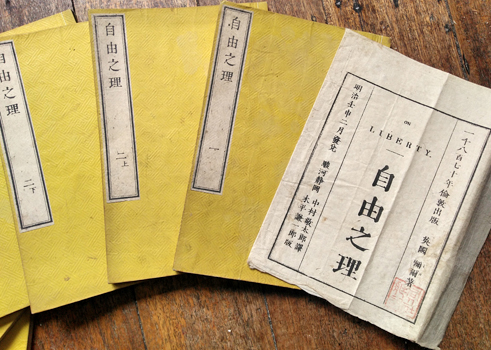

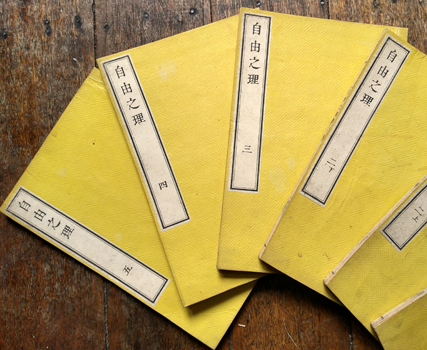
Mill, John Stuart and Nakamura Masanao. 自由之理 [Jiyu no Ri or Jiyuno Kotowari depending on the transcriber]. On Liberty. Shizuoka, Kihira Ken'ichiro [1872]. Five volumes in six books 23x16cm, publisher's yellow wrappers with title labels. Preface in English signed EWC, this was Edward Warren Clark who taught science in Shizuoka and, later, Tokyo. Covers a bit marked, an excellent set with the original printed outer wrapper (fukuro). Au$2500
The first Japanese edition of Mill's On Liberty - a book that Douglas Howland (in Personal Liberty and Public Good) tells us was "reportedly read by the entire generation of educated Japanese who came of age during the restoration".
I hoped to be able to nail down any issue points and clear up any confusion between the two forms this book takes: the five volumes bound as six books, as here, with volume two divided into two; or bound as five books. The confusion is heightened because many libraries and cataloguers use the 1871 date on the title, ignoring the preface dated January 1872.
I thought that a sort of colophon for Dojinsha - Nakamura's school - pasted inside the last back cover might help, but that leaf appears in both versions. Only the cover labels seem to be different. I've found nothing in any language that examines the printing history and while the rule of thumb - everywhere in the world - is that the more costly version - in materials and time - usually came first, I've had to conclude that there isn't any discernible priority and the difference may well be where, rather than when, the books were bound.
Nakamura's translation of Smile's 'Self Help' was also published by Kihira in Shizuoka and it seems that Kihira Ken'ichiro existed as a publisher only for Nakamura's translations of these two books which he made in Shizuoka - home of the deposed Tokugawa shogun - where he taught after his return from England in 1868 until 1872. In other words, Nakamura was really the publisher of both books.
Worldcat finds five, maybe six, locations outside of Japan - one in Britain, the rest in the US - all but one are catalogued as 1871.
It's by the way but I found this while reading up on something else: "Nakamura Masanao ... contributed a vitriolic piece on the sins of the novel to the first issue of Tokyj shinpo in 1876. He insisted that novels caused epidemics and violated the sanctity of marriage". (P.F. Kornicki; Disraeli and the Meiji Novel).
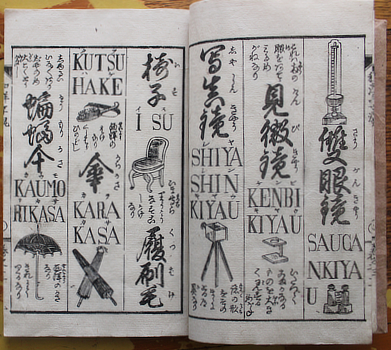
Miki Kosai (and/or Utagawa Yoshimori?). Wayou 字混部類 (和洋字混部類 on cover label). [Wayo Jikon Birui]. Tokyo, Hozando and others 1872 (Meiji 5). 18x12cm publisher's wrapper with title label (marked and a bit used); 30 leaves (60 pages) with small illustrations throughout. Inscription on the back cover; a voracious but neat bug has chewed a hole through the top margin of the first nine leaves and stayed outside the page borders; the first few illustrations with some neatish colouring. In all pretty good. Au$500
An endearing and uncommon little guide to placing stuff in the modern world: lots of common enough items and some that would soon become common, like clocks, binoculars, uncomfortable chairs, and cameras. Each is illustrated, named and described in Japanese and named in western capitals. But in phonetic Japanese, not English or any other European language, what would become romaji.
Miki Kosai signed the preface but Waseda attribute the book to Utagawa Yoshimori who presumably did the pictures. I'm inclined to believe Waseda. This is called part one but it seems no part two has ever been seen. Worldcat finds the NDL entry and a copy at the Huntington.
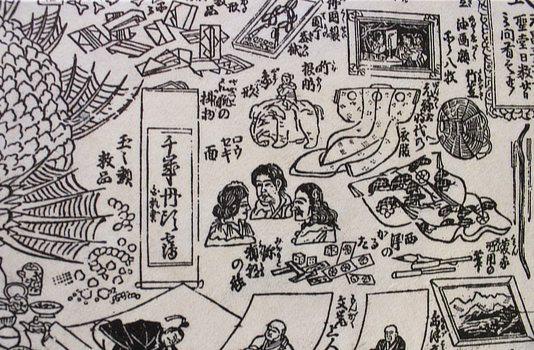
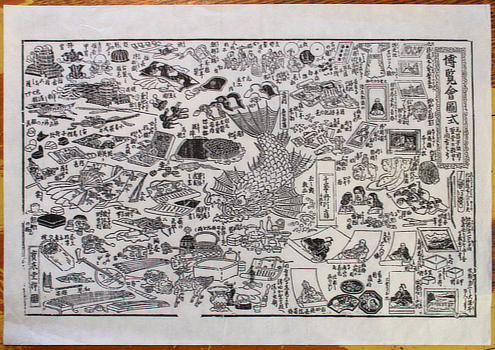
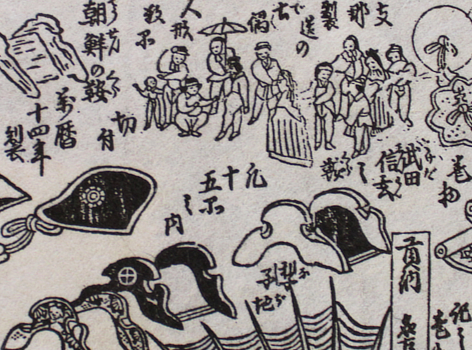
Exhibition. 博覧會圖式 [Hakurantaizushiki?]. n.p. Horaido [1872]. 26x36 lithograph? An excellent copy. Au$300
This clutter of bric-a-brac looks much like the oriental antique shop of my childhood dreams. This guide to the exhibition of antique artworks was the starting point for Tokyo National Museum's 150th Anniversary exhibition but their publicity gives us no details beyond the date 1872. I guess you had to be there.
Note that there are some western items included: a few paintings, those busts, what looks like a group of figurines ... The only other record I can find is the title in a gathering of prints called Meiji Restoration Surimono in a Kyoto museum.
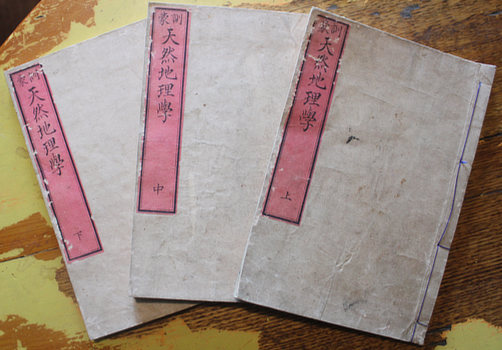
Sarah S. Cornell & Toriyama Hiraku. 天然地理学 [Tennen Chirigaku] Tokyo &c, 1873 (Shoyusha 2533 or Meiji 6). Three volumes, 22x15cm publisher' wrappers with title labels (marked). Coloured illustrations, maps and diagrams. Smudges and minor signs of use; rather good, specially for a school book. Au$500
Cornell's Primary Geography was printed in English for Japanese schools in 1866 - one of the first western school books in the country. I'm not sure which of her books has been translated here and I doubt it matters much. I guess they did their job: to mislead children, bore them, and induce a dislike of geography. The Japanese versions are nicer to look at than the blobby grey American originals.
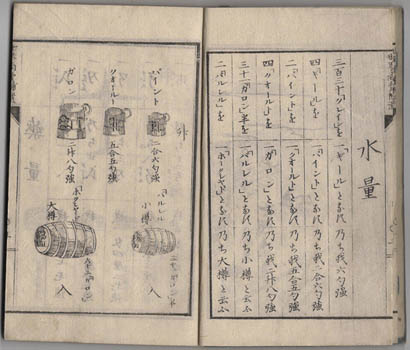

Hashizume Kan'ichi. 世界商売往来補遺 [Sekai Shobai Orai Hoi]. Tokyo 1873 [Meiji 6]. 180x120mm publisher's wrapper, missing the title label; 23 double folded leaves; one double page and numerous small illustrations throughout. A rather good copy. Au$275
Hashizume made a specialty of handbooks and vocabularies introducing the Japanese to the notion of international trade trade and western languages in the early Meiji period.� In 1871 he published a handy Japanese-English vocabulary of world trade for Japanese merchants dealing with westerners and in 1873 followed up with two companion works. This one, as I understand it, concentrates on sales.
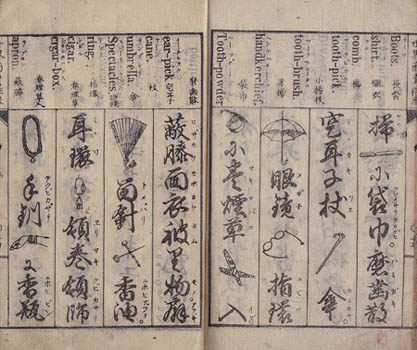

Hashizume Kan'ichi. 世界商売往来 [Sekai Shobai Orai - literally World Trade Traffic]. Tokyo 1873 [Meiji 6]. 180x120mm publisher's wrapper (title label gone, titled in manuscript on the front cover); 26 double folded leaves; one full page and numerous small illustrations throughout. Au$225
Second edition? - first published in 1871 - of this handy bilingual vocabulary of world trade giving the English, with Japanese explanations, of a wide range of terms, place names, goods, and so on. Hashizume, who specialised in handbooks on trade and on foreign languages, produced, I think, three of these guides for merchants with similar titles. This is the first and the next two supplement this.
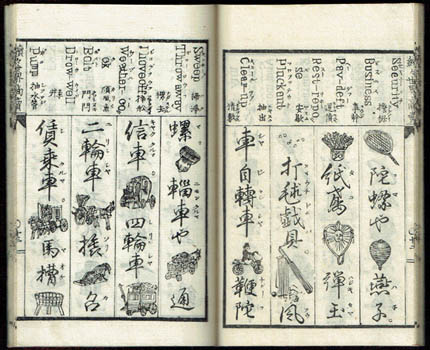

Hashizume Kan'ichi. 続々世界商売往来 [Zokuzoku Sekai Shobai Orai]. Tokyo 1873? 180x120mm publisher's wrapper with title label (a bit used); 26 double folded leaves; one double page illustration and several small illustrations through the text, title page framed in a blue barrel. A nice copy. Au$250
First edition? of this handy bilingual vocabulary of world trade giving the English, with Japanese explanations, of a wide range of terms, quantities, goods, professions, and so on. Hashizume, who specialised in handbooks on trade and on foreign languages, produced, I think, maybe four of these guides for merchants with similar titles; the first in 1871 following it up with at least two more in 1873. There are more than three but the variants in copies ostensibly of the same book make it all a bit confusing. Curious about this one is that the English text has been cut in wood, it isn't type. There are several endearing spelling mistakes, mishapen or reversed letters and odd truncations but more puzzling than these are some of the chosen terms for Japanese traders to learn. Sublemate of mercary [sic] makes some sense, as do gloziers, hornessmakers and portruit-painters - but how often did anyone have to discuss velocipedes and grave-diggers?

[HOBSON, Benjamin]. 博物新編 [Hakubutsu Shinpen]. Tokyo, 1874 (Meiji 7). Three volumes, 255x173mm, publisher's yellow wrappers with title labels (a bit smudged); wood cut illustrations in all three volumes. Rather good with the original printed outer wrapper loosely inserted and untorn. Au$300
Third edition, it seems, of this adaptation of Hobson's Bo Wu Xin Bian first published in Shanghai in 1855 and in Japan in 1864. Hobson wrote a few primers on science and medicine for the Chinese which were then adapted by the Japanese. This covers physics in the first volume - including such things as optics, electricity and hydraulics; astronomy in the second; and zoology in the third.
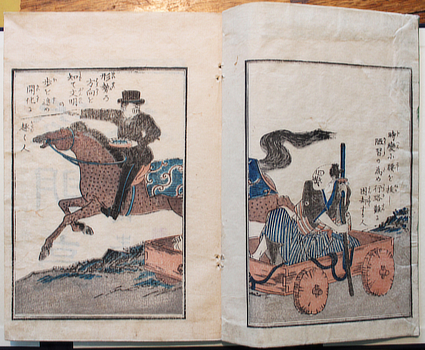
Nishimura Kanebumi. 開化の本 : 初編 [Kaika no Moto : Shohen]. Kyoto, Sugimoto Jinsuke 1874 (Meiji 1874). 23x16cm publisher's wrapper with printed title label; double page colour frontispiece and three double page b/w illustrations. Au$600
Nishimura was an imperialist and an anti-foreigner: they were all to be expelled. Kaika no Moto translates as the Book of Civilisation; it's part one but there was never a part two. A quick glance at the first picture might tell you where he stands but there's much going on in those illustrations I don't understand. A literal translation is of little help when you don't understand what it means. Why is that castle of books being blown up? I have no idea.
Nishimura was a much respected appraiser of treasures but it seems he was given to the odd bit of forgery of documents and single sheet editions. A couple of his scholarly books come with a warning about false publications but it has been said that, unlike thief and forger Thomas Wise, he wasn't in it for the money.
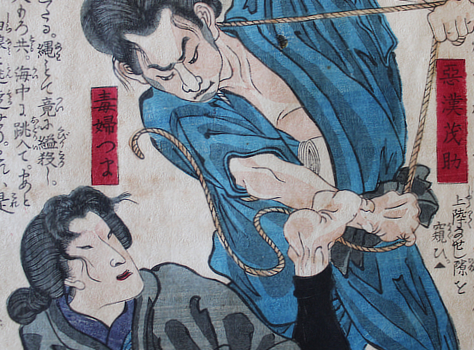
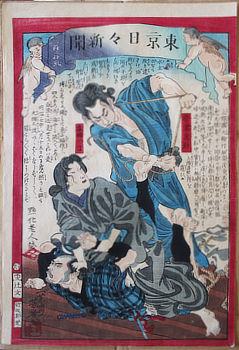
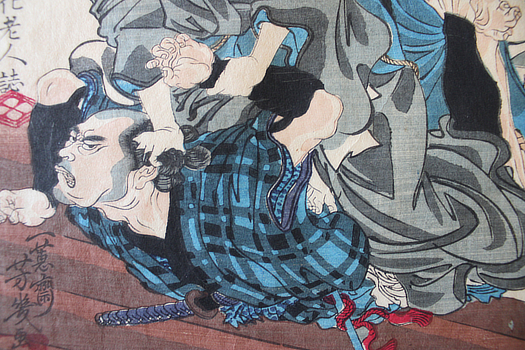
Dokufu. Ochiai Yoshiku (aka Utagawa Yoshiku). 悪漢茂吉と毒婦つまが縄ぬけ逃亡 [Akkan Mokichi to Dokufu Tsuma Ga Nawa Nuke Tobo]. [This title is taken from Tokyo University's catalogue and it has been used by others. I take it to be a paraphrase of the text]. Tokyo 1874 (Meiji 7). 36x24cm colour woodcut by Utagawa Yoshiku. A nice copy. Au$400
Issue 220 of the special colour supplement to the Tokyo Nichinichi Shimbun (Tokyo daily news) which captures the villain Mosuke or Mokichi and his Poisonous Wife escaping their captor after they were captured in August 1872; the original article appeared in October 1872 but it took a while to develop the picture. I'm uncertain about our villain's name: he is Mokichi in the text but Mosuke in the banner beside him. Cataloguers usually follow the text.
A peasant's wife who cripples herself in the field alongside her husband is a model wife. A clerk's wife who festers at home and cripples her children is a model wife. But let the wife of a vicious thug, who is after all a worker, share in her husband's work ... poisonous woman. Thank heaven the world's not like that any more.
Dokufu, poisonous women, are for all time but the first few decades of the Meiji, with the advent of western style newspapers, made for rich pickings.

Hashizume, Kan'ichi (publisher). 銅版 小学入門 地理初歩 [Doban : Shogaku Nyumon : Chirishoho]. Tokyo, Hashizume 1875 (Meiji 8). 11x8cm publisher's wrapper with title label; 22 double leaves (44pp), illustrations thoughout. An outstanding copy in the original printed outer wrapper (fukuro). Au$200
Another charming little version of this introduction to elementary school studies, this time engraved (Doban in the title means engraved) and devoted to geography. There are quite a few versions of Shogaku Nyumon under different titles, varying in subject, charm, interest and form. I've traced mention of another Hashizume Shogaku title but not this one.

NORITANE, Ninagawa. 観古図說 [Kanko Zusetsu]. Kwan Ko Dzu Setsu. Notice historique et descriptive sur les arts et industries Japonais ... art ceramique. Tokyo 1876-77. Five volumes oblong folio wrappers, 27x39cm, with printed labels; between 5 and 11 leaves of Japanese text in each and 90 handcoloured litho plates (actually 89 - there are 18 in each part but 15a in the first is a half plate in monochrome). With the five booklets (approx 27x24cm with small variations) containing the French text published in Tokyo 1876-78. A bit of nibbling to the first folio label and a small stain which touches the margins of the introductory text leaves but vanishes by the first plate; a rather good set in the publisher's portfolio (this worn but solid). Au$1750
A most appealing hybrid, this records Japanese pottery apparently in chronological order from ancient times on, illustrated with quite exquisite lithography and produced with a foreign audience in mind. Noritane was a founder of the Tokyo Museum and apparently taught Edward S. Morse everything Morse knew about Japanese ceramics. Noritane did plan to extend this series - plates had been prepared for a section on roofing tiles and another on armour - but his death in 1882 put an end to it. Most of the items illustrated here ended up in the Morse collection.
In the end I wonder if this is the most elaborate trade catalogue of 19th century Japan. Nothing sells art like a sumptuous monograph to wield as reference and a banner of importance.


Moustaches. 小學入門 : 教授繪解 [Shogaku Nyumon : kyoju etoki]. Tokyo, Kodama Yashichi 1877 (Meiji 10). 18x12cm publisher's colour woodcut front wrapper, illustrated throughout. A revolting copy. Au$300
A universal truth in all times and all cultures: give someone young - or young at heart - a picture of a face, an implement, a spare moment, and they will draw a moustache on that face.
There are quite a few versions of Shogaku Nyumon - elementary school texts - under different titles, varying in subject, charm, interest and form. This one, called the professor's illustrated guide, is rare and would be charming ... if. I've taken the publication details from the single opac entry I could find, not from the rag of colophon at the end of the book.
Note that our artist has also added the other touch essential once they were invented: spectacles on the swinging boy in the background.
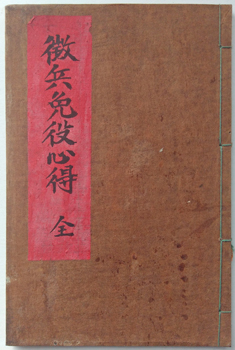

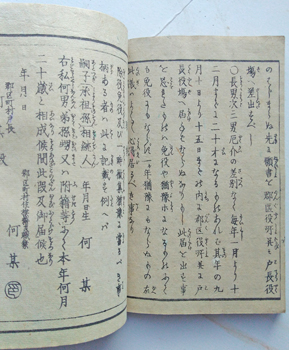
Inaba Eiko. 徴兵免役心得 [Chohei Men'eki Kokoroe]. Osaki Naosaburo 1879 (Meiji 12). 17x11cm later wrapper with manuscript title; illustrated title/self wrapper and eight leaves. An excellent copy. Au$500
The draft dodger's handbook: a guide to exemptions from conscription into the new Imperial Army. Conscription rolled out slowly across Japan from 1873 and one of the most useful exemptions was being a first son; which meant a rash of adoptions preferably into a family where conscription hadn't yet arrived. Fukuzawa wrote about "sons who do not know where their fathers live" and I read somewhere that one of Japan's great literary heroes - Soseki maybe? - registered himself in Hokkaido to escape the draft.
Of course money solved everything: an exemption or proxy fee meant that someone else took your place and I would guess that no true aristocrat would dream of having a son drafted; they were already in military school and officer training. So, naturally, peasants filled the draftee ranks and not all peasants were happy about this. There were 'blood tax' riots, the most furious in Okayama where authorities adroitly charged 20,000 rioters, executed a dozen or so and gaoled a few dozen more.
Without money, a good solid disease, disability or an affable sonless family this little pamphlet was your best friend. Worldcat finds no copies and CiNii finds one, at Tokyo University. It's often cited by academics but as they mostly repeat each other's mistakes I doubt many have seen it.
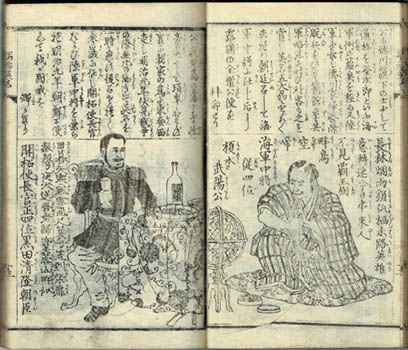


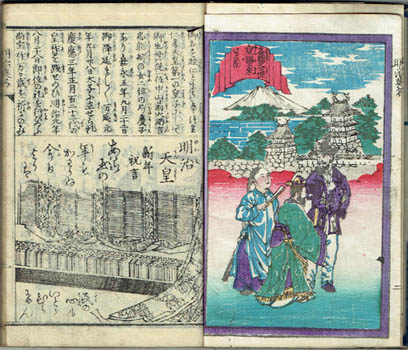
Shinoda Senka & Utagawa Yoshiharu, 明治英名百詠撰 [Meiji Eimei Hyakueisen]. Tokyo, Murakami 1879? 18x12cm publisher's wrapper with title label; one double page and one full page colour woodcut, 120 half page woodcuts on 60 double folded leaves. Two clean tears across the paste down title page without loss, a well read copy but solid and decent enough. The illustrations, not so well printed, are by Utagawa Yoshiharu. Au$100
A popular, poetic, gallery of famous folk of the Meiji period - the first bit of it anyway. There are the expected statesmen and lords but there are also scholars, a handful of women and what look to to be unsavoury reprobates. Perhaps they are great statesmen. I'm equally ignorant about the verse with each portrait. I presume these aren't cheeky limericks or Clerihews.
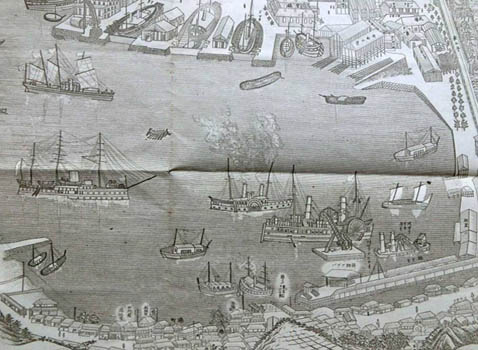

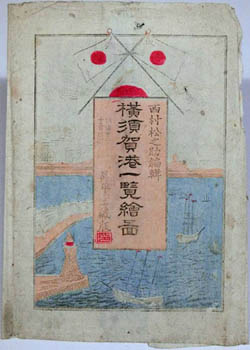
Yokosuka. 横須賀港一覧絵図 [Yokosuka-ko Ichiran Ezu]. Tokyo, Matsunosuke Nishimura1879 (Meiji 12). Engraved broadside 38x52cm. Folded as issued, with the original coloured wrapper (fukuro) - somewhat grubby and used but complete. A remarkably good copy. Au$600
Ideal for the detail fanatic: not much is missed and most of it is neatly labelled. This is the new Yokosuka naval base and shipyards where Japan's first modern warships were produced.
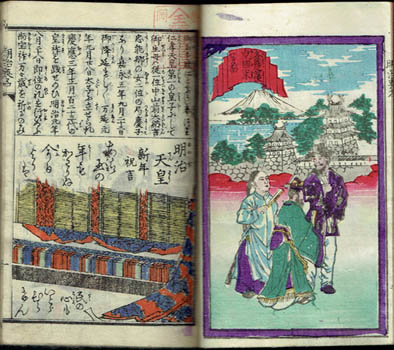

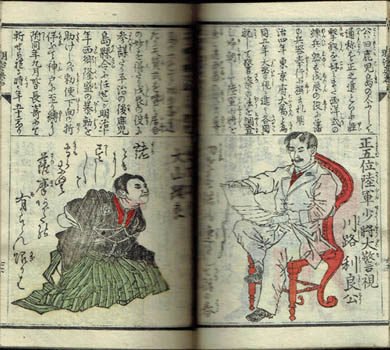

Shinoda Senka & Utagawa Yoshiharu, 明治英名百詠撰 [Meiji Eimei Hyakueisen]. Tokyo, Murakami 1879. 18x12cm publisher's wrapper with title label; one double page, one full page colour woodcut, 120 half page woodcuts - all but a couple coloured - on 60 double folded leaves. Inscription on the back cover; a nice copy. The illustrations are by Utagawa Yoshiharu. Au$400
First edition and a deluxe coloured copy of this popular, poetic, gallery of famous folk of the Meiji period - the first bit of it anyway. There are the expected statesmen and lords but there are also scholars, a handful of women and what look to to be unsavoury reprobates. Perhaps they are great statesmen. I'm equally ignorant about the verse with each portrait. I presume these aren't cheeky limericks or Clerihews. I don't know how rare coloured copies are but I haven't found another amongst the recorded copies.


新撰唱歌のふきよせ [Shinsen Shoka no Fukiyose]. n.p. n.d. [c1880?] 18x12cm publisher's colour woodcut wrapper; 10 double leaves (20pp); b/w woodcut illustrations throughout. Rather good. Au$125
A rare and charming songbook, apparently for children, which has a look of long tradition. But if these are proper shoka then it is a form of school song that began with Meiji reformation of education. The subjects are in any case thoroughly up to date: balloons, steamships and photographs.
None of these songbooks are going to be common. I found an entry for what might be the same book in the Ryukyu University catalogue; nothing else.

Sada Kaiseki. 冨国歩ミ初メ [Fukoku Ayumi Hajime]. Tokyo, Sada 1880 (Meiji 13). Woodcut broadside 36x52cm, stencil coloured? Expert repairs to the folds at each side and in the centre, some stains. Folded as issued with the outer wrapper woodcut mounted on old paper. Au$950
This captivating woodcut which looks like an advertisement for imported treasures is instead a strident protest and attack on these gewgaws. Sada was a troublesome priest but no reactionary flat-earther, not quite. He wasn't simple. He developed complex theories of science, culture and economics and saw the opening of Japan to this slew of imports as the cause of inflation and hardship for the lower classes. This woodcut was produced to promote the boycott of foreign goods and lists specific targets. Sada spent the last years of his life organising boycott societies and died - in 1882 - on a lecture tour.
The presence of a wrapper with this print suggests to me this was not given away, it was sold. Waseda University illustrates two copies, one in better shape but carelessly coloured compared to this. The other is fairly worm eaten. They do have a wrapper, which, according to the provenance, belongs to their better copy but it is separately catalogued without any mention of Sada. Worldcat finds the NLA copy.

Patent remedies. 諸薬功能書類綴 [cover title]. A gathering of 19th century handbills or descriptive and instructive leaflets or wrappers for various patent: herbal or quack medicines. v.p. c1880 to c1900? 26 individual pieces bound to fold into a handmade board and stiff paper wallet style string tied binding, 28x18cm, treated with persimmon, hand lettered title piece. Some are quite large, some are printed on both sides and a few are woodcut. Au$1500
The work of the sort of collector who deserves a small shrine. Here have been carefully preserved the most disposable, awkwardly shaped and ephemeral records of a recondite corner in modern history: when drugs and cures became an industry.
At least one of these brands is still available: Chujoto for "Female Complaints" still alleviates menstrual pain. There may be others and I'll bet many are the foundations of current industrial giants. The only date I've spotted is Meiji 13 - 1880; Chujoto was apparently invented in 1893 (or by princess Chujo of the Fujiwara clan in a Snow White like tale) and some may be a little earlier or later.


Puppets. 西洋あやつり人形 [Seiyo Ayatsuri Ningyo]. Tokyo, Hanayashiki [188-?]. Woodcut on translucent paper with added colours, 25x19cm. Old fold, rumpled; rather good. Au$300
This hikifuda or flyer for the western puppet show in Asakusa Park's Hanyashiti - amusement park - exists in two forms: one with the main title across the top and the other in the right column, as here. The illustrations are the same. The Tokyo Museum has a copy of this and Waseda a copy of the other; I can't find one outside of Japan.


Paper. Toyosha? 新発明 軽便紙 [Shin Hatsumei Keibenshi]. n.p. [Osaka?] [188-?]. 75x28cm woodcut with added colours. Piece from the top margin well away from the printing, a repaired tear; Quite good for a cheap, vulnerable bit of production. Au$150
I believe this to be an announcement for a new invention of a lightweight paper. I hope not the paper this is printed on which seems heavy and coarse to me. Probably not considering the easy grasp of our newspaper addict. I suspect the cigarettes will stay on that side of his mouth until his left eye looks as sore as the right does now. Then he will switch back.


Magic. Kitensai Shoichi 各国発明 : ふしぎのでん [Kakkoku Hatsumei : Fushigi No Den]. n.p. n.d. [c1880?]. 17x11cm publisher's colour woodcut wrappers, thread tied; 7 folded leaves including wrappers, b/w illustrations on eleven pages. Well thumbed but most acceptable. Au$900
Deservedly thumbed, an appealing little book of mostly western magic tricks that does not teach you, I'm sorry, how to drive a spike through your tongue. Kitensai supposedly learnt western magic in Paris in the early 1870s and brought it back to Japan in the mid to late 1870s; I can't find two writers that agree on dates.
The NDL has copies of another work on western conjuring tricks that appeared in the 1880's with Kitensai listed as first contributor to the earliest, 1882, printing but I can't find a record of our book anywhere. I suspect it was produced for sale at his shows.
The back wrapper might be purposeful or might have been pinched from a popular kabuki thriller about the battle between good and evil being printed across the workshop.
  1 2 [3] 4 5 6   |

