

CORNELL, Sarah S. 地学初歩 Cornell's Primary Geography for the Use of Schools. First Edition. [Chigaku Shoho]. Yedo. [Edo (ie Tokyo), Watanabe [1866?]. 18x12cm publisher's wrapper (insect blemished, title label missing); [72]pp on double folded leaves and seven folding colour maps, two colour maps and some illustrations in the text. A stain in the top corner; a thoroughly decent copy. Au$500
I wonder what, if anything, a Japanese student made of Miss Cornell. After her nonsense about Japan, how could anything else she said be taken seriously? Miss Cornell's Primary Geography - one of a string of geographies she prepared for all stages of schooling - first appeared in New York in 1855. Here we are introduced to the concept and working parts of a map, then run through a brief introduction to the regions of the world.
There seems to be two printings of this "First Edition"; one dated "the 2nd year of Kei-ou" (1866) on the title and apparently without a colophon; the other (our copy) not dated, with a colophon. In this undated copy the text is within borders, the other not. Waseda University also has a third, quite different printing but their copy is severely defective and has no title page or colophon. A Japanese translation was made in 1867. Worldcat finds only one copy of this outside Japan.

CORNELL, Sara S. 地学初歩 Cornell's Primary Geography for the Use of Schools. First Edition. [Chigaku Shoho]. Yedo. [Edo (ie Tokyo), Watanabe [1866?]. 18x12cm publisher's wrapper with printed label; [72]pp on double folded leaves and seven folding colour maps, two colour maps and some illustrations in the text. Au$500
I wonder what, if anything, a Japanese student made of Miss Cornell. After her nonsense about Japan, how could anything else she said be taken seriously? Miss Cornell's Primary Geography - one of a string of geographies she prepared for all stages of schooling - first appeared in New York in 1855. Here we are introduced to the concept and working parts of a map, then run through a brief introduction to the regions of the world.
There seems to be two printings of this "First Edition"; one dated "the 2nd year of Kei-ou" (1866) on the title and apparently without a colophon; the other (our copy) not dated, with a colophon. In this undated copy the text is within borders, the other not. Waseda University also has a third, quite different printing but their copy is severely defective and has no title page or colophon. A Japanese translation was made in 1867. Worldcat finds only one copy of this outside Japan.


Abe Tameto. 英学捷徑 : 七ッ以呂波 [Eigaku Shokei : Nanatsu Iroha]. Tokyo : Harimaya Kiemon, 1867 (Keio 3). 18x12cm publisher's wrapper with title label (midly used); 18 double folded leaves (ie 36pp). Signs of use, an ink smudge across one leaf; still rather good. Au$300
A neat manual for learning to write the English alphabet - it is specifically English rather than generic western - and opens right to left. This was naturalist Abe's first foray into beginner texts for students of English and apparently became the model for many that followed.


Les premiers pas de l'enfance. Orthgraphe Francaise: a l'usage de l'ecole quai-sei-zio. Premier edition. Yedo ... (1867). [sic]. Yedo (Tokyo), 1867 (Keio 3). 18x13cm publisher's wrappers with printed label (marked, stitching broken); 32pp including 10 pages of alphabets. Pretty good. The red stamp on the title is the school's. Au$300
The Kaiseijo (quai-sei-zio or Kaisezio or Kaiseizyo or Kaiseidzio or Kaiceizio depending on who wrote it) was the Bakumatsu school for barbarian studies, founded in 1857 and re-named in 1863. In 1865 the military joined in with this maybe unwelcome but necessary education and, I've read, quadrupled the number of students with 300 learning English and 100 learning French. It seems they began printing their own texts in 1866. Come Meiji it became the Kaisei gakko and eventually part of the conglomerate that became Tokyo University.
It's easy for blinkered anglophones like me to forget that the Japanese were busily digesting the whole planet, not just learning fractured English from absurd phrase books. They learnt many fractured languages from absurd texts and still somehow leapt into the modern world.
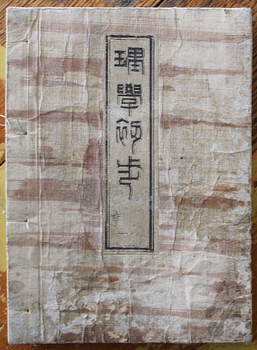
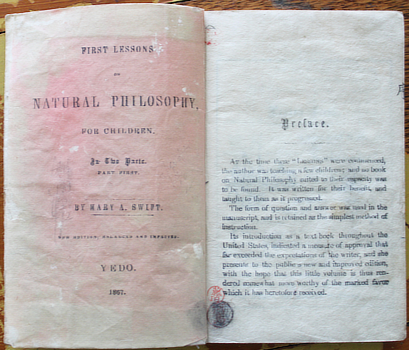
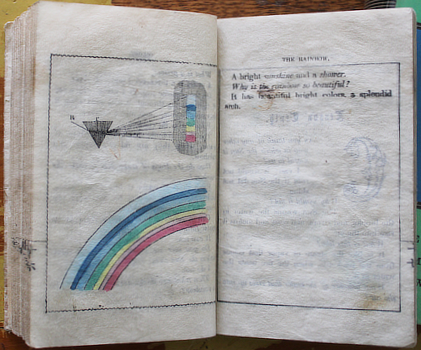
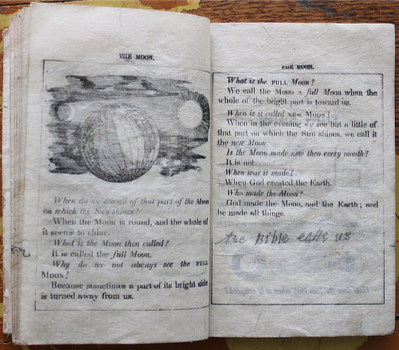
SWIFT, Mary A. 理学初歩 (cover title). First Lessons on Natural Philosophy: for children. [Rigaku Shoho]. Yedo (Tokyo) 1867. 16x11cm publisher's pattern wrapper with printed title label. Illustrations throughout, one with handcolouring. Stitching broken; a used but most acceptable copy. Ownership has been claimed in pencil in English at the back - which would be the front for a Japanese book. Au$165
This is part one of two and a new edition enlarged, but this is repeated from the title page of whichever edition was used as the copy book. The second part was published in two volumes, maybe a bit later. A quick look at Worldcat might convince us that the libraries of the world are swimming in copies of this but a run through the first dozen or so entries found one copy of part two of part two - in Japan. Several cited libraries deny that they have any copy, even an electronic copy.
Before we feel too sorry for Japanese children: from what I can gather this first generation of western primers produced in 1866 and 67 were for the bakumatsu schools which were to train officers and future diplomats. Which is not to say that children escaped unscarred as public education spread to the masses.

Tatsunosuke Hori et al. 英和対訳袖珍辞書 A Pocket Dictionary of the English and Japanese Language. Second and revised edition. At Yedo 1867. Tokyo, Kuradaya Seiemon 1869 (Meiji 2). Two volumes 15x22cm contemporary limp boards (battered, stitching broken but all solid enough). Stains, mostly at each end and some fairly mild worming at the very end. Sensibly divided into two volumes toward the end of N. Used but comparatively handsome copy of a book usually found as an incomplete wreck. Inscription in red on the back of the title: "This Book belongs to Miyake" and Miyake ownership seals and inscription at the end. Au$1100
Actually a new printing of the 1867 edition as, I suspect, are several of the copies catalogued by folk who haven't looked properly at the very end of the book. Tatsunoske's first edition appeared in 1862; apparently 200 copies were printed. A second revised edition arrived in 1866 and the 1867 printing has the English type newly made into wood blocks. Then comes our 1869 printing with the notice of approval (1869) on the last page and Kuradaya's name inside the back cover. And the Kaiseisho - the Bakumatsa school - seal on the tile and/or at the end has been changed for the Tokugawa seal. If you want to get fussy: this is type B of the colophon designated by Tomo Endo in his census of copies in Eigakushi Kenkyu (2006).
It seems accepted that this was the first English-Japanese dictionary. The Angeriagorian Taisei was compiled in 1814 but that has been dismissed as a word book - a mere 6000 words - and was only circulated in manuscript among the chosen few. A Japanese-English dictionary followed ours a few years later.
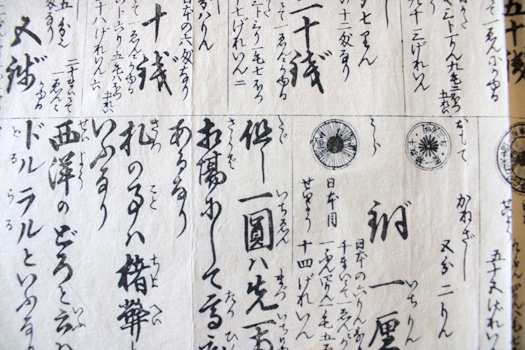

Kawaraban. 流通新貨幣位付早見 [Ryutsu Shin Kahei-i-tsuki Hayami]. n.p.n.d. [c1870]. 32x41cm wood cut. A couple of small blotches, rather good. Au$165
A quick guide to the new coins in circulation. Added to the mass of new things for Japanese to learn and new ways of thinking, with the Meiji restoration, was the new yen based currency.
Kawaraban - illicit illustrated news sheets for the streets - were produced by the million for a couple of hundred years so of course few survive. They were produced for anything more interesting than the drop of a hat.


Masakata Ishibashi. 英語箋 [Eigosen]. Tokyo [Bankyukau c1870?]. Two volumes (18x12cm) publisher's wrappers, title labels mostly gone. Some worming at each end of volume one, unsightly on a couple of leaves but not serious. Pleasingly used, with some annotations in red, some pencilled notes and a bored-student kabuki face brush drawn at the end of the first volume. Au$375
A comparatively substantial English Japanese vocabulary and conversation book which like many of their first such manuals I suspect is based on some outdated, possibly Dutch model. There seems no other explanation for the long chat about what can only be the Napoleonic wars. The expected errors are sweetly amusing of course but I think I can see two completely different kinds of errors - those that come from phonetic transcription and those that come from copying alien writing. In more than one case I suspect the woodcutter gave up and aimed at a swirl that held the spirit of the word he had to copy.
Waseda University illustrates their copies of an 1861 edition, an 1872 edition and an undated edition. This most closely resembles the 1872 edition but there are several differences.

Hikifuda : NYK Line 伏木湊川ノキワ 水戸半右衛門 [Fushikiminato-gawa Nokiwa Mito Han Uemon]. n.p. [187-?]. 36x49cm colour woodcut. Bug chewed and carefully repaired, either some time ago or done using old paper. Au$200
This large and still quite handsome steamship advertises ships, routes and fares from Fushikiminato, now part of Takaoka City. Takaoka Museum illustrates their copy online and it is just as chomped as this one.
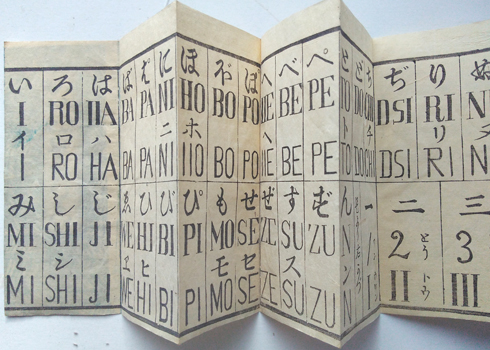

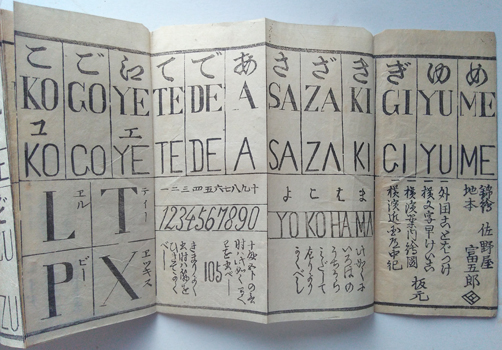
横文字いろは - 早けい古 [Yokomoji Iroha - Haya Keiko]. Yokohama? Sanoya Tomigoro [c1870?]. Woodcut on four joined sheets that folds from 15x7cm out to 130cm. Decorated title panel printed in blue and black, last blank panel with several small red stamps reading Naga (長) and one Nagata (長田). An outstanding copy of something pretty well guaranteed not to survive second or third uses. Au$600
A captivating pocket or sleeve guide to horizontal writing with some numbers thrown in - Roman numerals for reading clocks - the latest of what must have seemed an endless array of challenges to life in Meiji Japan. Iroha might be translated into English as ABC.
Sanoya Tomigiri was a print publisher who moved from Tokyo (Edo) to Yokohama when it opened to the west and where he also became a singer. He is known as the publisher of prints by Yoshitoshi and at least four of the Utagawas, maps, guides and handy educational things like this.
I found a reference to something with almost this title printed by him at the beginning of the Meiji but it isn't the same thing, not even close. There may be another copy of this somewhere but I haven't found it.
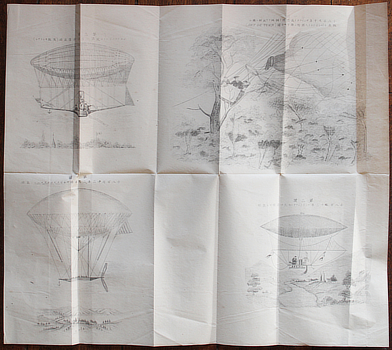
Airships. Four illustrations: three of airships and one of a balloon in a tree: on one sheet. n.p. n.d (187-?). Engraving 40x45cm, folded. Au$165
A mysterious print with no indication of who produced it. Each illustration is numbered and captioned in Japanese and three are dated to their original appearance: 1852, 1870 and 1872. They all seem to be from French originals. Number one has "Art de Tuer" in the caption and is supposed to be the wreck of the balloon with Leon Gambetta (escaping from the siege of Paris) on board in 1870; number two is Giffard's 1852 steam powered airship; number three is, I think, a Dupuy de Lome airship of 1870; number four is the Dupuy de Lome airship of 1872.
Was this a supplement to something? Such things are usually identified. Are they proofs? Until someone finds another copy it is all up in ... sorry.

Hashizume Kan'ichi. 六大洲國盡 [Rokudaishu Kuni Zukushi] Name of the Land on the Globe. VI. Daishiu Kuni Dzkushi [sic]. Tokyo, Wan'ya Kehei 1871 (Meiji 4). 18x13cm publisher's wrapper with title label (covers mottled); [32]pp, doubled page colour world map in two hemispheres and two folding colour maps (Asia and Europe). A touch of worming, pretty insignificant; quite a good copy. Au$350
Just when I thought I must have seen all of Hashizume's handy little guides to English, up pops another. This guide to place names in the three forms: upper, lower case and long hand, is titled as complete but, as this covers Asia and Europe, now I have to look for a companion volume for the rest of the world.
Hashizume, the translator, produced quantities of handy guides to English and useful translations, most of which are idiosyncratic in their choices of what is considered essential to any Japanese setting out to work in English.
Worldcat finds only the NDL entry.


Hashizume Kan'ichi. 世界商売往来 [Sekai Shobai Orai - literally World Trade Traffic]. Tokyo, Seikichi 1871 [Meiji 4]. 180x120mm publisher's wrapper (a bit rumpled); 26 double folded leaves; one full page and numerous small illustrations throughout. Title page on yellow with a man operating some mysterious, to me, mechanism. Au$200
First edition of this handy bilingual vocabulary of world trade giving the English, with Japanese explanations, of a wide range of terms, quantities, goods, professions, and so on. I used to think the bibliography of Hashizume's handbooks on foreign trade was straightforward: three, this, the first in 1871 following it up with two more in 1873. Since then I've discovered variants and variants of variants. There are some of the expected amusing errors in spelling and typography but far fewer than in the later books.


英字訓蒙図解 [Eiji Kunmo Zukai or Ei Kuno Zukai depending on the transcriber]. Kyoto, Ogawa Kinsuke 1871 (Meiji 4). 225x155mm publisher's wrapper with title label; woodblock illustrations throughout. Some worming and a marginal stain, neat repairs to the first few margins. A very decent copy with its colour illustrated outer wrapper, this smudged and rumpled but complete and untorn. Au$750
A rare and most appealing illustrated introduction to English. To an extent unseen in any other non-western culture faced with the colonial ambitions of the west the Japanese controlled their own re-education. They were not showered with unwanted primers by missionaries and other pious businessmen. They produced, printed and determinedly digested their own, using whatever sources they could find, the occasional hired expert and their imagination.
The more I look at books like these, which were assiduously studied, the more I wonder how anyone learnt any English. How many Japanese went to their graves calling a camera a desk and hoping for an opportunity to introduce 'pluckant' into conversation? Leaving aside errors, books like these make no sense as tools to me but tens, hundreds of thousands of Japanese students set out with these as guides on the road of bunmei kaika - government sponsored enlightenment and civilization - and got there way faster than anyone should have. In fact the more I think about it the more I wonder how anyone learns any language.


和西十體以呂波 [Wasei Jutai Iroha]. Tokyo, Yoshidaya Bunzaburo 1871 [Meiji 4]. 165x63mm, publisher's wrapper with title label (rumpled and forgivably grubby); 30pp accordian folding. Used but a more than decent copy. Au$475
A nifty little pocket or sleeve book - that opens right to left like western books - teaching how to write English letters but not in English. This teaches how to write Japanese phonetically with the English or romanised alphabet - what was to become romaji. The Portugese missionaries had formulated a romanised system so that missionaries could instruct their Japanese victims without having to learn how to read Japanese but once they were tossed out of Japan such a system was quickly forgotten. It was only with the Meiji restoration and orders from the top that modernisation must follow that making Japanese intelligible to westerners became a desirable skill. At the end are numbers, the twelve animals of the zodiac - more or less, unfamiliar characters and spelling defeated the writer or block cutter on a few - and the seasons and points of the compass.
This seems rare, both in and outside Japan. OCLC finds no copies and my searches of Japanese libraries finds only one copy - in the Tokyo University of Foreign Studies.


Hashizume Kan'ichi. 世界商売往来 [Sekai Shobai Orai - literally World Trade Traffic]. Tokyo 1871? 180x120mm publisher's wrapper (title label with a small chip); 26 double folded leaves; one full page colour and numerous small colour illustrations throughout, a half-page plain illustration inside the front cover. Clearly a read copy, with some small blotches and smudges but still rather good. Au$750
First edition it seems of this delightful and handy bilingual vocabulary of world trade giving the English, with Japanese explanations, of a wide range of terms, place names, goods, and so on. I've seen a couple of copies of the second edition, 1873, not in colour. Neither can I find a record of a colour copy of any edition. Waseda University illustrates a copy of the 1871 edition with the half page illustration inside the front cover in colour but not anything else. Clearly even workaday Japanese books like this can be intricate enough to please any French bibliophile.
Hashizume, who specialised in handbooks on trade and on foreign languages, produced, I think, three of these guides for merchants with similar titles. This is the first and the next two supplement this.


掌中 : 新貨定規略 [Shochu : Shinka Jogi Ryaku]. Kagoshima Prefecture, Dajokan 1871 (Meiji 4). 36x49cm folding into 12x6cm publisher's wrapper with title label (a bit grubby); woodcut illustrations of coins in colours. Rather good. Au$200
A palm size guide - until it's unfolded - to the new currency issued by the Ministry of Finance. Added to the mass of new things for Japanese to learn and new ways of thinking, with the Meiji restoration, was the new yen based currency. 1871 must have been a tough year for the slower thinking Japanese - I'm still hazy about metrification - and 1871 bought a new calendar, new system of time keeping, new currency, a new education system, new haircuts ...
I can only find mention of this in two provincial museums in Japan, nowhere else.

Hashizume Kan'ichi. 大日本國盡 英字三體 [Dai Nihon Kunizukushi - Eiji Santai]. Tokyo, Wan'ya Keihe 1871 [Meiji 4]. 18x13cm publisher's wrapper (a bit used, label missing); 36pp on 18 double folded leaves; opening right to left. Au$300
A writing guide teaching how to read and write the English alphabet in its three guises but not in English. One of the earlier attempts at formulating what is now Romaji; Hashizume here standardizes Japanese place names into phonetic transliteration. The Portugese missionaries had formulated a romanised system so that missionaries could instruct their Japanese victims without having to learn how to read Japanese but once they were tossed out of Japan such a system was quickly forgotten. It was only with the Meiji restoration and orders from the top that modernisation must follow that making Japanese intelligible to westerners became a desirable skill. Worldcat finds a couple of copies in Japan, none outside.
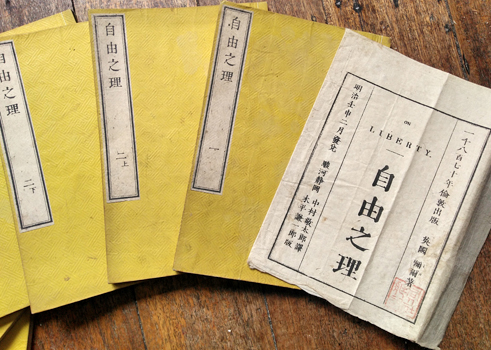

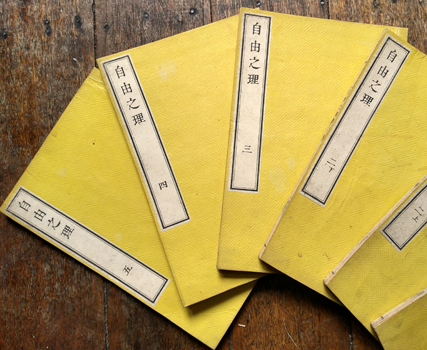
Mill, John Stuart and Nakamura Masanao. 自由之理 [Jiyu no Ri or Jiyuno Kotowari depending on the transcriber]. On Liberty. Shizuoka, Kihira Ken'ichiro [1872]. Five volumes in six books 23x16cm, publisher's yellow wrappers with title labels. Preface in English signed EWC, this was Edward Warren Clark who taught science in Shizuoka and, later, Tokyo. Covers a bit marked, an excellent set with the original printed outer wrapper (fukuro). Au$2500
The first Japanese edition of Mill's On Liberty - a book that Douglas Howland (in Personal Liberty and Public Good) tells us was "reportedly read by the entire generation of educated Japanese who came of age during the restoration".
I hoped to be able to nail down any issue points and clear up any confusion between the two forms this book takes: the five volumes bound as six books, as here, with volume two divided into two; or bound as five books. The confusion is heightened because many libraries and cataloguers use the 1871 date on the title, ignoring the preface dated January 1872.
I thought that a sort of colophon for Dojinsha - Nakamura's school - pasted inside the last back cover might help, but that leaf appears in both versions. Only the cover labels seem to be different. I've found nothing in any language that examines the printing history and while the rule of thumb - everywhere in the world - is that the more costly version - in materials and time - usually came first, I've had to conclude that there isn't any discernible priority and the difference may well be where, rather than when, the books were bound.
Nakamura's translation of Smile's 'Self Help' was also published by Kihira in Shizuoka and it seems that Kihira Ken'ichiro existed as a publisher only for Nakamura's translations of these two books which he made in Shizuoka - home of the deposed Tokugawa shogun - where he taught after his return from England in 1868 until 1872. In other words, Nakamura was really the publisher of both books.
Worldcat finds five, maybe six, locations outside of Japan - one in Britain, the rest in the US - all but one are catalogued as 1871.
It's by the way but I found this while reading up on something else: "Nakamura Masanao ... contributed a vitriolic piece on the sins of the novel to the first issue of Tokyj shinpo in 1876. He insisted that novels caused epidemics and violated the sanctity of marriage". (P.F. Kornicki; Disraeli and the Meiji Novel).
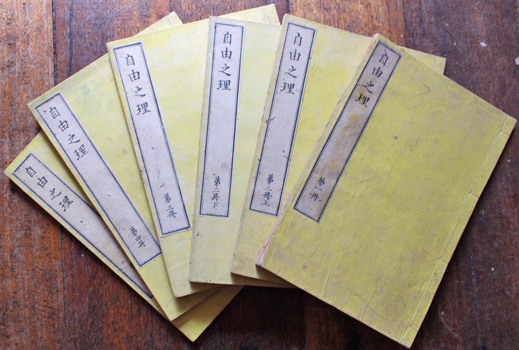
Mill, John Stuart and Nakamura Masanao. 自由之理 [Jiyu no Ri or Jiyuno Kotowari depending on the transcriber]. On Liberty. Shizuoka, Kihira Ken'ichiro [1872]. Five volumes in six books 23x16cm, publisher's yellow wrappers with title labels. Preface in English signed EWC, this was Edward Warren Clark who taught science in Shizuoka and, later, Tokyo. A square red stamp in the top corner of the first page of each volume with faint signs of characters, no other signs of ownership. A rather good set. Au$1500
The first Japanese edition of Mill's On Liberty - a book that Douglas Howland (in Personal Liberty and Public Good) tells us was "reportedly read by the entire generation of educated Japanese who came of age during the restoration".
I hoped to be able to nail down any issue points and clear up any confusion between the two forms this book takes: the five volumes bound as six books, as here, with volume two divided into two; or bound as five books. The confusion is heightened because many libraries and cataloguers use the 1871 date on the title, ignoring the preface dated January 1872.
I thought that a sort of colophon for Dojinsha - Nakamura's school - pasted inside the last back cover might help, but that leaf appears in both versions. Only the cover labels seem to be different. I've found nothing in any language that examines the printing history and while the rule of thumb - everywhere in the world - is that the more costly version - in materials and time - usually came first, I've had to conclude that there isn't any discernible priority and the difference may well be where, rather than when, the books were bound.
Nakamura's translation of Smile's 'Self Help' was also published by Kihira in Shizuoka and it seems that Kihira Ken'ichiro existed as a publisher only for Nakamura's translations of these two books which he made in Shizuoka - home of the deposed Tokugawa shogun - where he taught after his return from England in 1868 until 1872. In other words, Nakamura was really the publisher of both books.
Worldcat finds five, maybe six, locations outside of Japan - one in Britain, the rest in the US - all but one are catalogued as 1871.
It's by the way but I found this while reading up on something else: "Nakamura Masanao ... contributed a vitriolic piece on the sins of the novel to the first issue of Tokyj shinpo in 1876. He insisted that novels caused epidemics and violated the sanctity of marriage". (P.F. Kornicki; Disraeli and the Meiji Novel).


英和早学字引便覧 English: Japanesh: Small Dictionary; [Eiwa haya-gaku jibiki Binran]. Tokyo, Osaka? 1872 (Meiji 5). 16x6cm publisher's wrapper with title label; illustrated title in English on red paper, 30pp accordian folding, first page printed in blue. Owner's inscriptions on the covers. A pleasing copy, a most pleasing book. Au$300
Perfect for the narrowest pocket, or sleeve maybe. The explanatory Japanese with each of the 509 entries is tiny and clear. Osaka Women's University has a copy and that's all I could find anywhere. The NDL database lists it only on microfilm as part of a collection of English studies titles issued in the seventies.

Inoue Kohe & Hasegawa Sadanobu (artist). 西洋画引節用集 Seiyowuyebiki setuyowusiyu [Seiyo Ebiki Setsuyoshu]. Osaka, Onoki Ichibe 1872 (Meiji 5). 18x12cm publisher's wrapper (grubby, title label missing); double page colour frontispiece, small illustrations throughout. A little inoffensive worming, used but very decent copy for an old school book. In place of the title label is written: 'English of words'. Au$400
Another entrancing little educative book that leaves me stumped as to how anyone ever learnt anything. A baffling selection of English vocabulary made easy with illustrations so that any child can confidently talk and write about leeches, ear-picks, grave diggers, widowers, limbo, kidney beans, and nostrils. Unlike many such books this hasn't all been lifted wholesale from some English or American primer. The illustrations are by artist Hasegawa Sadanobu II and are all properly Japanese; these are the ear-picks, grave diggers and widowers that every child will see about them. How long will it take you to works out 'Shalms' - a boy riding a buffalo?
Worldcat finds two copies outside Japan: Brigham Young and the British Library. This opens right to left by the way.


Yanagawa Shunsan. 西洋時計便覧 [Seiyo Tokei Benran]. Tokyo, Yamatoya Kihee 1872 [Meiji 5]. 185x80mm publisher's stiff wrapper with title label (marked), accordian folding to form 34pp with woodblock illustrations throughout. Rather good. Au$500
An introduction to the western watch and its workings and - more important - western time and how to tell it. Roman numerals and the hour, minute and seconds hands are explained and a series of watch faces guide us through the rest of the intricacies of measuring time in the western style. Obviously for the sleeve or pocket, this could be hauled out with the new gizmo when its fledgling owner was stumped. Or even by a non-watch owner faced with a public clock. At the end the thermometer is illustrated and explained too.
This is not to say that the Japanese hadn't already mastered the clock. Since the Jesuits introduced clocks in the 16th century Japanese clockmakers had developed complex weight and spring driven mechanisms to run timekeepers according to the unequal hours of day and night, varying according to season. But in 1872 the government switched from the lunar calendar to the solar calendar and abolished traditional timekeeping and a whole nation had to start again from scratch.
Makes sense to me that daylight hours are longer and night hours shorter in summer and the reverse in winter. We all know that despite what the clock says all hours are not created equal. Bring back traditional Japanese timekeeping I say.

Uryu Masakazu & Hashimoto Sadahide 西洋新書 [Seiyo Shinsho]. Tokyo, Yamatoyo Kihei (Eto Kihei for volumes six & seven) 1872 - 75 (Meiji 5 to 8). 23x15cm, 7 volumes in 14 parts publisher's wrappers with printed labels (recently restitched); seven double page colour maps, a folding plan, a folding plate, two double page and some 174 other illustrations (most half page) by Sadahide. Some surface nibbling of part covers toward the outside of the bundle; a rather good set. Au$3500
A complete set, which is rare, of this expansive gathering of news from the west. The title is well represented in libraries but I could not find a complete set anywhere outside Japan. Few libraries get close. Even the electronic version held by many seems to be incomplete.
I can't work out the organisation of this but, roughly, the first half of the work is devoted to the United States and Mexico before moving on to Europe. A lot is military with much on the civil war, pretty up to date and natural enough for a country just emerged from their own civil war and having to face and deal with the threat of the west. The plan of Paris is dated 1867 which together with the folding plate of Paris vignettes is from material presumably collected at the Exposition.
Sadahide is not so well served by his block cutters as he was with his masterpiece books like the views of Yokohama life and Meriken Shinshi but there is plenty of charm and characteristic sharp-eyed fluid precision. He was, after all, getting on and was dead before the sixth and seventh volumes appeared so he may not have had much to say about it.

Photograph. 東京日日新聞 : 本所深川販売局 : 浦報文舎 [Tokyo Nichiniichi Shimbun : Honjo fukagawa hanbai-kyoku : Urahobunsha]. n.p. [1872?]. Albumen print 27x21cm mounted on card (42x34cm) with a printed border. Some blotches and small flaws; the white spots you can see appear to be in the negative. Ink inscription on the back. Au$480
An impressive pageant of hats if nothing else. But this is something else: a large commemorative group portrait of the staff of Tokyo's first daily newspaper - the Tokyo Nichi Nichi Shimbun - outside their headquarters.
The 1909 inscription on the back tells us that this photo commemorated sales of three thousand papers. Their first issue appeared in March 1872 (dated February per the old calendar) and I doubt that having set up their office, had staff jackets made and made sure no-one was wearing the same hat, they would lounge around too long.
The paper went on to bigger and better things quickly. In 1877 they moved to a large brick building and by the early 20th century it was one of Japan's major newspapers. In 1943 it was merged with the Osaka Mainichi Shimbun to become the Mainichi Shimbun.
I wonder how much this photograph was a conscious exercise in hierarchy and how much might be instinctive. It's clear the centre of power is in the three men who stand higher than anyone else. The man in the panama, centre in that trio, stands imperious and his right hand man in the boater is hunched so that he doesn't overtop him. The third man loafs at ease. The distance from those three marks seniority.
  1 [2] 3 4 5   |

