


Itagaki Takao. 藝術界の基調と時潮 [Geijutsukai no Kicho to Jicho]. Tokyo, Rokubunkan 1932 (Showa 7). 22x16cm, publisher's cloth with onlaid colour illustration, mildly used printed card slipcase; 428pp including 36 pages of photo illustrations. Rather good. Au$650
First edition. Itagaki was seemingly indefatigable as a champion of modernity and modernism in the late twenties and early thirties. Between 1929 and 1933 he worried at the relationship of the machine to art, design, architecture, photography and film, propounding his concept of "machine realism" in a small bundle of books like this. Come the deadly government crackdown on Itagaki's natural disputants - the "proletarian realists" - he apparently retreated into conservative didactic writing on western art and film.


Catalogue - fire engines. Nihon shobo-ki seizo kabushikigaisha. 日本式消防ポンプ [Nihonshiki Shobo Ponpu]. The company 1932 (Showa 7). 26x19cm publisher's illustrated wrapper; 9 leaves printed on one side, photo illustrations. A chomp from the top edge. Au$150
A catalogue of proper fire engines. This is when the last fireman down the pole, struggling into his boots, tenaciously grips the last rung of the ladder as he flaps like a flag behind the speeding engine. There is as well as the standard engines, a nifty little run-about, a motor trike and some handy accessories.
Seems not much survives of the Japan Firefighting Machinery Co now but a few small pumps and a much prized three wheeler in fire museums. I found none of their catalogues in any library.
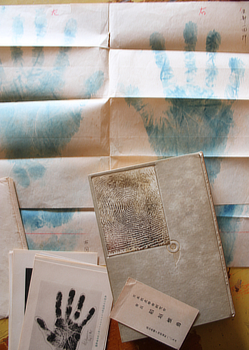
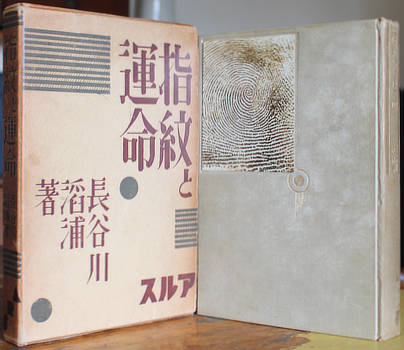
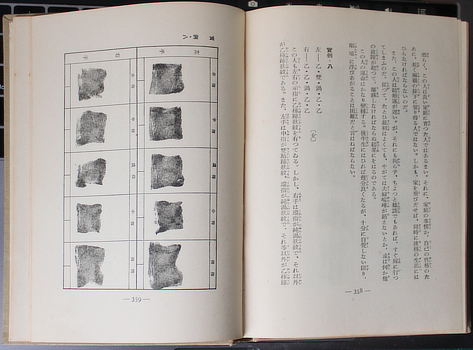
Hasegawa Toho. 指紋と運命 [Shimon to Unmei]. Tokyo, Ars 1933 (Showa 8). 20x14cm publisher's cloth with mounted photo (spine browned), printed card slipcase. Small illustrations throughout. The photo on the front cover is a photographically printed enlargement of a fingerprint. Discrete stamp of the newspaper Hochi Shimbun, now a sporting paper. Au$200
First edition of this study of fingerprints and destiny (the title translated) with extras: the envelope with 19 illustrations of hands and handprints which was included loose in a 1934 book on palmistry; two pairs (left and right on each) of handprints in blue ink; and the business card of Inagaki Tobari. I'll presume the handprints are his. They are the same hands, one pressed lightly, the other pressed hard against the paper.
Hasegawa published a couple of books on fingerprints which were translated into Chinese and reprinted quite recently. Remember these are fingerprints, none of that palmistry nonsense.
Book design by Onchi Koshiro; missed by the catalogue.
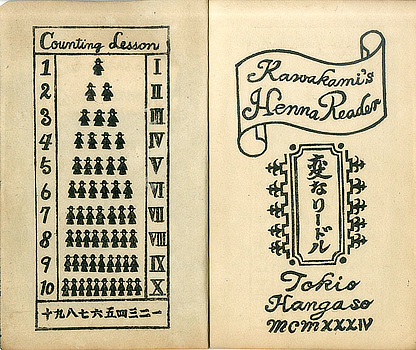
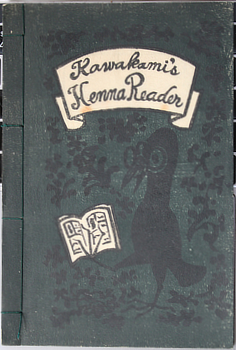
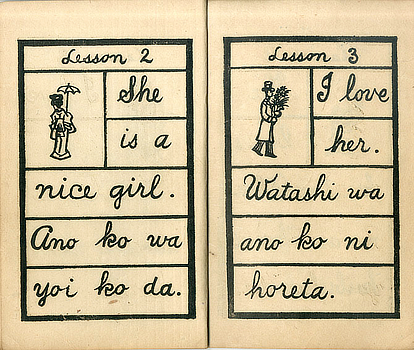
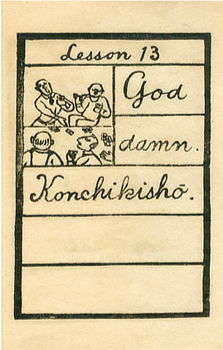
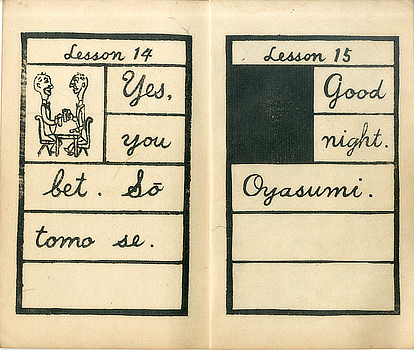
Kawakami Sumio. 変なリードル [Henna Ridoru] Kawakami's Henna Reader. Tokyo, Hangaso 1934 (Showa 9). 19x13 publisher's illustrated dark green wrapper printed in white and darker green; 16pp woodcut printed. Au$400
Kawakami's work is charming, simple to the point of naive so of course it isn't. Kawakami nursed a nostalgia for a time he did not experience. I'm sure there's word for that which isn't nationalism, xenophobia or popularism. In his case it was the Meiji enlightenment and the confusion of westernisation that fascinated him, particularly primers for children. Here is his. Henna translates as strange or weird; they were all weird but Kawakami is purposeful.
*These pictures of the contents have been stolen from somewhere else; I didn't want to squash this nice fresh copy to photograph the inside. This copy is better.
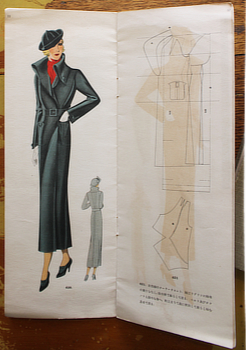
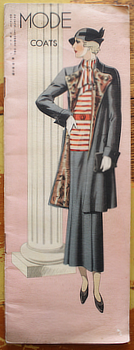
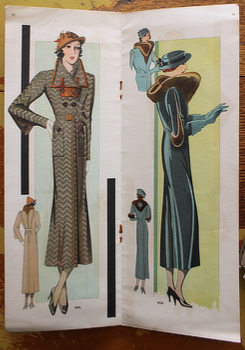
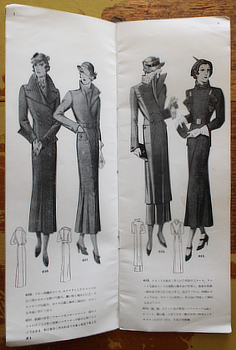
Fashion. モード Mode : Coats. Tokyo, Modosha 1934 (Showa 9). 31x11cm publisher's colour illustrated wrapper; 32pp including wrappers; illustrated throughout, six pages colour on heavier paper, each with the pattern on the back. Titled in Japanese if you start at the right end and in English if you start at the wrong end but paginated from the western end. A bit used. Au$175
Mode looks to be taken direct from a Paris journal but I haven't found an exact match. There were a lot of them. Since these models' legs look to be about shoulder height for an average Japanese woman it's hard to see these coats translated into Japanese. But the days of Meiji women looking uncomfortable and frumpish in western frocks were long gone. Come to that, the average height of a French woman wasn't much more and, come to that, high fashion is not meant for the average person.


Posters. 商業美術展ポスター集成 [Shogyo Bijutsuten Posuta Shusei]. Osaka, Shogyo Bijutsu Renmai 1934 (Showa 9). 27x20cm publisher's patterned boards and slipcase printed in orange and black (this fairly rubbed but solid and presentable enough); [5]ll and 104 b/w plates printed on one side. Au$300
Short on colour maybe but still a good exhibition of modern Japanese poster designs mounted by the Commercial Art League (Shogyo Bijutsu Renmai). Designs - not printed or published posters - with artists all identified. Not such a rare book but hard to find in better than revolting condition.


Kawakita Renshichiro & Takei Katso. 構成教育大系 [Kosei Kyoiku Taikei]. Tokyo, Gakko Bijutsu Kyokai Shuppan-bu 1934 (Showa 9). 22x16cm publisher's colour printed boards (a bit spotted with small surface scrapes at the tips); [2], 12 plates (four colour), 520pp, profusely illustrated throughout. Some spotting around the edge; a rather good copy of a vulnerable book. Au$1650
First edition. A textbook in a way but a remarkable and thoroughly modernist one. Much influenced but, I'm told, not slavishly, by the Bauhaus method of teaching, this education in design or composition contains both the philosophy and practice of Kawakita's Shinkenchiku Kogei Gakuin (School of New Architecture and Design) successor to his Seikatsu Kosei Kenkyusho (Research Institute for Life Configurations).
Kawakita's success in the Ukraine state theatre competition apparently isolated him even more than he was from the modernist mainstream. I've read that this book caused some unhappiness among cutting edge architects who complained that it was too abstract but was hugely popular among art teachers. This might explain why the book seems so hard to find: a bunch of black thumbed, paint spattered art students soon put paid to any book. Worldcat finds only the NDL entry.


City Planning. Xinjing or Shinkyo (Changchun) - Manchukuo. 國都新京建設の全貌 [Kokuto Shinkyo Kensetsu no Zenbo]. Shinkyo, Manshukoku Kokumuin Kokuto Kensetsukyoku 1936. Colour printed sheet 54x78cm with colour bird's eye view and panorama on one side; colour plan, smaller b/w photo illustrations and text on the other. Folded as issued, a small knick in a margin, minor signs of use. Au$750
In many ways the new capital of Manchukuo was - is - a planner's dream. Here was an empire building militaristic government wanting to both experiment with all that had been learned about city planning and show the west that not only could they do it, but do it better.
Changchun, a hybrid Chinese-Russian-Japanese railway town, was appointed the new capital, it was renamed, a five year plan for a new city was drawn up under the guidance of Professor Riki (or Toshikata) Sano in 1932, a quick compromise with a competing plan was made, and building was underway in early 1933.
Local interests (ie the Chinese and Manchu population) and business were allowed notional input but the brief was clear: social theory, technology and architecture that made for an efficient colonial capital could be put into place, local self-interest could not. Of course it was not so simple. This was to be a pan-Asian showcase, superior to western, especially colonial western, models - not equal. Confucianism, traditional ritual and Asian racial harmony were to be a central part of the city. What more could any urbanist ask for?
Students of the plan might like to start with Yishi Liu's 2011 doctoral thesis, 'Competing Visions of the Modern;' where Griffin's Canberra plan and Griffin's diagrams for road classification are illustrated beside Xinjing's. By 1936 - when our view of the future city was produced - a lot was still dust and open space but, by the gods, whatever else they learnt from Burley Griffin's Canberra - and it was a lot - about planning a city, they certainly learnt how not to build a city.
What they already knew is what all architects know - by instinct? - to redraw plans to fit what has been built and what is likely to be built. This is, I think, the third or fourth of such views of the new city. There were similar prints in 1933, maybe in 34, and 35. The city was declared open in 1937. I'm yet to see the first but the changes between 1935 and 1936 are noteworthy. The plan is much the same, mildy shrunk, and some buildings in our imaginary bird's eye view may reflect actual building but what becomes clear is that ambition has been scaled back to come closer to what they thought could exist next year. City blocks of large scale housing are now more sparse clumps of bungalows; elaborate Sino-Japanese modernism is plain modernism.


Poster. 大阪優良染織見本市 [Osaka Yuryo Senshoku Mihonichi]. [Osaka 1936?]. Colour poster 77x53cm. Folded, some browning and offsetting; pretty good. Au$400
This sinister warning of looming evil advertises the Osaka textile trade fair. Signed in print by the artist but I can't read it.
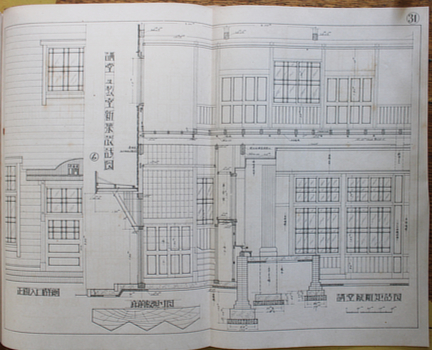
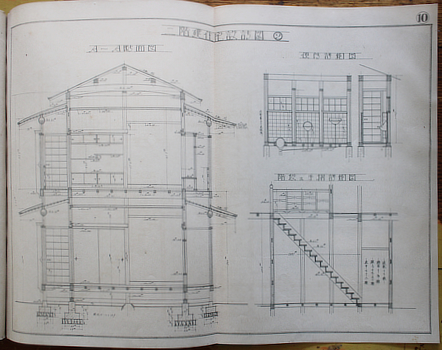
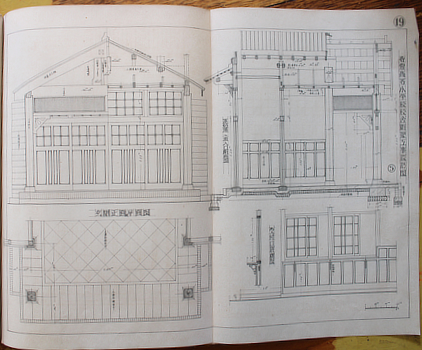
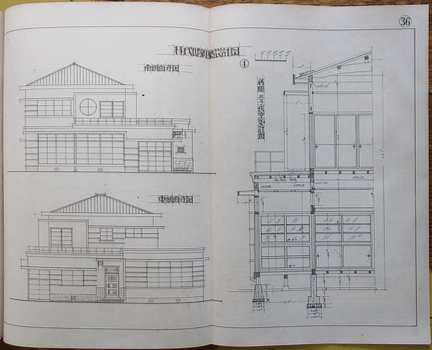
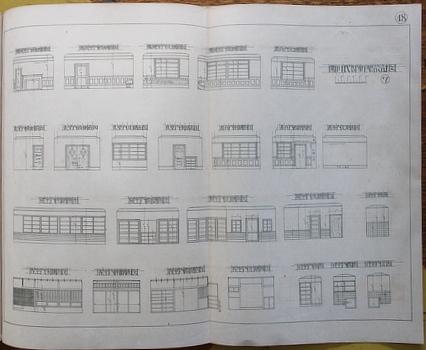
Architecture. Kenchiku Kenkyukai. 和洋建築設計実例編 [Wayo Kenchiku Sekkei Jitsurei-hen]. Osaka, Kenchiku Kenkyukai 1936. 27x20cm publisher's printed boards; 51 folding plans, elevations, measured drawings; a few photo illustrations. A little browning. Au$225
A reprint, first published in 1934, this is a thoroughly useful book from the Architectural Research Association. Enlarge the plans and you could build straight out of the book. Japanese and western are still differentiated and you can choose from ten houses, small school houses, or small apartments.
Worldcat finds no copies outside Japan and it's not so common in Japan.


Yamashita Ken'ichi (illustrator). 小学科学絵本 : 石油 [Shogaku Kagaku Ehon : Sekiyu] . Tokyo, Mitsukoshi 1937 (Showa 12). 215x195mm, publisher's boards with mounted illustration, dustwrapper (this used: browned and a bit chipped); colour and b/w illustrations by Yamashita throughout. Some browning here and there. Au$150
This is volume 10 of the 12 volumes series Shogaku Kagaku Ehon - elementary science - devoted to oil. This is a quite exciting and vivid series hidden under dreary dustwrappers so it is natural to discard the dustwrappers immediately. They seemed inexplicable to me until I realised that many of these artists were in disgrace with officials and neither high modernism nor the fanciful were suitable for anyone let alone an impressionable child. The dustwrappers are the book equivalent of thick rimmed glasses and a false moustache. Proof that communists and such troublemaking artistic riff-raff can't be trusted.


Yamashita Ken'ichi (illustrator). 小学科学絵本 : 石炭 [Shogaku Kagaku Ehon : Sekitan] . Tokyo, Mitsukoshi 1937 (Showa 12). 215x195mm, publisher's boards with mounted illustration, dustwrapper (this used: browned and a bit frayed); colour and b/w illustrations by Yamashita throughout. Some browning here and there. Au$125
This is volume 9 of the 12 volumes series Shogaku Kagaku Ehon - elementary science - devoted to coal. This is a quite exciting and vivid series hidden under dreary dustwrappers so it is natural to discard the dustwrappers immediately. They seemed inexplicable to me until I realised that many of these artists were in disgrace with officials and neither high modernism nor the fanciful were suitable for anyone let alone an impressionable child. The dustwrappers are the book equivalent of thick rimmed glasses and a false moustache. Proof that communists and such troublemaking artistic riff-raff can't be trusted.


Yamashita Ken'ichi (illustrator). 小学科学絵本 : 家 [Shogaku Kagaku Ehon : Ie] . Tokyo, Mitsukoshi 1937 (Showa 12). 215x195mm, publisher's boards with mounted illustration, dustwrapper (this used: smudged and a bit frayed); colour and b/w illustrations by Yamashita throughout. Some browning here and there. Au$100
This is volume 8 of the 12 volumes series Shogaku Kagaku Ehon - elementary science - devoted to housing. This is a quite exciting and vivid series hidden under dreary dustwrappers so it is natural to discard the dustwrappers immediately. They seemed inexplicable to me until I realised that many of these artists were in disgrace with officials and neither high modernism nor the fanciful were suitable for anyone let alone an impressionable child. The dustwrappers are the book equivalent of thick rimmed glasses and a false moustache. Proof that communists and such troublemaking artistic riff-raff can't be trusted.


Manchuria colonisation. 満洲移住百問百答 [Manshu Iju Hyakumon Hyakuto]. Manchuria Nichinichi Shimbun 1937. 19x13cm publisher's illustrated wrapper (a bit used); 138pp, some photo illustations and diagrams. Au$275
Everything a poor Japanese farmer needed to know about resettling in Manchuria in 100 questions and 100 answers, published by the Manchuria daily news. This was the Manchuria Million Houses Plan, created in 1936 and put into action in 1937, which was to see a million households of poor farmers resettled in northern Manchuria over the next twenty years. It seems that of the almost quarter of a million settlers abandoned there when the Soviets invaded at the end of the war about half made it back to Japan.
Worldcat finds no copies, neither does NDL, and CiNii finds a scant handful in University libraries.

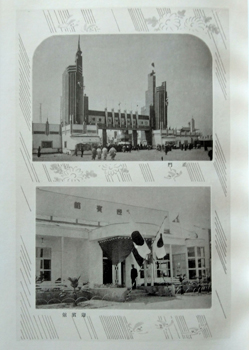
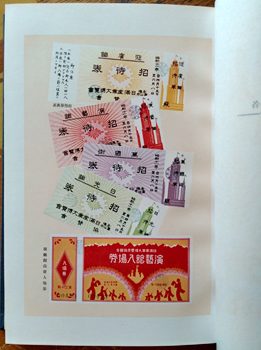

Exhibition - Toyama 1936. 富山市主催日満産業大博覧会協賛会誌 [Toyamashi Shusai Nichiman Sangyo Daihakurankai Kyosankai Shi]. Toyama 1938 (Showa 13). 23x16cm publisher's cloth and card box; numerous photo illustrations, colour plates, folding plans and elevations. A nice copy. Au$650
The official report on the 1936 Japan-Manchuria Great Industrial Exhibition. Though blemished by too many portraits of personages, this is still an excellent record of thirties Japanese expo architecture and design with coloured pictures of posters, advertising, tickets and so on, plans and elevations of buildings, lighting, and photo views. There is also the obligatory Hatsusaburo colour folding birds-eye panorama.
Worldcat finds two copies outside Japan, both in California.


Sugiura Hisui, Takeo Takei, Takeshi Kimata &c. わが子の歴史 [Wagako no Rekishi]. Osaka, Mitsokushi [1939] (Showa 14). 27x19cm publisher's cloth backed boards decorated in gilt and black in mildy worn decorated box; 84pp illustrated in colour throughout by Takei and others; cover design by Sigiura. Partly filled in with pencil, two chubby hands have been traced in ink; occasional browning or offsetting; a remarkably good copy. Au$300
This book was child of the Mitsokushi department store, first published in 1928, reprinted fairly often and presumably updated. One of Takei's illustrations is dated 1934. Who was the titan that came up this genius innovation - the predigested baby album? Does he or she have a shrine in the marketing hall of fame? They - books like this - seem to have popped up round the world in the twenties - were they earlier? This has one foot planted in revoltingly cute of course but, thanks to Takei and a couple of fellow artists, enough pages keep the other foot in stylish and exciting.
Worldcat finds one copy - a 1938 edition at Princeton - and NDL finds two - 1928 and 1936 editions - in Japanese libraries. While doing homework on this I came across a poor - so to speak - descendant: the Blot. For a mere 20,000 yen you get something that looks suspiciously like a leather filofax - if you're old enough to remember the filofax - no cute pictures, no revolting sentiment. Poor kids.


Coal mine. 炭礦 [Tanko]. Tokyo, 1940 (Showa 15) Colour poster 53x77cm. A little dusty and frayed around the edges. Au$175
Mines sure came a long way from the hell for the choiceless, the bereft, and the suicidal that Soseki wrote about in 1908. That was a copper mine, I admit, but by 1940 underground workers in coal mines weren't just women and convicts. Unless of course you were forced labour from Manchuria, China, or Korea. Still, all that has nothing to do with the shining, automated, downright pretty, triumph of tidy technology we have here. The artist is K. Homma.
This is from a series of educational posters for schools, Wakamoto Kyoiku Kakezono. This changed my preconceptions about life in a coal mine so I wonder what else they published in the series; I might have to change my mind about a lot of things. I've found no mention of any other posters in the series.


Poster. Sasao (?). 四月三十曰 ... 大東亜戦争完逐翼賛選挙 [... Daitoasenso Kansui Yokusan Senkyo]. n.p. [printed by Biseido Insatsu?1942]. Colour poster 77x54cm. Folded and rumpled, a couple of small nicks; with a neat, mysterious diagram drawn in ink on the back. Signed in print Sasao. Au$600
Election poster for the 1942 general election reminding everyone to get out on April 30, vote for their endorsed candidate and ensure victory in the great Asian war. Though the whole business was meant to ensure that only endorsed Yokusan candidates could run I was surprised to find that more unendorsed than endorsed candidates ran for parliament and quite a few of them were elected. Of course that made no real difference to the running of the government and the war but it must have irked the military.
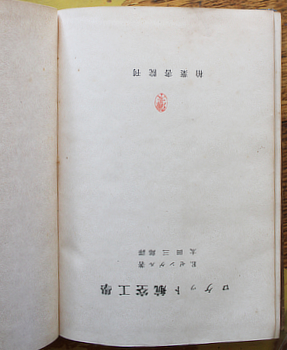
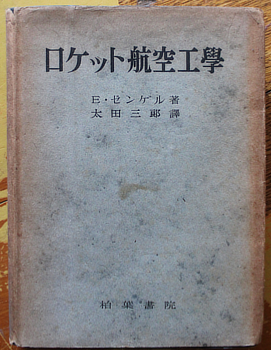
Eugene Sanger and Ota Saburo. ロケット航空工學 [Roketto Koku Kogaku]. Tokyo, Hakuyo Shoin 1944. 22x16cm publishers cloth and dustwrapper; diagrams throughout. Expected browning, a rather good copy. Au$150
First edition. Eugene Sanger's rocket aeronatics (Raketen-Flugtechnik; 1933) translated into Japanese at about the same time a lithoprint version - but no translation - was printed in the US. And just before the V-1 jet and V-2 rocket bombardments began.
This apparently was Sanger's university thesis, rejected as too fanciful. Rockets as weapons in Japan of course were nothing new and rockets going into space were nothing new but I can't find any serious work in Japan earlier than this.
The book opens right to left which misled someone at the bindery who properly inserted the title page the way it should be, making it upside down. I don't know whether all copies are like this, the only other title page I've seen is the third edition and it's the right way up.
Worldcat finds no copy outside Japan.
And note that the translator is not Ota Saburo the artist/illustrator, just as the author of the first Japanese publication on the atom bomb is not Takeo Takei the artist/illustrator.
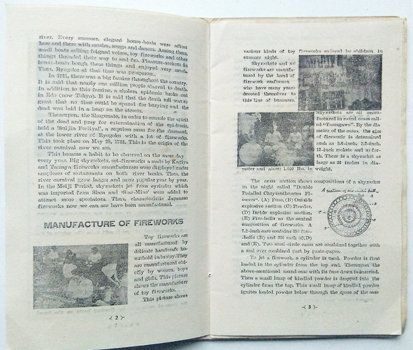

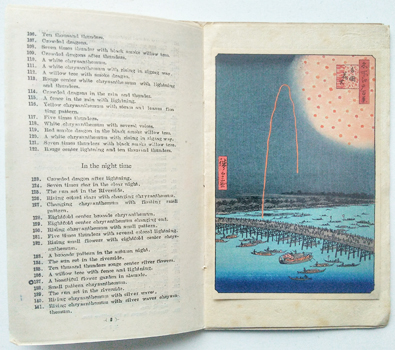
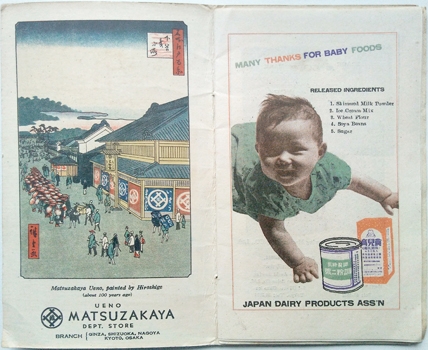
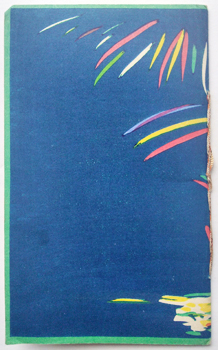
Sumida Fireworks. Fireworks. Tokyo-To Tourist Assn. [1948]. 18x11cm publisher's colour woodcut card wrapper, cord tied; 12pp with a few illustrations, eight pages of illustrated adverts and two mounted colour woodcuts (miniature Hiroshiges). Au$60
Quite cute. Issued for the 1948 Sumida fireworks contest on September 18 it includes a complete list of the 278 fireworks to be launched; the first 122 are daytime fireworks. According to received history this event didn't happen. Most accounts tell us the festival stopped before the war and didn't start again until 1978 but a first hand account by the daughter of an organiser says that fireworks were set off on August 1st 1948 and the festival continued until the early sixties when the river was deemed too polluted and foul. By the late seventies the river had been revived and the contest resumed in 1978.
August 1st was apparently the day the national ban on fireworks was lifted which may be the reason for that date being remembered. So did the contest happen in September?
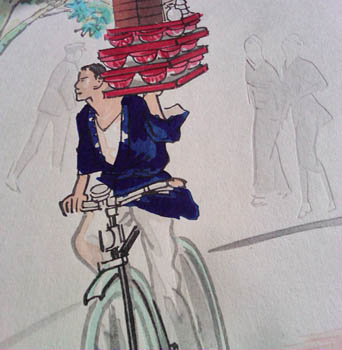

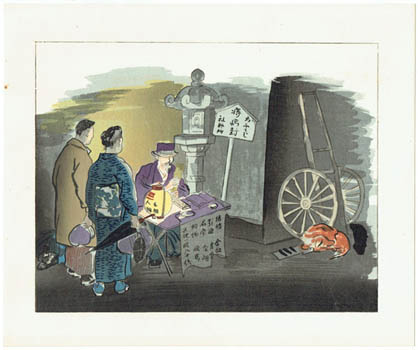
Wada Sanzo. Wood Block Hand Prints - Japanese Life and Customs - A set of six pictures by Sanzo Wada. [aka 昭和職業絵盡: Showa Occupations or Japanese Vocations in Pictures]. Kyoto Hanga-In [195-?]. Publisher's patterned board folder (24x30cm) with illustrated label; six colour woodcut prints, loose as issued. A scratch to the label, an excellent copy, the prints bright and fine. This contains the flower sellers, the fortune teller, the weavers, the soba vendor, the komuso, and the farming family. Au$450
In the late thirties Wada gathered an in-house team of woodblock cutters and printers and began work on a projected series of 100 prints recording occupations in his changing Japan. Some were traditional and vanishing and some were the product of modern industrialised Japan. From here we can see that some of those modern jobs barely lasted out the century. The prints began appearing in 1939 and struggled on until 1943 when two series totalling 48 prints had appeared. After the war the project was resurrected by the Kyoto Hanga-In and a third series of 24 prints appeared from 1954 to 56. They also re-did some earlier prints from new blocks; the originals had been destroyed.
Ross Walker (Ohmi Gallery) wrote that the owners of Kyoto Hanga-In told him that they could not afford too many cherry woodblocks so their blocks for the prints of the fifties were planed and re-used and nothing before 1960 survives. This album is obviously for foreign consumption and contains six prints from the first and second series. The paper size is smaller than the separately issued prints but the quality of printing is no less, often better than copies of the separate prints I've seen. The colours are strong and vibrant and the extra embossing that is such an important part of the print - and can't be seen in reproduction - is deep and crisp where used. These copies aren't lettered or signed, one has the artist's seal. I've traced two other sets and both hold the same six prints but small variations in the prints and signatures occur in all.
Wada's drawings have a modest charm and get better the more you look at them. The best may not hold your gaze at first but after a while you realise that they are the work of a great master of observation and deceptively simple expression. The fortune teller is not the focus of his picture, his customers - maybe worn, anxious parents of a son at war - are. Look at the impossible bull neck of the soba seller and the shadow pedestrians and there is the way this young human bulldozer sees the world. He refuses to become one of the slumped, defeated customers of a fortune teller.


Street Kamishibai. Gataro & Yaeko? 死神むすめ : 13巻 [Shinigami Musume : 13 kan]. [& 23]. np. Sadamusha? 195-? Ten handpainted and varnished sheets on heavy boards, 26x36cm. Text handwritten on the back. Edges worn and minor scrapes and blemishes as expected. Stamps of the Osaka and Nagoya kamishibai ethics committees, which my informant speculates were self proclaimed entities that existed nowhere other than as stamps on a handful of stories. Added is the wrecked but complete episode 23, also ten cards. The left hand quarter has been wet and is quite damaged but it is certainly worth saving. Au$1000
If you've looked at published kamishibai and wondered how it could ever have been popular ... it wasn't. The published stuff was almost all heavy handed propaganda and improving drivel produced without any artistic skill or imagination by government and education agencies and pressed on children in schools. Real street kamishibai was produced by hand by the kamishibai men themselves or by associations - such as the Sadamusha - that acted more or less as lending libraries. Which is not to say that a hell of a lot of street kamishibai wouldn't be described kindly as 'naive'. But enough had to be compelling to bring and keep audiences. Specially through hundreds of episodes, which some stories ran for.
Kamishibai was not long lived. It was more or less born with cinema and died with television, and the greatest works, as far as they have survived, were produced toward the end, during the occupation after the war. The connection to film serials is inescapable of course but kamishibai is not burdened with technical restraints. If you can imagine it, you can draw it and you can tell the story.
This is the complete episode 13 of what might be translated as 'Death's Daughter' which I'm told is a story of horror and revenge but I doubt that anyone living knows the whole story. As far as I can figure, when the kamishibai industry ground to a halt the kamishibai men just packed away, or threw away, whatever episodes they had. If a large hunk of a story or, something I've never seen, a whole story was held by the association you can be sure it was dull, rarely used. Here, I've traced only episodes 10 to 15* which all seem to have come from the same source. How many episodes were there? Who knows.
*Episode 23, now added from the same source and unlikely to be supplemented, doesn't help with the plot but it does ratchet up the tension. Is it all as brutally murderous as this? I suspect so.
It's pretty fabulous, no Golden Yasha but a fair slice of that essential overwrought pervasive dread and stark fear.
Kamishibai are public stories usually told by kamishibai men who set up a folding stand on the back of their bicycles and acted the dramas illustrated on the cards. With the plates in order, the text for the first picture is on the back of the last. The sheets are transferred to the back as the story continues; the text for the second picture is on the back of the first, and so on.


Pesticide posters. Nihon Nohyaku. Set of five posters advertising pesticides from the company: Nihon Nohyaku. Nihon Nohyaku [1952?]. Five colour posters 52x37cm. All in excellent shape. Au$500
Vivid, charming and, in a couple of cases, dramatic representations of the evil threatening your crops. These herald the introduction of new chemicals developed in the forties and introduced into Japan before the moribund chemical industry - like the rest of Japanese industry - revived after the occupation years in the late fifities and early sixties. And long before human safety and the environment appeared in legislation.
  9 10 11 [12] |

