First appearance
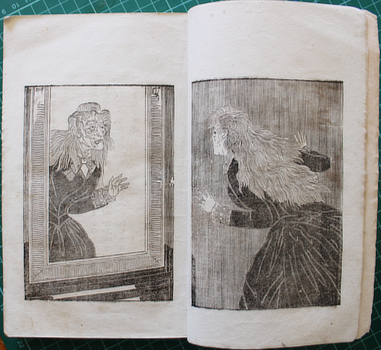
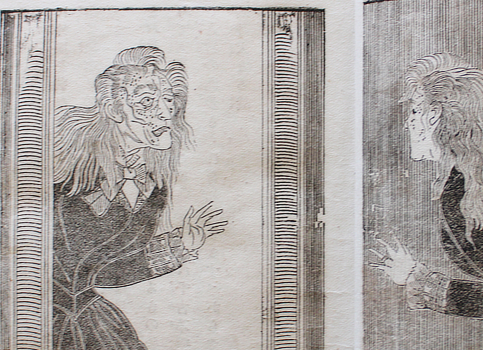
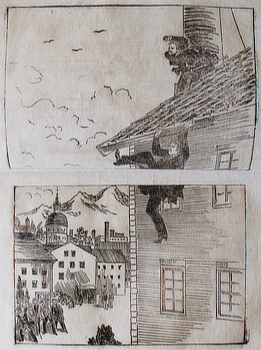
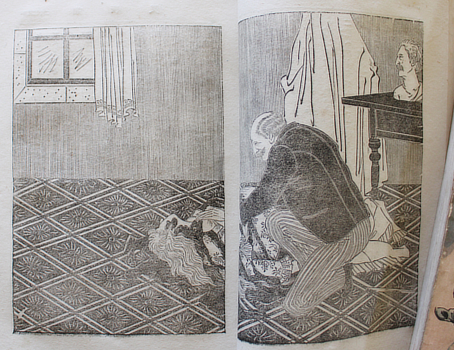
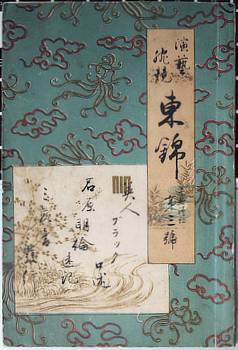
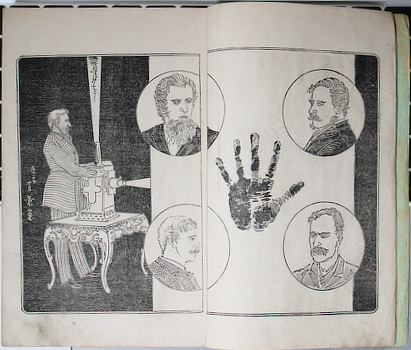
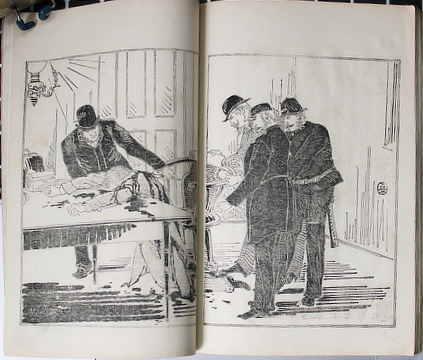
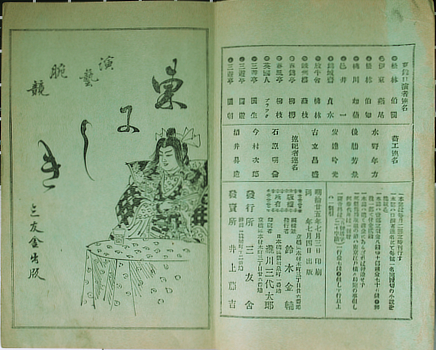
Henry James Black. (Kairakutei Burakku). 岩出銀行 : 血染の手形 [Iwade Ginko : Chishio no Tegata]. (aka Gento : Tantei Shosetsu); the complete issue of Azuma Nishiki no. 3. Tokyo, Sanyusha July 4, 1892 (Meiji 25). 185x123mm publisher's colour printed wrapper; illustrated title & 97pp, three double page illustrations. Ink inscription on the plain back cover, smudges and signs of use; certainly read but still rather good. Au$3500
Perhaps the most remarkable detective novel ever. Where to start? This is a London set murder mystery solved by an amateur detective using fingerprints - or a handprint - and a magic lantern that was told as a serial story to a Japanese audience by a gay Australian who became a professional Japanese story teller, taken down in shorthand and turned into a book. I probably don't need to add much to that but I will.
Better known as Gento - its title when published as a book, this is the second known book to use fingerprints to solve a crime. The hero of fingerprint detecting is of course Mark Twain who solved a story within the story with a thumb print in his Life on the Mississippi in 1883 and followed it up with Pudd'nhead Wilson in 1893-4 - a year after Galton's Fingerprints was published. Now to Henry Black: Black was born in Adelaide and arrived in Japan in 1865 at the age of almost seven - his father, up until now a singer, had bought into the Japan Herald. Henry seems to have grown into something of a no-hoper in the eyes of some of his family at least and rather than settle to respectable work became first a proponent of progressive reform, like his father, then a professional rakugoka - story teller - and even a kabuki actor playing women. His reaction to his siblings' disapproval was to change his name to Kairakutei Burakku (Pleasure Black), marry a Japanese woman and become a Japanese citizen. Ian McArthur, Black's biographer, quotes from a police report made at this time that he was living in "virtually a husband and wife relationship" with a young Japanese man but otherwise there was nothing untoward to worry about.
At the height of his fame - 1891 and 92 - maybe six or seven of these stenographic novels were published and other stories appeared in newspapers. It's a bit hard to unravel as a couple appeared more than once with different titles. Even the concise and acerbic Edogawa Rampo gets muddled and misled trying to work out a bibliography at the end of his 1951 essay translated as Fingerprint Novels of the Meiji Era. He cites another essayist who wrote on Black and said he had five* of his books, Edogawa has only three but Gento is one of them - hence his essay.
Edogawa tells this appeared in June 1892 but elsewhere it is listed as July and CiNii's single entry is also dated July. The book edition, from the same publisher, is dated December. So this, then, is the first appearance of the novel. The title here translates more or less as Iwade Bank : the bloody handprint while the book is Magic Lantern : a detective story. Apart from the title page and some extra advertisements the contents are identical to the December book and were probably printed from the same stereoptypes. The title shows an overdressed chubby story teller who may well be Black in full drag.
This handful of detective stories or thrillers was bracketed by two translations or adaptations of novels: Mrs Braddon's Flower and Weed in 1886 and Dickens' Oliver Twist in 1895. Of the thrillers from these two boom years, two are known to be adapted from stories by Mrs Braddon and one from a story by Fortune du Boisgobey. The others - most particularly this, the jewel in the crown - have no known antecedent.
I would like to suggest that scholars chase connections with Henry Faulds - the disgruntled pioneer of fingerprint studies - who lived in Japan through the 1870s and 80s and published his first paper in Nature in 1880 - the paper that Galton said had no part in his discoveries. The bright spark in Black's story spent time in China and Japan where he learnt about prints as a form of identification - exactly as Faulds did in Japan.
*He lost his copy of Gento during the war.

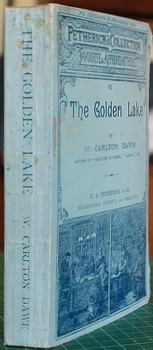
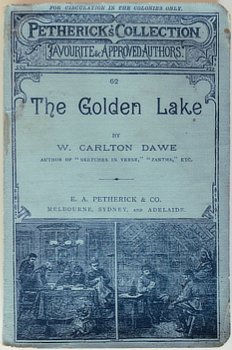
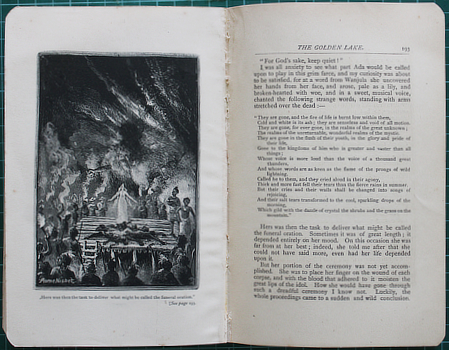
DAWE, W. Carlton. The Golden Lake or, the marvellous history of a journey through the great lone land of Australia. Melbourne &c, Petherick; London, Trischler 1891. Octavo publisher's flexible light blue cloth printed in darker blue; eight plates by Hume Nisbet (all but the frontispiece not at the pages called for in the list). A little browning, minor signs of use; rather good. Au$1200
Colonial edition using the Trischler sheets which were issued dated 1890; I suspect the same sheets re-appeared as the 'new edition' of 1894. So: first edition, colonial issue if you are that way inclined. Petherick was busy - the endpaper list of titles, dated April 1891, is up to 65 titles with six more to come; this book coming in at no.62 - but couldn't make a go of a colonial library without having a substantial publishing base to work from. I have also seen this Petherick edition in a plainer dark green binding. Trischler was likewise a short-lived firm. They began as the Hansom Cab Publishing Company with Hume's one hit wonder, morphed into Trischler and were dead by 1892.
A hard book to find, whoever's name is at the bottom of the title page, this is a lost civilisation fantasy. Now I know wild Australia is a pretty big place with plenty of room for unknown civilisations, mysterious tribes, aliens and a fair sprinkle of white goddesses or queens but I don't get how so many of these travellers ran down the remains of Leichhardt but never bumped into each other.

LORD, W.F. [William Fisher?]. The Mysterious Disappearance of Ralph Forrester. In ten chapters. Launceston, Examiner Office 1902. Octavo publisher's printed wrapper; [4],90pp. A few spots and insignificant signs of use. Au$400
A particularly obscure little Tasmanian detective novel not set in Tasmania. Missed by Loder's bibliography though he did find a copy in time for the sale of his collection. It is a fairly recent addition to Hubin who names him William Fisher Lord and The Bibliography of Australian Literature allows it possible such a person was then resident in Launceston. He did get married in Launceston in 1887. This seems to be his only book.

To a vile specimen
FARJEON, B.L. [Benjamin Leopold]. Grif. A story of Australian Life. Seventeenth edition. London, Hutchinson 1898. Octavo publisher's cloth, spine decorated in gilt. A little browning at the very ends, quite a nice copy. Inscribed and signed by Farjeon with an accompanying letter. Au$350
A gift from Farjeon to Mrs Granville Ellis in 1901. The short letter on Farjeon's letterhead explains that it isn't always easy to find spare copies of his books but he is sending three, including this one, and Harry - Farjeon's composer son - is sending along some sheet music just published. Mrs Ellis must be the American born journalist, Anna May (or Mai?) Bosler, who married Granville Ellis twice and wrote under the name Max Eliot. Elizabeth Pennell described her as "that awful American newspaper woman ... a vile specimen! Vulgar!"
Gifted copies of Farjeon's books have a longer history than Farjeon himself. Decades later Harry used his father's own copies as school prizes.

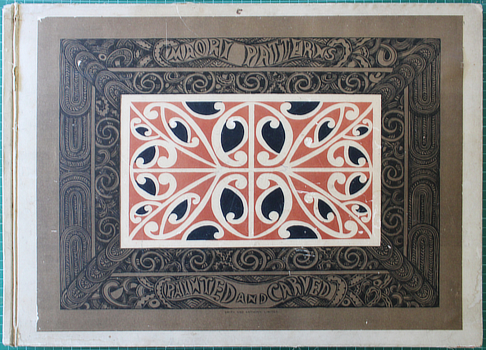
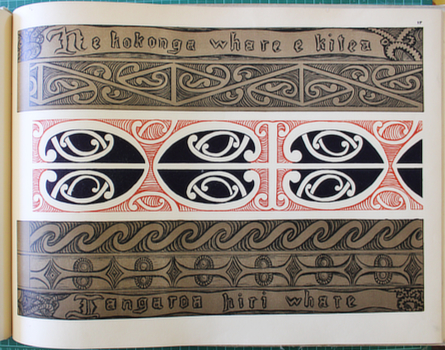
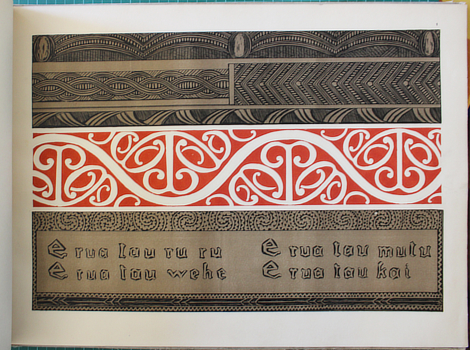
MENZIES, J.H. [John Henry]. Maori Patterns Painted and Carved. [Privately printed] Christchurch [1904?]. Printed and bound by Smith & Anthony of Christchurch. Large oblong folio (37x50cm) original white cloth with mounted colour lithograph title; 2 preliminary leaves (one decorated & printed in two colours) & 28 colour lithograph plates. White cloth a bit grubby with some wear around the edges; a few other signs of use but a rather good copy of this wonderfully impractical book.
A family copy of some sort, inscribed in 1964 to Julian Thorpe, great-grandson of Menzies, by D.D. (David Dumville) Thorpe, grandson. More than one of Menzies children married Thorpes.
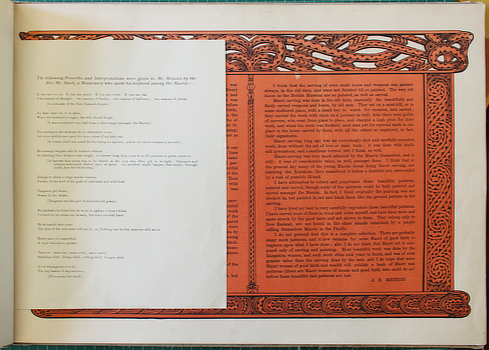
Bound in at the beginning is a printed quarto sheet headed, The following Proverbs and Interpretations were given to Mr. Menzies by the Rev. Mr. Stack ... This is something I've not seen in another copy. Au$7500
Quite rare nowadays. In his preface to his facsimile edition (1975) Norman Oberg suggested a publication date of 1904 rather than the commonly attributed 1910 - 1910 is when Menzies retired to Christchurch and when he gave a copy to the National Museum - and a print run of 125 copies of which he found 25 unbound copies. These he dispersed as single plates with his facsimile. Smith & Anthony printed a prospectus which stated they were authorised to offer for sale 125 sets of the plates which could be bound or loose. A copy of this is in that National Museum copy.
An enthusiast's book, idiosyncratic in its production and choice of examples, but it is a serious attempt to collect and preserve these patterns, leaving it for "some Maori of good birth" to improve his work in the future. It deserves its place with the great colour ornament encyclopaedias and pattern books of the 19th and early 20th centuries and is, I guess, the only one to come from this half of the world.

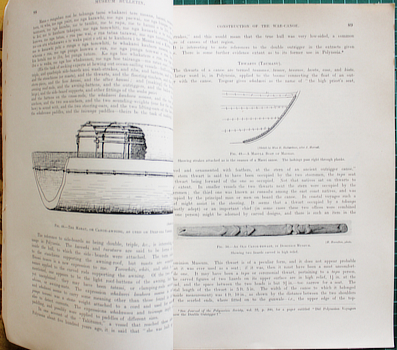
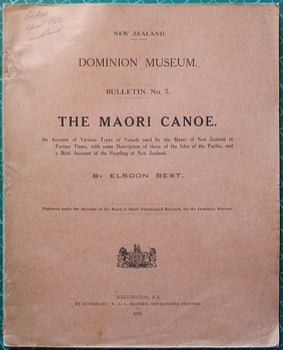
BEST, Elsdon. The Maori Canoe. An acount of various types of vessels used by the Maori of New Zealand in former times, with some description of those of the isles of the Pacific ... Wellington, Govt Printer 1925. Quarto publisher's printer wrapper; vi,312pp, map, some 170 photo illustrations, line drawings and diagrams. Spine ends a bit chipped, a short tear in the wrapper, name on the front cover, minor signs of use. Dominion Museum Bulletin No.7. Au$250
The definitive work, it isn't superceded by Haddon's Canoes of Oceania but forms a good companion. Best covers everything from tree felling to decoration and investigates the history of Polynesian migration.

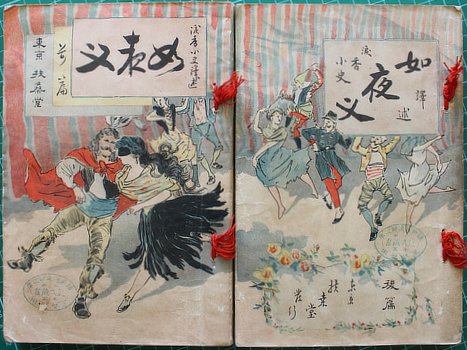
Fortune du Boisgobey & Kuroiwa Ruiko. 如夜叉 [Nyoyasha]. Tokyo, Fusodo 1897 (Meiji 30). Two volumes 22x15cm, publisher's colour illustrated wrappers with silk ties; 10 double page illustrations. A few inoffensive owner's stamps; definitely used but still rather good for a popular thriller. Au$200
Third edition according to the colophon; it first appeared in 1891. This is Ruiko's adaptation of Boisgobey's Margot la Balafree (1884) though because Ruiko worked from English versions he likely used The Sculptor's Daughter published in the American Seaside Library and other cheap forms. Ruiko didn't muck about with such bland titles: Nyoyasha more or less translates as Like a Demon. And neither did French or American audiences get these illustrations.
How much Boisgobey remains in Ruiko's version is for someone who can read it in all three languages to answer. Ruiko was open about slashing, expanding and rewriting his material to fit what he wanted the novel to say.
Worldcat finds only an entry in Taiwan outside Japan.

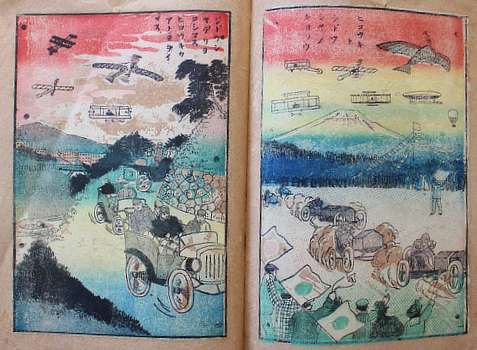
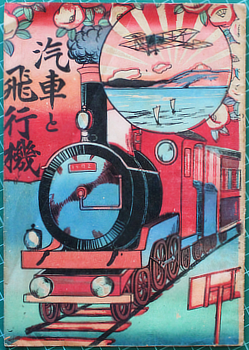
Cars & Planes. 汽車と飛行機 [Kisha to Hikoki]. Osaka, Enomoto shoten 1919 (Taisho 8). 21x15cm publisher's illustrated wrapper; 10pp including cover, colour lithograph illustrations throughout. Natural browning of the cheap paper, A small tear in the top margin. Au$165
Yes, this is called Cars and Planes, or Automobiles and Aeroplanes if you want to be formal, but that train on the cover is too exciting to sulk about. Maybe not the finest printing but these akahons (red books) - cheap and gaudy - do manage to catch the thrill of being alive in a time when everything is new and speedy. This is the third edition, published a couple of years after the first.

Woogaroo lunatic asylum. Report from the Joint Select Committee on the Woogaroo Lunatic Asylum: together with the proceedings ... and minutes of evidence. Brisbane, Govt printer 1869. Foolscap disbound; [4],73pp and nine litho plates: plans and elevations. Au$450
Woogaro, Queensland's first lunatic asylum, was opened in 1865 and was a disaster: built in the wrong place, badly staffed, badly managed, with woefully inadequate buildings. Two inquiries were held in 1869, one by public servants and this one by a parliamentary committee. The focus here is on the buildings, the general plan and proper management. From this inquiry came the 1869 Lunacy Act. The committee recommend buildings on the "cottage" system and given the choice between plans by Tiffin and Suter - illustrated here - chose Suter's. He crammed twice the number of patients into each building at a saving of £18 per head.

How to travel
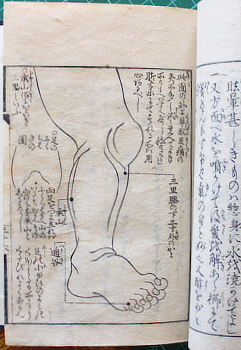
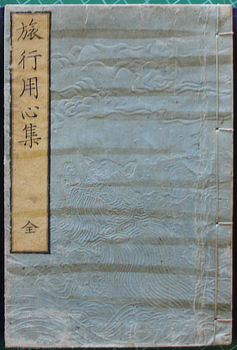
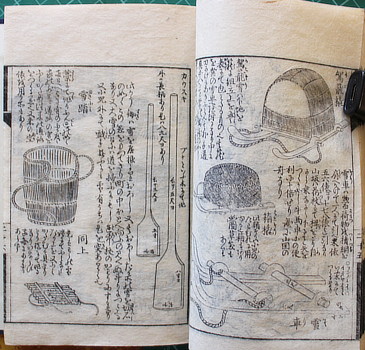
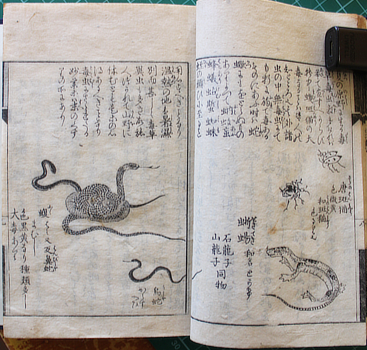
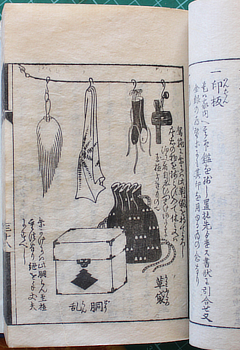
Yasumi Roan. 旅行用心集 [Ryoko Yojinshu]. Toto (ie Tokyo), Suharaya 1810 (Bunka 7). 18x12cm original patterned and embossed wrapper with printed title label; 77 leaves including title and colophon, illustrations on 27 pages. An outstanding copy. Au$3500
First edition. A fabulous copy of a fabulous book. This singular book has no parallel in Japan and nothing much elsewhere until mid century with writers like Francis Galton and Thomas Baines. There were plenty of guide books in Japan and the west, unhelpful vocabularies in many languages for Europe; but nothing like detailed instructions on how to travel.
It's difficult to choose an example or two from the 61 introductory precautions, they are all jewels of experience from an expert traveller. A lot of useful advice on health and medications, as well as Yasumi's three books on medical matters, led Constantine Vaporis to guess that Yasumi was a physician of some sort (Caveat Viator; Monumenta Nipponica 44; 1989).
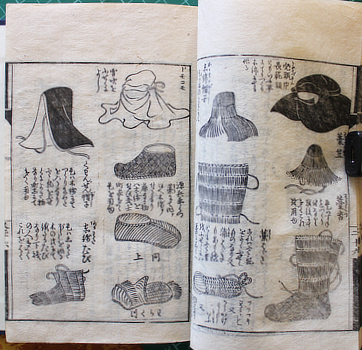
What to wear; what to take; how to behave; what to do when arriving at an inn: find the toilet and check all exits; what to avoid: too much cheap booze (drink none in winter), poisonous insects, inn prostitutes; how to find your way again if bewitched by foxes or badgers; how to wear in your essential straw sandals and how to treat blisters; how to avoid sea sickness (first, don't get on a boat unless there's no other choice) and motion sickness if riding in a palanquin ... there is too much to list here. In any case, there is now an English translation in print.

The Great Moon Hoax
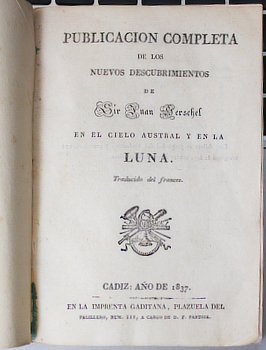
Herschel. [LOCKE, Richard Adams]. Publicacion Completa de los Nuevos Descubrimientos de Sir Juan Herschel en el Cielo Austral y en la Luna. Cadiz, Imprenta Gaditana 1837. 14x10cm later plain wrapper (a small chip from a corner); [2],116pp (last blank). Rather good. Au$800
Locke's account in the New York Sun in August 1835 of Herschel's discovery with his revolutionary new telescope of life on the moon was the first definite report by a credible scientist and the news spread faster than a trip to the moon would take. It first appeared in Spanish in Havana in 1835 (something I want to find) and a couple of Spanish publishers used that version in 1836, including Gaditana in Cadiz. Here they have gone to the complete French edition, presumably the anonymous French version by Fourierist Victor Considerant and general hack Raymond Brucker. They rightly considered that when you're handed a delightful hoax, run with it, and so they added to it.

Plus atomic death rays in ancient Egypt
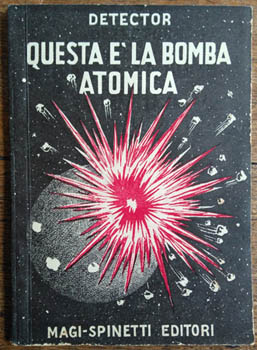
MARALDI, Ugo (Detector). Questa e la Bomba Atomica. Rome, Magi-Spinetti, August 1945. Octavo publisher's illustrated wrapper printed in black and red; 80pp. A nice copy. Au$175
A speedy entry into atom bomb literature by the writer of popular science and speculation. He ends with a chapter on a favourite subject - interplanetary travel - and a postscript on the announcement by 'eminent physicist' Luigi Bulgarini that the ancient Egyptians understood atomic energy and used a death ray to protect the tombs of pharaohs. Worldcat finds two copies, both in the US. SBN finds three copies in Italy but I can't find it in either national library.

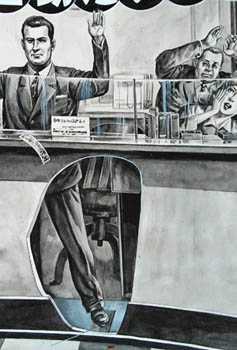
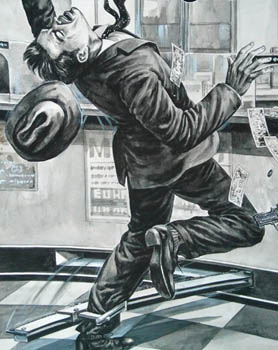
Minamimura Takashi. 自動たいほ器 [Jido Taiho-ki]. Original illustration for a double page spread in Shonen magazine. n.p. [195-?] Illustration in ink and gouache on two cards, each 32x22cm. Tape marks on the backs. Au$500
Minamimura is best known for his outer space and apocalyptic monster and alien illustrations but it's clear he could work happily with any new wizzbang invention. And what could be better than this FBI automatic crook catcher for banks? How many bank robbers would it catch before they stood a foot or two to the right?

Superhero tulip comic. Bulb Magic! NY, Custom Comics for the Associated Bulb Growers of Holland [1956]. 19x13cm publisher's colour illustrated wrapper; 16pp; comic strip in colour. Au$30
Forget Captain America and Superman. What did they ever do for the American suburb? We lose little time in exposition: on page one Tom and Bob meet on the homeward bound 5.04 and Bob is flummoxed to find Tom has sold his house at asking price while he, Bob, hasn't had a nibble for his, the same model. Not entirely the same, Tom explains, his bulb plantings "sure did increase the value!" So we learn how bulbs produced a colorful miracle for Tom and can do the same for us. Did Batman ever increase your property value? Worldcat finds two copies but one of those can't be verified.
I found I still have two copies of a tiny cache I bought ten years ago.

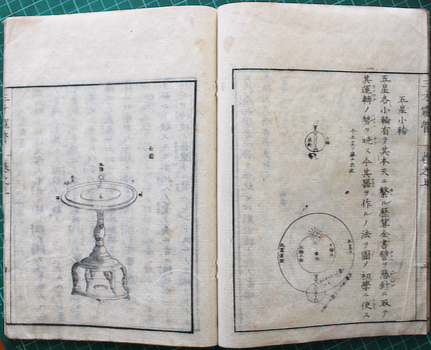
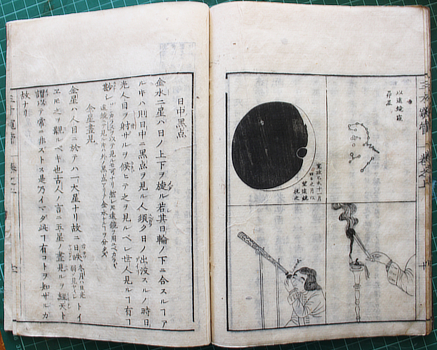
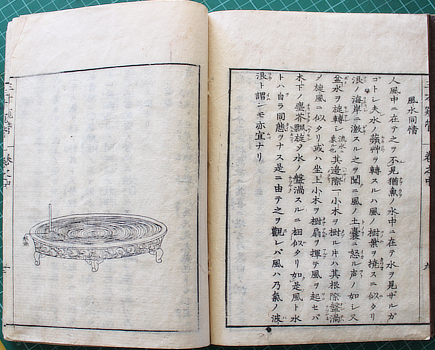
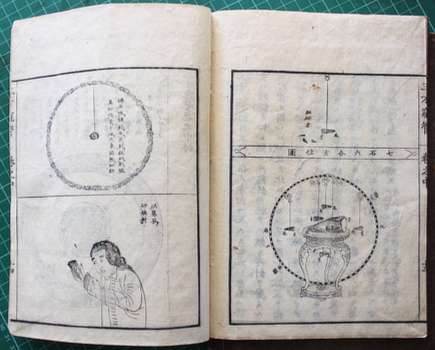
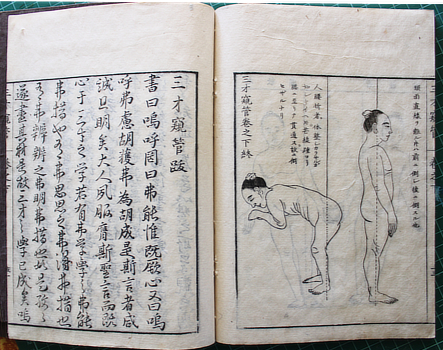
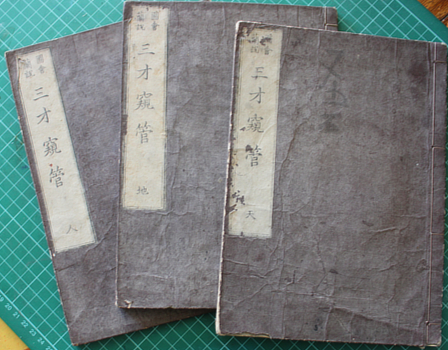
Hirose Shuhaku 三才窺管 [Sansai Kikan]. Edo (Tokyo), Yamazeki Kinbei 1808 (Bunka 5). Three volumes 26x18cm, publisher's wrappers with title labels (stitching on the last volume broken); woodcut illustrations. One astronomical illustration in the first part is meant to have a moving part (a volvelle) which isn't in this copy. Au$1500
Dutch studies - ie western science - rightly divided into three parts: heaven, earth, and people. This was apparently written by 1799 but not printed until 1808.
Not a lot seems known about Hirose beyond than he was a physician in Yatabe, student of Sugita Genpaku, a keen explorer of western science, and author of this book. Uehara Sadaharu in a paper investigating when Japanese scientists learnt about Uranus proposes an English source for Hirose's diagram of the solar system which includes Herschel's fairly recent discovery and suggests that, since Hirose was not a trained astronomer, his illustration is a bit crude but that he grasped the notion that planets exist beyond the reach of bright sunlight and may have unknowingly included Uranus well before the real astronomers caught up.

A sky full of poems
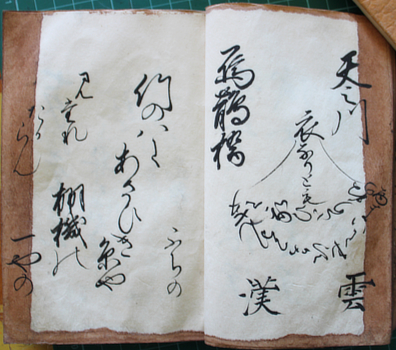
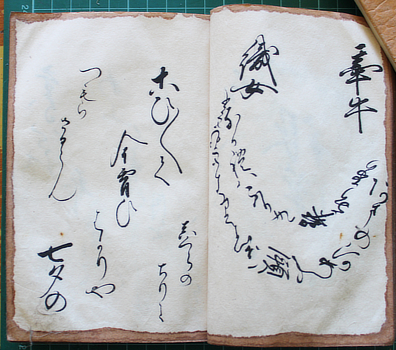
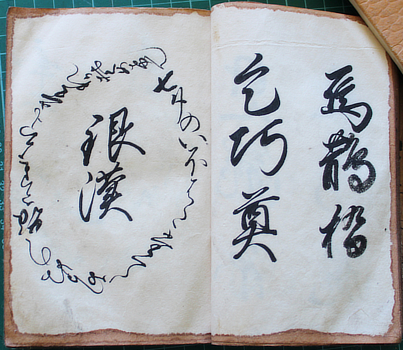
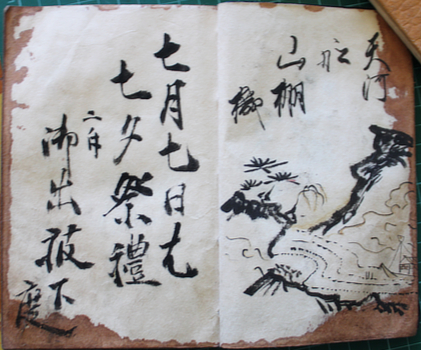
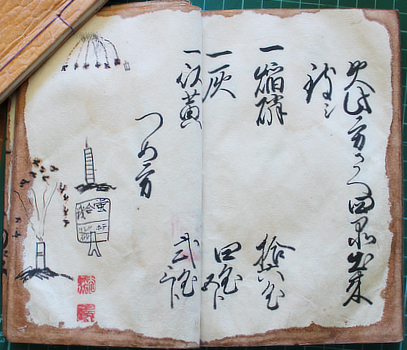
Fireworks. 棚機火術控 [Tanabatahijutsu Hikae?]. n.p. (c1860?). 17x11cm wrapper with manuscript title label (modern stitching); manuscript in ink with a few small illustrations. The edges have been treated with persimmon juice (kakishibu) which strengthens the paper and resists bugs. Loosely inserted three leaves in the same hand. Au$800
Intriguing, even among fireworks manuals, this is actually two books. The second half is the manual and the first half is poetry celebrating the Tanabata fireworks festival. Much of this is written in the form of fireworks, each page is a painting of a sky full of fireworks. At the beginning is a small sketch map showing where to park your boat to watch the fireworks.
The inscription at the end says, I think, that this written by Imai Noboru and a small stamp near the beginning says 今井職書 (Imai Shokusho), and the date Ansei 5 (1858) appears a couple of times at the beginning of the manual section. In 2024 a lecture was given at the Miyoshi City (Hiroshima) Library on this work which suggests they have a copy but I can't find a record of this anywhere else.

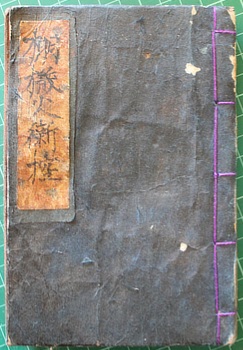
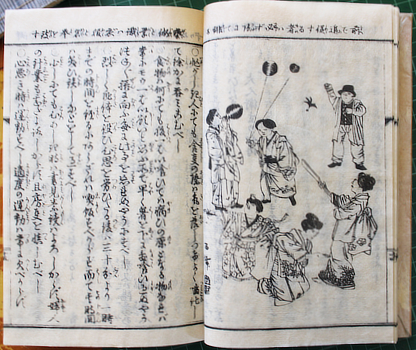
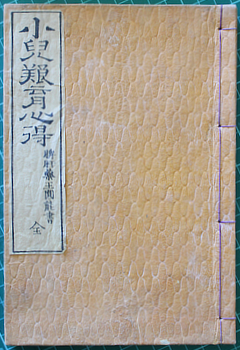
Ishida Katsunobu. 小児養育の心得 : 脾肝薬玉円功能書 [Shoni yoiku no kokoroe : hikan'yakugyokuenkonosho]. Kyoto, Ishida 1895 (Meiji 28). 22x15cm, publisher's embossed wrapper with printed label; 56pp (28 double folded leaves); woodcut illustrations, some full page, one with added dash of red (which is purposeful). Au$200
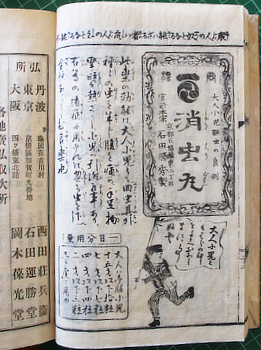
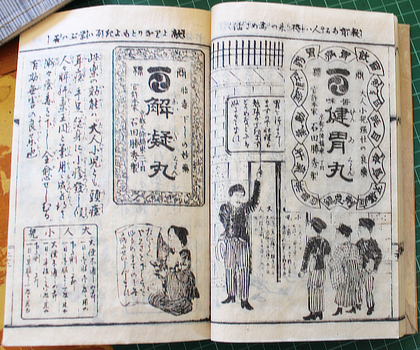
A popular manual of child rearing that appeared in various forms through the Meiji period. This edition is particulary appealing thanks to the illustrated advertisements for pills for stomach complaints, worms and something as yet unidentified. In one schoolboys are being instructed in the benefits of Kenigan for the stomach and in another a schoolboy hurries to bring the news of Shochugan - for worms - on his banner.

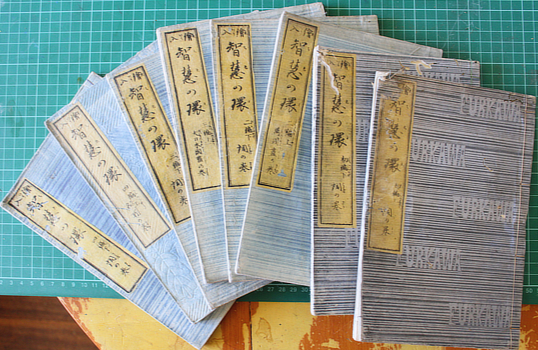
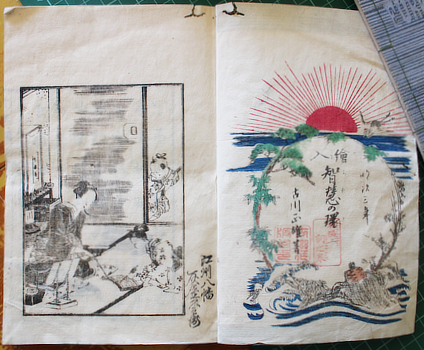
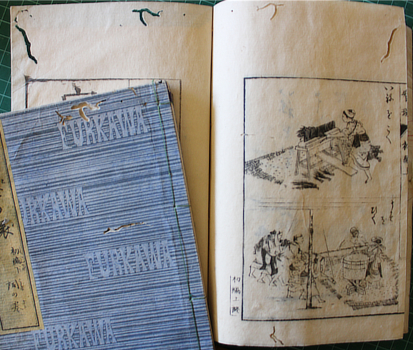
Furukawa Masao. 繪入智慧の環 [Eiri Chienowa]. Tokyo, Okataya Kashichi 1870-72 (Meiji 3 - 5). Four books in eight volumes publisher's patterned wrappers, title labels. 13 folding colour maps (one fold partly separated), nine pages of colour flags, numerous illustrations throughout. A few outbreaks of worming, unsightly but not fatal.
I suspect this is a made up set - mostly because of volume four part two - but with the time gap between each part and since I've only ever seen a complete set of the second edition (1873), it's just a guess. The first two parts here have 'Furkawa' incorporated in to the cover design which was used on the second edition. Just noting the differences from copy to copy of the same edition will keep you busy for a while. Au$750
A complete set, and rare, of this introduction to children's elementary education. This was chosen as one of the first modern picture books by the NDL, for their 2018 exhibition of Japanese picture books: it "led to the development of today's knowledge picture books for children" (see the NDL Newsletter no.218).
Despite the help of Worldcat I traced four complete sets outside Japan: Harvard Yenching; Amherst Lyman; Stanford; and the BL.

Any colour as long as ...
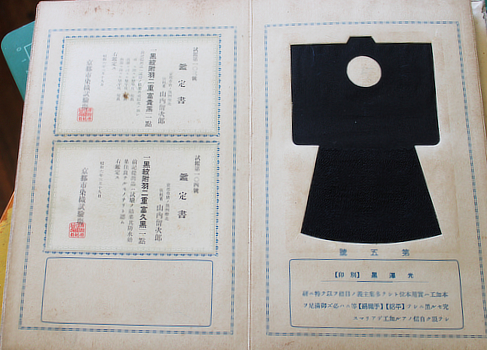
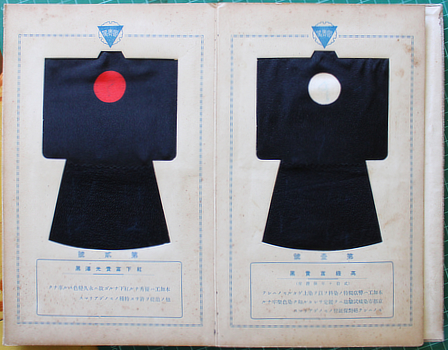
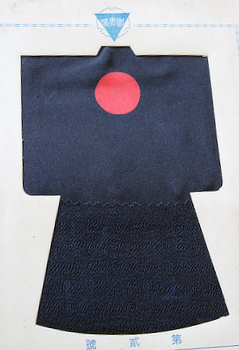
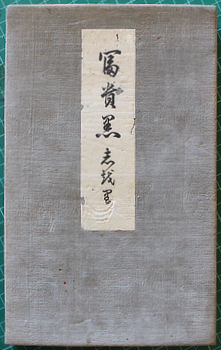
Black silk samples. 冨貴黒 [Fukikuro]. Kyoto, 1931 (Showa 6). 25x15 publisher's cloth (silk?) with printed label (marked); six heavy card leaves accordian folding with silk samples in five kimono shaped frames and accompanying text. Browning of the card. Au$350
This smart sample book shows off new rich black dyes, years in the making. The Japanese might have embraced western wear but nothing beats the elegance of a black kimono. That's the message of the introduction.
This is even smarter than a first glance reveals: the upper, short jacket, part is different fabric from the rest.

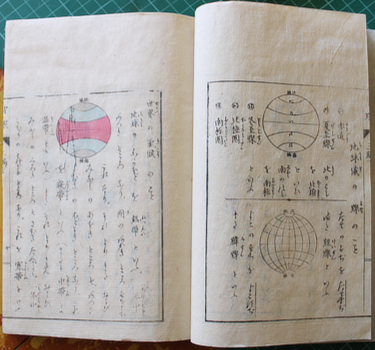
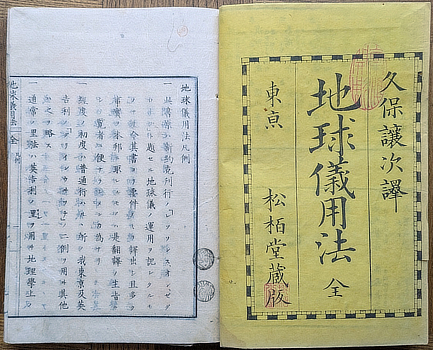
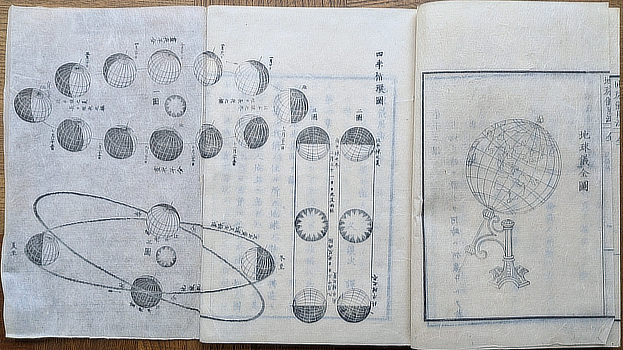
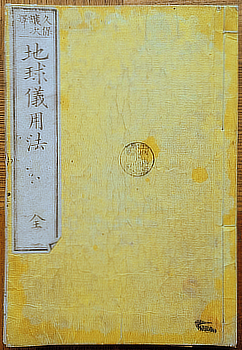
Kubo Joji. 地球儀用法 [Chikyugi Yoho]. Tokyo, Shohakudo 1874 (Meiji 7). 23x15cm publisher's wrapper with title label (marked; stitching broken); one full page and one folding plate. Au$250
Instructions for using a globe. Kubo is the translator but I haven't figured out who from and no-one else helps. Worldcat finds no copies outside Japan.

The curse of the photograph
Gomeiro Tamasuke & Ito Senzo 開明奇談写真廼仇討 [Kaimei Kidan Shashin no Adauchi]. Tokyo?, Hiyoshido 1887 (Meiji 20). 19x12cm publisher's cloth backed colour illustrated boards; 100pp, one double page, four full page illustrations. Smudges and minor signs of use, rather good. Au$750
A murder mystery revenge tale in which a photograph both identifies the killer and can curse that killer. Stabbing portraits has a long history in the west but usually in fury, for wish fullfilment and, in a few cases, as practice for the real thing. Witchcraft didn't come into it. As far as I'm aware using a portrait to curse someone was not much of a thing in Japan, there were plenty of other ways. And photographs? Is there any earlier use of photos to curse someone? The authority on early Japanese photography, Ozawa Takeshi, said this is the first Japanese novel about photography and I'm not going to argue with him.
This is a reprint; it first appeared, I think, in maybe 1883-84 in two parts. Another expert, Uchibayashi Shun, who unravelled some of the tangle of editions wrote in 2020 that after 15 years search he had managed to get his hands on volume one of the original edition. It is a sokkibon, a stenographic book, from a story told by Gomeiro transcribed by Ito. And it's a 'ball cover' (boru hyoshi) book - a symbol of modernity and the Japanese equivalent of a yellowback: flimsy western style bindings with lithograph covers that rarely survive in decent shape. Worldcat finds no copies of any edition outside Japan.

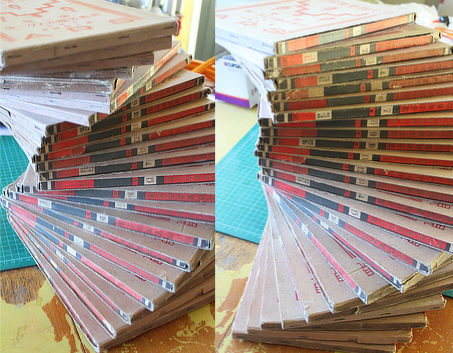
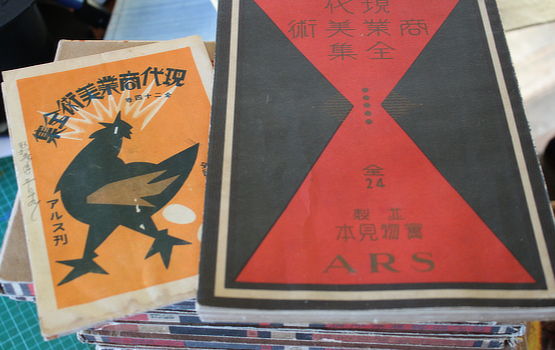
Hamada Masuji, Sugiura Hisui and others. 現代商業美術全集 [Gendai Shogyo Bijutsu Zenshu - The Complete Commercial Artist]. Tokyo, Ars 1928-30 (Showa 3 - 5). 24 volumes quarto, publisher's wrappers & printed card slipcases; thousands of illustrations, most colour. A rather good set, small chips from a few spines.
With: the publisher's sample book: publisher's wrapper; [2],8pp, 62 pages of illustrations and plates, most in colour, 16pp of text and a quanity of blank leaves to bulk out the book. Endpapers mostly cut out.
And: a scruffy copy of the prospectus which unfolds to 39x54cm with details on one side and a colour collage on the other. Au$6500
A better than complete set of the Shogyo Bijutsu, one of the great monuments of Japanese modernism, of modernism anywhere and everywhere. Thanks to its scope there is nothing else quite like this.
Largely the work of Hamada Masuji - credited with the invention of design as a profession in Japan - it is an encyclopaedic gathering of all that is new and exciting in Russia, Europe, Britain and America from art nouveau to bauhaus and constructivism, with futurism, expressionism, dada and everything else along the way lavishly mixed with Japanese responses to, and digestion of, these western ideas. Any number of exciting artists and designers contributed.
Each volume is devoted to a topic or related topics and commercial design here means more than it does to us. So as well as volumes on posters, advertisements, billboards, typography, and similar graphic arts (like bookbindings, magazine, brochure and catalogue covers, packaging, labels, trademarks and placards), there are volumes devoted to the architecture of the shop from the mightiest department store to the most chic Parisian shop window and the display within. Exterior and interior design, showcases and fittings - shops, restaurants, cinemas, even a barber shop or beauty parlour is laid out. One volume is devoted to lighting: neon lights, the lighting of commercial spaces and illuminated signs. Another volume is devoted to kiosks, pavilions and floats, festive decoration, facades, gateways and entrances, while the following volume continues into international exhibitions. Volume 22 is devoted to traditional Japanese shop signs and banners, a treat in itself, while volume 14 explores photography and humour in graphic art - so German photo-montage and French caricature share a volume.
*Rather than do any work I've re-used old photos of the contents of these. The outside is new, the inside not so much.

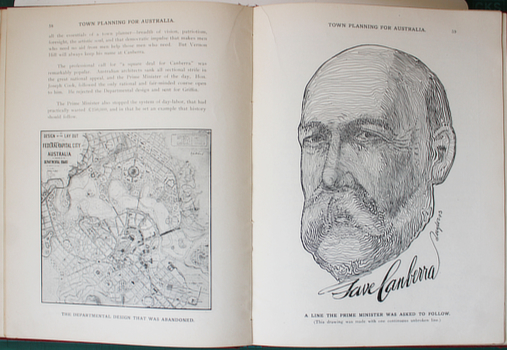
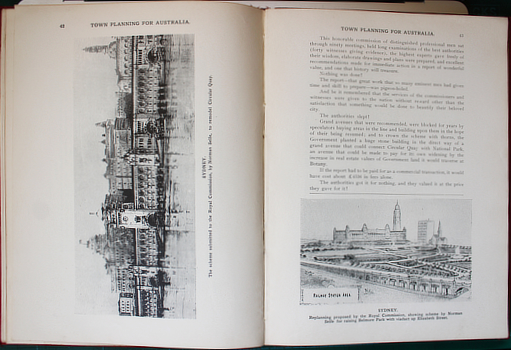
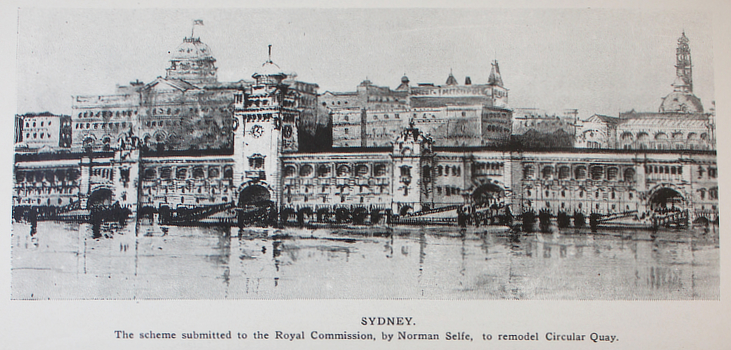
TAYLOR, George A. [Augustine]. Town Planning for Australia. Sydney, Building Limited [1914]. Small quarto publisher's cloth; 136pp, numerous photos illustrations, plans & diagrams. Signs of use but nothing too serious. Inscribed and signed by Taylor. Au$500
First edition and quite uncommon. There were at least three editions but has anyone ever seen all of them? Taylor was a tireless progressive reformer with an old testament approach and style. His themes and subjects are familiar, he worked at them over and over again: Griffin's Canberra design championed; Andersen's and Hebrard's proposed World Centre. Local details are not forgotten. The faults, flaws and chances for improvement in Sydney or Melbourne are worried over with examples, good and bad, drawn from all over the world.
That distinguished portrait of the prime minister is apparently a single line drawing, by Taylor, showing him the line to follow.

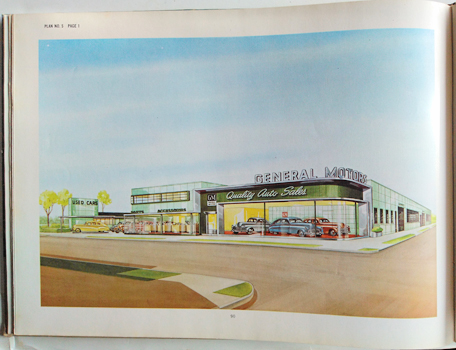
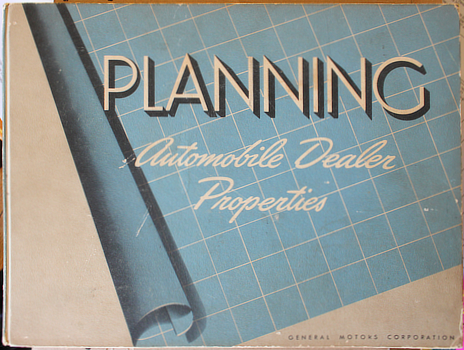
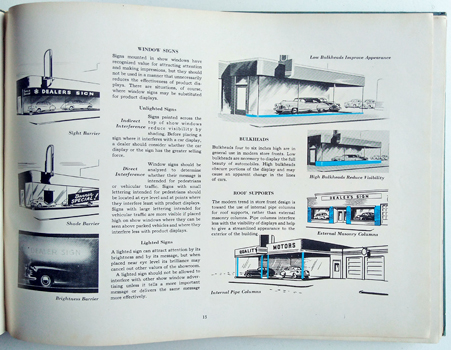
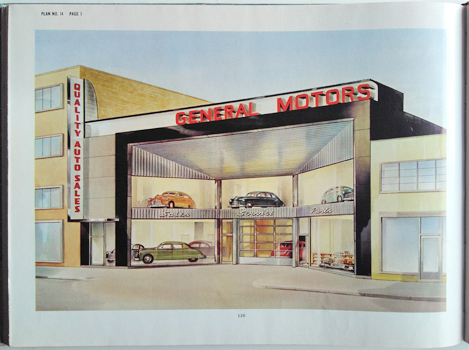
Architecture. General Motors Corporation. Planning Automobile Dealer Properties. Detroit, GMC 1948. Oblong folio (26x35cm) publisher's illustrated boards (edges rubbed, minor signs of use); 142pp, 16 colour plates with facing folding pages of description and plan; numerous other illustrations, diagrams and plans. Au$750
"This is a presentation of ideas rather than plans. Planning based on ideas looks forward." Archetypic automobile architecture doesn't get much better than this mid-century motoring modern manifesto. And I cut back the first draft alliteration in that sentence.
General Motors sponsored a competition through the Architectural Forum though it's not clear how that was incorporated into the sixteen designs offered here. GM say they took suggestions from architects, builders and dealers - as far away as Australia (probably Bill Stack). These ideas follow chapters on all sorts of stuff, from spare parts to sign lighting, and each suggestion tackles specific sites or problems.

Catalogue - hearses. Merts & Riddle, Ravenna, Ohio. Merts & Riddle: Coach and Hearse Builders. Ravenna, printed by S.D. Harris [188-?]. Oblong octavo publisher's illustrated wrapper; 50pp, full page wood engraved illustrations throughout. A remarkably good copy. Au$250
Ravenna was clearly more than a one hearse town in the later 19th and early 20th centuries. Merts and Riddle bought their employer's coach building company in 1861 and expanded into hearses a decade or so later. When Merts left in 1891 the company became Riddle Coach & Hearse Co.
This is the earliest catalogue - dated "1880 or so" - in the collection of Thomas Riddle, descendant and company historian. The catalogues at the Huntington with a conjectured date of 1875 aren't. Romaine did not see any Merts & Riddle catalogues.

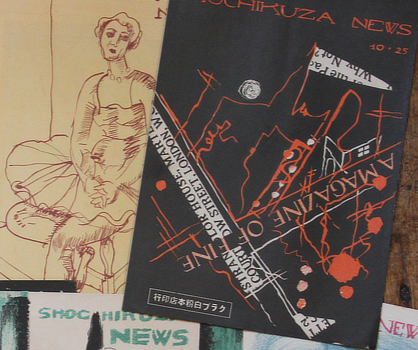
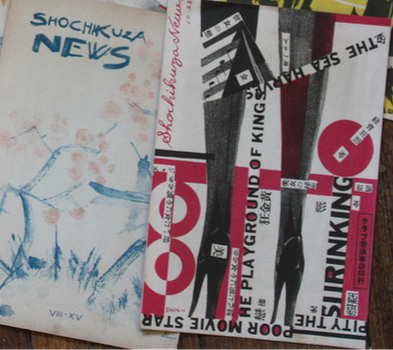
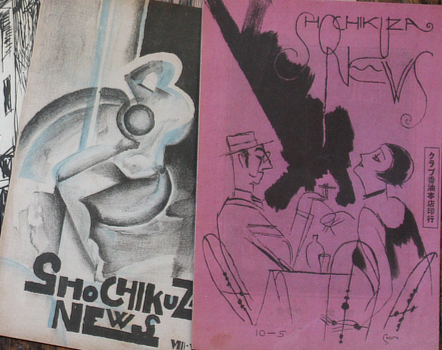
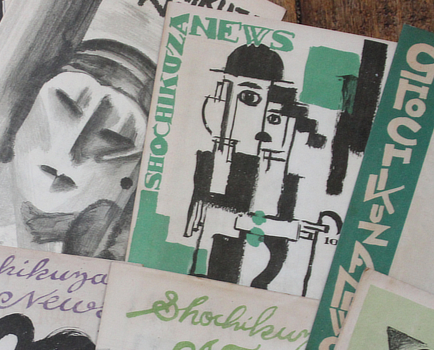
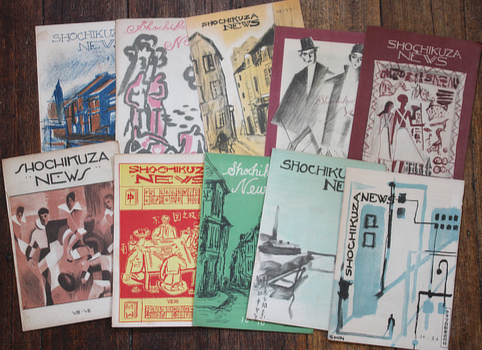
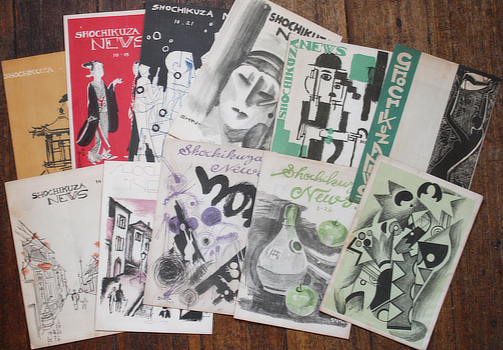
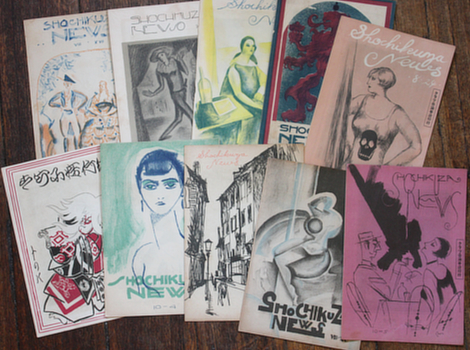
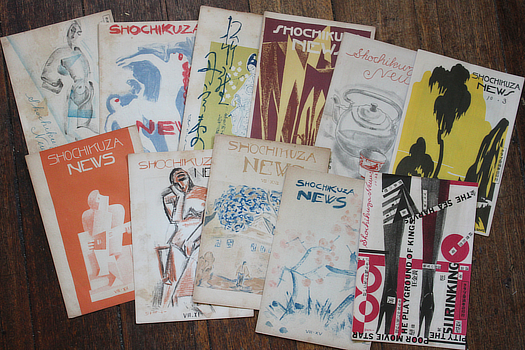
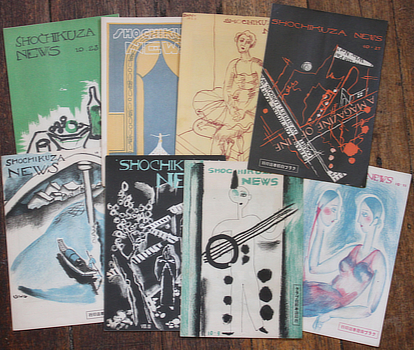
Shochikuza News. Osaka, Shochikuza 1927-1929. 50 issues 22x15cm publisher's colour illustrated wrappers; mostly four pages and covers. Some browning and minor signs of use. Added are three duplicates, one quite scruffy, and a couple of similar items from other companies. Au$1750
A pretty good gathering, there are a few half hearted issues. There might be a complete run of these out there somewhere but anyone mad enough to want them all would have to buy a lot of dull stuff, especially as the thirties went on.
Shochiku, now part of the megafauna of the entertainment industry, spread into film from Kabuki in 1920, built Japan's first western theatre in Osaka in 1923, and soon had a chain of cinemas showing foreign movies. This was their weekly news letter. I think the cover was shared but the contents were printed for each theatre. Inspired and aspiring young designers presumably worked on the usual terms: no credit and less money. There is quite a bit of remarkable anonymous graphic art of the twenties and early thirties with the Shochikuza banner. Not all of it is good but what is can be fabulous. As the thirties progressed the adventurousness evaporated and by the mid thirties they looked like film magazines from anywhere.
Here we can identify the artist of many. Those signed Shin or 伸吉 are by Yamada Shinkichi who started in Shochikuza's publicity department in 1922 and worked his way up to set and costume designer. What's remarkabe about Shochikuza and their artists is that while it's clear they studied and stole a lot, mostly from Europe, they didn't copy advertising. They studied art and design movements, graphic art, theatre and film design. It's no coincidence that a lot of covers were really set designs. They weren't selling film stars, they were selling the modern world. And showing that Japan - and Shochikuza of course - was a vital part of the modern world.

The Australian Joan of Arc
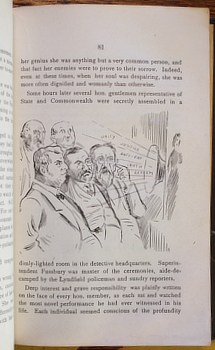
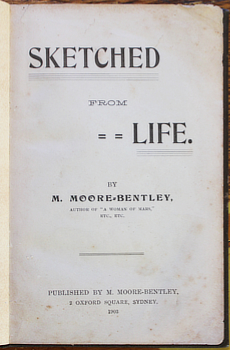
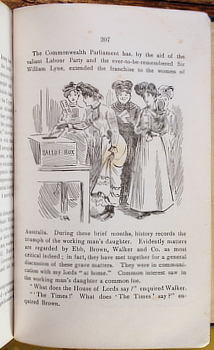
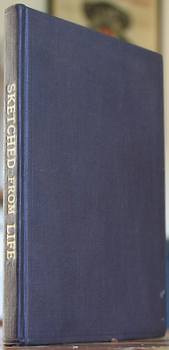
MOORE-BENTLEY, M. [Mary Ann]. Sketched from Life. Published by M. Moore-Bentley, Sydney 1903. Octavo modern cloth; b/w illustrations scattered throughout, most but not all signed C.H.H. Signs of use but most acceptable. Au$600
A political romance and novel of wish fulfillment with a heroine pursued by all the powers of the press, the police, the establishment, variously called "The Lyndhurst Mystery," the "Australian Joan of Arc", the "working man's daughter", physically a "tall, commanding, Minerva-like figure," (Moore-Bentley was described as tall and slender) and finally an "Australian Dreyfus."
Our Australian Joan of Arc terrifies her enemies, the old men, by using something that is in effect the talkies. The explanation confused me but it has the same effect as film with sound.
At the end is an advertisement inviting subscriptions for A Woman of Mars, or Australia's Enfranchised Woman (1901) with a page of subscribers' names. If that is the complete list then I count 25 copies sold. A lot less that the 18,000 odd votes she got when she ran for the New South Wales senate this same year. A Woman of Mars starred a feminist visitor from Mars in Sydney.
Trove finds two copies of this: at the Mitchell and the National Library; Worldcat adds no more. I noticed that the ADB still lists her under her married name, Mary Ling, a name she had discarded by 1901.
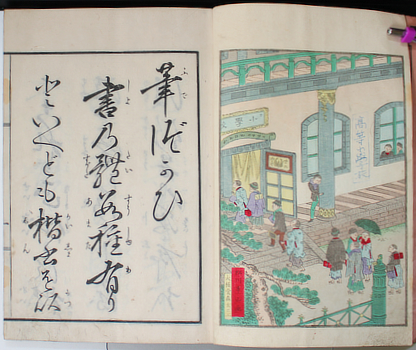
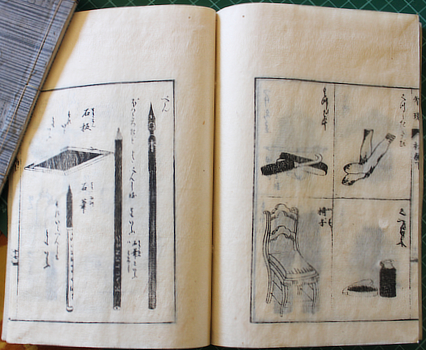
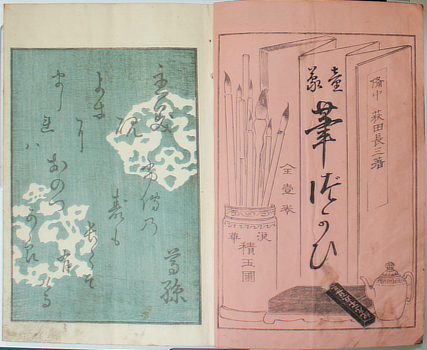
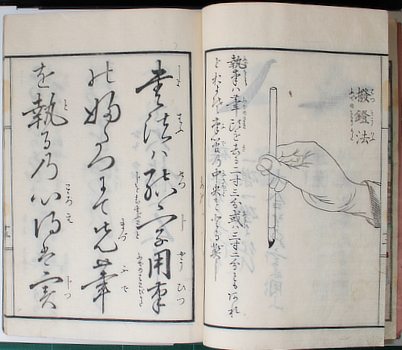
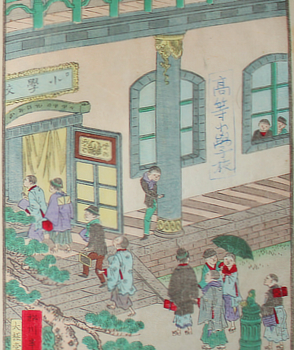
Ogita Chozo. 童蒙筆づかひ [Domofudezukai]. Osaka, Sekigyokuho 2533 (ie 1873). 22x15cm publisher's wrapper with title label (surface a bit chewed); 21 double leaves and six more of advertisements, illustrated title, colour woodcut title and frontispiece by Matsukawa Hanzan, one illustration in the text. The imperial date is on the ink stick in the title page. Used but mildly for a kid's book. Au$350
A charming handwriting book; the frontispiece is of cheerful - and well-to-do - looking boys on their way into an ultra modern school to learn traditional brushmanship. In an Osaka exhibiton that included this book I came across a popular quote which roughly translates as, "Tap a cropped head and you'll hear the sound of modernisation."
Worldcat finds one copy outside Japan, in the Benjamin Smith Lyman collection.

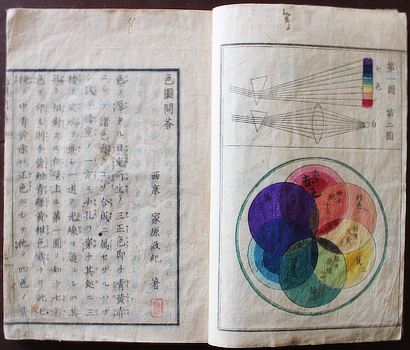
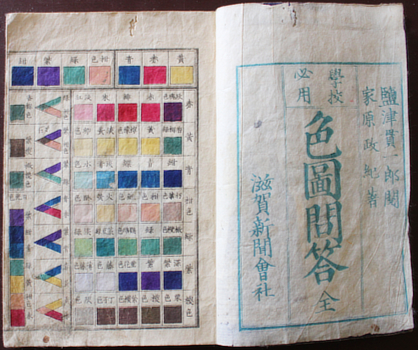
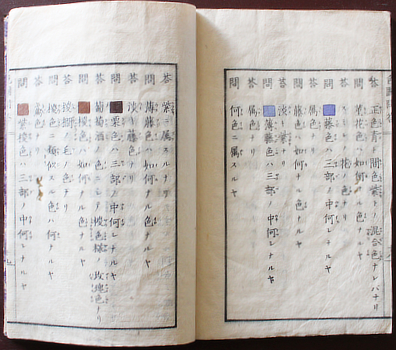
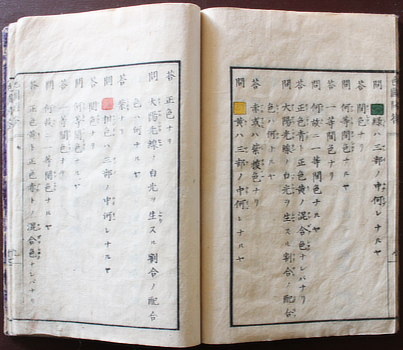
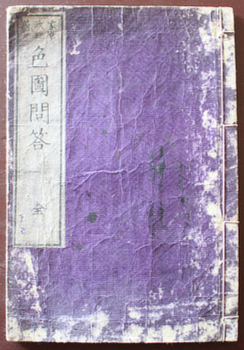
Iehara Masanori & Shiozu Kanichiro. 学校必用 : 色図問答 [Gakko Hitsuyo : Irozu Mondo]. Kyoto, Shiga Shinbun 1876 (Meiji 9). 21x15cm publisher's wrapper with title label; 22 double folded leaves, two colour charts and small colour squares through the text, hand coloured. Used, with some grubby thumbprints and an insignificant touch of worming. Not bad for an old school book. Au$500
Western colour theory introduced to Japanese students. This was, according to one historian and repeated by others, first published in 1873 but I can't find any copy earlier than 1876. I have read that it comes from a copy of an American book by Marcius Willson but I think there is some confusion. Willson produced wall charts for American schools that were used in Japan and maybe in 1873 wall chart no. XIV arrived. The chart was included in a version of the Shogaku Nyumon seies of elementary introductions in 1875, without the explanation we have here. His accompanying writings on color in his Manual of Information and Suggestions for Object Lessons - the work cited - are nothing like this. In any case he seems to have borrowed Field's chromatics. So it was English colour theory that made its way into Japan first. I'd make a pretty confident bet that this is the first edition.

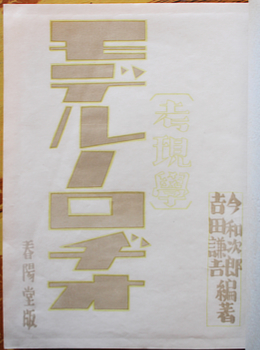
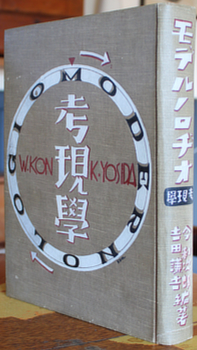
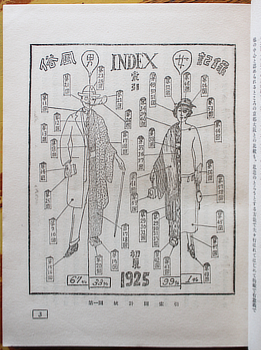
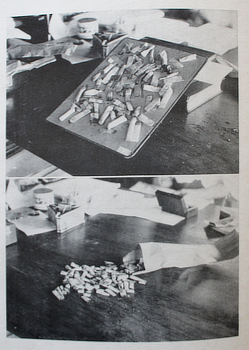
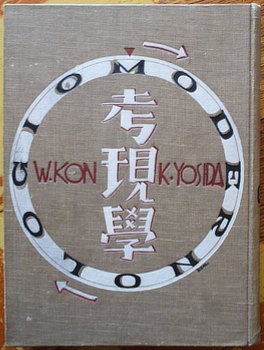
Kon Wajiro & Yoshida Kenkichi. モデルノロヂオ : 考現学 [Moderunorojio - Kogengaku]. (Modernologio on the cover). Tokyo, Shun'yudo 1930 (Showa 5). 26x20cm, publisher's decorated cloth blocked in white, red and black; 361pp, profusely illustrated throughout, a few photo or colour plates. Endpapers and edges browned as usual; a rather good copy, the cover bright, of a book that invites thumbing. Au$850
First printing. This is an extraordinary book; the gospel of Modernology. Kon and Yoshida have compiled an encyclopaedia, surely unsurpassed, of the apparently ordinary, of the people of Tokyo, fit to provoke unseemly enthusiasm in theoreticians and urban planners ever since. I gather that their thesis - born out of watching the people of Tokyo begin to rebuild after the 1923 earthquake and fire - is that those who do the planning, designing and building know nothing of what people actually do, what they own and how they use those things ... how they live and who they are.
The cover, signed Ken, and a lot of the illustrations are by Yoshida who has re-spelled his name on the cover for the sake of the design. The more I find out about Yoshida the more interesting he gets. I'm starting to think he was, to Kon, what Braque was to Picasso.

The female messiah
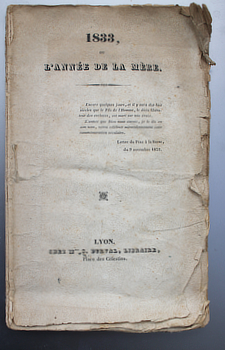
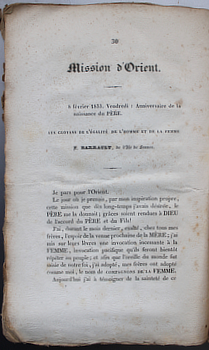
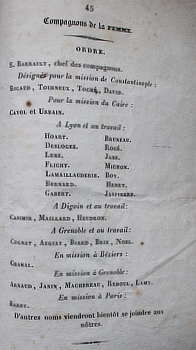
Compagnons de la Femme. [Emile Barrault]. 1833: ou l'Annee de la Mere. Lyon, Mme S Durval [1833]. Octavo, side stitched; 48pp. Title rather ragged and dusty, dog-eared. A tired copy but worth preserving. Au$150
Probably the second of maybe four issues of this rare work. This is titled February on the leaf after the title; others known to exist are January and two more with different titles that apparently appeared in June and July.
One of the more loopy, to be polite, excursions of the Saint-Simonians: a group formed themselves as the Companions of Women and set off to find a prophesised female messiah in the middle east. If nothing else it allowed them to ignore all and any women at home. Papa Enfantin intervened and got them to work building industry and railroads and colonising north Africa.