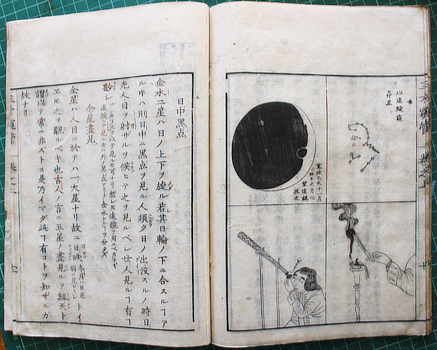
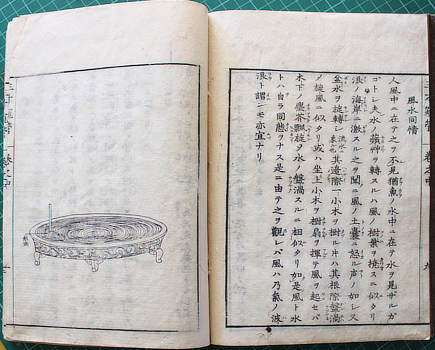
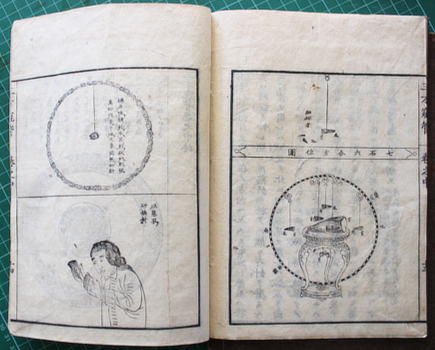
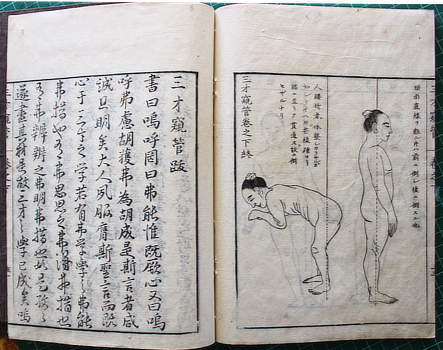
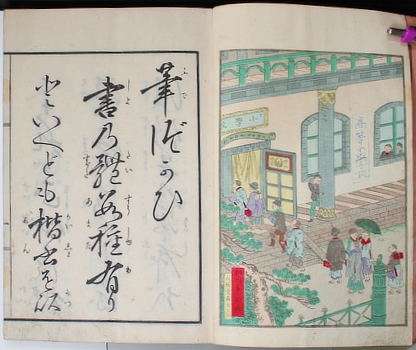
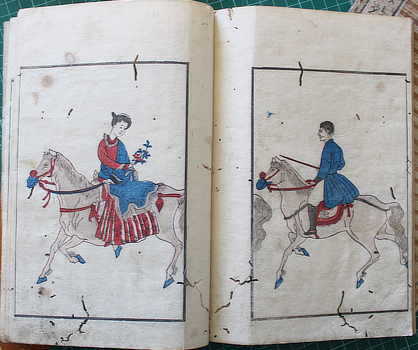
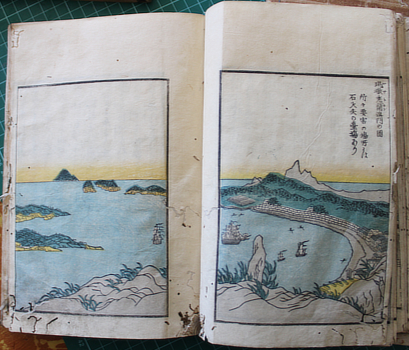
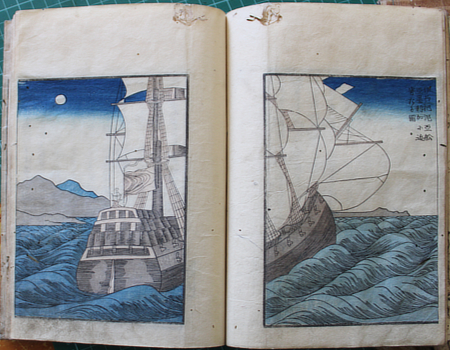
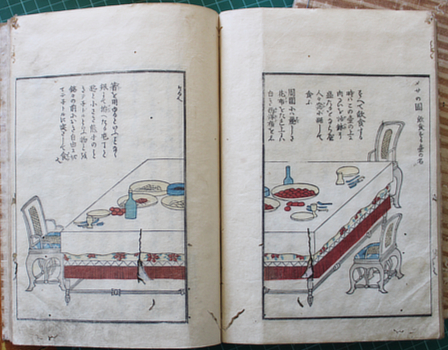
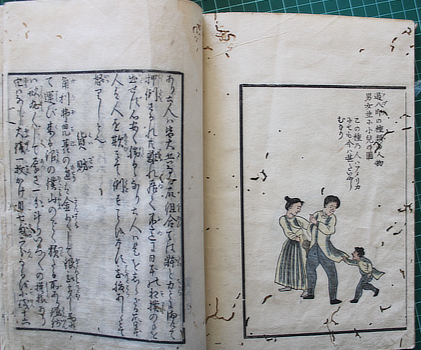
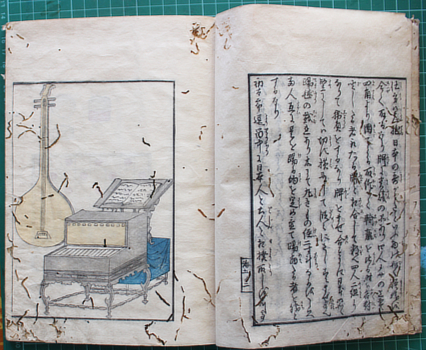
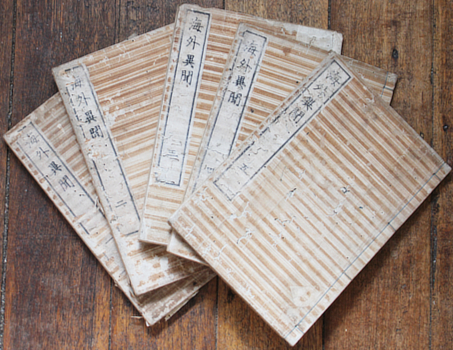
Hirose Shuhaku 三才窺管 [Sansai Kikan]. Edo (Tokyo), Yamazeki Kinbei 1808 (Bunka 5). Three volumes 26x18cm, publisher's wrappers with title labels (stitching on the last volume broken); woodcut illustrations. One astronomical illustration in the first part is meant to have a moving piece (a volvelle) which isn't in this copy. Au$1500
Dutch studies - ie western science - rightly divided into three parts: heaven, earth, and people.

A sky full of poems
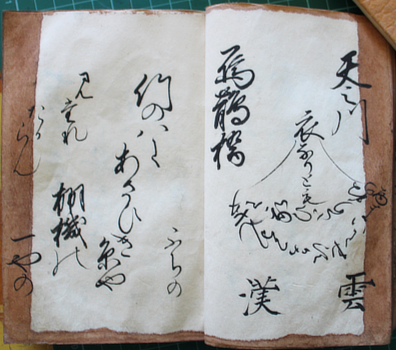
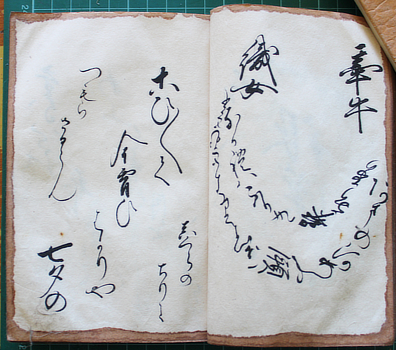
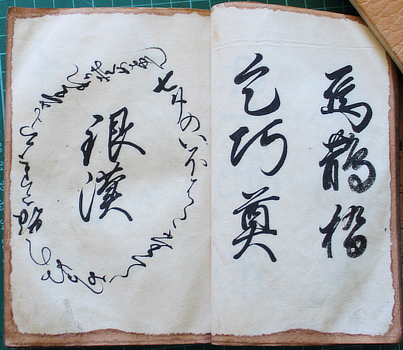
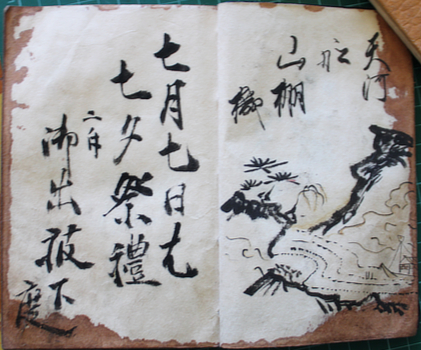
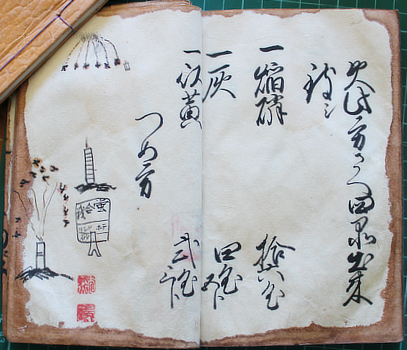
Fireworks. 棚機火術控 [Tanabatahijutsu Hikae?]. n.p. (c1860?). 17x11cm wrapper with manuscript title label (modern stitching); manuscript in ink with a few small illustrations. The edges have been treated with persimmon juice (kakishibu) which strengthens the paper and resists bugs. Loosely inserted three leaves in the same hand. Au$800
Intriguing, even among fireworks manuals, this is actually two books. The second half is the manual and the first half is poetry celebrating the Tanabata fireworks festival. Much of this is written in the form of fireworks, each page is a painting of a sky full of fireworks. At the beginning is a small sketch map showing where to park your boat to watch the fireworks.
The inscription at the end says, I think, that this written by Imai Noboru and a small stamp near the beginning says 今井職書 (Imai Shokusho), and the date Ansei 5 (1858) appears a couple of times at the beginning of the manual section. In 2024 a lecture was given at the Miyoshi City (Hiroshima) Library on this work which suggests they have a copy but I can't find a record of this anywhere else.

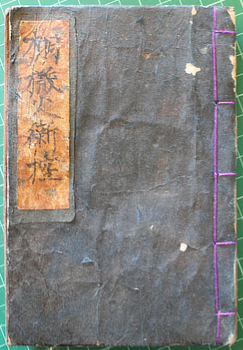
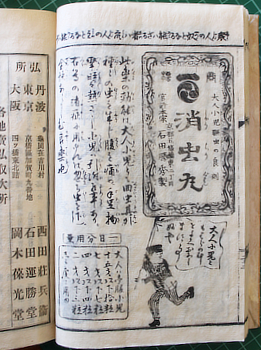
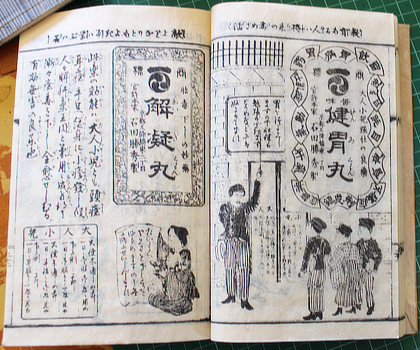
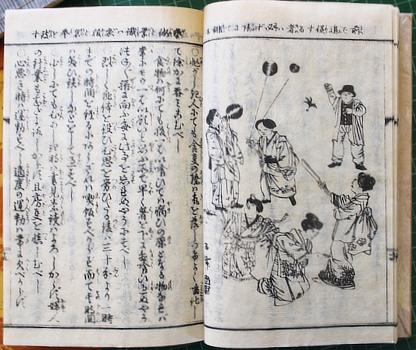
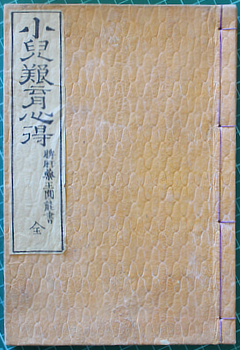
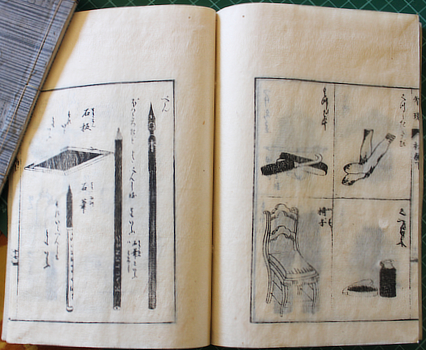
Ishida Katsunobu. 小児養育の心得 : 脾肝薬玉円功能書 [Shoni yoiku no kokoroe : hikan'yakugyokuenkonosho]. Kyoto, Ishida 1895 (Meiji 28). 22x15cm, publisher's embossed wrapper with printed label; 56pp (28 double folded leaves); woodcut illustrations, some full page, one with added dash of red (which is purposeful). Au$200
A popular manual of child rearing that appeared in various forms through the Meiji period. This edition is particulary appealing thanks to the illustrated advertisements for pills for stomach complaints, worms and something as yet unidentified. In one schoolboys are being instructed in the benefits of Kenigan for the stomach and in another a schoolboy hurries to bring the news of Shochugan - for worms - on his banner.

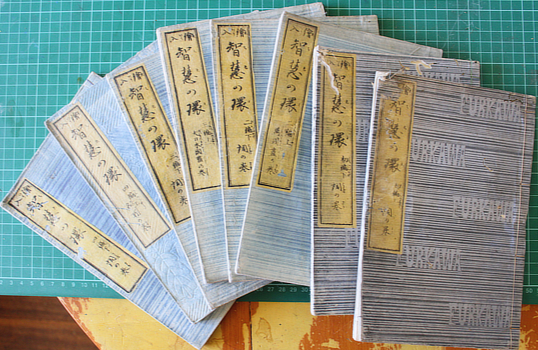
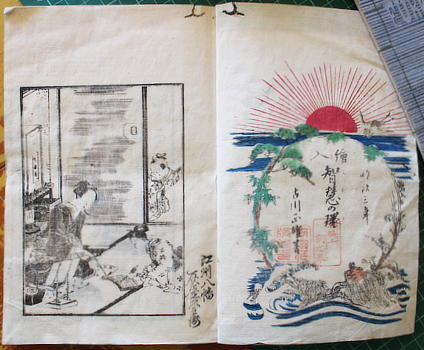
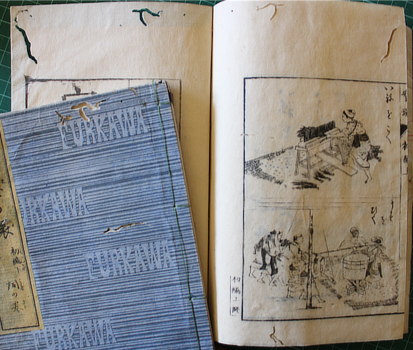
Furukawa Masao. 繪入智慧の環 [Eiri Chienowa]. Tokyo, Okataya Kashichi 1870-72 (Meiji 3 - 5). Four books in eight volumes publisher's patterned wrappers, title labels. 13 folding colour maps (one fold partly separated), nine pages of colour flags, numerous illustrations throughout. A few outbreaks of worming but nothing fatal.
I suspect this is a made up set - mostly because of voloume four part two - but with the time gap between each part and since I've only ever seen a complete set of the second edition (1873), it's just a guess. The first two parts here have 'Furkawa' incorporated in to the cover design which was used on the second edition. Just noting the differences from copy to copy of the same edition will keep you busy for a while. Au$750
A complete set, and rare, of this introduction to children's elementary education. This was chosen as one of the first modern picture books by the NDL, for their 2018 exhibition of Japanese picture books: it "led to the development of today's knowledge picture books for children" (see the NDL Newsletter no.218).
Despite the help of Worldcat I traced four complete sets outside Japan: Harvard Yenching; Amherst Lyman; Stanford; and the BL.

Any colour as long as ...
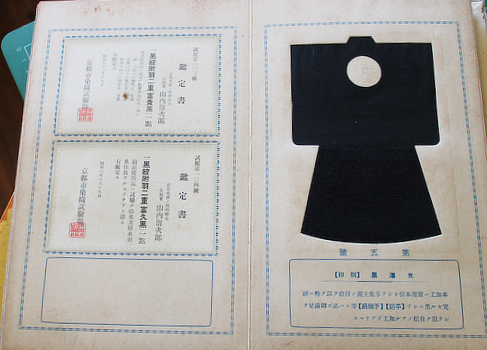
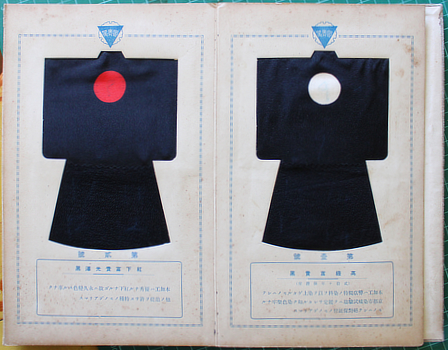
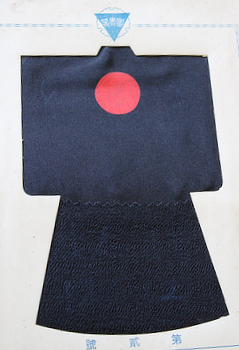
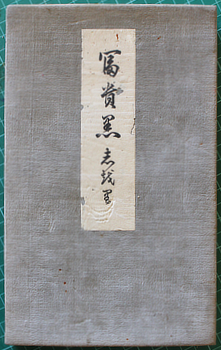
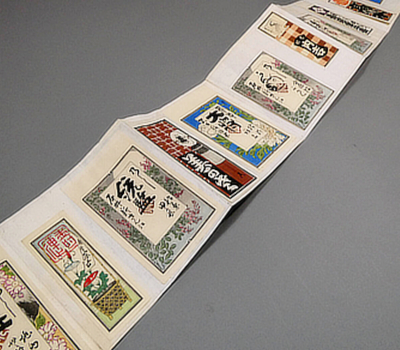
Black silk samples. 冨貴黒 [Fukikuro]. Kyoto, 1931 (Showa 6). 25x15 publisher's cloth (silk?) with printed label (marked); six heavy card leaves accordian folding with silk samples in five kimono shaped frames and accompanying text. Browning of the card. Au$350
This smart sample book shows off new rich black dyes, years in the making. The Japanese might have embraced western wear but nothing beats the elegance of a black kimono. That's the message of the introduction.
This is even smarter than a first glance reveals: the upper, short jacket, part is different fabric from the rest.

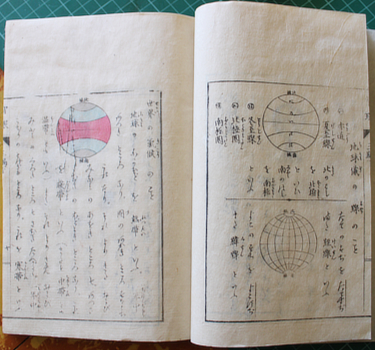
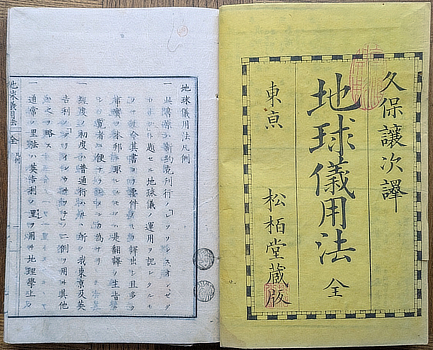
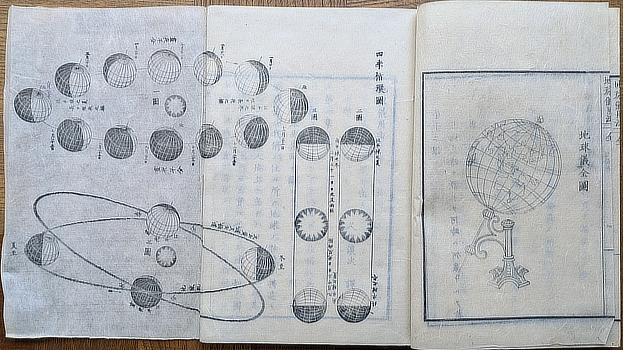
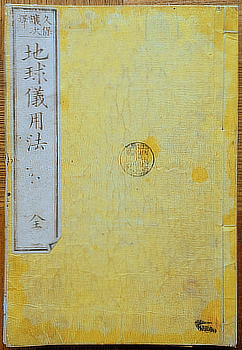
Kubo Joji. 地球儀用法 [Chikyugi Yoho]. Tokyo, Shohakudo 1874 (Meiji 7). 23x15cm publisher's wrapper with title label (marked; stitching broken); one full page and one folding plate. Au$250
Instructions for using a globe. Kubo is the translator but I haven't figured out who from and no-one else helps. Worldcat finds no copies outside Japan.

Gomeiro Tamasuke & Ito Senzo 開明奇談写真廼仇討 [Kaimei Kidan Shashin no Adauchi]. Tokyo?, Hiyoshido 1887 (Meiji 20). 19x12cm publisher's cloth backed colour illustrated boards; 100pp, one double page, four full page illustrations. Smudges and minor signs of use, rather good. Au$750
A murder mystery revenge tale in which a photograph both identifies the killer and can curse that killer. Stabbing portraits has a long history in the west but usually in fury, for wish fullfilment and, in a few cases, as practice for the real thing. Witchcraft didn't come into it. As far as I'm aware using a portrait to curse someone was not much of a thing in Japan, there were plenty of other ways. And photographs? Is there any earlier use of photos to curse someone? The authority on early Japanese photography, Ozawa Takeshi, said this is the first Japanese novel about photography and I'm not going to argue with him.
This is a reprint; it first appeared, I think, in maybe 1883-84 in two parts. Another expert, Uchibayashi Shun, wrote in 2020 that after 15 years search he had managed to get his hands on volume one of the original edition. It is a sokkibon, a stenographic book, from a story told by Gomeiro transcribed by Ito. And it's a 'ball cover' (boru hyoshi) book - a symbol of modernity and the Japanese equivalent of a yellowback: flimsy western style bindings with lithograph covers that rarely survive in decent shape. Worldcat finds no copies of any edition outside Japan.

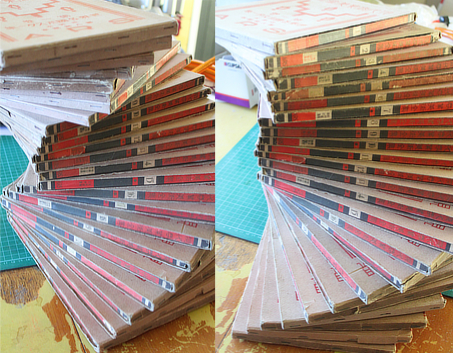
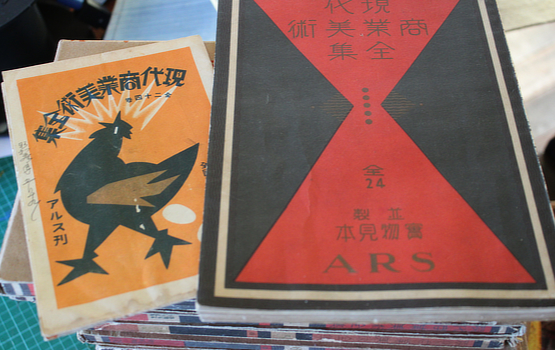
Hamada Masuji, Sugiura Hisui and others. 現代商業美術全集 [Gendai Shogyo Bijutsu Zenshu - The Complete Commercial Artist]. Tokyo, Ars 1928-30 (Showa 3 - 5). 24 volumes quarto, publisher's wrappers & printed card slipcases; thousands of illustrations, most colour. A rather good set, small chips from a few spines.
With: the publisher's sample book: publisher's wrapper; [2],8pp, 62 pages of illustrations and plates, most in colour, 16pp of text and a quanity of blank leaves to bulk out the book. Endpapers mostly cut out.
And: a scruffy copy of the prospectus which unfolds to 39x54cm with details on one side and a colour collage on the other. Au$6500
A better than complete set of the Shogyo Bijutsu, one of the great monuments of Japanese modernism, of modernism anywhere and everywhere. Thanks to its scope there is nothing else quite like this.
Largely the work of Hamada Masuji - credited with the invention of design as a profession in Japan - it is an encyclopaedic gathering of all that is new and exciting in Russia, Europe, Britain and America from art nouveau to bauhaus and constructivism, with futurism, expressionism, dada and everything else along the way lavishly mixed with Japanese responses to, and digestion of, these western ideas. Any number of exciting artists and designers contributed.
Each volume is devoted to a topic or related topics and commercial design here means more than it does to us. So as well as volumes on posters, advertisements, billboards, typography, and similar graphic arts (like bookbindings, magazine, brochure and catalogue covers, packaging, labels, trademarks and placards), there are volumes devoted to the architecture of the shop from the mightiest department store to the most chic Parisian shop window and the display within. Exterior and interior design, showcases and fittings - shops, restaurants, cinemas, even a barber shop or beauty parlour is laid out. One volume is devoted to lighting: neon lights, the lighting of commercial spaces and illuminated signs. Another volume is devoted to kiosks, pavilions and floats, festive decoration, facades, gateways and entrances, while the following volume continues into international exhibitions. Volume 22 is devoted to traditional Japanese shop signs and banners, a treat in itself, while volume 14 explores photography and humour in graphic art - so German photo-montage and French caricature share a volume.
*Rather than do any work I've re-used old photos of the contents of these. The outside is new, the inside not so much.
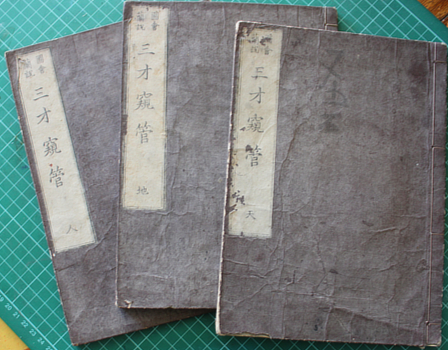
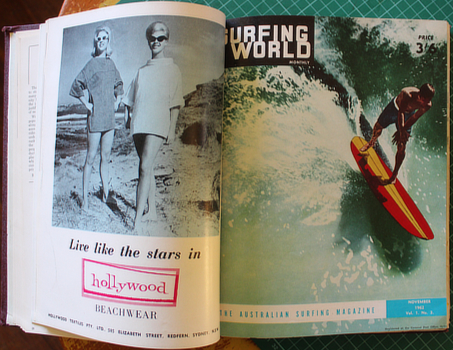
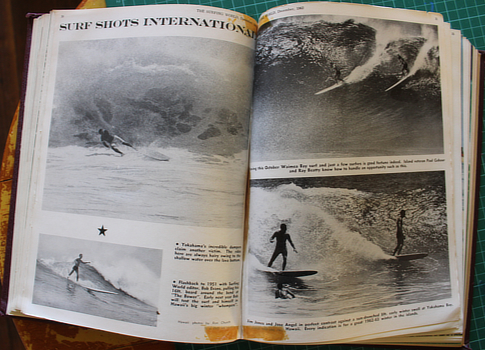
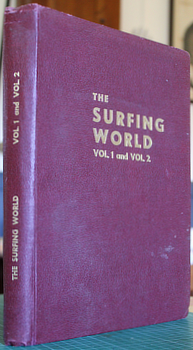
EVANS, Bob [ed]. Surfing World Vol 1 No 1 ... Vol 2 No 6. Sydney, September 1962 to August 1963. 12 issues quarto together in contemporary cloth titled in gilt, all covers preserved; thoroughly illustrated. A couple of old tape repairs; rather good. Au$625
The first year of the pioneering surf journal, begun as a sport went viral and became a way of life, but still more wholesome than not - a subculture rather than the drug raddled counterculture it would soon be. Trove finds no complete run, only two libraries hold issues from the earliest years.

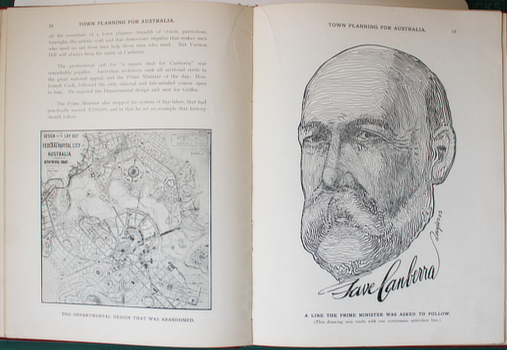
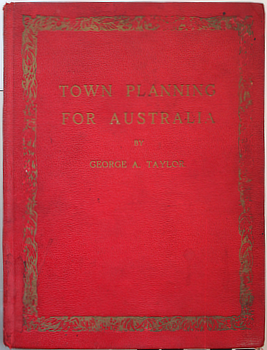
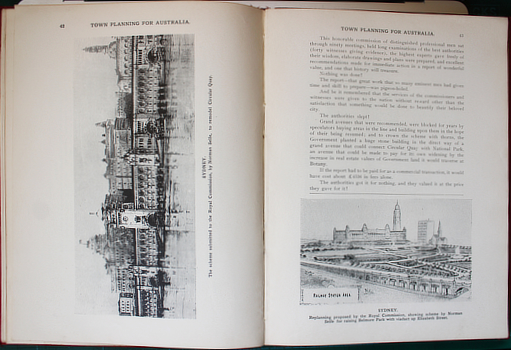
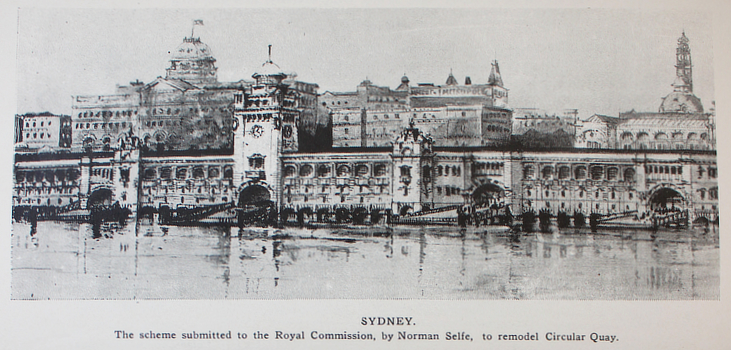
TAYLOR, George A. [Augustine]. Town Planning for Australia. Sydney, Building Limited [1914]. Small quarto publisher's cloth; 136pp, numerous photos illustrations, plans & diagrams. Signs of use but nothing too serious. Inscribed and signed by Taylor. Au$500
First edition and quite uncommon. There were at least three editions but has anyone ever seen all of them? Taylor was a tireless progressive reformer with an old testament approach and style. His themes and subjects are familiar, he worked at them over and over again: Griffin's Canberra design championed; Andersen's and Hebrard's proposed World Centre. Local details are not forgotten. The faults, flaws and chances for improvement in Sydney or Melbourne are worried over with examples, good and bad, drawn from all over the world.
That distinguished portrait of the prime minister is apparently a single line drawing, by Taylor, showing him the line to follow.

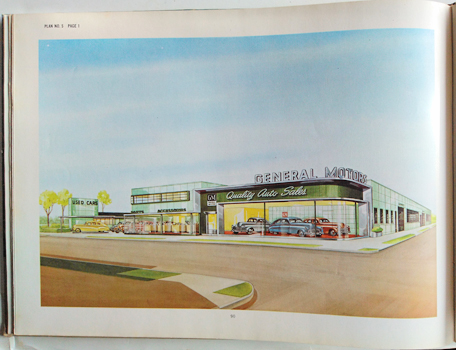
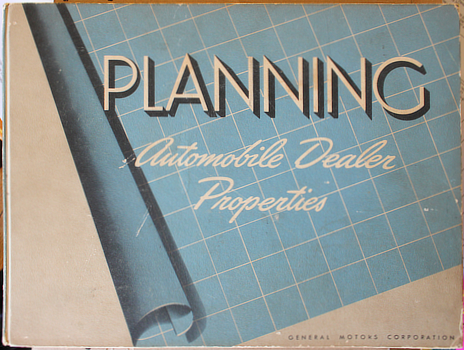
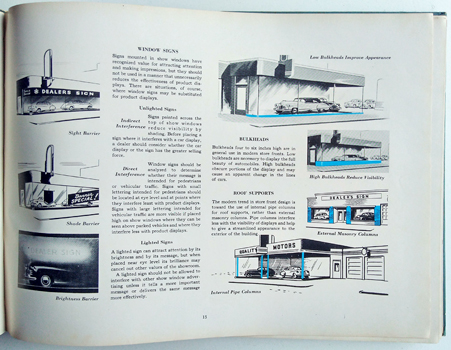
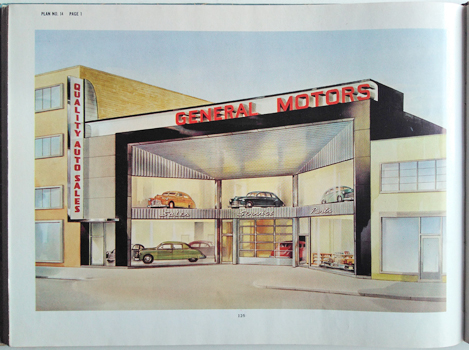
Architecture. General Motors Corporation. Planning Automobile Dealer Properties. Detroit, GMC 1948. Oblong folio (26x35cm) publisher's illustrated boards (edges rubbed, minor signs of use); 142pp, 16 colour plates with facing folding pages of description and plan; numerous other illustrations, diagrams and plans. Au$750
"This is a presentation of ideas rather than plans. Planning based on ideas looks forward." Archetypic automobile architecture doesn't get much better than this mid-century motoring modern manifesto. And I cut back the first draft alliteration in that sentence.
General Motors sponsored a competition through the Architectural Forum though it's not clear how that was incorporated into the sixteen designs offered here. GM say they took suggestions from architects, builders and dealers - as far away as Australia (probably Bill Stack). These ideas follow chapters on all sorts of stuff, from spare parts to sign lighting, and each suggestion tackles specific sites or problems.

Catalogue - hearses. Merts & Riddle, Ravenna, Ohio. Merts & Riddle: Coach and Hearse Builders. Ravenna, printed by S.D. Harris [188-?]. Oblong octavo publisher's illustrated wrapper; 50pp, full page wood engraved illustrations throughout. A remarkably good copy. Au$250
Ravenna was clearly more than a one hearse town in the later 19th and early 20th centuries. Merts and Riddle bought their employer's coach building company in 1861 and expanded into hearses a decade or so later. When Merts left in 1891 the company became Riddle Coach & Hearse Co.
This is the earliest catalogue - dated "1880 or so" - in the collection of Thomas Riddle, descendant and company historian. The catalogues at the Huntington with a conjectured date of 1875 aren't. Romaine did not see any Merts & Riddle catalogues.

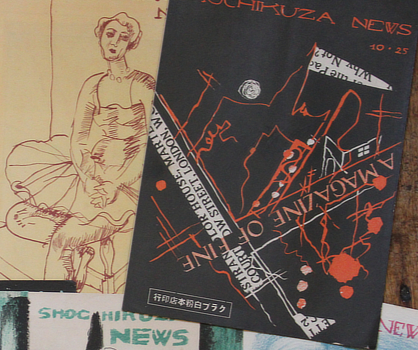
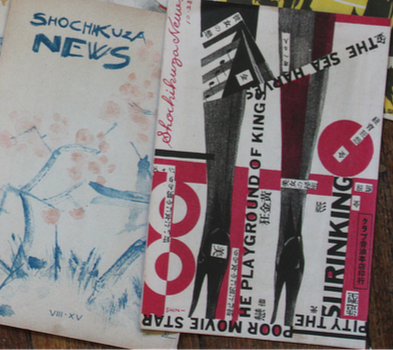
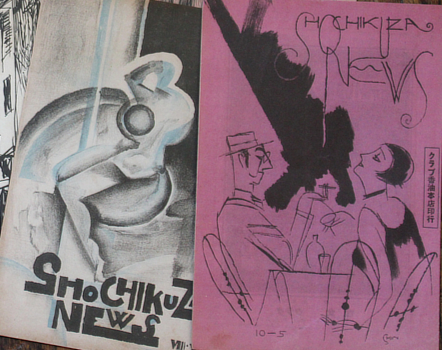
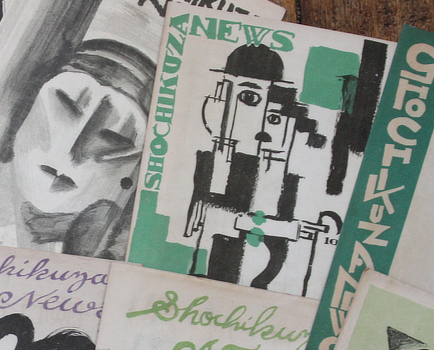
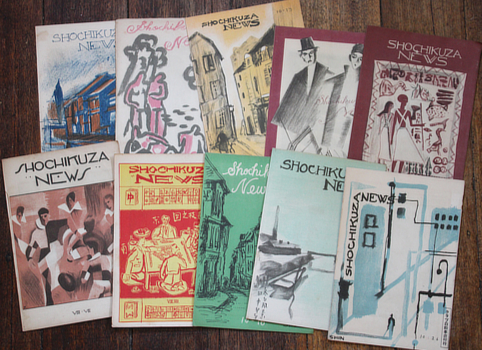
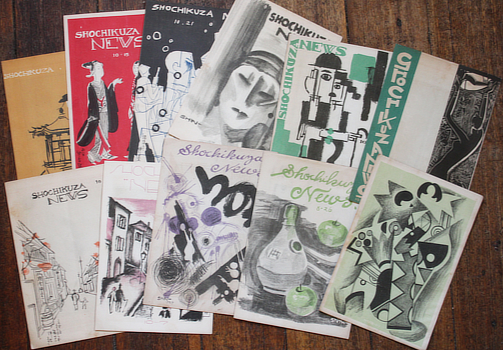
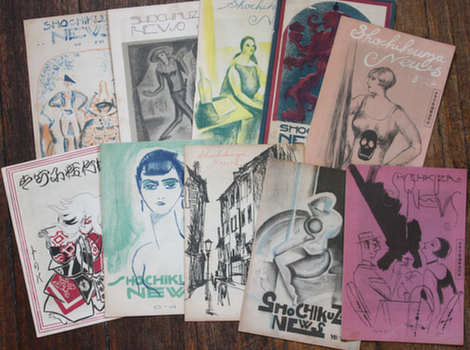
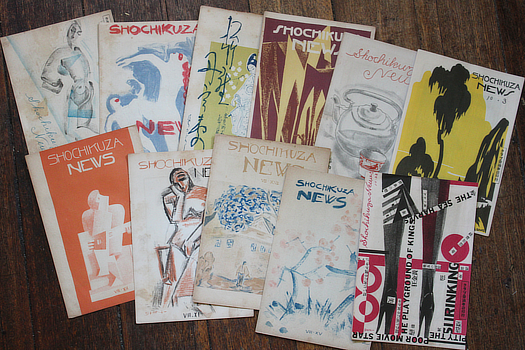
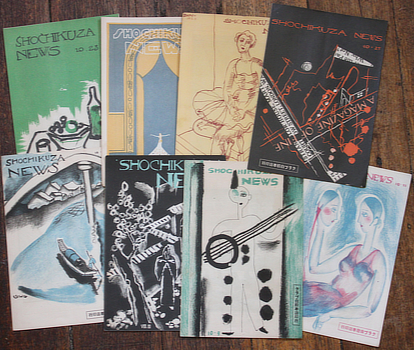
Shochikuza News. Osaka, Shochikuza 1927-1929. 50 issues 22x15cm publisher's colour illustrated wrappers; mostly four pages and covers. Some browning and minor signs of use. Added are three duplicates, one quite scruffy, and a couple of similar items from other companies. Au$1750
A pretty good gathering, there are a few half hearted issues. There might be a complete run of these out there somewhere but anyone mad enough to want them all would have to buy a lot of dull stuff, especially as the thirties went on.
Shochiku, now part of the megafauna of the entertainment industry, spread into film from Kabuki in 1920, built Japan's first western theatre in Osaka in 1923, and soon had a chain of cinemas showing foreign movies. This was their weekly news letter. I think the cover was shared but the contents were printed for each theatre. Inspired and aspiring young designers presumably worked on the usual terms: no credit and less money. There is quite a bit of remarkable anonymous graphic art of the twenties and early thirties with the Shochikuza banner. Not all of it is good but what is can be fabulous. As the thirties progressed the adventurousness evaporated and by the mid thirties they looked like film magazines from anywhere.
Here we can identify the artist of many. Those signed Shin or 伸吉 are by Yamada Shinkichi who started in Shochikuza's publicity department in 1922 and worked his way up to set and costume designer. What's remarkabe about Shochikuza and their artists is that while it's clear they studied and stole a lot, mostly from Europe, they didn't copy advertising. They studied art and design movements, graphic art, theatre and film design. It's no coincidence that a lot of covers were really set designs. They weren't selling film stars, they were selling the modern world. And showing that Japan - and Shochikuza of course - was a vital part of the modern world.

The Australian Joan of Arc
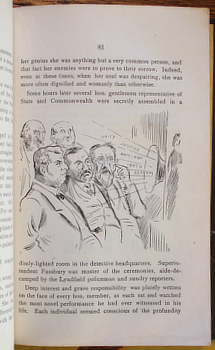
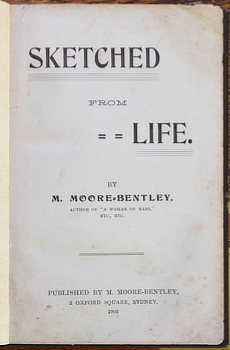
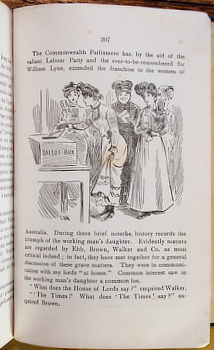
MOORE-BENTLEY, M. [Mary Ann]. Sketched from Life. Published by M. Moore-Bentley, Sydney 1903. Octavo modern cloth; b/w illustrations scattered throughout, most but not all signed C.H.H. Signs of use but most acceptable. Au$600
A political romance and novel of wish fulfillment with a heroine pursued by all the powers of the press, the police, the establishment, variously called "The Lyndhurst Mystery," the "Australian Joan of Arc", the "working man's daughter", physically a "tall, commanding, Minerva-like figure," (Moore-Bentley was described as tall and slender) and finally an "Australian Dreyfus."
Our Australian Joan of Arc terrifies her enemies, the old men, by using something that is in effect the talkies. The explanation confused me but it has the same effect as film with sound.
At the end is an advertisement inviting subscriptions for A Woman of Mars, or Australia's Enfranchised Woman (1901) with a page of subscribers' names. If that is the complete list then I count 25 copies sold. A lot less that the 18,000 odd votes she got when she ran for the New South Wales senate this same year. A Woman of Mars starred a feminist visitor from Mars in Sydney.
Trove finds two copies of this: at the Mitchell and the National Library; Worldcat adds no more. I noticed that the ADB still lists her under her married name, Mary Ling, a name she had discarded by 1901.

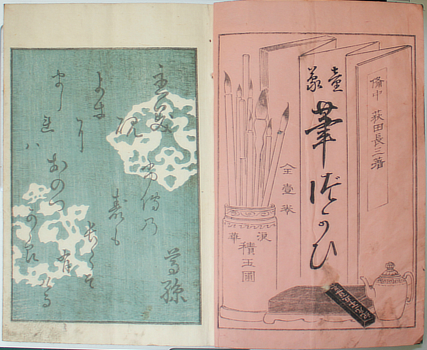
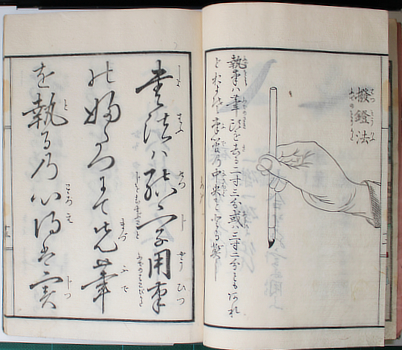
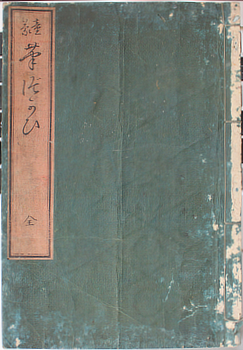
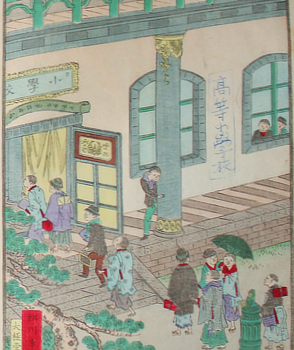
Ogita Chozo. 童蒙筆づかひ [Domofudezukai]. Osaka, Sekigyokuho 2533 (ie 1873). 22x15cm publisher's wrapper with title label (surface a bit chewed); 21 double leaves and six more of advertisements, illustrated title, colour woodcut title and frontispiece by Matsukawa Hanzan, one illustration in the text. The imperial date is on the ink stick in the title page. Used but mildly for a kid's book. Au$350
A charming handwriting book; the frontispiece is of cheerful - and well-to-do - looking boys on their way into an ultra modern school to learn traditional brushmanship. In an Osaka exhibiton that included this book I came across a popular quote which roughly translates as, "Tap a cropped head and you'll hear the sound of modernisation."
Worldcat finds one copy outside Japan, in the Benjamin Smith Lyman collection.

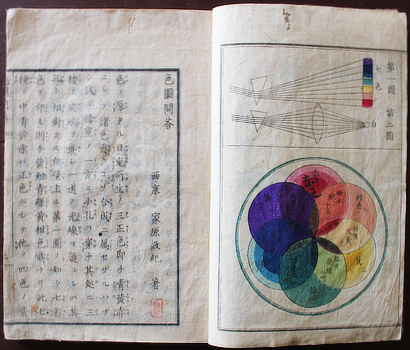
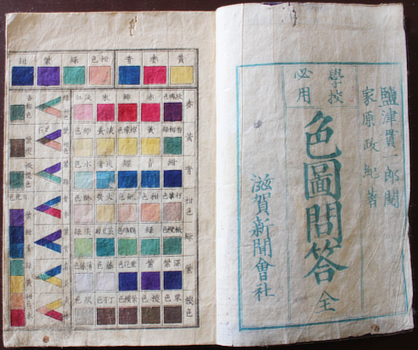
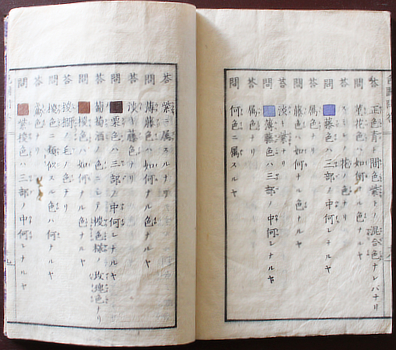
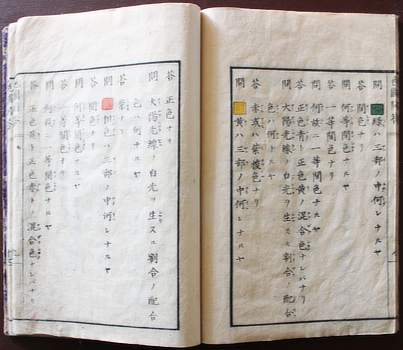
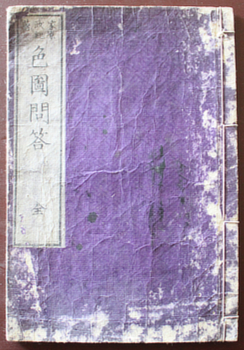
Iehara Masanori & Shiozu Kanichiro. 学校必用 : 色図問答 [Gakko Hitsuyo : Irozu Mondo]. Kyoto, Shiga Shinbun 1876 (Meiji 9). 21x15cm publisher's wrapper with title label; 22 double folded leaves, two colour charts and small colour squares through the text, hand coloured. Used, with some grubby thumbprints and an insignificant touch of worming. Not bad for an old school book. Au$500
Western colour theory introduced to Japanese students. This was, according to one historian and repeated by others, first published in 1873 but I can't find any copy earlier than 1876. I have read that it comes from a copy of an American book by Marcius Willson but I think there is some confusion. Willson produced wall charts for American schools that were used in Japan and maybe in 1873 wall chart no. XIV arrived. The chart was included in a version of the Shogaku Nyumon seies of elementary introductions in 1875, without the explanation we have here. His accompanying writings on color in his Manual of Information and Suggestions for Object Lessons - the work cited - are nothing like this. In any case he seems to have borrowed Field's chromatics. So it was English colour theory that made its way into Japan first. I'd make a pretty confident bet that this is the first edition.

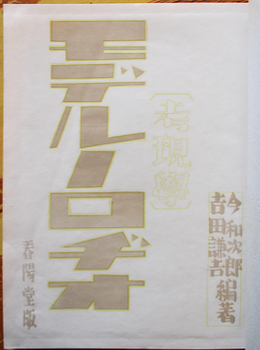
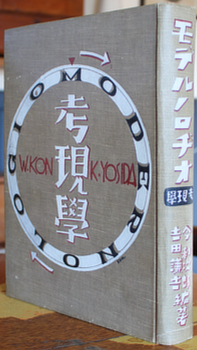
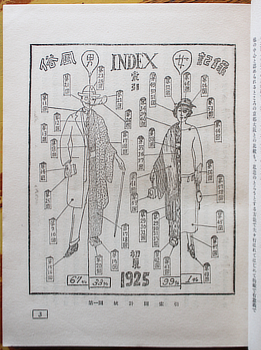
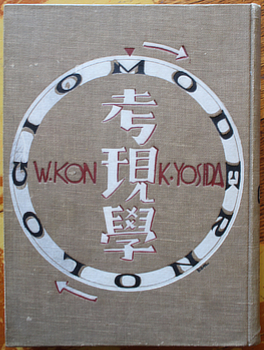
Kon Wajiro & Yoshida Kenkichi. モデルノロヂオ : 考現学 [Moderunorojio - Kogengaku]. (Modernologio on the cover). Tokyo, Shun'yudo 1930 (Showa 5). 26x20cm, publisher's decorated cloth blocked in white, red and black; 361pp, profusely illustrated throughout, a few photo or colour plates. Endpapers and edges browned as usual; a rather good copy, the cover bright, of a book that invites thumbing. Au$850
First printing. This is an extraordinary book; the gospel of Modernology. Kon and Yoshida have compiled an encyclopaedia, surely unsurpassed, of the apparently ordinary, of the people of Tokyo, fit to provoke unseemly enthusiasm in theoreticians and urban planners ever since. I gather that their thesis - born out of watching the people of Tokyo begin to rebuild after the 1923 earthquake and fire - is that those who do the planning, designing and building know nothing of what people actually do, what they own and how they use those things ... how they live and who they are.
The cover, signed Ken, and a lot of the illustrations are by Yoshida who has re-spelled his name on the cover for the sake of the design. The more I find out about Yoshida the more interesting he gets. I'm starting to think he was, to Kon, what Braque was to Picasso.

The female messiah
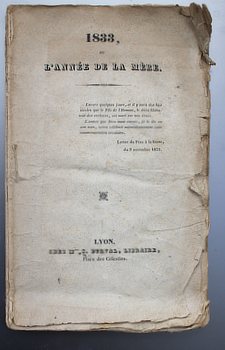
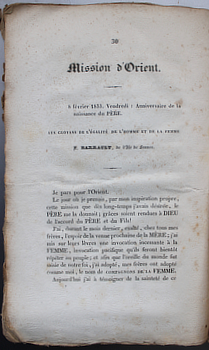
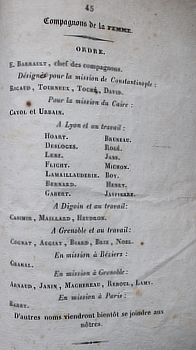
Compagnons de la Femme. [Emile Barrault]. 1833: ou l'Annee de la Mere. Lyon, Mme S Durval [1833]. Octavo, side stitched; 48pp. Title rather ragged and dusty, dog-eared. A tired copy but worth preserving. Au$150
Probably the second of maybe four issues of this rare work. This is titled February on the leaf after the title; others known to exist are January and two more with different titles that apparently appeared in June and July.
One of the more loopy, to be polite, excursions of the Saint-Simonians: a group formed themselves as the Companions of Women and set off to find a prophesised female messiah in the middle east. If nothing else it allowed them to ignore all and any women at home. Papa Enfantin intervened and got them to work building industry and railroads and colonising north Africa.

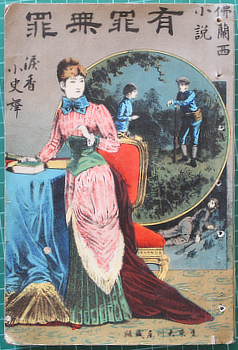
Emile Gaboriau & Kuroiwa Ruiko. 有罪無罪 : 仏蘭西小説 [Yuzai Muzai : Furansu Shosetsu]. Tokyo, Okawaya 1904 (Meiji 37). 22x14cm colour illustrated wrapper; 19 full page and one double page illustration. Contents thumbed, ink inscription on the back advertising leaf. Stab holes indicating this was bound in something else - why the covers are in such good shape. Au$200
First printing of a revised edition of Ruiko's adaptation of Gaboriau's Le Corde au Cou according to the colophon. The first Japanese edition appeared in 1889. He usually worked from English translations and how much Gaboriau remains in Ruiko's version is for someone who can read it in all three languages to answer. Ruiko was open about slashing, expanding and rewriting his material to fit what he wanted the novel to say.
I don't know why this is subtitled as a French novel rather than a courtroom novel (the precurser to 'detective novel') which had been used on a Gaboriau/Ruiko novel in 1888. I guess publishers were still feeling out what sold best but I'm surprised it is still a French novel in 1904. Worldcat finds no copies outside Japan: that Ohio entry is a microfiche.

File No.113
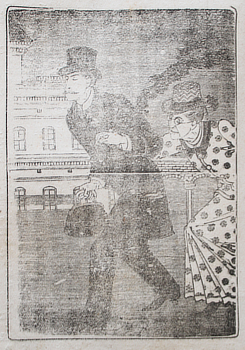
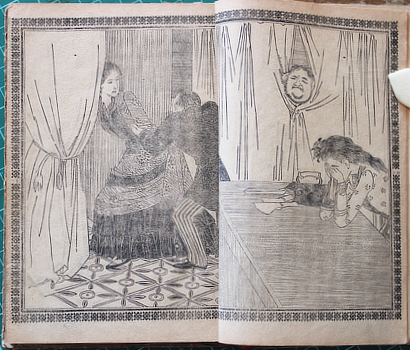
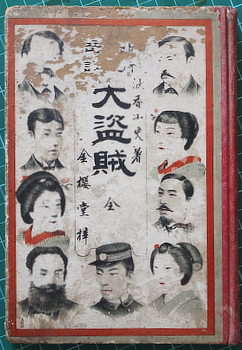
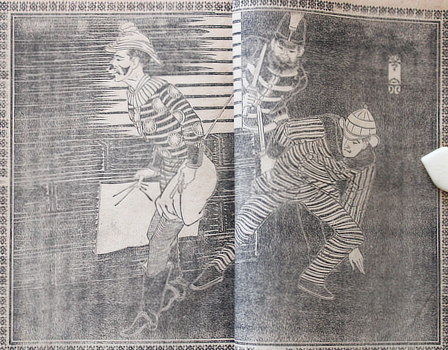
Emile Gaboriau & Kuroiwa Ruiko. 大盗賊 [Daitozoku]. Tokyo, Kin'odo 1889 (Meiji 22). 19x13cm colour illustrated boards and cloth spine (surface chewed by bugs); seven double page illustrations. Browning of the cheap paper; not a bad copy for a flimsy thriller. Au$350
First edition of Ruiko's adaption. UC Berkeley helpfully tells us this is a translation of File No. 113 (Le Dossier No. 113 in the French original) but then spoils that good work by adding that Fortune du Goisgobey wrote it. Ruiko usually worked from English translations and how much Gaboriau remains in Ruiko's version is for someone who can read it in all three languages to answer. Ruiko was open about slashing, expanding and rewriting his material to fit what he wanted the novel to say.

From the earth to the moon
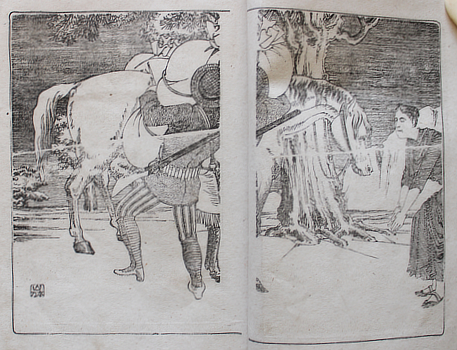
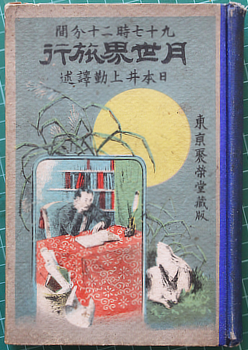
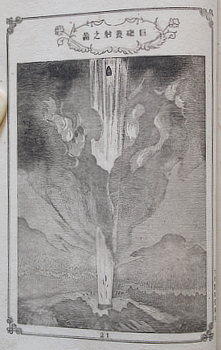
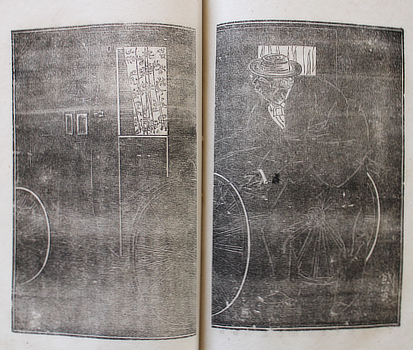
Jules Verne & Inoue Tsutomu. 九十七時二十分間 : 月世界旅行 [Kyujushichiji Nijippunkan : Gessekai Ryoko]. Tokyo, Okawaya 1888 (Meiji 21). 18x13cm publisher's colour illustrated boards and cloth spine (wear to edges); illustrated title and 21 full page illustrations. Inner hinges cracked, less than expected browning of the paper, a quite acceptable copy. Title written on the bottom edge. Au$475
A reprint of Verne's From the earth to the Moon. Inoue's version first appeared in Osaka in two volumes in 1880-81 though you wouldn't guess that from the colophon here. Inoue was a busy translator with a specialty in Jules Verne but he squeezed in Herbert Spencer, Thomas More, Bulwer Lytton, Wilkie Collins, Shakespeare and a lot more. Inoue worked from the English translation and I found a note somewhere about the changes made by Japanese translators that used a small sample from this book, with the French, the 1873 English version and Inoue's additions and revisions, not always correct, for an audience who knew little of the foreign.

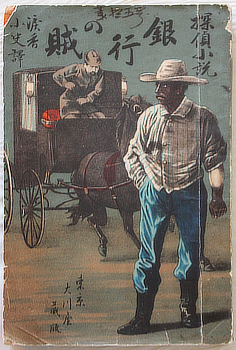
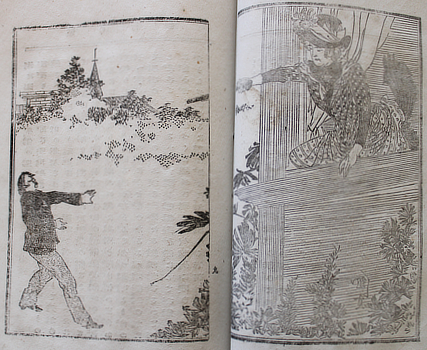
Harry Rockwood (Ernest A Young) & Kuroiwa Ruiko. 銀行の賊 : 探偵小説 Ginko no Zoku : Tantei Shosetsu]. Tokyo, Okawaya 1894 (Meiji 27). 22x14 cm colour illustrated wrapper; seven double page illustrations. Wrapper used and chipped; well read but not mortally. Ink inscription on the colophon leaf. Like most of this type of book what passes as a back cover is a flimsy advertising leaf. Au$175
A retitled edition of Majutsu no Zoku (The magic robber, now downgraded to bank robber) published in 1889. UC Berkeley tells us that this is a translation from Ernest A. Young's Donald Dyke, the Down-East Detective (1882), written as Harry Rockwood. There's not much of interest about Donald but that he was married to Clarice who emerges as a detective in her own right and got her own book in 1883. I'm hoping to discover that Clarice also made it into Japanese but not too hopeful.
Is that Donald Dyke in blackface on the cover? Perhaps someone learned out there can help.

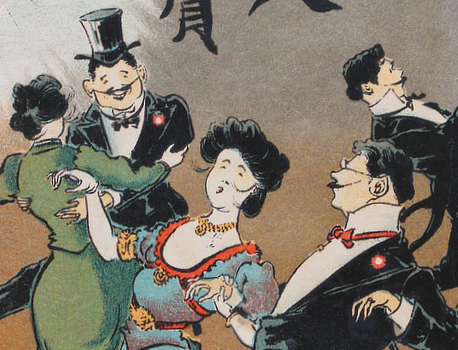
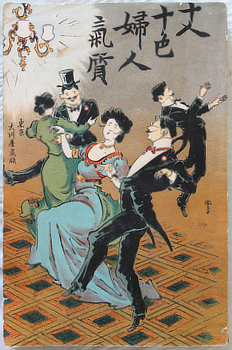
Fugetsu Sanjin. 十人十色婦人気質 [Junin Toiro Fujin Katagi]. Tokyo, Okawaya 1909 (Meiji 42). 22x14cm colour illustrated wrapper; one double page illustration. Mild browning of the cheap paper, quite good. Like most of this type of book what passes as a back cover is a flimsy advertising leaf. Au$200
This is the first edition according to the colophon but a few seconds search will find the same title by the same author with the same frontispiece with the same number of pages published in 1887. Odd. Still, this is undoubtedly the best edition: the 1887 cover is nothing like this. Never judge a cover by its book.
I gather this this something of a Decameron, a study or perhaps musings, about ten types of women. I'm sure there is plenty to enrage a modern reader.

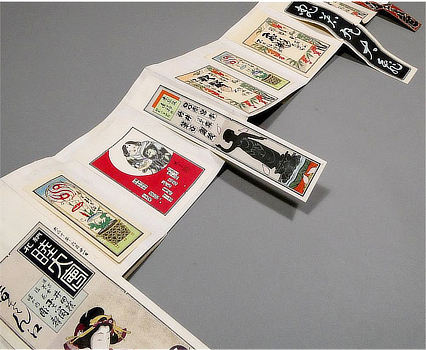
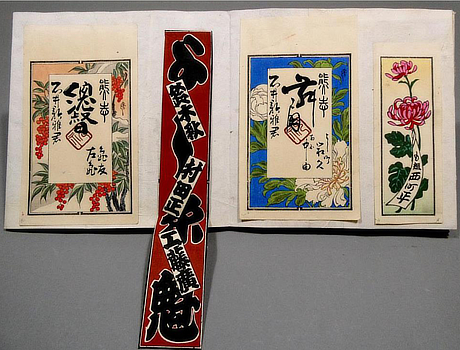
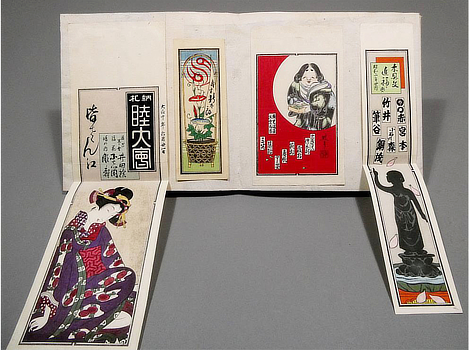
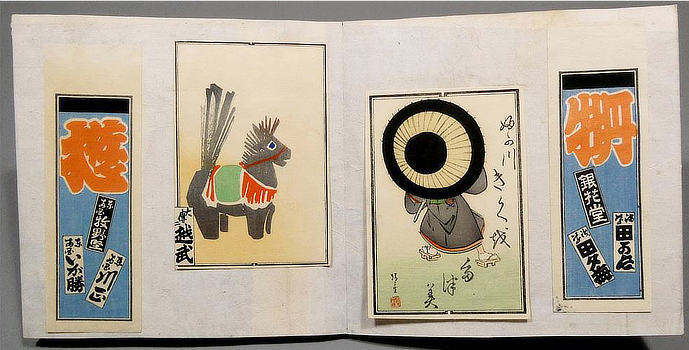
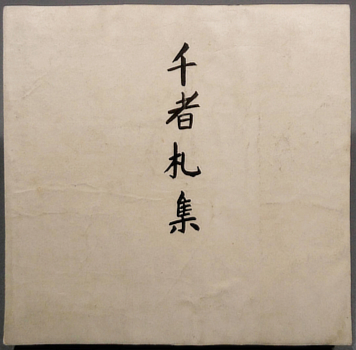
Senjafuda. 千者札集 [Senjafuda Shu]. n.p. [1920's?]. 20x21cm handmade concertina album forming 14 leaves with 54 mounted colour woodcut prints mounted on both sides; ie you open it both ways. Intriguing - and a bit infuriating - is that it's possible to see in places that the album has been made by pasting together large and quite smart looking textile designs and using the backs for the album. Au$500
A smart album of senjafuda. It's a universal law of humanity that as soon as someone makes more than two of anything a collector is born. And as soon as two or more collectors exist an association and an industry is formed. No-one knows these facts and does a better job with them than the Japanese. Senjafuda - votive slips left at temples and shrines - are a thousand odd years old tradition but in the last couple of hundred years they evolved into elaborate prints made as much to be swapped and traded as pasted on shrine gates. The tens and twenties maybe represent the peak years before lithography and then self adhesive mass produced stickers took over. Afficiandos commisioned them, companies used them as advertisements and business cards. Designers and printers made them a speciality and typographers loved them. And collectors collected them.

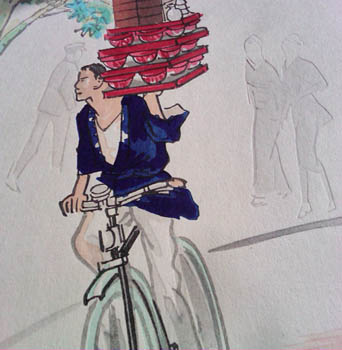
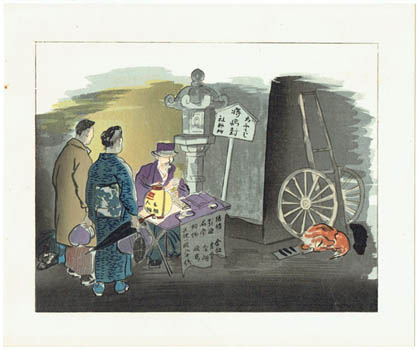
Wada Sanzo. Wood Block Hand Prints - Japanese Life and Customs - A set of six pictures by Sanzo Wada. [aka 昭和職業絵盡: Showa Occupations or Japanese Vocations in Pictures]. Kyoto Hanga-In [195-?]. Publisher's patterned board folder (24x30cm) with illustrated label; six colour woodcut prints, loose as issued. A scratch to the label, an excellent copy, the prints bright and fine. This contains the flower sellers, the fortune teller, the weavers, the soba vendor, the komuso, and the farming family. Au$450
In the late thirties Wada gathered an in-house team of woodblock cutters and printers and began work on a projected series of 100 prints recording occupations in his changing Japan. Some were traditional and vanishing and some were the product of modern industrialised Japan. From here we can see that some of those modern jobs barely lasted out the century. The prints began appearing in 1939 and struggled on until 1943 when two series totalling 48 prints had appeared. After the war the project was resurrected by the Kyoto Hanga-In and a third series of 24 prints appeared from 1954 to 56. They also re-did some earlier prints from new blocks; the originals had been destroyed.
Ross Walker (Ohmi Gallery) wrote that the owners of Kyoto Hanga-In told him that they could not afford too many cherry woodblocks so their blocks for the prints of the fifties were planed and re-used and nothing before 1960 survives. This album is obviously for foreign consumption and contains six prints from the first and second series. The paper size is smaller than the separately issued prints but the quality of printing is no less, often better than copies of the separate prints I've seen. The colours are strong and vibrant and the extra embossing that is such an important part of the print - and can't be seen in reproduction - is deep and crisp where used. These copies aren't lettered or signed, one has the artist's seal. I've traced two other sets and both hold the same six prints but small variations in the prints and signatures occur in all.
Wada's drawings have a modest charm and get better the more you look at them. The best may not hold your gaze at first but after a while you realise that they are the work of a great master of observation and deceptively simple expression. The fortune teller is not the focus of his picture, his customers - maybe worn, anxious parents of a son at war - are. Look at the impossible bull neck of the soba seller and the shadow pedestrians and there is the way this young human bulldozer sees the world. He refuses to become one of the slumped, defeated customers of a fortune teller.

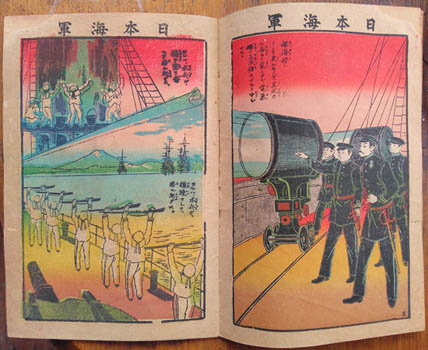
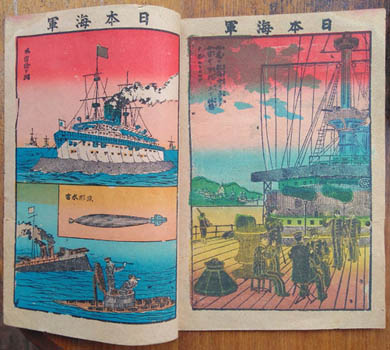
日本海軍 - 教育繪話 [Nihon Kaigun - Kyoiku Ebanashi]. Osaka, Enomoto 1917 (Taisho 6). 19x13cm publisher's colour illustrated wrapper; 10pp including wrapper, seven full page colour illustrations. Expected browning of the paper, short marginal tear and a nibble from the front wrapper; pretty good for one of these cheap booklets. Au$165
The glory of the Japanese navy for kids in the eye watering colours of akahon (red book) tradition. This is apparently the fifth edition, it first appeared in 1915.

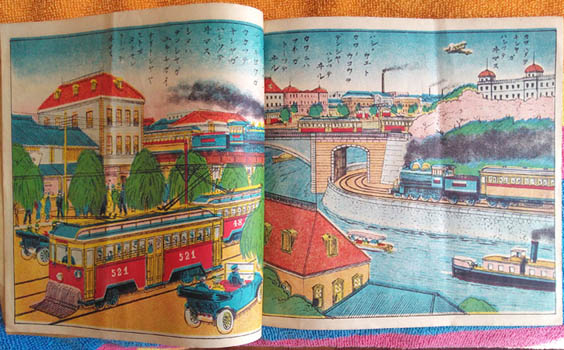
汽車と乗物 [Kisha to Norimono]. Osaka, Okamoto Zoshindo 1923 (Taisho 12). 17x18cm publisher's colour illustrated wrapper; [12]pp including wrapper, eight full page illustrations inside. The back wrapper - which is flimsier paper - is browned and creased; a pretty good copy. Au$150
Machines and people on the move - what better subject for a book? Better quality than the really cheap akahon (red books) for kids that came out of Osaka but not a lot.

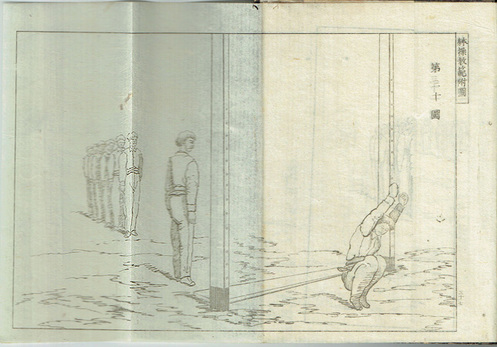
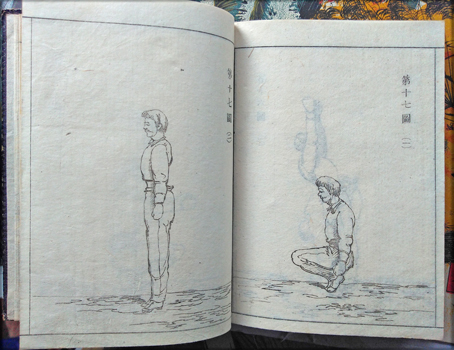
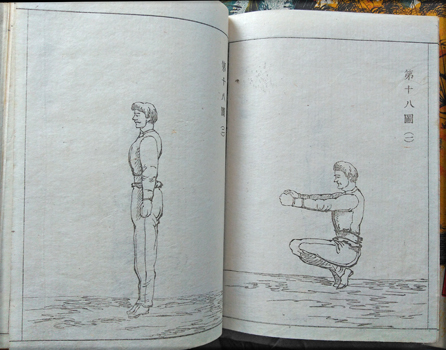
Gymnastics. 体操教範 [Taiso Kyohan]. Ministry of War, 1884 (Meiji 17). 15x11cm in what appear to be original cloth backed boards (spine a touch nibbled); 37 double folded leaves (ie 74pp) and 73 full page illustrations (5 folding) numbered to 32 with several bis. A little worming, nothing notable, and a couple of small stains; a quite good fresh copy. Au$300
The Japanese first got in French experts on military physical training in the late 1860s and the first Japanese book I've been able to trace was a translation of part of an 1847 manual the French visitors brought with them. That is I've traced mention of it, not the book itself. This manual also has the look of coming from a French manual but, being light on in French gymnastic manuals of the mid nineteenth century here, I don't know which one. Certainly it models the fine mustachios that became de rigueur for dashing Japanese officers.
The Taiso Kyohan apparently also became the model for gymnastics in secondary schools as the idea of physical education was introduced into Japan. There were many editions of the Taiso Kyohan, presumably updated and changed as the decades went on but I'm unable to trace any copy this early in a library catalogue.

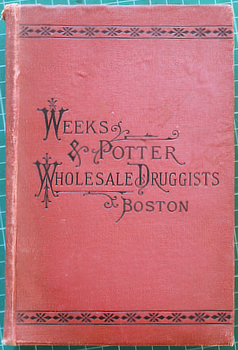
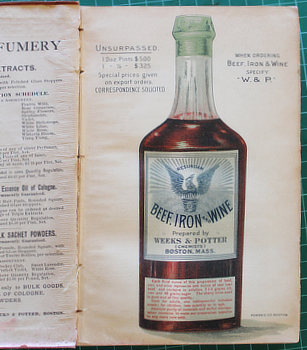
Catalogue - Pharmaceuticals. Weeks & Potter, Boston. Revised Catalogue of Foreign and Domestic Drugs: selected powders: fine essential oils: waters and extracts ... wines and liquors: proprietry medicines: druggists shop furniture ... sundries and surgical appliances: sponges: fancy goods: and toilet articles. Boston 1890. Octavo publisher's limp cloth, the front titled in black (spine browned and a bit rubbed); 468,130pp, profusely illustrated with wood engravings and a handsome full page colour lithograph of a bottle of their Beef, Iron and Wine. Used but solid and very decent. The second section consists of advertisements. Au$300
The advertisements include a warning by Dr S.A. Richmond of Tuscola, Illinois, against fraudulent companies selling bogus versions of his justly celebrated Samaritan Nervine. He prints the text of a judgment against such a company and invites the many thousands of those he has saved from epilepsy, insanity and death to join him "lashing these ignorant, impotent, piratical scoundrels through the earth with a whip of scorpions."

英和対訳新体運動歌 New of Pom and Song The English and Japanese. [Eiwa Taiyaku Shintai Undoka]. Tokyo, 1887 [Meiji 20]. Small octavo publisher's illustrated wrapper; [2],32,[2]pp. A bit used, rather good copy for such a vulnerable thing. A christmas gift inscription on the front to 'Father' dated Dec 16, 1887. Au$600
A pioneering Japanese foray into English poetry and poetry in English which I can't find anywhere but the National Diet Library. Elsewhere I found two references to this. One is Basil Chamberlain's Things Japanese, the other Japan for a Week by Alexander M. Thompson who clearly never saw this booklet but, misreading Chamberlain, requotes a poem from Things Japanese which isn't in this. Chamberlain, in the chapter English as She is Japped quotes two poems without explicitly stating they are from this; they aren't. Did he see the book?
What is here is a mix of what seem to be poems by English and Japanese writers, things that are more aphorisms and morals than poems and an intriguing excerpt from Tennyson's Charge of the Light Brigade. This isn't a production for western tourists or export of the pretty sort that became popular through the 1890's. This is a modest first step of the Japanese setting out - as they did with all things western - to learn, encompass and digest a new form.

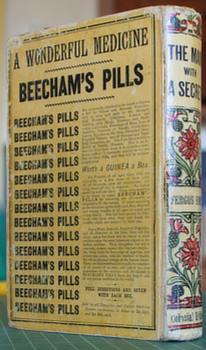
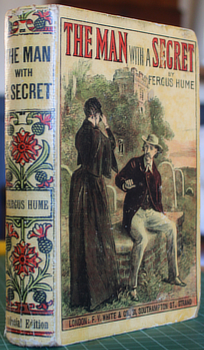
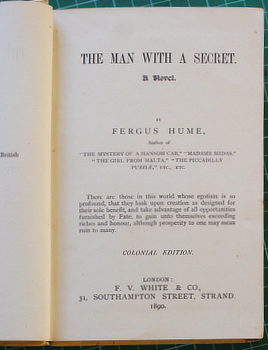
HUME, Fergus. The Man With a Secret. A Novel. Colonial edition. London, F.V. White 1890. Octavo publisher's colour illustrated boards; wear to edges and corners. Pretty good for a yellowback thriller. Au$950
Published the same year as the three volume first edition. Topp (Victorian Yellowbacks v.VII) seems to differentiate between this colonial edition and the domestic yellowback, announced in January 1891, with a note that indicates this came first, in 1890.

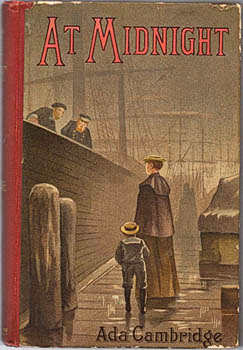
CAMBRIDGE, Ada. At Midnight and Other Stories. London, Ward Lock 1897. Octavo publisher's cloth backed glazed illustrated boards (edges a bit rubbed); four plates. The title foxed by the tissue guard, a remarkably good copy. Au$500
First edition; later (but preferable) issue as no.14 of Ward Lock's series of two shilling thrillers.

SHIEL, M.P. The Dragon. London, Grant Richards 1913. Octavo publisher's illustrated ochre cloth blocked in red and black. A couple of spots but a particularly good copy. Au$650
First edition of Shiel's second yellow peril novel. The first, The Yellow Danger (1898) was a success. There is a copy of The Dragon floating around that Shiel inscribed in 1924, “The fact that God has a predilection for pigtails and microbes (to judge from their number) had always struck me, and ... I was led into writing my second book on one subject ..." This was, in his view, a far better book and it flopped. I suggest that, apart from timing, it was a mistake by the publisher to make it look so much like The Yellow Danger. It's easy to suppose that it's just a retitled reprint.

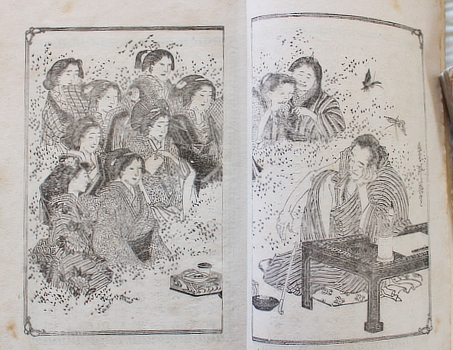
英字訓蒙図解 [Eiji Kunmo Zukai or Ei Kuno Zukai depending on the transcriber]. Kyoto, Ogawa Kinsuke 1871 (Meiji 4). 225x155mm publisher's wrapper with title label; woodblock illustrations throughout. Some worming and a marginal stain, neat repairs to the first few margins. A very decent copy with its colour illustrated outer wrapper, this smudged and rumpled but complete and untorn. Au$750
A rare and most appealing illustrated introduction to English. To an extent unseen in any other non-western culture faced with the colonial ambitions of the west the Japanese controlled their own re-education. They were not showered with unwanted primers by missionaries and other pious businessmen. They produced, printed and determinedly digested their own, using whatever sources they could find, the occasional hired expert and their imagination.
The more I look at books like these, which were assiduously studied, the more I wonder how anyone learnt any English. How many Japanese went to their graves calling a camera a desk and hoping for an opportunity to introduce 'pluckant' into conversation? Leaving aside errors, books like these make no sense as tools to me but tens, hundreds of thousands of Japanese students set out with these as guides on the road of bunmei kaika - government sponsored enlightenment and civilization - and got there way faster than anyone should have. In fact the more I think about it the more I wonder how anyone learns any language.
Good book, bad copy, low price
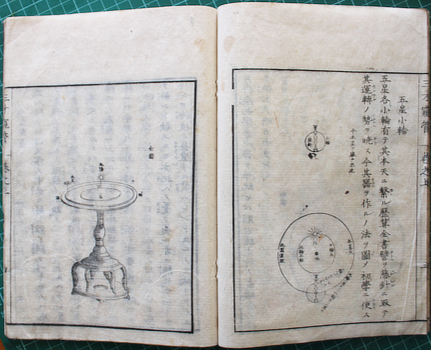
Hatsutaro. Maekawa Bunzo & Sakai Junzo. 海外異聞 - 一名亞墨利加新話 [Kaigai Ibun - Ichi Mei Amerika Shinwa]. n.p. 1854. Five volumes 25x17cm, publisher's patterned wrappers with title labels; 14 double page - including a map - and 26 single page colour woodcuts. A pretty lousy set, well thumbed and wormed too enthusiastically in places. Au$375
First edition of this classic drift or castaway account by a Japanese sailor who ended up in America. This was worked up from the account of coasting sailor Hatsutaro whose ship went astray in 1841, ending up on the other side of the Pacific. Rescued, the crew were dropped in Baja California. Hatsutaro and the Captain, Zensuke, made their way back to Japan where he was leapt upon by curious scholars who prepared this in 1844, the year he returned, but didn't publish.
Drift accounts, most books relating to the outside, were unpopular with the authorities. Like many books about things western this was circulated in manuscript until the arrival of Perry and his Black Ships made any and all information about the outside world, especially America, desirable and necessary.
The first two volumes are Hatsutaro's narrative and the next three a sort of encyclopedia of America prepared by Maekawa and Sakai from Hatsutaro's information and whatever could be gleaned elsewhere. The artist, Morizumi Sadateru (aka Tsurana), reported that, at a loss as to how to illustrate this, he sent for Hatsutaro and they spent days molding rice into landscapes and making models.