These books haven't necessarily been uploaded to antiqbook yet. So, if you order through antiqbook and get a message claiming the book has been sold, email in case that isn't true.


>A collection of 48½ large sample books of Kyoto silk from the twenties and thirties. Kyoto Orimonoshodo Meikai &c, c1920 to 1940. Various sizes corresponding to quarto or small folio, publisher's cloth or silk with stamped or paper label titles, some still in their card slipcases. Thousands of fabric samples mounted in window card leaves.
These were, I'm told, in the family storehouse for decades and insects have sampled several covers and occasionally worked their way into the card leaves. A few covers show signs of mild damp but nothing drastic and there is general dustiness and some browning of card leaves - again nothing drastic - and all but one or two fabric swatches are in excellent shape. There are, out of however many thousand swatches in 48 volumes, perhaps a half dozen missing. The 49th - the half referred to - has about half of its 144 samples removed. Au$7,200
These belonged to the Onishi Gofukumise, the Onishi Drygoods Store - kimono drapers of Uchika in the Ehime prefecture - a company that still exists in modern premises in the area. Their stamp is in many volumes and sometimes they have added a date stamp or written in the date, ranging from 1923 to 1938. All are from Kyoto, most under the banner of the Kyoto Orimonoshodo meikai - the textile merchants association. Lists of the member textile firms appear in some volumes.
The first thing that struck me looking through these is the quality of book production. Many of these, most of these, are books produced with the same care as the best Kyoto design albums by publishers like Unsodo. There's nothing flimsy or slipshod; these books took a lot of time and care to make.
The album titles, those I've been able to decipher, are not much help to me. They seem to be evocative or aspirational. Perhaps a textile expert will know that 'Encouragement', 'Mikado', 'Star' and 'Maple' (my approximations), if not trade marks, are particular ways of weaving or dyeing.
I don't like to boast but I can honestly say I know near as much about silk weaving as I do about playing the pedal steel guitar. Most of these seem to focus on the new season colours rather than patterns, though patterns are certainly there, but the weaving styles aren't by any means plain. There are creped silks, ribbed silks, damask like patterns and other esoteric textures produced by whatever occult means Japanese weavers used to make light play in different ways over the fabric. The pattern fabrics are I think resist dyed. In all, I believe I spot chirimen, kinsha, rinzu, and maybe omeshi techniques. Maybe.
Whether it's the pre-war born generation dying off or economic shift, a lot of fabulous textile stuff - design and sample albums - of the late 19th and early twentieth century has come out of Japan in the last few years. I've bought some and watched with hungry eyes much more go by and I notice it's slowed to a trickle. I'd like to think there's more to come but I suspect those old company and family storehouses have been pretty much emptied. I doubt another cache as rich as this, so specific to place and time, will be along anytime soon.
*Click on the picture to see more in the gallery.
You can email an inquiry or order securely through antiqbook
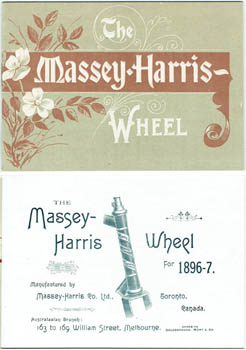
>Massey-Harris, Toronto & Melbourne. The Massey-Harris Wheel for 1896-7. Melbourne, printed by Peacock Bros 1896. Oblong octavo publisher's colour printed and embossed wrapper; 16pp, illustrations throughout. An outstanding copy. Au$750
A stylish little catalogue, only proper for the introduction of the Canadian bicycle to Australia. In fact the debut bicycle for Massey-Harris during their digression from farm machinery into sport and fun. There is only one model offered - Model 1 - so there is plenty of illustrated description of construction and mechanisms. There is a copy of the parent company's 1896 catalogue in their archives but I found none elsewhere. And no copy of this anywhere at all. Are there any other 19th century Australian bike catalogues?
You can email an inquiry or order securely through antiqbook
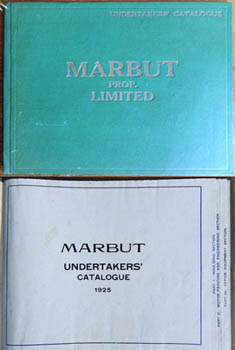
>Marbut Pty Ltd. Marbut Undertakers' Catalogue 1925. Melbourne, printed by Pelzer & Lee 1925. Oblong quarto (25x19cm) publisher's cloth titled on the front cover; 34pp, photo and line illustrations throughout. A rather good copy with its hanging cord intact. Au$750
The death industry has always kept its finger on the pulse of the latest technology and of course it was America that industrialised the whole business. There are old European trade catalogues of things like mass produced hearses, coffins and fittings, but not so many. America is the place for such things. Marbut, which began life as the Australasian Marbut Carving Company in 1902, has brought some of the American approach to Australia. They haven't attempted to mass produce everything but they are on their way, producing mouldings for coffin makers, painting hearses and so on. It is modern production and efficiency they are selling.
And they produced the only Australian catalogue for undertakers older than me that I've ever seen. It seems odd that a forward thinking company like Marbut took so long to issue a trade catalogue but if there is anything earlier I can't find any mention of it. This catalogue is of course unrecorded and neither can I find anything else similar in the death line.
You can email an inquiry or order securely through antiqbook
Three catalogues of future Tasmanian rust
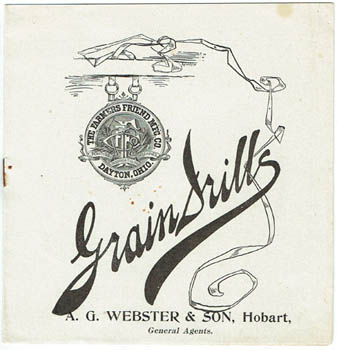
>Catalogue - farm machinery. The Farmers Friend Mfg Co, Dayton Ohio. Grain Drills. The company [c1890?]. Square octavo publisher's illustrated wrapper; 8pp including wrapper, illustrated. Marks on the back but a nice copy. Au$75
With the Hobart agent's name, A.G. Webster & Son, printed on the front. Webster & Son - now Webster Ltd - went big in the 1880s publishing their own Tasmanian Agriculturist and Machinery Gazette and importing just about everything farm that there was.
You can email an inquiry or order securely through antiqbook
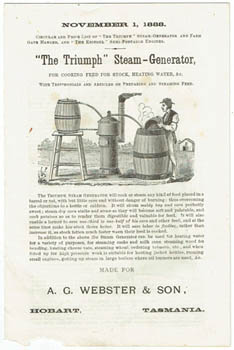
"The Triumph" Steam Generator ... made for A.G. Webster & Son, Hobart, Tasmania. n.p. November 1, 1888. Octavo self wrapper; 8pp, illustrated. Bottom margin gnawed. Au$75
A circular that seems to have been run up specially for the agent, in this case the Tasmanian agent. It also advertises Kriebel engines and boilers and the Triumph Farm Gate-Hanger.
You can email an inquiry or order securely through antiqbook
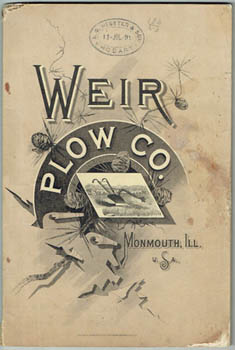
>Weir Plow Co, Monmouth Ill. Plows, Cultivators, Harrows, Three-wheeled Riding, Tongueless, Single and Gang Plows ... etc., etc. The company [c1890]. Large octavo publisher's illustrated wrapper, 67pp, well illustrated. Unfortunately a mouse, my guess, nibbled the edge of this and stuck a few pages together which have been torn, without loss, by an over eager reader. Still a decent copy. With two update leaves dated February and December 1891 pasted in at the end as instructed. And with the date stamp - 11 Jul 1891 - on the front of agent A.G. Webster & Son of Hobart. Au$90
A particularly handsome plow catalogue, and I don't say such things lightly, with two full page minor masterpieces of midwest wood engraving.
You can email an inquiry or order securely through antiqbook
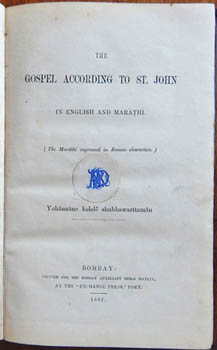
[MITCHELL, John Murray]. The Gospel According to St. John in English and Marathi. (The Marathi expressed in Roman characters.) Bombay, printed for the Bombay Auxiliary Bible Society at the Exchange Press, 1861. Octavo, doubtless original unlettered pebble cloth (marked and used but solid); 4,163pp & errata leaf. Small engraved monogram pasted on the title - an arrangement of the initials A.R.A.D. Au$165
Rare it seems. A search of likely catalogues finds only two copies, both in England. The second edition of 1882 is a touch more plentiful. Mitchell, as well as having a distinguished pedigree in translation and scholarly writings on India, was something of a missionary trouble shooter. He retired - first in 1863 - at least twice and was called back to India in times of crisis, only making his final departure from the place in 1888, fifty years after he first got there.
You can email an inquiry or order securely through antiqbook
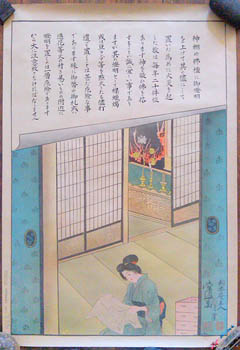
>One of a series of fire safety posters produced by the Hokkaido Police. Hokkaido-cho Keisatsubu, 1918 (Taisho 7). Colour lithograph 79x54cm. Au$200
As a fan of safety posters I can tell you they are not known for subtlety, taste or elegance. I'm not sure whether the quite delicate style and colouring of these make them more or less ominous. I don't know whether these posters were peculiar to Hokkaido, a long way from the frenetic machine made world of Tokyo, Osaka et al. Nor whether they are a tribute to tradition or a more jaundiced and sardonic comment on traditional culture in traditional houses.
Here the lesson is that devotion means just that. No matter that this woman has the altar beautifully arranged and the candles lit, no matter how interesting the news, her inattention is catastrophic.
All these posters are signed and sealed by the same artist but I'm unable to read it. Neither can I find an indication of how many were in the series. They are marked - a superfluous gesture - not for sale and were presumably exhibited in police stations and public places.
You can email an inquiry or order securely through antiqbook
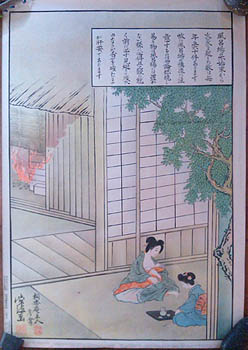
> Another. Au$250
Again the woman of the house may think she is doing her proper job and once again inattention leads to disaster. Why is that girl looking after the tea when there is a fire going?
You can email an inquiry or order securely through antiqbook
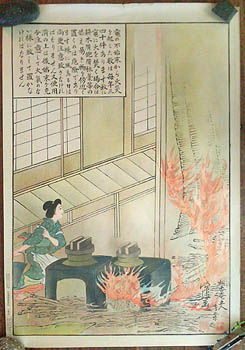
> Another. A short tear in the top margin. Au$175
This is one for labouring woman, a lesson in carelessness about the stove, the woodpile and nearby combustibles.
You can email an inquiry or order securely through antiqbook
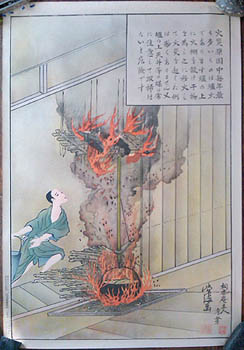
> Another. Au$200
Here's one for the labouring man, again a lesson in carelessness with the woodpile and dangerously close combustibles. The ratio of women to men burning down the house may rankle with unforgiving feminists but this is reportage not sexism. What self respecting man would be doing work round the house?
You can email an inquiry or order securely through antiqbook
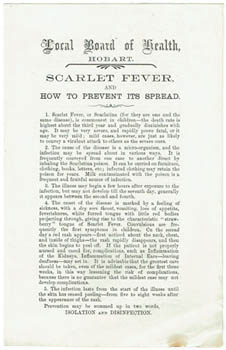
Scarlet Fever. Gregory Sprott. Local Board of Health, Hobart. Scarlet Fever and How to Prevent its Spread. Hobart, Mercury Print [1897]. Octavo, three pages of text on two conjugate leaves. Au$35
The Mercury announced this leaflet and printed part of it on September 27, 1897 - "scarlet fever has made its appearance in some of the outlying districts." By today's unctuous standards this is a refreshingly succinct and cold hearted bulletin: an unlucky patient should be "conveyed direct to the grave with the least possible delay, and the funeral be attended by as few friends as possible."
The State Library of Tasmania
catalogued this title but describes it as one page; same or different?
You can email an inquiry or order securely through antiqbook
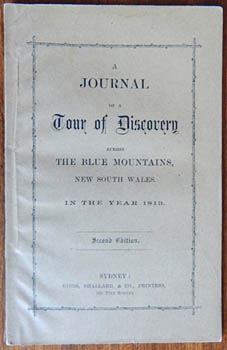
[BLAXLAND, Gregory]. A Journal of a Tour of Discovery Across the Blue Mountains, New South Wales, in the Year 1813. Second edition. Sydney, Gibbs Shallard [1870]. Small octavo publisher's printed wrapper; 46pp. Some spotting as usual, a rather impressive copy. Au$3,500
The opening of the Australian inland for settlement, though not too many modern Australians have followed Blaxland's, Lawson's and Wentworth's footsteps any further than the Hydro-Majestic hotel. This second edition was published by Blaxland's son as a memorial to his father when the original had become unobtainable.
You can email an inquiry or order securely through antiqbook
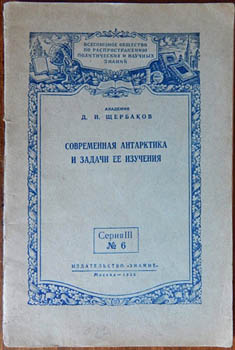
SHCHERBAKOV, D.I. Современная Антарктика и задачи ее изучения. [Sovremennaia Antarktika i Zadachi ee Izucheniia]. Moscow, Znanie 1956. Octavo publisher's printed wrapper; 40pp, maps in the text. Au$120
Shcherbakov here outlines the program and problems of modern Antarctic research as the Soviet Union set out on its first Antarctic Expedition. As Shcherbakov wrote later - but well before any moon landing, "it turned out that though 260 expeditions had visited the area of the South Pole since the discovery of Antarctica ... scientists knew less about the internal areas of the ice continent than about the visible side of the Moon." Shcherbakov has an Antarctic mountain range named for him; it's not everyone who can say that. Unknown to Spence; OCLC finds three copies, in English and US libraries; Trove none.
You can email an inquiry or order securely through antiqbook
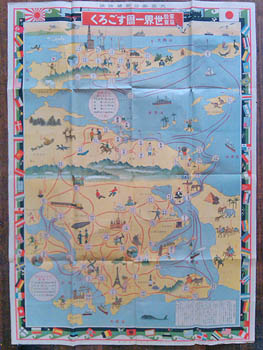
>Sugoroku. 家庭教育世界一周すごろく [Katei Kyoiku Sekai Isshu Sugoroku]. Osaka Mainichi Shinbun, 1926 (Taisho 15). Colour printed broadside 109x80cm. Used with some tears repaired; not bad for a particularly large and vulnerable sugoroku. Au$350
You must have a smarter brain than me. I'm sure you do. It took me a few moments of slackjawed wonder before I realised this is a world map turned sideways and sat on. From where in space did the artist choose their viewpoint, unpeel the globe and spread it out flat? This a self titled educational game for the family. What does it teach us about our place on the planet and relationship to each other? Maybe that all maps are fiction.
The Japanese flag flying in the Canadian Rockies marks the first ascent of Mount Alberta by the Japanese Alpine Club in 1925.
You can email an inquiry or order securely through antiqbook
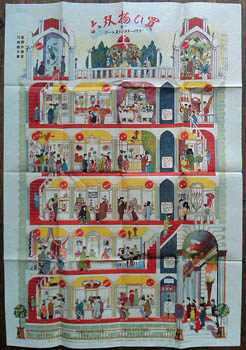
The meaning of life by Kawabata Ryushi
>Kawabata Ryushi. 買い物双六 [Kaimono Sugoroku]. Tokyo, 1914 (Taisho 3). Colour printed broadside 79x55cm. Minor signs of use; a nice copy. Au$750
The New Year gift from the magazine Shojo no Tomo - the Girl's Friend. Shopping and fun, fun and shopping, indivisible here as it should be. There is a zen-like approach to this. The goal is the top balcony where the winner can gaze with calm detachment back and down on the world of the great department store. Only by immersing yourself in the experience can you come to comprehend. As the master who gave me the only coherent account of zen I ever heard said, as he bit the top off the eleventieth bottle of beer, "When you're drinking you're only drinking."
Kawabata's career took a curious turn during a 1913 stay in America to study western painting. Apparently he was so impressed with the Japanese art he saw in Boston he switched to being a Nihonga painter. Still, he remained being an illustrator for magazines for quite some time. As did most of the early to mid 20th century artists now revered.
You can email an inquiry or order securely through antiqbook
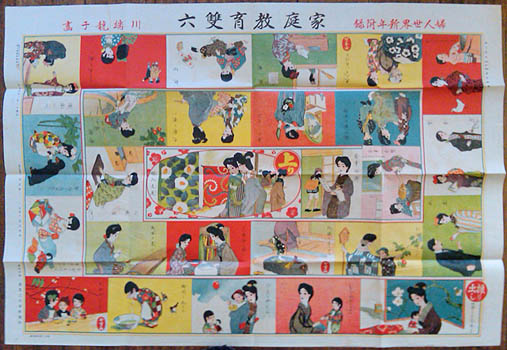
It's a girl's life
>Kawabata Ryushi. 家庭教育双六 [Katei Kyoiku Sugoroku]. Tokyo, 1915 (Taisho 4). Colour printed broadside 53x77cm. Au$500
The New Year gift from the magazine Fujin Sekai - Women's World. The modern Japanese girl will treasure tradition; she is conscientious, industrious, gentle, kind, neat, cultured, respectful, obedient, and if she follows her path she will be rewarded with high level shopping.
You can email an inquiry or order securely through antiqbook
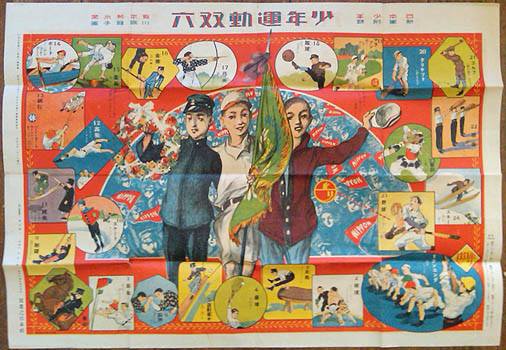
A boy's life
>Kawabata Ryushi. 少年運動双六 [Shonen Undo Sugoroku]. Tokyo, 1916 (Taisho 5). Colour printed broadside 54x79cm. Minor signs of use. Au$450
The New Year gift from the magazine Nihon Shonen - Japanese Boy. A splendid vision of the life of the active, enthusiastic Japanese boy: success, fame, and soon. The girl in the sugoroku above must wait until she's adult before her mother introduces her to the glory of serious shopping.
You can email an inquiry or order securely through antiqbook

Does an Australian death make an Australian author?
HILLCOAT, Captain C.H. [Charles Henry]. Ida Hall or a Mystery of the Suez Canal. Glasgow, David Bryce [1896]. Narrow octavo publisher's red cloth (mild signs of use). A bit canted, pretty good. Au$300
Only edition of this uncommon thriller which sees our young Miss Ida Hall of Berkley Square [sic] snatched by slavers from a Port Said hotel. Despite the £1000 reward posted nothing has been known of her until this account. Fear not, she will be alive and well at the end of the book despite her terrible sufferings. This wasn't Captain Hillcoat's most successful book, his Notes on Stowage went through at least three editions.
Now - at the risk of drawing too long a parochial bow - can we claim some place for this in Australian literature? Captain Hillcoat (Charles Henry Lorenzo Westernra Hillcoat in full) was of a clan of emigres. His immediate family, after time in India, emigrated to America when he was a child while at least one uncle headed for Australia. His sister Cecilia joined the Australian rush in 1866 so the place was soon packed with cousins, nieces and nephews. He certainly sailed Australian waters, as the captain of the Anglo Indian in the eighties and as captain of the Futami Maru in the late nineties. His wife died in Townsville during a voyage, in 1883, and he himself died in Gosford, NSW, in 1902.
You can email an inquiry or order securely through antiqbook

The thousandth and second reason to kill yourself
>DAKE, Charles Romeyn. [spelt 'Romyn' on the title page and 'Romeyn' on the cover which seems to be correct]. A Strange Discovery. NY, Kimball 1899. Octavo publisher's red cloth (spine a bit discoloured and worn at the tips); [4],310pp and three plates, one a map. Au$325
First edition of this Antarctic lost race thriller. An elaborately set up continuation of Poe's Narrative of Arthur Gordon Pym; it includes a photo of Loomis House in Bellevue Illinois, a focal point of the introduction to the story. Bellevue is apparently Belleville, Dake's home where he was a homeopath - as is the character Bainbridge in this book. Dake committed suicide in 1899; ostensibly because he discovered he had cancer, not because his only novel had his name misspelled on the title page.
You can email an inquiry or order securely through antiqbook
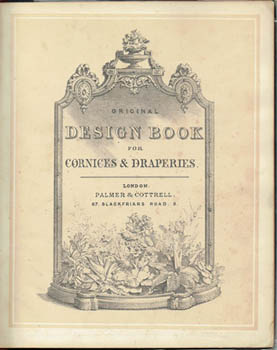
>Lorenzo Booth. Original Design Book for Cornices & Draperies. London, Palmer & Cottrell [c1865]. Small folio publisher's cloth (front cover near detached); illustrated title and numerous designs on 24 plates - lithos on various coloured backgrounds. Some spots, blotches and small flaws; a used but very decent copy. Au$350
A most uncommon pattern book of high Victorian decoration. The plates are signed L. Booth who must be the Lorenzo Booth who published The Exhibition Book of Ornamental Designs for Furniture in 1864.
You can email an inquiry or order securely through antiqbook
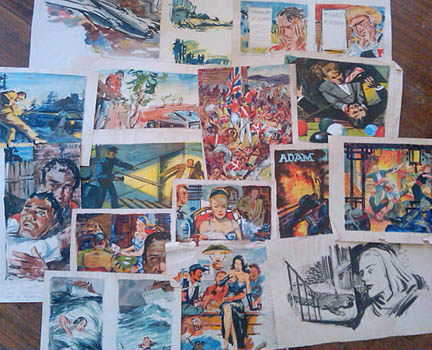
>BELBIN, Phil. A gathering of 120 original colour sketches and roughs for story illustrations and covers for the Australian magazines Famous Detective Stories and Adam. n.p. [Sydney c1946 - 52?]. Pencil, watercolour and gouache on paper, most more or less foolscap, a few smaller, one or two larger. All but a few are on printer's left over sheets, many with part of a wool sale catalogue on the back. Au$2,750
In the world of commercial illustration, specially illustration for pulp publishers like Frank H. Johnson, can there be anything more ephemeral than the artist's roughs and sketches? These were submitted to the editor - often, as shown in this bundle, more than one version at a time - who rejected, approved and demanded changes. The finished artwork went into the publisher's files and some of that might survive the collapses and fresh starts that was a pulp publisher's lot. But the roughs - why would an artist keep them once the job was done?
The great majority of these are for Famous Detective and Johnson's handwriting is recognisable and his demands unsurprising: make the storm more violent; put a dead horse in the desert; more red; bigger knife. Belbin was young when he started working for Johnson just after the war and he worked for him for some years. Unlike the writers, the artists were important and got paid.
The drawings here range from from very quick and sketchy to quite polished, which may reflect Belbin's pleasure in some subjects. Certainly his boats and planes are lovingly painted. His naked corpses - always women of course - are variable but there is one very alive and near shocking nude that makes me wonder whether it was a challenge to Johnson. I can't imagine that anyone thought it publishable.
One sketch is, for some reason, signed and dated by Belbin - 1947 - and on the back of another are some jottings about money, earnings maybe, for 1949, 51 and 52.
*Click on the picture to see more.
Just close the window when you're done.
You can email an inquiry or order securely through antiqbook

>Wada Sanzo. Wood Block Hand Prints - Japanese Life and Customs - A set of six pictures by Sanzo Wada. [aka 昭和職業絵盡, Showa Occupations or Japanese Vocations in Pictures]. Kyoto Hanga-In [195-?]. Publisher's patterned board folder (24x30cm) with illustrated label; six colour woodcut prints, loose as issued. A scratch to the label, an excellent copy, the prints bright and fine. This contains the flower sellers, the fortune teller, the weavers, the soba vendor, the komuso, and the farming family. Au$450
In the late thirties Wada gathered an in-house team of woodblock cutters and printers and began work on a projected series of 100 prints recording occupations in his changing Japan. Some were traditional and vanishing and some were the product of modern industrialised Japan. From here we can see that some of those modern jobs barely lasted out the century. The prints began appearing in 1939 and struggled on until 1943 when two series totalling 48 prints had appeared.
After the war the project was resurrected by the Kyoto Hanga-In and a third series of 24 prints appeared from 1954 to 56. They also re-did earlier prints from new blocks; the originals had been destroyed. According to Ross Walker (Ohmi Gallery), the owners of Kyoto Hanga-In told him that they could not afford too many cherry woodblocks so their blocks for the prints of the fifties were planed and re-used and nothing before 1960 survives.
This album is obviously for foreign consumption and contains six prints from the first and second series. The paper size is smaller than the separately issued prints but the quality of printing is no less, often better than copies of the separate prints I've seen. The colours are strong and vibrant and the extra embossing that is such an important part of the print - and can't be seen in reproduction - is deep and crisp where used. These copies aren't lettered or signed, one has the artist's seal. I've traced two other sets and both hold the same six prints but small variations in the prints and signatures occur in all.
Wada's drawings have a modest charm and get better the more you look at them. The best may not hold your gaze at first but after a while you realise that they are the work of a great master of observation and deceptively simple expression. The fortune teller is not the focus of his picture, his customers are. Look at the impossible bull neck of the soba seller and the shadow pedestrians and there is the way this young human bulldozer sees the world. He refuses to become one of the slumped, defeated customers of a fortune teller.
You can email an inquiry or order securely through antiqbook

>Furuya Korin. 竹づく志 [Take Zukushi]. Kyoto, Unsodo 1906 (Meiji 39). 18x25cm publisher's boards; 50 colour woodcut designs on 25 double leaves, accordian folding. Light signs of use or offsetting, a rather good copy. Au$1,650
Exquisite printing, with metallic inks and dustings of mica, of often exquisite designs by the foremost of neo-Rimpa designers. One of maybe four independent portfolios of designs by Korin each devoted to one plant. This one is bamboo. Others include pines and plums.
Korin, whose name is taken from the original master, started as a gifted but unsurprising designer - prolific and workmanlike in ambition compared to Sekka. But come the twentieth century - the final years of his life; he died young in 1910 - his albums of designs (rather than art) need no apology.
You can email an inquiry or order securely through antiqbook

KIRMESS, C.H. [i.e. Frank Fox?]. The Australian Crisis. Melbourne, George Robertson 1909. Octavo publisher's decorated red cloth blocked in black and white (a little flecked); 336pp. A nice copy. Au$300
First edition, Australian issue. Presumably the first binding - it also came in undecorated red cloth. One of the classic yellow peril novels, this chronicles (from 1922 looking back to 1912) the Japanese invasion of Australia - first by wile and cunnning, then by war. It is of course a bit more complex; there is social turmoil and political breakdown, civil war and the abandonment, if not betrayal, of Australia by Britain. The central section of the book is the romance of the White Guard - the volunteer militia - and their guerilla warfare against the Japanese in the Northern Territory.
You can email an inquiry or order securely through antiqbook

WYLIE, I.A.R. [Ida Alexa Ross]. The Paupers of Portman Square. London, Cassell [1913]. Octavo publisher's cloth blocked in black. A bit of browning, a rather good copy. Au$165
First edition? Published in London and New York in 1913. I wonder how much Wylie drew on her own childhood for this novel of feckless parenthood. The ever reliable Spectator dismissed it with customary contempt: "Seldom have we met people so amazingly unlike real men and women," but I suspect they would have regarded a biography of Wylie's father equally unlikely. She wrote this of her father: "From the day of his birth to the hour of his death he never had a penny that he could legitimately call his own. If by some strange chance he had earned it, he already owed it several times over, and it was only an additional reason for borrowing more. Quite often he didn't have a penny of any sort, and there were days in our large absurd house in London when there was no food for anyone except the bailiff occupying our one completely furnished room." (My Life With George).
For those who care, I find no copy of this Melbourne born author's book in any Australian library.
You can email an inquiry or order securely through antiqbook

Pioneering Nordic murder
ROSENKRANTZ, Baron Palle. The Magistrate's Own Case. London, Methuen 1908. Octavo publisher's red cloth decorated in gilt (spine a little discoloured); 32pp publisher's list for 1911 at the end - clearly not a fast seller, this book. Prize inscription for spelling on the front fly; quite a good copy. Au$165
First English edition of this thriller which, despite what the sloppy Encyclopedia of Nordic Crime Fiction says, is not a translation of Mordet i Vestermarie (1902), Denmark's first detective novel. This particular Danish crime is the murder of an English lord in Germany and the magistrate is German, most cosmopolitan.
Rosenkrantz was maybe Denmark's busiest writer in the early 20th century - he had to support a noble's lifestyle which had already seen him in trouble when he was arrested for misuse of public funds and bankrupted.
You can email an inquiry or order securely through antiqbook

A woman boxer and murderous insect eaters - how could it not be a bestseller?
TURNER, George Frederic. The Toad and the Amazon. London, Ward Lock 1907. Octavo publisher's decorated cloth blocked in white and gilt (minor signs of use, a little white gone from the spine); frontispiece and one other plate. A pretty good copy. Au$250
First edition. I'm not sure why Turner's books have disappeared so thoroughly. The style is a bit precious but no more than most of his contemporaries and the repartee is often witty and amusing. The necessary conceit - or gimmick - to keep us reading: a pair of society gentlefolk disguise themselves to follow their passion - boxing - might seem ordinary until we discover that one is a beautiful young woman. In case our interest flags, cut to the meeting of the high society Entomophagites where the abolition of section C of Rule 15 is being argued. Section C is the requirement that any outsider who stumbles over or into the Entomophagites is summarily executed. Needless, maybe, to say, our hero is going to be lured into blundering into the Entomophagite stronghold by his rival for the beautiful Amazon.
Turner, a London architect, published a decent number of novels between 1906 and 1920, most with some thrilling or macabre twist, and all apparently sank with barely a ripple.
You can email an inquiry or order securely through antiqbook

Venal sex and betrayal
Henry Fielding. The Letter-Writers: or, a New Way to Keep a Wife at Home. A farce in three acts. As it is acted at the Theatre in the Hay-Market. Written by Scriblerus Secundus. London, printed and sold by J. Roberts 1731. Diminutive slender quarto later blind panelled calf by Riviere (wear to spine, front hinge cracked); 48pp. Trimmed a bit close along the top touching "The" on the title but above the headlines throughout; some natural browning but a good, quite fresh copy. Au$1,250
First edition and hard to find. Rushed through the press and published the day the play opened - the 24th of March - to little purpose. Modern critics have described The Letter-Writers as the best of 18th century farces and as dismal but Fielding's contemporaries don't seem to have had any disagreements. It lasted three days and wasn't reprinted for a long time.
You can email an inquiry or order securely through antiqbook

More venal sex and betrayal
FIELDING, Henry. The Modern Husband. A Comedy. As it is Acted at the Theatre-Royal in Drury-Lane. London, for J.Watts 1732. Octavo later gilt calf (spine a bit darkened). Some browning, a good, fresh copy, complete with the publisher's list at the end. With the bookplate of Viscount Birkenhead which seems to cover a smaller plate - perhaps his own predating his elevation? Au$475
First edition. A copy that marks the heady days of the Fielding craze of the late 19th and early twentieth centuries when every good copy that could be found was banged into smart bindings by Riviere or Sangorski and flogged to millionaires. This binding isn't signed but looks Riviere.
The Modern Husband was so thoroughly modern that it took a brave company to perform it and they were hissed on the first night. That a man could sell his wife to pay his gambling debts and then sue his customer for not paying enough was no surprise to London audiences but many did not want to see it dissected on stage. Enough did though and it had a respectable run. Fielding "began to think it was a good play till the Grub-street Journal assur'd me it was not."
You can email an inquiry or order securely through antiqbook

No more sex
FIELDING, Henry. A Proposal for Making an Effectual Provision for the Poor, for Amending Their Morals, and for Rendering Them Useful Members of the Society. To which is added, a plan of the buildings proposed, with proper elevations. Drawn by an eminent hand. London, for A. Millar 1753. Octavo later calf by Riviere (spine darkened and hinges cracked); large folding plate with plans and elevations after designs by Thomas Gibson. An excellent, fresh copy inside. Au$1,800
First edition and hard to find; harder to find in good condition and even harder to find complete with the plate. We are a long way here from the farcical sex, betrayal and venality of his early plays. Many of the great social reforms are born from such simple things as: neither gentleman nor shopkeeper can relax during the necessary pleasure of shopping for fear of beggars and thieves. Fielding was not heartless - he does evoke compassion for families "oppressed with hunger, nakedness, cold, and filth, and with diseases ... who could look into such a scene as this, and be affected only in his nostrils?" - but he does seem tough from this distance. His great plan here, too ambitious even for his parliamentary champions, was to scrap the poor laws altogether, start again, and build a monumental poorhouse, out beyond Hammersmith, where all the poor, honest or not, could be set to work and become an asset to the nation. The estimated £100,000 invested in the buildings could show a profit within a couple of years according to his figures.
The architect of Fielding's great Palladian prison is not, no matter what Fielding scholars have said, the portrait painter Thomas Gibson. It seems obvious that our Gibson is the obscure but well connected architect of the 1750s Palladian Marchmont House and may well be the father of architect George Gibson who claimed, according to James Elmes, that his - George's - father had been architect to Queen Caroline.
You can email an inquiry or order securely through antiqbook

Translators take note please
>Kyokutei Bakin. [sometimes called Takizawa Bakin]. 夢想兵衛胡蝶物語 [Muso byoe kocho monogatari - A Dreamer's Butterfly Tale]. Tokyo, Haishi Shuppansha 1882 [Meiji 15]. Two volumes 225x155mm, publisher's embossed yellow wrappers; a half-page, ten double page and five full page woodcut illustrations by Yoshitoshi. A tiny bit of nibbling to a couple of page edges, a good fresh copy. Au$750
Bakin's imaginary voyage fantasia was first published in 1809-10 and this is, I deduce, the second edition, revised or corrected from Bakin's own copy of the first edition; the first with Yoshitoshi's illustrations. Further editions followed thick and fast but apart from a partial translation in The Chrysanthemum (Yokohama 1882) I can't find an English version exists - particularly frustrating as Yoshitoshi's illustrations are magnetic. The surreal and grotesque are always hard to resist - and Yoshitoshi was a master among masters - and I don't think I've ever seen a better illustration, a better description, of the world of an opium smoker.
The best account of the book I've found is in a 1909 letter from Minakata Kumagusu to the publisher Gowans & Gray who had approached him for a translation of a Bakin work of his choice. He chose this, "the only book that ever took me out of bed 30 minutes sooner than I wished to get up", and described it as something like Gulliver's Travels in which a man, decided there is nothing more to learn in his own land, determines to travel the world. He is told the means - a kite - in a vision and sets off to explore the lands of Infancy, Lust (high, medium and low grades), Drunkenness, Greed, Trouble, Sorrows, Falsehood and Happiness. Unfortunately Gowan & Gray wouldn't spring for Kumagusu's fee and that was the end of that. At least we have Yoshitoshi.
You can email an inquiry or order securely through antiqbook

>Goto Seikichiro. 和紙と漆 [Washi to Urushi]. Tokyo, Gohachi 1962 (Showa 37). 18x15cm publisher's illustrated wrapper in lacquered textured chitzu and labelled box. 25 double folded leaves including endpapers; handprinted throughout with colour woodcuts - text and illustrations - and eleven mounted samples of lacquer patterned papers.
Edition of 100 copies, signed by the author on the front endpaper. Au$950
A captivating book. Whether or not you care about paper making or modern Japanese woodcuts this is so beautifully printed that you can't help but admire it. Goto produced a few impressive books on handmade Japanese papers; this is the most recondite, hardest to find and the most charming.
*Click on the picture to see a couple more.
You can email an inquiry or order securely through antiqbook

>Catalogue - fire engines. 消防御用喞筒製作所 [Shobo goyo sokuto seisakusho]. 1897 (Meiji 30). Octavo publisher's illustrated wrapper; [12]pp, each illustrated with the 'brass' highlighted (small splodges of brown). A bit smudged, used but rather good. Au$185
A most definitely rare trade catalogue with a dozen hand operated fire engines of varying size and capacity. Printed on quite heavy, decent paper; unlike other such catalogues of the time.
You can email an inquiry or order securely through antiqbook

NEURATH, Otto. Modern Man in the Making. London, Secker & Warburg 1939. Quarto, excellent in publisher's cloth and dustwrapper (this with a couple of small holes and chips); colour and b/w isotype illustrations throughout. An outstanding copy. Au$1,250
First English edition - or first edition, English issue if you like - of what must be Neurath's most desirable book which, as Lancelot Hogbin said, "combines all that is best in Descartes and the Daily Mirror." So many attempts to help humanity take a great evolutionary step forward vanish without trace but the descendants of Isotype, the universal graphic language created by Neurath, Gerd Arntz et al, have become ubiquitous, telling us when to cross the street and where to piss.
You can email an inquiry or order securely through antiqbook

>BRADSHAW, Lewis. Modern Mansions. A solution of the housing, the servant, and the drink problems, by a rational, an evolutionary, and a scientific method of housing reform. Kettering, Northamptonshire Printing [1908]. Octavo publisher's illustrated blindstamped cloth (a bit rubbed); 80pp and endpaper advert, six plates (five folding) - plans and elevations. A bit dusty or smudged. Inscribed with the author's compliments. Au$450
Only edition, issued in cloth or wrappers. Bradshaw has seeded sensible British calm through his title - rational, evolutionary, scientific - but this is a radical little book. Bradshaw proposes housing along lines not just co-operative but communal; he goes so far as to use the term "collective". He diverges from the high density urban solutions and the Garden City ideals then dominant among pioneering town planners. Proposed here are short rows of villas or terrace houses - possibly built using Edison's prefabricated concrete system - radiating out from a central amenities hall, these in turn radiating out from a circular town centre of markets and shops. I suspect his killjoy attitude and unforgiving symmetry owe much to James Buckingham but there are some intriguing parallels here with Garnier's schemes - worked out at about the same time but not published for another decade - given we leave out the epic grandeur of Garnier.
A rare book; a search of moderate intensity found three copies in British libraries and one in Canada.
You can email an inquiry or order securely through antiqbook

CARSWELL, John & C.J.F. DOWSETT. Kutahya Tiles and Pottery from the Armenian Cathedral of St. James, Jerusalem. Oxford Univ Press 1972. Two volumes quarto publisher's cloth and dustwrappers; photo plates (some colour), plans and illustrations through the text. I. The Pictorial Tiles & Other Vessels Including a Catalogue of Inscribed and Dated Armenian Pottery ... and an edition of the Armenian Texts with a Translation and Notes. II. A Historical Survey of the Kutahya Industry and A Catalogue of the Decorative Tiles. Au$150
You can email an inquiry or order securely through antiqbook
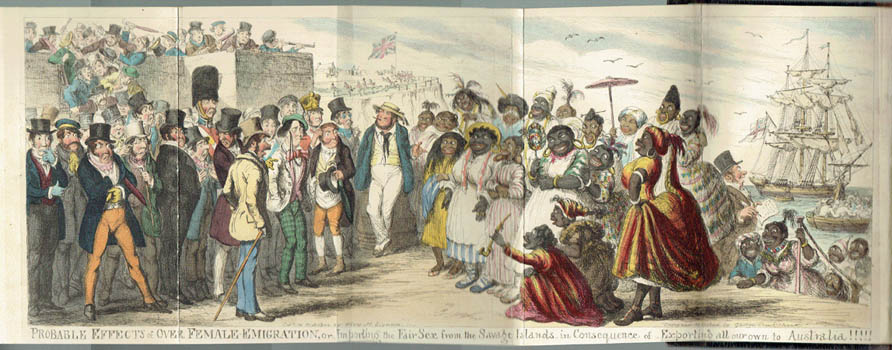
A triple dose of prejudice and insult
>CRUIKSHANK, George, Henry MAYHEW etc. The Comic Almanack and Diary 1851. [with] ... 1852. [with] ... 1853. London, Bogue 1850-52. Three volumes small octavo together in contemporary quarter gilt calf; long folding handcoloured frontispieces to each volume, etched plates and numerous illustrations. Bound without the extraneous government information and publisher's lists. A pleasing, fresh gathering. Au$300
On purely parochial grounds this is of interest for the first frontispiece: the 'Probable Effects of Over Female Emigration, or, Importing the Fair Sex from the Savage Islands in Consequence of Exporting all our own to Australia!!!!!' In the 1852 Almanack we find 'The Gold in Australia' by Jemmy Bullseye, Professional Burglar of Bottiney Bay and in the 1853 Almanack there is 'An Australian Eclogue', a plate of a cobbler in Australia and a further plate and description of a tragedy caused by female emigration to Australia. The more I look the more important colonial documents these become.
For those with broader views the second frontispiece depicting the craze for bloomers and the third on the effects of female enfranchisement have their chauvinistic appeal.
You can email an inquiry or order securely through antiqbook