Breaking the law

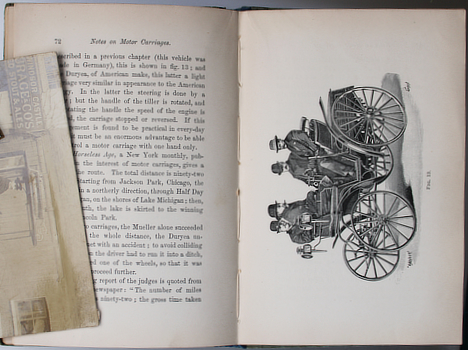
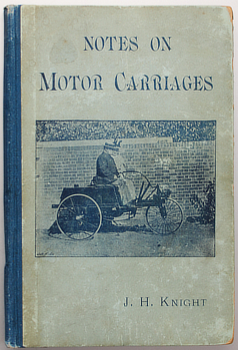
KNIGHT, John Henry. Notes on Motor Carriages with hints for purchasers and users. London, Hazell &c 1896. Octavo publisher's cloth backed illustrated boards (a bit rubbed & worn at corners); 84pp, illust with cuts & photo illustrations. Minor signs of use, a pretty good copy. Au$900

Only edition? Just about the first book on cars written for the English everyman. Engineer Knight was the motor car equivalent of a suffragette. I don't think he hurled bricks but in 1895 he did, with willful disregard of the law, take to the highway in his own motor car without a license and a man to walk in front with a red flag. He and his fellow motorists got the red flag act repealed not long after he wrote this. In the last passage he hopes the law will change in time for the planned October 1100 guinea road-carriage competition.
I read somewhere that this was the first automobile book added to the Detroit Public Library - in 1896 - the beginning of their self proclaimed "premier" auto collection.


You can email an inquiry or order securely through antiqbook

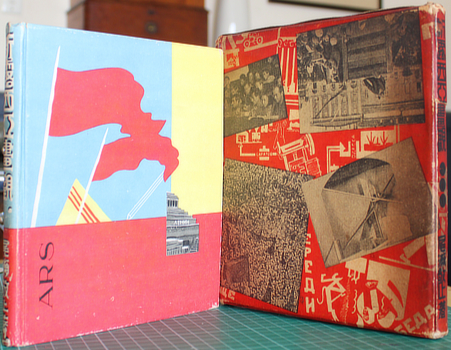
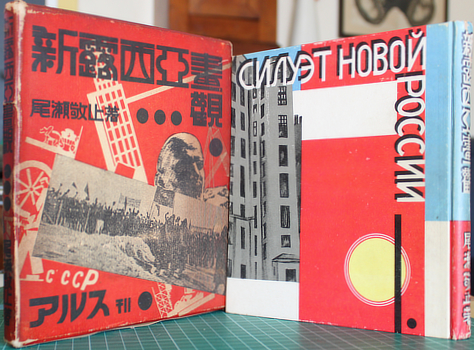
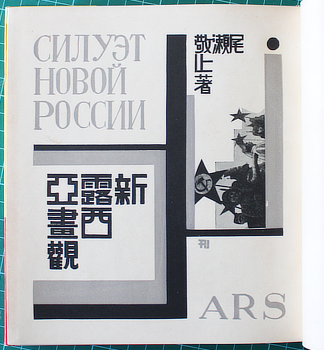
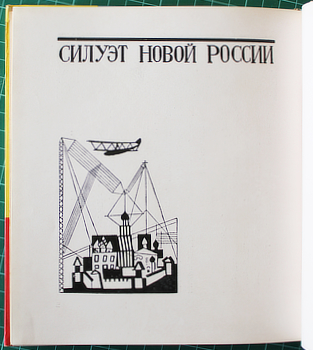
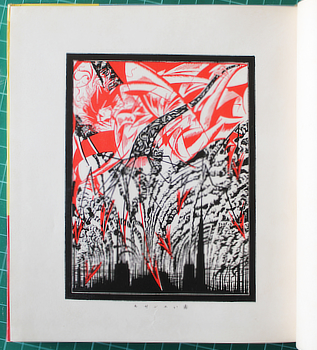
Ose Keishi & Onchi Koshiro. 新露西亜画観 [Shin Roshia Gakan]. Tokyo, Ars 1930 (Showa 5). 20x18cm publisher's colour illustrated boards and illustrated card slipcase; numerous photo illustrations, other illustrations and decorations, one full page in red and black. Box browned, used but solid; spine tips a touch rubbed; a nice copy. Au$750

First edition. Ose was an industrious reporter and interpreter of all things Soviet for Japan. I didn't see this in Hokkin Hon (Banned Books) but of course he has other entries.
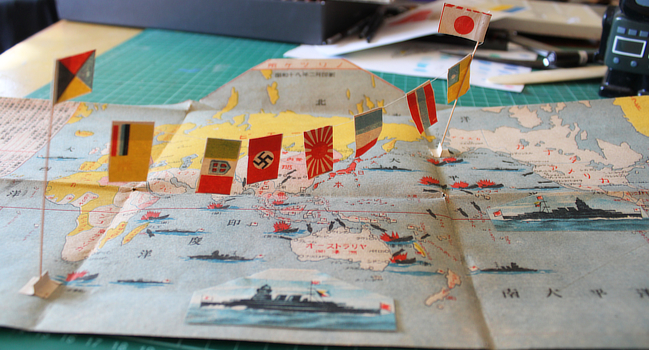
The design is by Onchi Koshiro. Onchi has plundered constructivist sources and photo-montage but has - as often - made it his own and Japanese.


You can email an inquiry or order securely through antiqbook

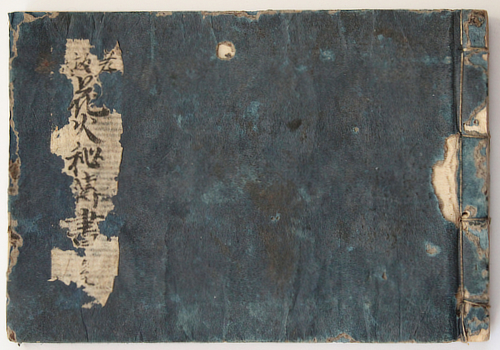
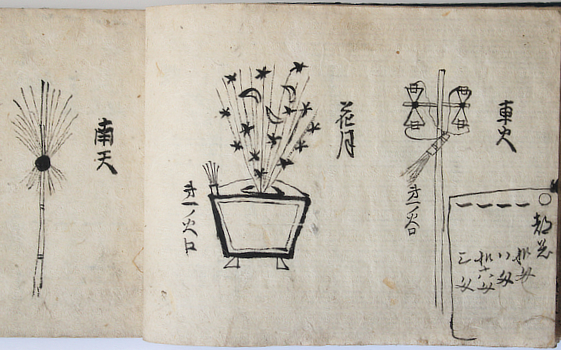
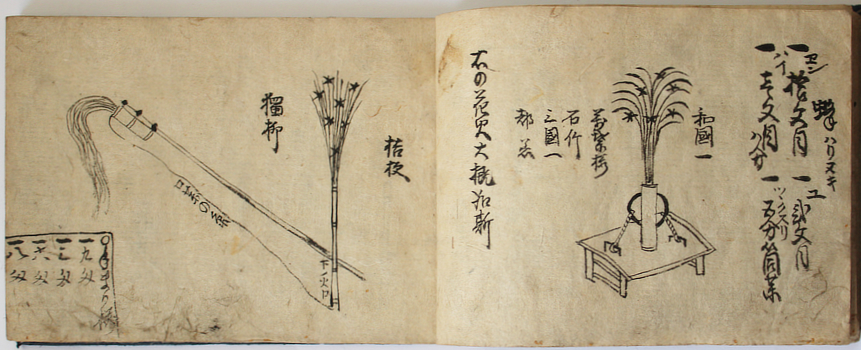
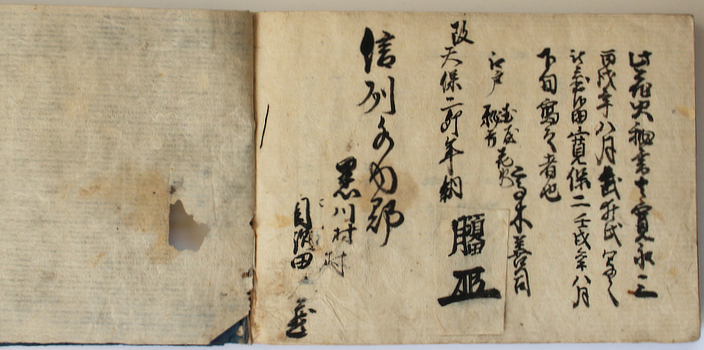
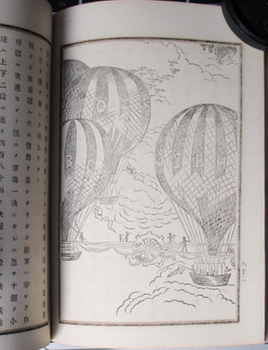
Fireworks. 孝坂流花火秘伝書 [Kosaka-ryu Hanabi Hidensho]. n.p. n.d. Probably early to mid 18th century. 12x17cm wrapper with remnant of a label; manuscript in ink on 31 double leaves (62pp), illustrations on six pages. Covers gnawed but not into the text pages, well thumbed but very decent. Au$950

Here are the secret methods of the Kosaka school. This is the earliest known fireworks manual in Japan; it dates from 1706. There are almost no published manuals of Japanese fireworks before the 20th century. Risho published a small book around 1817 and that is properly rare. Such information was occult knowledge, circulated in manuscript and passed from master to apprentice.


You can email an inquiry or order securely through antiqbook

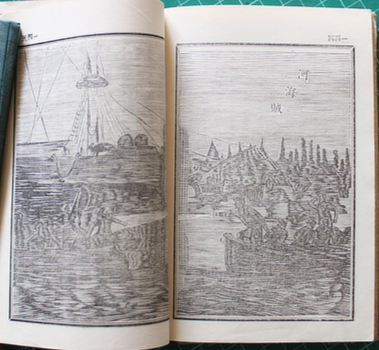
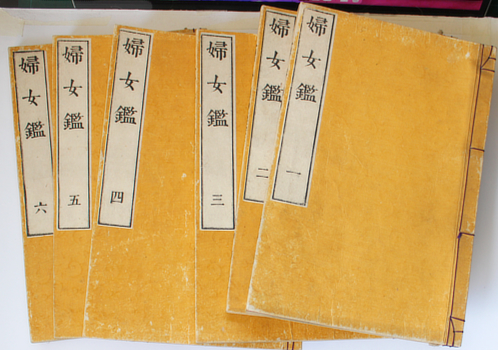
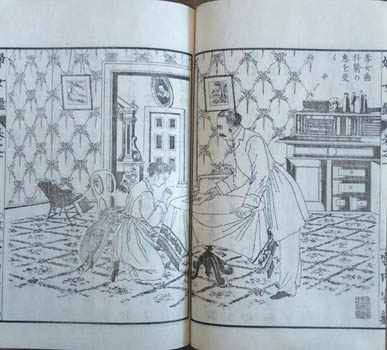
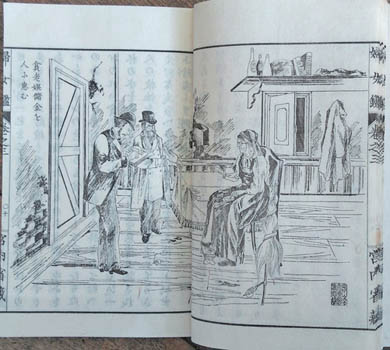
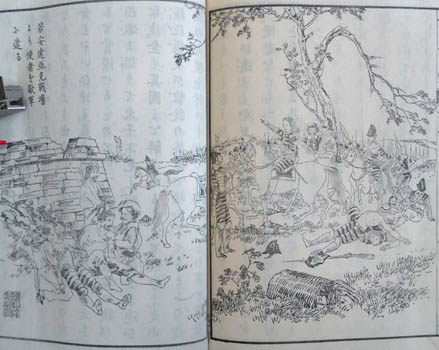
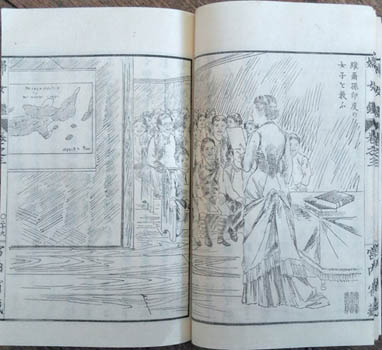
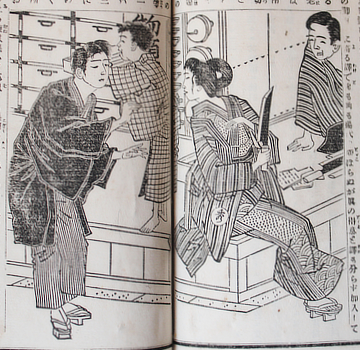
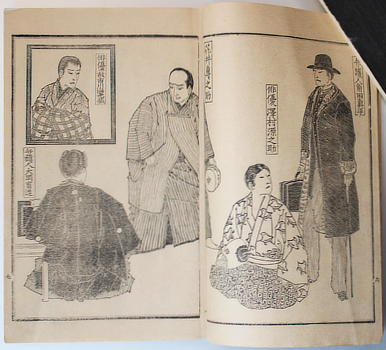
Nishimura Shigeki and others. 婦女鑑 [Fujo Kagami]. Tokyo, Kunaisho 1887 (Meiji 20). Six volumes 23x16cm, publisher's wrappers with title labels; double page page woodcut illustrations. An excellent set. Au$375

First edition of this official piece of moral education for women: the lives of inspiring women around the world. It was republished well into the 20th century. Moral philosopher and scholar of things western, Nishimura tutored emperor Meiji on the West. Apparently this book had some influence on the choice of Nishimura to head the Peeress's School the following year.
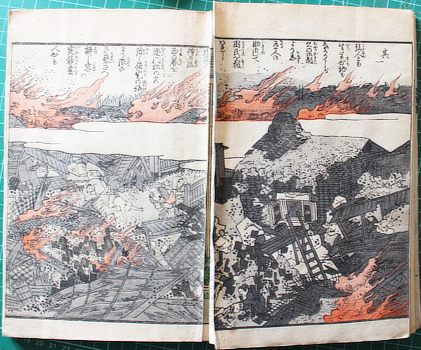
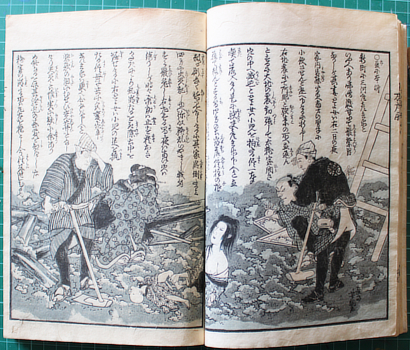
It is a monument to self denial and sacrifice on the part of women - clear enough from the illustrations - not much different from similar books for girls anywhere in the world but that it is deeply Confucian. Looking at the remarkable likeness of descriptions of this book by modern historians I wonder who read it and who just read each other.


You can email an inquiry or order securely through antiqbook

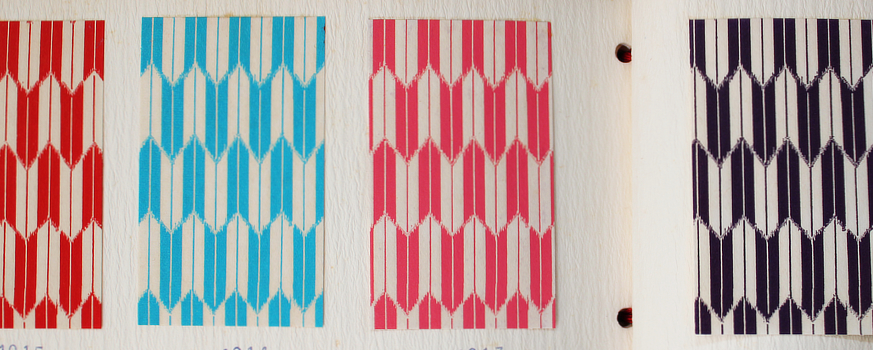
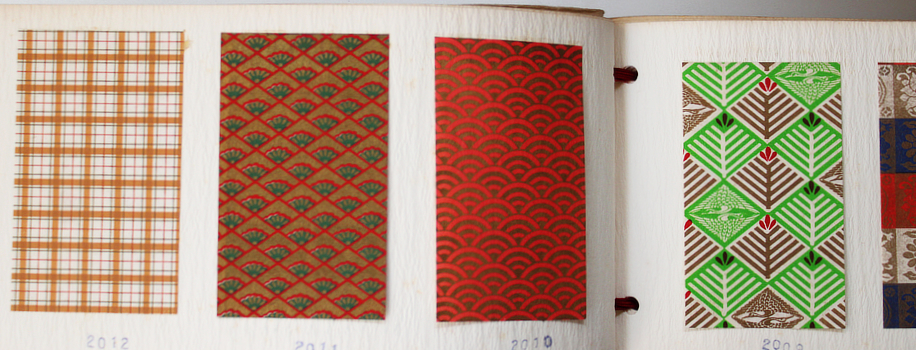
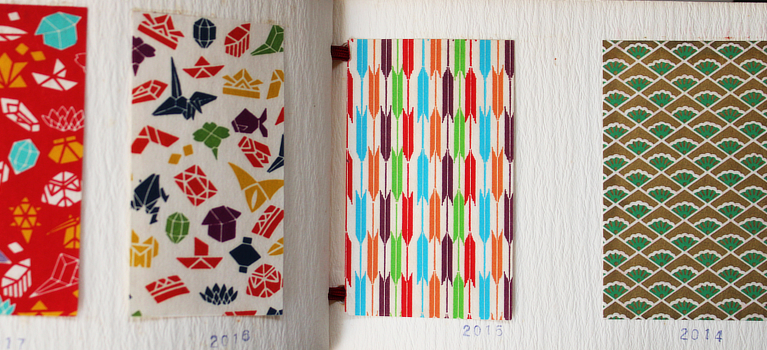
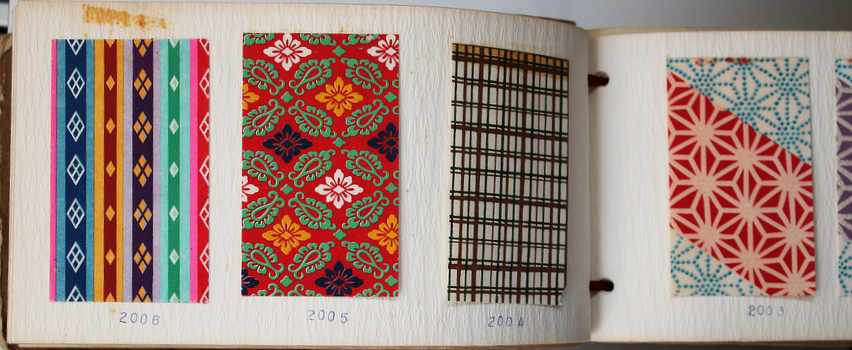
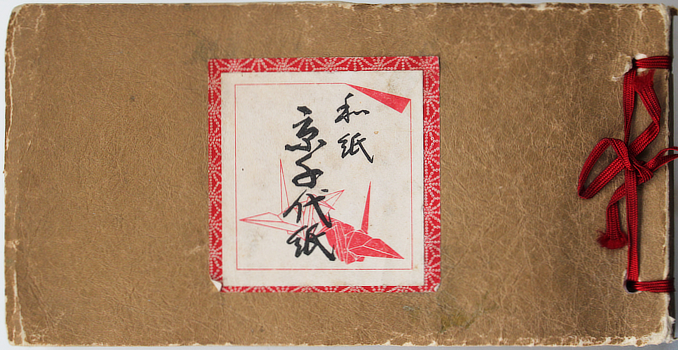
Paper 京紙 : 京千代紙 [Kyogami : Kyochiyogami]. n.p [c1930?]. 12x24cm card album, ribbon tied with a printed label on the front; 91 colour woodcut printed paper samples mounted three a page on double folded leaves, each with a serial number stamped under it. Au$400

Very cute, this is a sample book of chiyogami - special decorated paper - aimed at the origami marked according to the cover label. That label is a printed slip mounted on a piece of chiyogami. There are two series here: the first, numbered to 74, is bright and cheerful; the second, numbered to 17, is even more bright and cheerful. You can buy mountains of mass produced chiyogami these days but a glance at this album will convince you it's not the same thing. Experts might be able to tell the difference between Kyoto and Tokyo - Kyochiyogami and Edochiyogami - papers. I won't live long enough to master that.
I'm not convinced by my transcription of the first character of the title.


You can email an inquiry or order securely through antiqbook

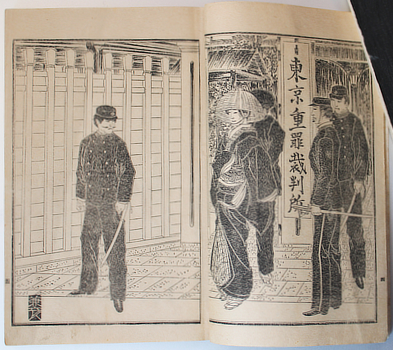
Naruko Isshi. 大鷹裁判記 : 明治擬律 [Ootaka Saibanki : Meiji Giritsu]. Tokyo, Kyowa Shoten 1889 (Meiji 22). 19x13cm publisher's colour illustrated litho boards, cloth spine; five full page and three double page illustrations. Expected browning of the cheap paper; used but rather good for a flimsy thriller meant to be read to pieces Au$300

First edition. I'm not sure what happens in this chronicle of the Ootaka trial but I assure you it involves a lot of violence and murder, some police and maybe a beautiful ghost. The preface seems to talk about exploring new ways of writing fiction and western novels but, as it's poetic, I can't make much sense of it.
And I can't tell you anything about Naruko. The name appears on two books published in 1889 and one in 1892, all from the same publisher.
This is a 'ball cover' (boru hyoshi, apparently a corruption of 'board') book, a signal of modernity and the Japanese equivalent of a yellowback: flimsy western style bindings with lithograph covers that rarely survive in good shape.


You can email an inquiry or order securely through antiqbook

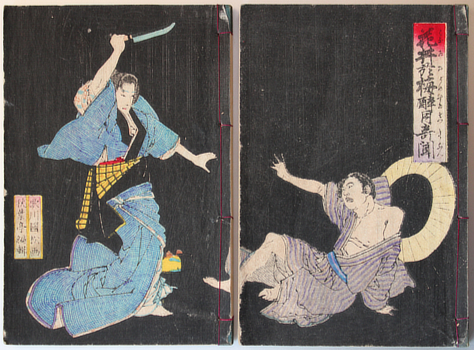
Hanai Oume. Shuyotei Sofu. 花井於梅 粹月奇聞 [or 花井お梅 酔月奇聞] [Hanai Oume Suigetsu Kibun]. Tokyo, Ishikawa Denkichi December 1887 (Meiji 20). Two volumes 18x12cm, colour wood covers by Utagawa Kunimatsu; two double page, two single illustrations at the front, four large illustrations through the text. A pleasing copy. Au$500

One of the prizes of the dokufu craze of the early Meiji. Dokufu - poisonous women - are nothing new of course but the happy conjunction at the advent of mass circulation newspapers of a beautifully timed series of murders by unvirtuous young women set the sensation mongers and their readers all of a fever. Newspaper to book, lurid print to kabuki and back again, dokufu were all the rage for a couple of decades. Along the way crime fiction was born and, in a way, modern Japanese literature.
Hanai Oume earned her place as one on the trinity of great dokufu for the murder of her employee for helping her sponging father muscle her out of her business - the teahouse Suigetsu. The famous umbrella was part of her defence.
Of course nothing about cheap popular trash like this is going to be straightforward. The colophon here tells us this is a reprint but lists the first as November 1887 which must be a newspaper appearance. Keio university's copy which uses the same covers is a different printing from a different publisher (Mizuno Ikutaro) with a colophon listing nothing before December while Yamanashi University's copy, published by Yamazaki Matasaburo and dated the same day as Keio's, is yet another different printing with a different cover. None of this is helped by the book being titled by both variants in the same copy.


You can email an inquiry or order securely through antiqbook

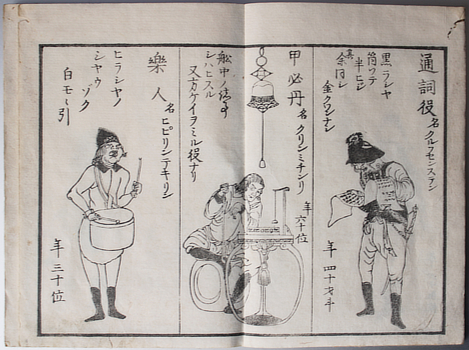
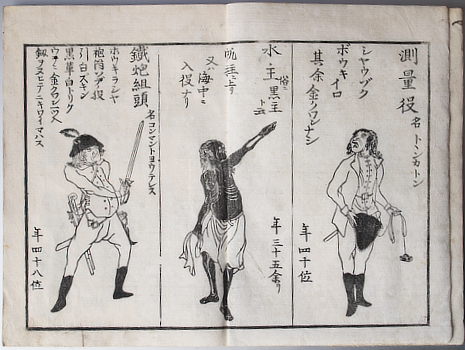
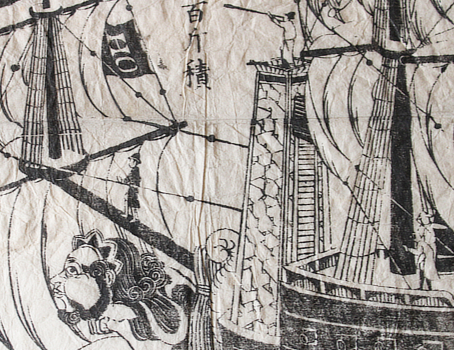
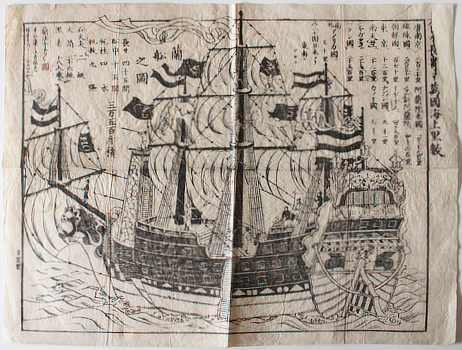
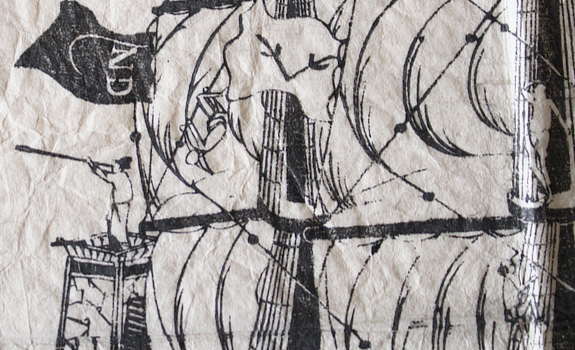
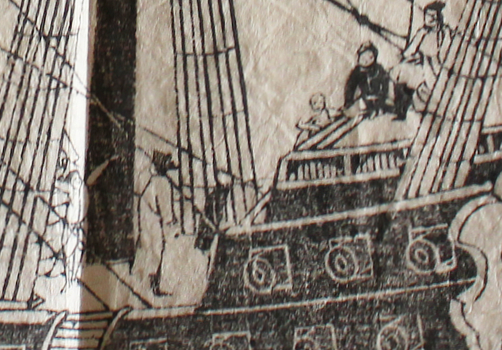
Kawaraban. 大日本長崎ヨリ萬國海上里數 [Dai Nihon Nagasaki Yori Yorozu Kuni Kaijo Risu?]. n.p. earlyish to mid 19th century. Woodcut 32x41cm. Piece torn from the right edge affecting a few characters repaired. Still, a good copy. Au$500

The classic Dutch ship was a required souvenir for every Japanese tourist in Nagasaki and, in various forms and fancies, was dusted off and reworked all over Japan every time a stranger appeared around Japan. This may have been occasioned by news of a Russian ship, American, British, or to fill in a dull patch in the foreign barbarian trade.
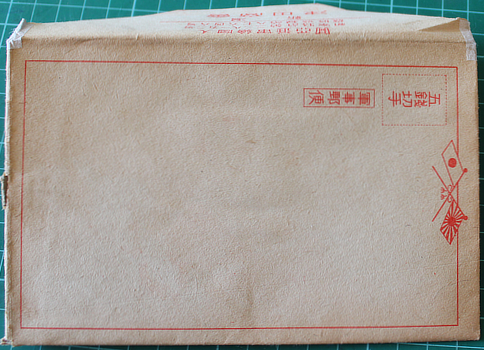
Maybe hard to see in my shaky pictures but this is one cheery bunch of sailors. They look more like they are having fun than working.
Kawarabans were illicit news sheets for the streets and produced by the million for a couple of hundred years so of course few survive. They were produced for anything more interesting than the drop of a hat. Foreign visitors were exciting news, much less common than flood, fire, quake, and famine.


You can email an inquiry or order securely through antiqbook

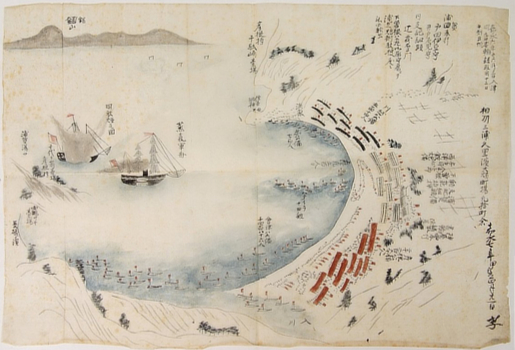
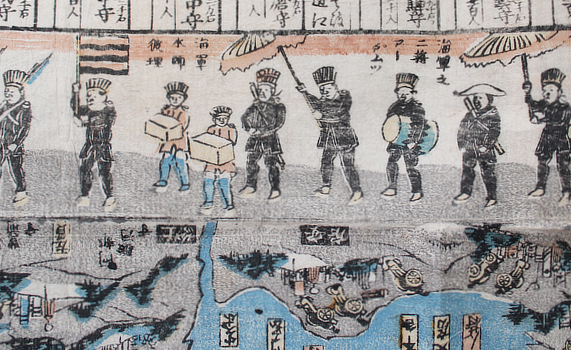
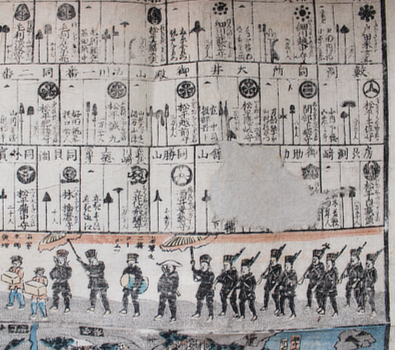
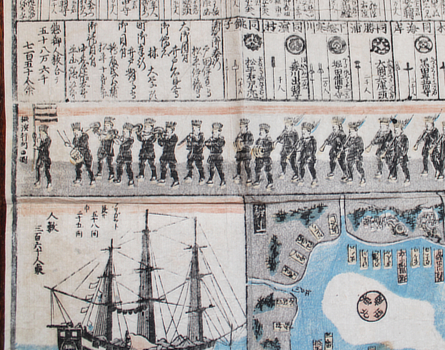
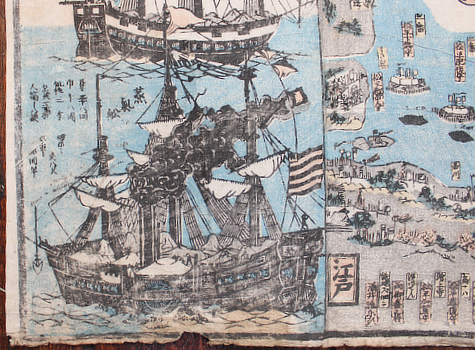
Kawaraban. Perry and the black ships. [Kairiku Okatame] Untitled large kawaraban of the arrival of Perry's black ships in 1854, the defences and the American parade. These defence of Tokyo and Perry ship prints usually have 'Kairiku Okatame' in the title. n.p. [1854]. 45x62cm colour woodcut on two joined sheets. A largish hole towards the top right, bottom edge stained and a bit damaged, some unimportant holes elsewhere. Repaired with backing some time ago, the damage at the bottom and small worm holes have happened since. Au$900

It would be wrong to call this a poor cousin of the similar kawaraban, Kairiku Okatame Onbasho Tsuke, the largest and most sumptuous I've yet seen. This is still an aristocrat among kawaraban. It is also a four in one print: details of the clans defending Tokyo bay at the top, the American procession in the middle, close ups of two of Perry's black ships bottom left, and a map of the whole situation bottom right.


You can email an inquiry or order securely through antiqbook

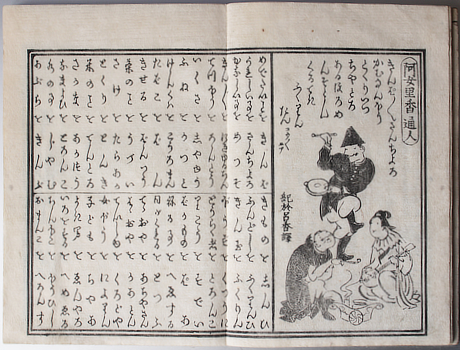
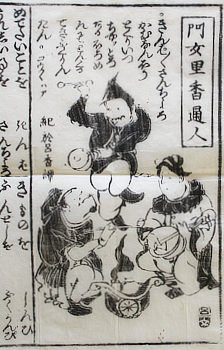
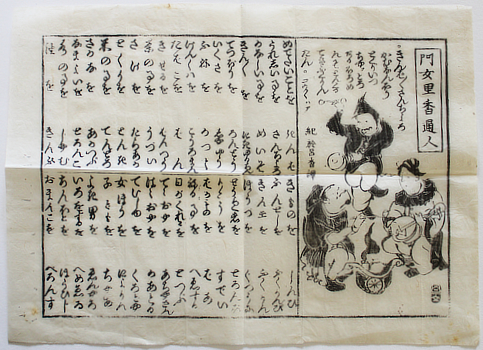
Kawaraban. Perry and the black ships. 阿女里香通人 [Amerikatsujin]. n.p. [1854] 23x31cm woodcut. Folded; rather good. Au$300

This lesson in the American language might be useless but when has that been an impediment to success? Those three figures are Americans having fun and that's a list of Japanese words or phrases and phonetic transcriptions from American. One ('child') is not too far off. Since the translator signs himself as 'foolish' was it ever meant to be taken seriously? I'm sure the artist's seal, something rarely, perhaps never, seen on a kawaraban is also a joke but it's too subtle for me.
In one piece I found on this print the writer found it necessary to blur the last two words but the less prudish Tokyo Museum, thank goodness, transcribed them all. So you get a good idea of what the children and vulgar of Edo were chanting or shouting at each other. No American would have understood what they were saying but they knew what they meant.


You can email an inquiry or order securely through antiqbook

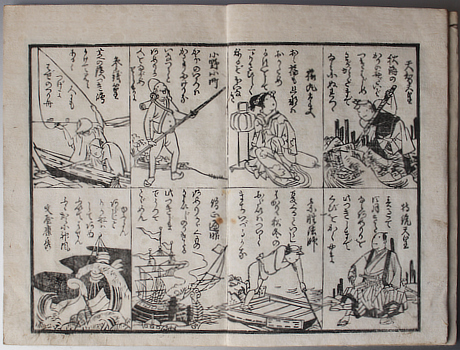
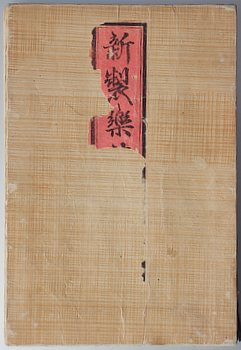
Perry and the black ships. 新製楽草紙 [Shinsei Tanoshimi Soshi]. n.p. n.d. [1854]. 18x12cm publisher's wrapper, most of the label missing; 20 double leaves; illustrated pretty much throughout, double page colour map at the beginning. Some insignificant worming at the beginning, signs of use but quite good. Au$600

One of two volumes with this title. As far as I can figure out this is mostly a compilation of separately issued prints or kawaraban - illicit news sheets - about the arrival of Perry and the black ships. Afficianados will recognise some of those pictures from other kawaraban. Much of this is satirical or parody which makes it unintelligible for me. I can tell you that the trio of celebrating Americans accompanies a list of mock American vocabulary (see the item above). And that ancient looking black man is the youngest person on that page - 35 years old the caption tells us.


You can email an inquiry or order securely through antiqbook

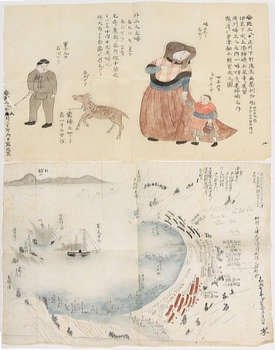
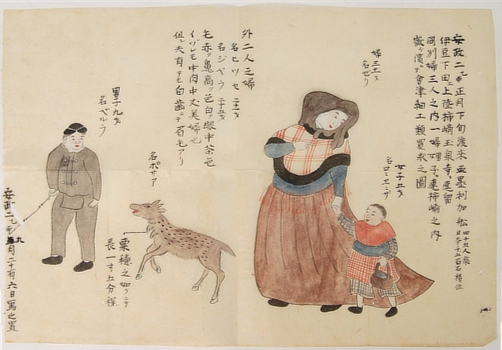
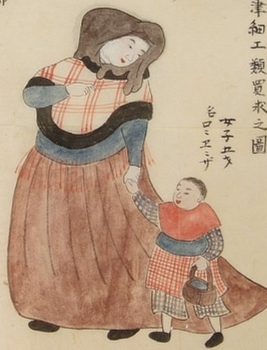
Putiatin mission? Perry and the black ships. Two drawings: a view of the American black ships and their reception at Kurihama in 1853; portraits of a foreign woman, young girl, young man and goat, dated 1855. n.p. 1853-55. Two ink and colour drawings 27x38cm. Small hole in the second drawing. Au$500

Despite all the detail I'm still uncertain about where these foreigners came from. I can tell you their names, ages and give a pretty good physical description of the woman. I can't tell the goat's age but we are given it's size. Since it's February 1855 at Shimoda I'd say they are Russian. The surprise for me is that women and children were included in the Putiatin mission.
That American ship on the left in the other drawing is not damaged, it's shrouded in smoke.


You can email an inquiry or order securely through antiqbook

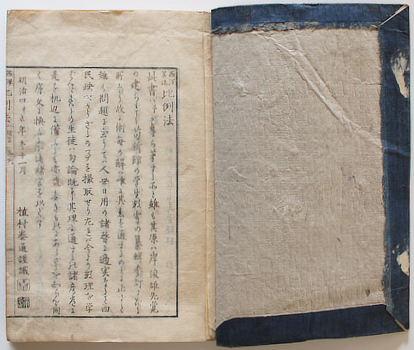
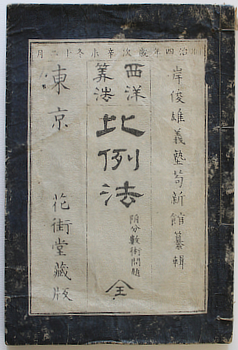
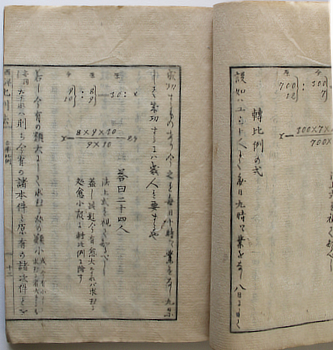
Kishi Toshio. 西洋算法 : 比例法 附分数術問題 [Seiyo Sanpo : Hireiho Bunjutsu Mondai]. Tokyo, Kagaido 1871 (Meiji 4). 23x15cm publisher's? wrapper with mounted title. Signs of use but pretty good for an old maths book. That's the title page mounted on the front cover, likely removed before binding. Au$135

Japanese students are introduced to simple western algebra and proportional ratios. Until the 1860s and the establishment of modern schools - for officers at first - western mathematics, like all things western, was the domain of a few curious scholars. Mathemeticians gave credit to the west in astronomy but judged western theory decidely inferior. Such disdain was of no use to a government determined to know everything. Mathematics came after languages, history, geography ... but not by much.


You can email an inquiry or order securely through antiqbook

MANSON, Marsden. The Yellow Peril in Action. A possible chapter in history. Privately published, San Francisco, January 1907. Octavo publisher's printed wrapper; 32pp (including two blank leaves at the end), folding map. Au$125

A salutary piece of yellow peril literature, this is the history of the war between the USA and China - with help from Japan - in 1910. I'll tell you now it didn't end well for America. Manson was the San Francisco City Engineer during the immediate post earthquake years and some of his predilection for technical detail has crept in here. This understandable desire to reinforce polemic with fact is the mark of the amateur and usually the reason why such tales are forgotten but Manson hasn't tried to disguise his aim with fiction; a fair bit is straightforward xenophobic agitprop.
I wonder how much the cataclysm of the San Francisco earthquake and fire had to do with this but I find no direct mention. Is it odd that it went to press so soon after the quake - Manson's preface is dated December 1906 - without a word? Did Manson think the shock of the quake was a good prompt for a battered public to take notice of an even greater threat? Certainly there was a movement to push the Chinese out of central San Francisco as rebuilding began. Was this a misguided bit of timing that guaranteed his pamphlet would be ignored?


You can email an inquiry or order securely through antiqbook

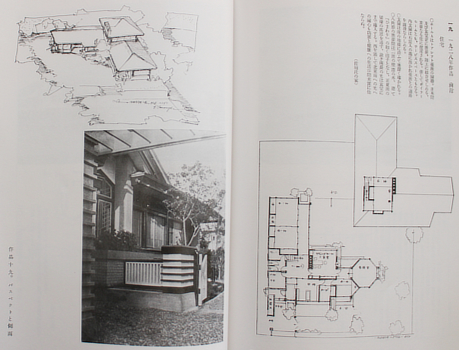
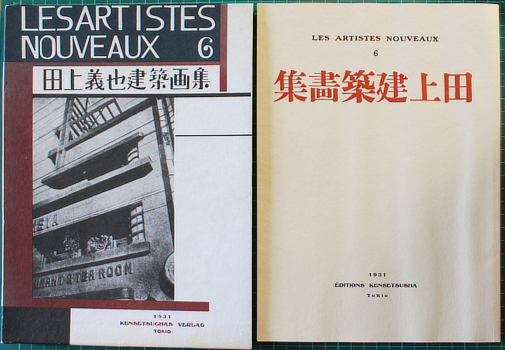
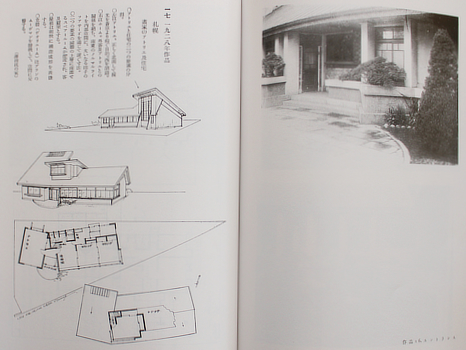
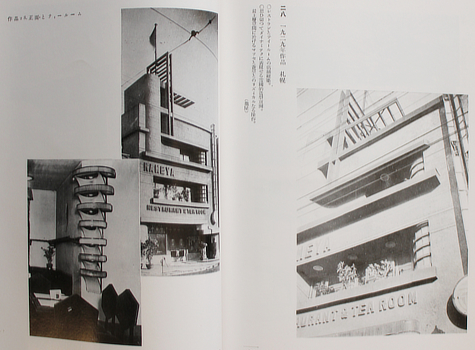
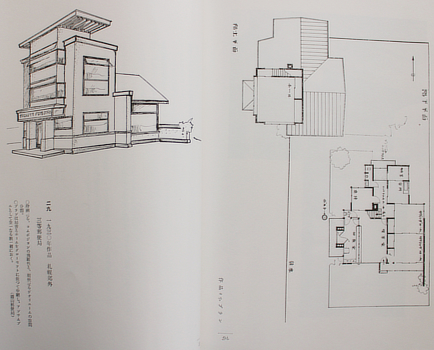
Tanoe [or Tanoue or Tanouye] Yoshiya. 田上義也建築画集  [Tanoe Yoshiya Kenchiku Gashu]. Tokyo, Kensetsusha 1931 (but Raifushuppansha 1987). 27x19cm publisher's printed wrapper, illustrated card slipcase; 110pp, photo illustrations, renderings and plans. At cost price. Au$250

Not the great bargain I hoped for. This is not the first edition, it's a facsimile I didn't know existed until I unwrapped this. It's a good facsimile, very good, and it's more obscure than the original. It's a local production by a Hokkaido publisher - not to be confused with current Tokyo 'Life Publishing' which deals in puerile self help stuff.
Tanoe began his career working for Wright on the Imperial Hotel - from 1919 to 1923. He then headed off to Hokkaido and is now an architectural hero of the island, even while many of his buildings have vanished. The prairie style is evident in some of these early houses but no more than Japan is evident in the prairie style. I read somewhere that for one of the buildings in this book he kept his original plan rather than the compacted plan that was actually built. This was so that his sense of space was preserved.
I think the rest of this Artistes Nouveaux series - maybe seven titles in all - are all painters including three Europeans: Matisse, Vlaminck and Chagall. They weren't reprinted of course.
Worldcat finds no copies outside Japan and it's not common in Japan, neither the original nor this reprint. At cost price.


You can email an inquiry or order securely through antiqbook

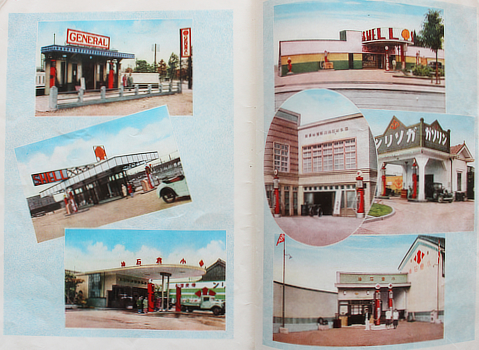
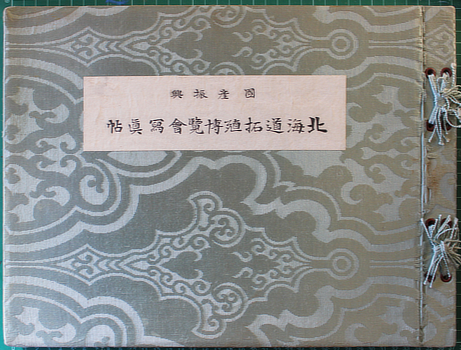
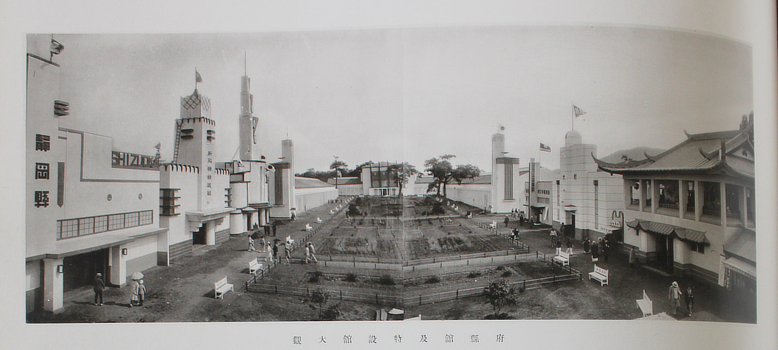
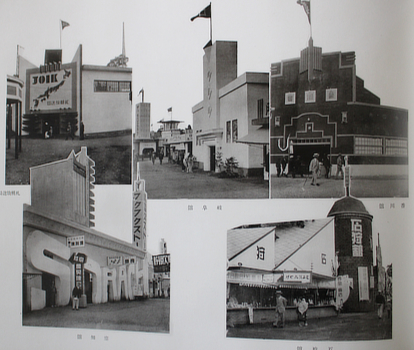
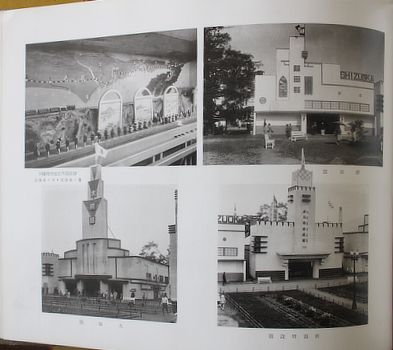
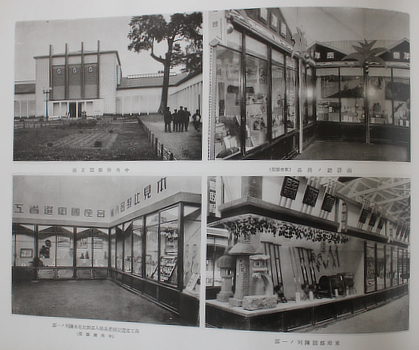
Exposition - Hokkaido 1931. 国産振興北海道拓殖博覧会記念写真帖 [Kokusan Shinko Hokkaido Takushoku Hakurankai Kinen Shashin Jo]. Hokkaido Takushoku Hakurankai, 1931 (Showa 6). 27x37cm publisher's patterned silk, cord ties; title page, photo illustrations on 35 leaves of heavy gloss paper, 12 pages of text and a plan. A nice copy. Au$600

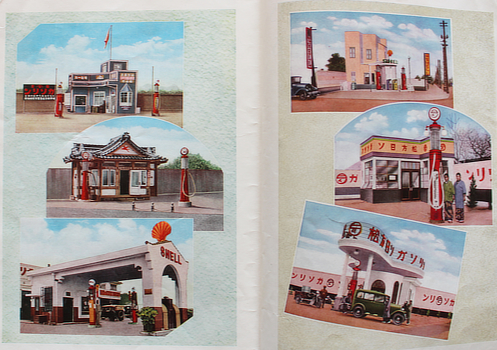
A luxurous celebration, with exemplary printing, of the 1931 Hokkaido Colonization Exposition. Had you heard of it? Me neither. Thankfully the important old men who always head such books don't take up too much space and it gets more interesting the further we go in. What's wonderful is the number of pavilions that might have come straight out of the pages of the exposition volume of the Gendai Shogyo Bijutsu Zenshu - the Complete Commercial Artist - of 1928-30 (see the next item). Either the same designers were at work or the organisers handed out copies of the book and said, "go for your life."
At the very end we find what seem to have been the big draws for the 600,000 plus visitors: the human cannonball, the world's fattest woman, and dancing girls.


You can email an inquiry or order securely through antiqbook

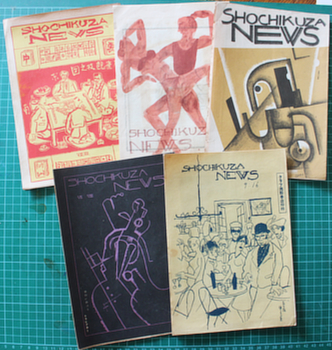
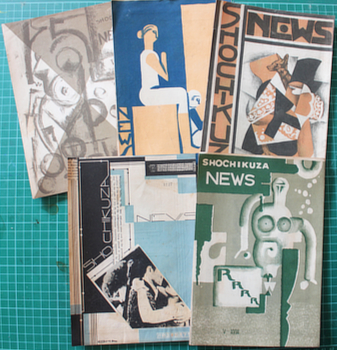
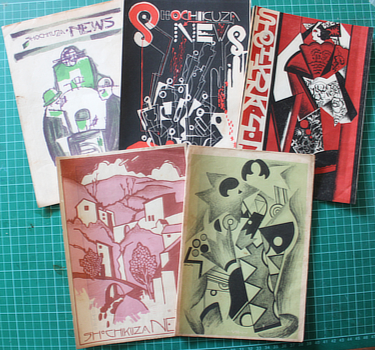
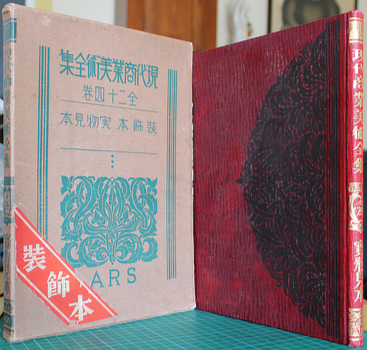
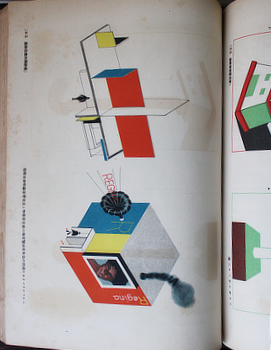
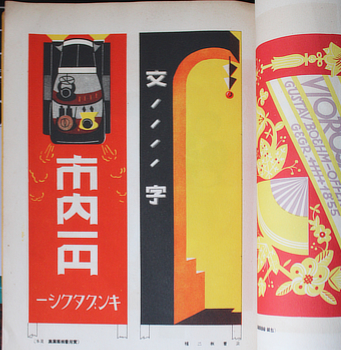
Hamada Masuji, Sugiura Hisui and others. 現代商業美術全集 : 装飾本 : 内容見本 [Gendai Shogyo Bijutsu Zenshu : Soshokuhon : Naiyo Mihon] [The Complete Commercial Artist]. Tokyo, Ars c1928. 26x20cm publisher's cloth and printed card slipcase; [2],8pp, 62 pages of illustrations and plates, most in colour, 16pp of text. The blank leaves used to bulk out the binding have been removed, odd in a copy that looks like it has barely been opened. Au$800

I didn't know this existed until quite recently. This is the publisher's sample book for the Gendai Shogyo Bijutsu, one of the great monuments of Japanese modernism, published by subscription in 24 volumes. It contains a sample range of illustrations from the work and explanatory text. The set was issued in wrappers or this, presumably more expensive, cloth binding.
Largely the work of Hamada Masuji - credited with the invention of design as a profession in Japan - the Shogyo Bijutsu is an encyclopaedic gathering of all that is new and exciting in Russia, Europe, Britain and America from art nouveau to bauhaus and constructivism, with futurism, expressionism, dada and everything else along the way lavishly mixed with Japanese responses to, and digestion of, these western ideas. Any number of exciting artists and designers contributed. Except to the binding.


You can email an inquiry or order securely through antiqbook

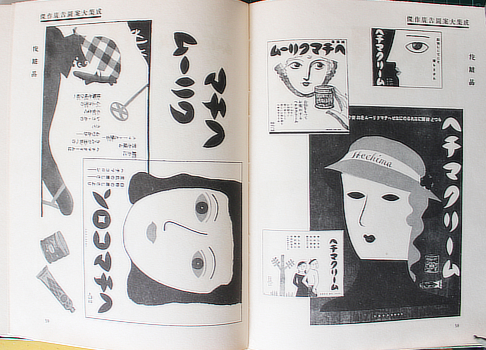
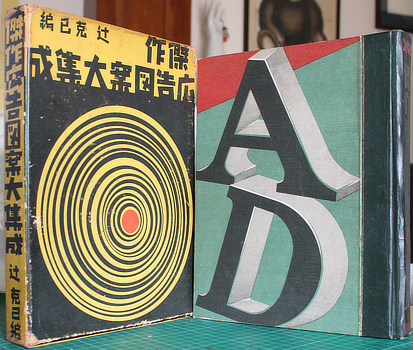
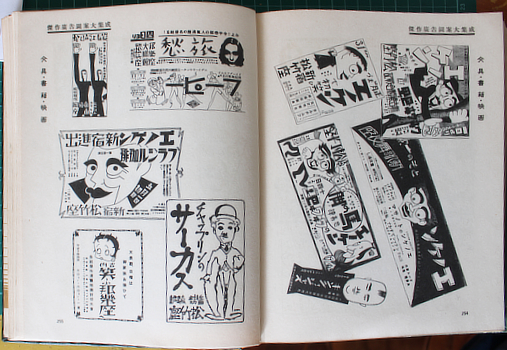
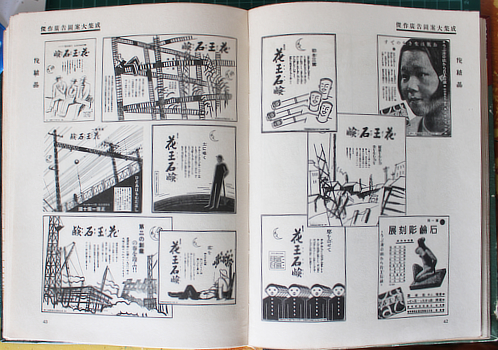
Advertising. Katsumi Tsuji. 傑作廣告圖案大集成 [Kessaku kokoku zuan daishusei]. Tokyo, Kobunsha 1934. 27x20cm publisher's illustrated cloth, illustrated slipcase; 320pp with hundreds of illustrations (eight pages in colour, the rest in varying monochromes). A mildly fatigued copy, used but nothing in particular. Au$350

A splendid compendium of modern advertising layout and typography; there are examples from Europe and America but fortunately the bulk is Japanese. Both the book cover and the slipcase are pretty smart, the slipcase in particular. The 'AD' design on the cover of the book is a direct link to the Art Directors Club, presumably this is a forerunner of the current Tokyo Art Directors Club.


You can email an inquiry or order securely through antiqbook

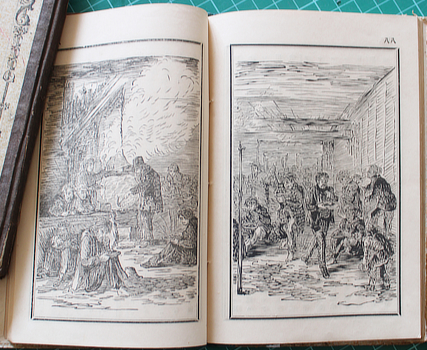
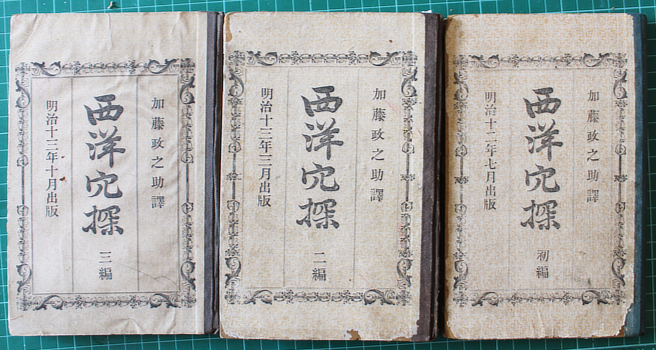
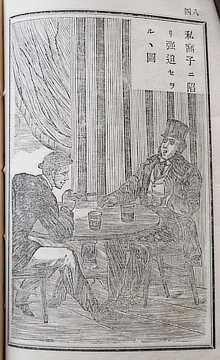
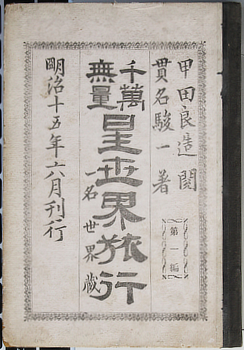
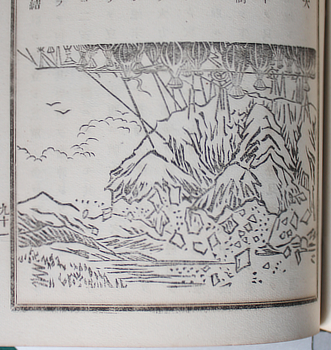
Nukina Shun'ichi. 千萬無量 : 星世界旅行 - 第一編 [Senman Muryo : Hoshi Sekai Ryoko - Dai-ichi-hen]. Kyoto, Nukina Shun'ichi 1882 (Meiji 15). 18x13cm publisher's cloth backed thin printed boards; [6],144,[3]pp, one full page and five half page illustrations. Brushed inscription on the last blank leaf. Edges a touch chipped, title and last leaf browned; a remarkably good copy of a vulnerable book. Au$6000

First edition of the first Japanese science fiction novel. This is proper interplanetary - intergalactic even - space travel, not old fashioned fantasy or fable. The title translates literally as 'Star World Travel'. For a while this was apparently regarded as a Jules Verne translation until someone figured out that there is no Jules Verne novel like this to translate.
This has never been translated and until very recently there was virtually nothing written in English and very little in Japanese on Nukina and his novel. Michal Daliot-Bul published two papers on this novel in 2021 and 22, Voyage to Innumerable Star Worlds, which are helpful but unfortunately written in Academic. A vague reference I found elsewhere to artificial life is expanded: on the dystopian planet of untrammelled technology and capitalism work will soon be done by artificially created organic humans - androids or robots - that are governed by three rules. It would be hard to argue that either Capek or Asimov pinched their ideas from Nukina but once again we find that no great notion doesn't have a precursor. Daliot-Bul also claims this as almost certainly the first utopian anarchist novel of Japan. The reason - she posits - for it's failure and disappearance.
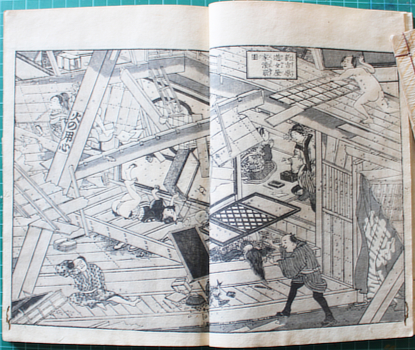
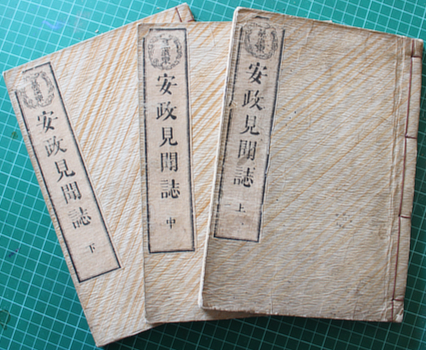
This is volume one of what was meant to be a trilogy - containing five chapters - there is no more. At the end is a teasing hint of what chapters six to twelve might contain but we are unlikely to ever know for sure. 
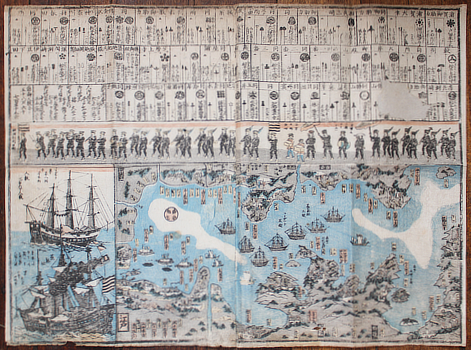
I believe that last illustration is of a cop chasing a perp.


You can email an inquiry or order securely through antiqbook