
If you would like to get email notices when a new list appears, send your email address. No other details are necessary.

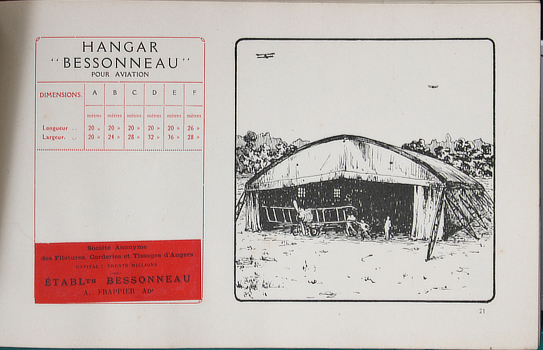
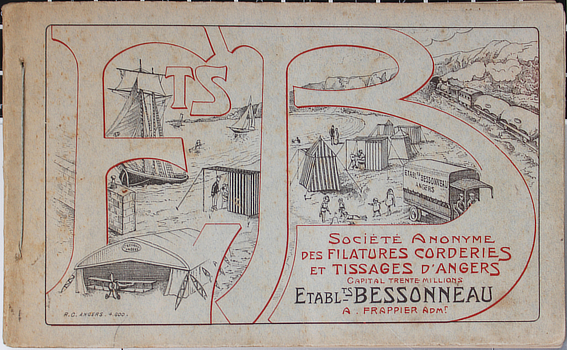
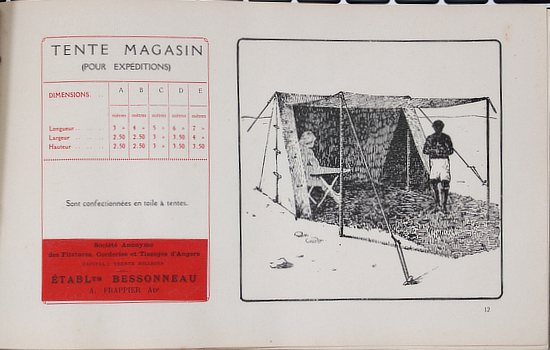
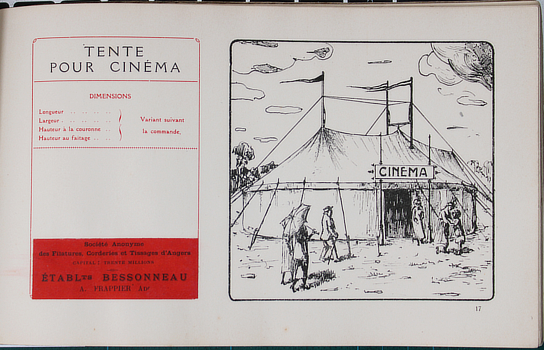
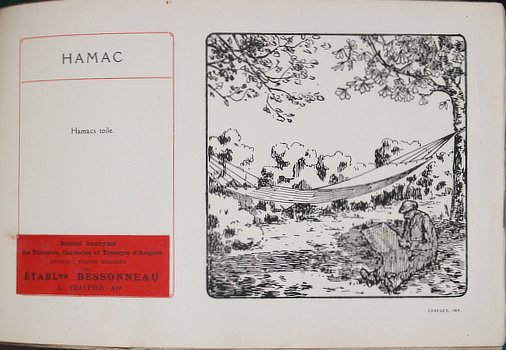
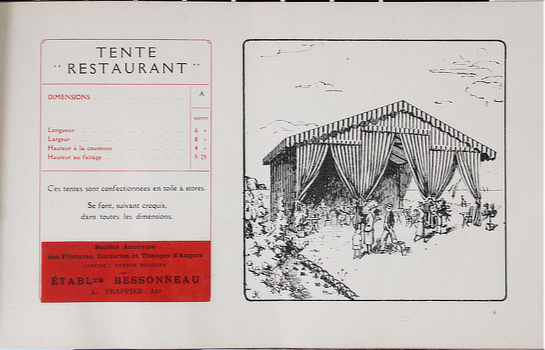
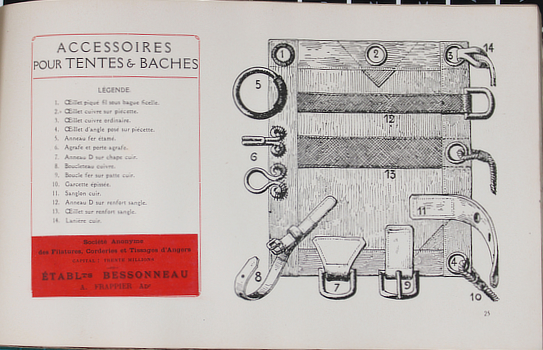
Catalogue - tents & more. Bessonneau, Angers. Etablts Bessonneau ... (cover title). Angers [191-?]. 13x22cm publishers illustrated wrapper, string tied; 35 leaves printed on one side. Minor signs of use. Au$650
From Bessonneau airplane hangars to a hammock, imagine canvas at work and Bessonneau have likely made it along with others you never thought of. Hospital, tick; colonial police office and expedition shop, tick, tick; restaurant, tick; horse cover, tick; cafe canopy, tick; cinema, tick; tarpaulins for trucks, wagons, barges, tick, tick, tick.
Rare? Tick.
Note that hammocks are still useful as shade for gentlemen of certain stature or age.
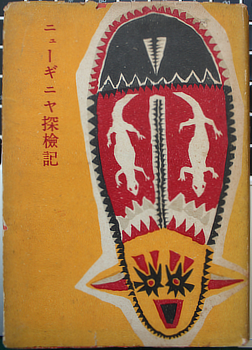
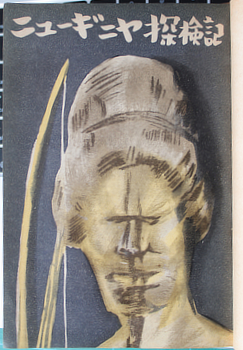
Papuan Wonderland
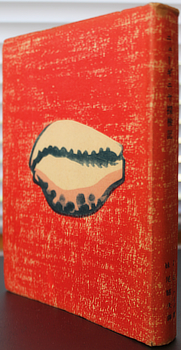
HIDES, J.G. (Jack Gordon) & Senoo Akio. ニューギニヤ探檢記 [Nyuginiya Tankenki]. Tokyo, Hakubunkan 1942 (Showa 17). 19x13cm publisher's colour illustrated flexible card and dustwrapper (the dustwrapper a bit frayed and chipped); colour illustrated title page, photo illustrations on four plates, b/w illustrations through the text, endpaper map. First gathering loose from the flimsy stitching, the cheap paper is browned but not brittle. sold
First edition; a translation of, I'm pretty sure, Papuan Wonderland (1936) at the time most Japanese were paying attention to New Guinea for the first time. Senoo was a busy writer and translator, mostly of detective fiction. The covers and illustrations are by Kato Taizo. Worldcat finds only a copy in Taiwan outside Japan.
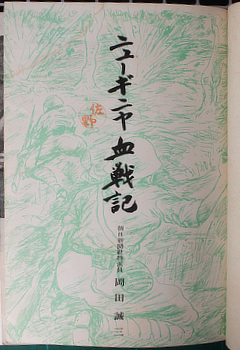
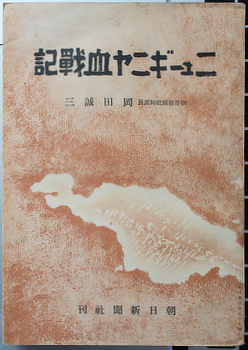
The bloody battle of New Guinea
Okada Seizo. ニューギニヤ血戦記 [Nyuginiya Kessenki]. Tokyo, Asahi Shimbunsha 1943 (Showa 18). 18x13cm publisher's illustrated wrapper; illustrated title page, photo illustrations on four plates, a few b/w illustrations through the text, endpaper map. Paper browned but a rather good copy. Au$400
First edition. Okada reported for the Asahi Shimbun from New Guinea. He also turned part of his experiences into a short story and won the Naoki prize in 1944. He began a new career as a novelist after he retired from the paper, in the seventies. I read somewhere about the constraints he worked under writing about Japan's first defeat - something headquarters wanted erased. I have also heard of Japanese officers furious about soldiers continuing to return alive from battles as defeat loomed: they had already been reported dead. So they were sent out again.
Worldcat finds two locations in Taiwan and one in the US outside Japan.
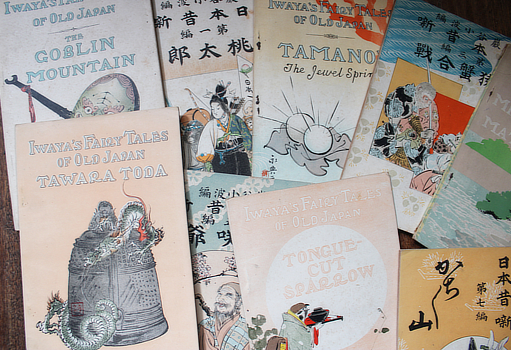
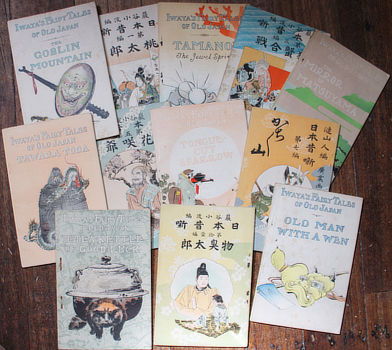
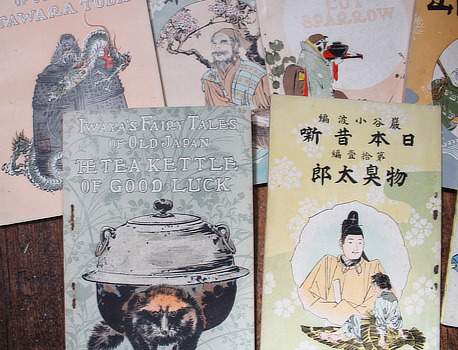
Iwaya Sazanami. 日本昔噺 Iwaya's Fairy Tales of Old Japan. [Nihon Mukashibanashi]. Tokyo, Eigaku-Shimpo-Sha 1903-04. 12 volumes 22x15cm publisher's colour illustrated wrappers; b/w illustrations throughout. A few minimal signs of use, some natural browning of the paper; an outstanding set. sold
A complete set of what I believe is the original bilingual edition of Iwaya's fairy tales produced as back to back books: the Japanese reader starts from one end, the English from the other. Each cover has a different illustration but only the English half gets the pictures inside.
I first took this to be a cheap cash-in on the crepe paper fairy tales produced for westerners but find I am wrong. Iwaya was a dedicated writer for children and is credited with the first original Japanese story for children - Kognemaru (1891). The Japanese versions appeared earlier but I read somewhere that Iwaya revised, simplified and modernised his style for this bilingual edition. The English versions, translated by Hannah Riddell (founder of the first Japanese hospital for lepers) and others, were republished in one volume several times.
There are scatterings of this all over the place and multiple reprints but I haven't found another set still in original parts.
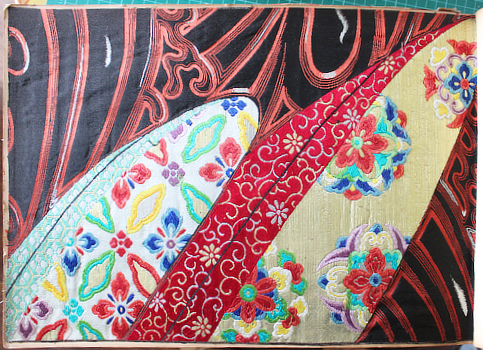
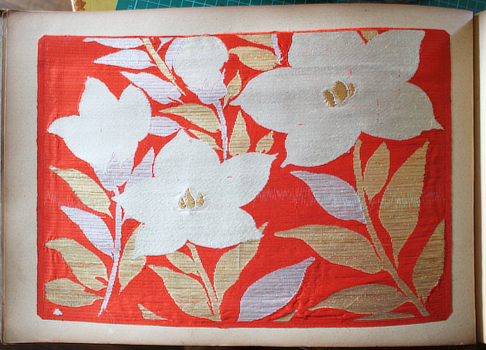
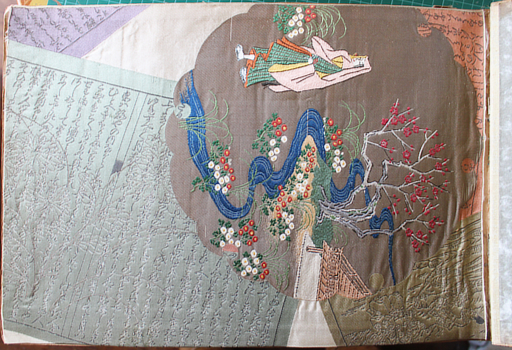
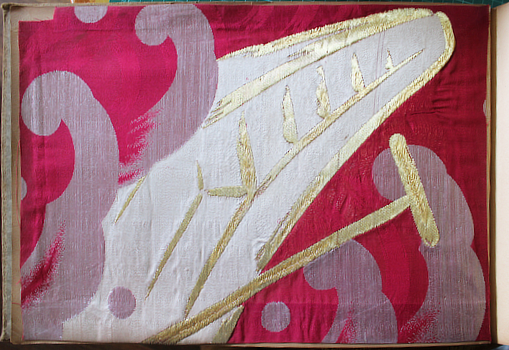
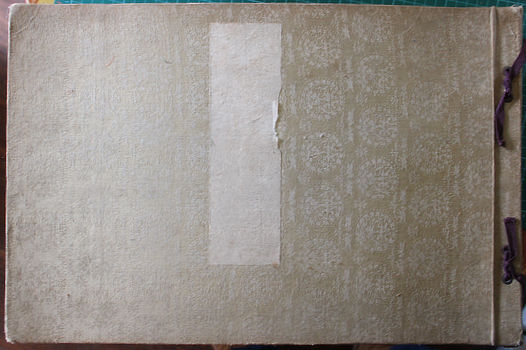
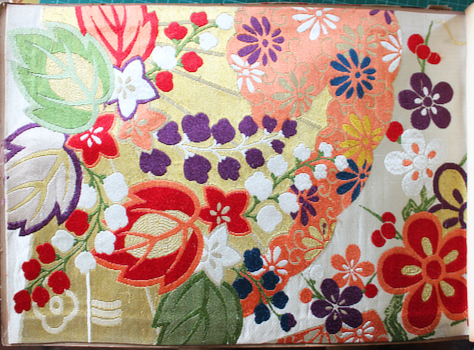
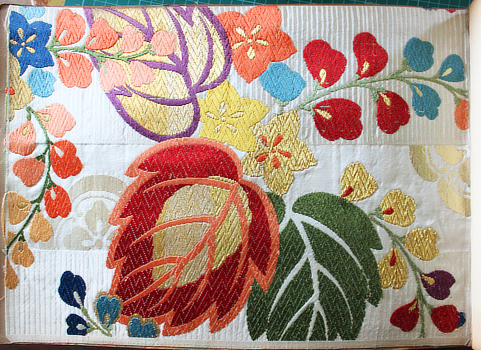
Textile embroidery sample album. [紫芳藏書]. An album of embroidered designs in silk. n.p. earlyish c20th. 30x45cm silk covered album, ribbon tied; 40 samples on 43 card leaves (two have been removed and one leaf was left blank). Signs of use but nothing worrisome. Au$750
A formidable collection of large, if often overwrought, designs in embroidered silk. I take these to be Obi designs but I'm no expert. The first design, perhaps a scene from some antique romance, features an illustrated book that looks as if it could be read by someone literate.
A stamp at the very end tells us this is the shihokurashu - purple fragance collection - and this is no.469. Purple is not a predominant colour anywhere so it must be the spirit of an ineffable fragrance at work.
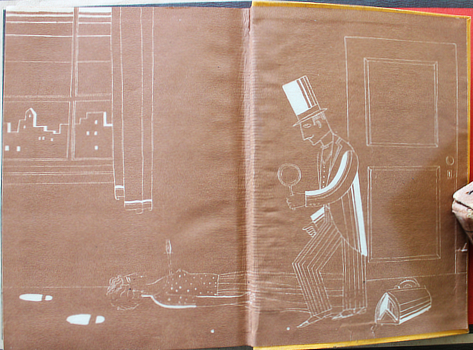
Sherlock Holmes
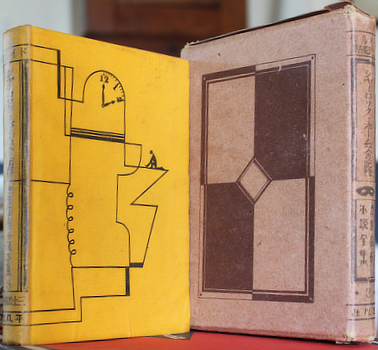
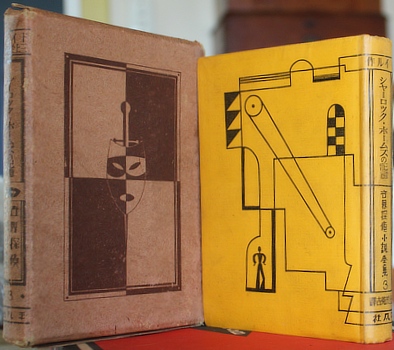
DOYLE, Arthur Conan & Mikami Otokichi. シャーロック ホームズの記憶 [Sharokku Homuzu no Kioku]. Tokyo, Heibonsha 1930 (Showa 9). 15x12cm publisher's illustrated flexible yellow cloth printed in black, printed card slipcase; frontispiece. Minor signs of use; edges browned, quite good for a pocket detective novel bound in bright yellow; seldom found with its box. The frontispiece is drab, the endpapers - which are common to the series - delightful. Au$350
First Japanese edition of the Memoirs of Sherlock Holmes. Mikami was a phenomenally busy and succesful novelist who apparently worked best in brothels. His partner, novelist Hasegawa Shigure, said it was the only way he could write. When he couldn't write she filled in.
This is volume 3 in the Complete Collection of World Detective Novels which I think ran to 20 volumes and was published in no particular order in 1929 and 1930. Volume 4 was Mikami's translation of The Return of Sherlock Holmes which I think beat this into print. I can tell you that volume 18 also came before this. Don't confuse this with the Complete Collection of World Detective Novels published by Hakubunkan at the same time.
The binding has a strong family resemblance to one by Onchi Koshiro for an Ars photography book the same year but this isn't any guarantee of anything.
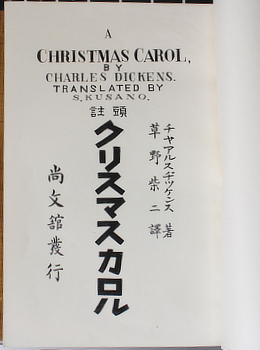
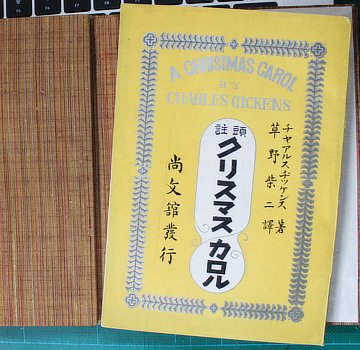
DICKENS, Charles & Kusano Shibaji. クリスマス カロル [Kurisumasu Karoru] A Christmas Carol. Sendai, Shobunkan 1902 (Meiji 35). 19x13cm publisher's yellow wrapper printed in black and silver; frontispiece portrait. A fabulous copy in a cloth case by binder, writer and fastidious collector Ikuta Atsuo. Au$500
First Japanese translation of A Christmas Carol and quite early in Japanese Dickens. They didn't take to Dickens with the same enthusiasm as with more exciting writers like Bulwer Lytton. Some fragments were published in the eighties and nineties but I think the first Dickens to become a book was the Child's History of England (1891), a shame. This might be the second book. Once it was realised how soppy and didactic this Christmas story is, not to mention ghosts and time travel, there was a plethora of new translations and editions over the next few decades.
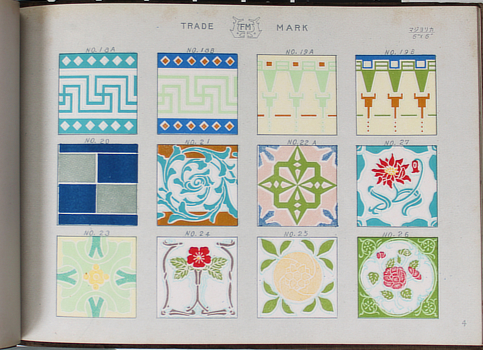
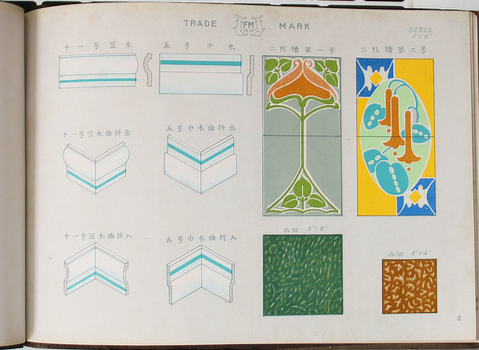
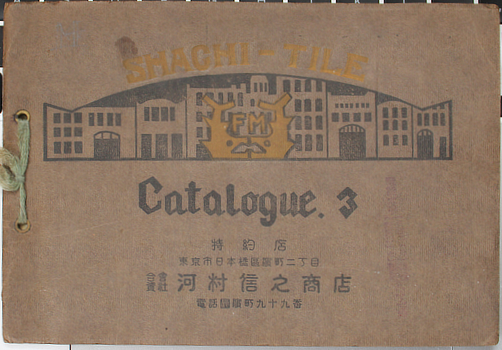
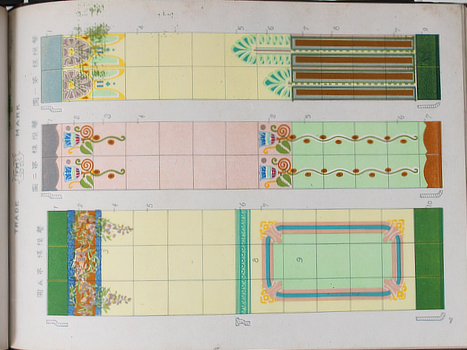
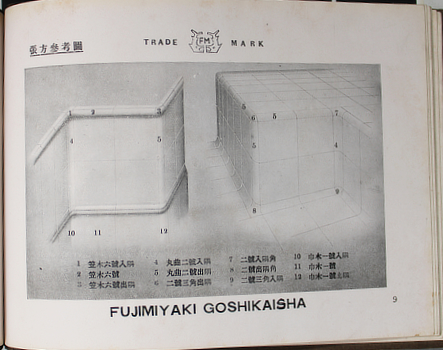
Tile catalogue. Fujimiyaki. Shachi Tile. Catalogue 3. (cover title). Tokyo, Kawamura Nobuyuki Shoten [c1920?]. 13x19cm publisher's printed wrapper, ribbon tied; view of the works and 17 plates on 17 leaves: a colour chart and seven pages of colour patterns (several to a page); the rest are b/w illustrations of fancy shapes. sold
Fujimiyaki - who were still in business not long ago - tiles sold by Kawamura Nobuyuki. Fujimiyaki became a limited company in 1908 so our catalogue dates to after that. They went into export mode and I've read that Singapore was awash with their tiles in the years before the war.
The examples are small but bright and cheerful and clear enough to judge easily.
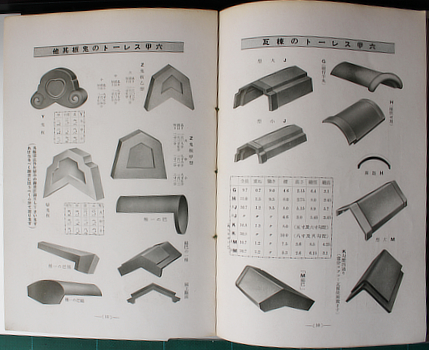
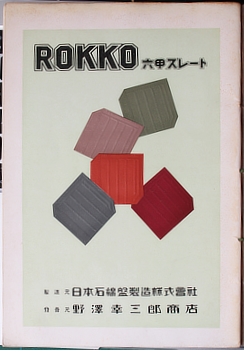
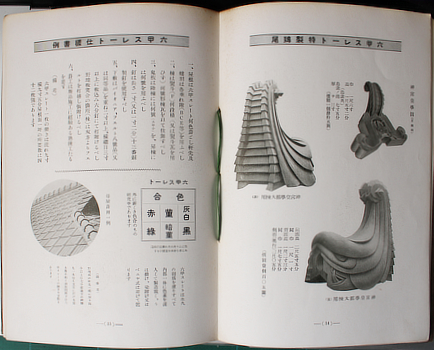
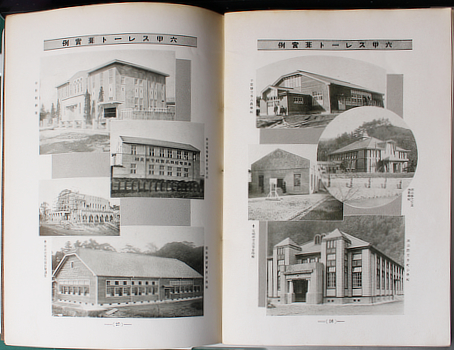
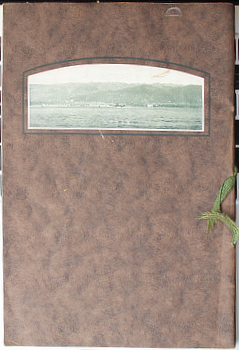
Catalogue - asbestos tiles. Rokko 六甲スレート [Rokko Sureto]. Japanese Asbestos Board Manufacturing 1928 (Showa 3). 23x16cm publisher's wrapper with mounted illustration; 36pp, illustrations throughout. Ribbon tie broken; rather good. sold
Asbestos loaded tiles and decorations, including some fancy traditional stuff along with a lot of buildings using their goods.
Nozawa Kozaburo, the company's predecessor began importing fire proof tiles in 1906 and the manufacturing company formed in 1913. Rokko Slate a (thick improved version) came in 1926. The company has changed name and shape several times since then - asbestos began to be dropped from their names in the seventies - and the company is still going with a strong commitment to the environment.
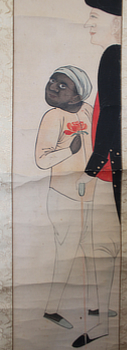
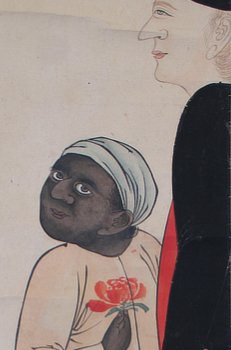
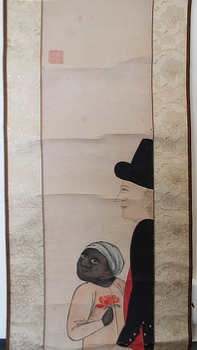
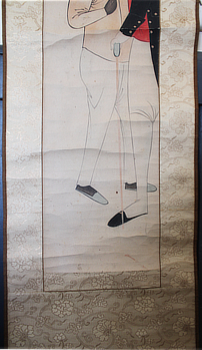
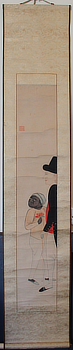
Japanese portrait of a Dutch man's servant or slave and his master. n.p. late 18th or early 19th century? 93x16cm painting in ink and colour on paper, mounted on a scroll, 144x27cm. Some creases. One of the scroll ends has come adrift but is there; I'm not going to glue it back on. In a modern wood scroll box. Au$1500
An impressively long narrow painting, the proportions of a pillar print which were popular in the late 18th century. Really a portrait of the attendant rather than the master. He is just there to frame and give scale to the centre of the painting. I have noticed in paintings of the Dutch and their attendants that far more attention is paid to the attendants. One tall blonde man with blue eyes looks much like another.
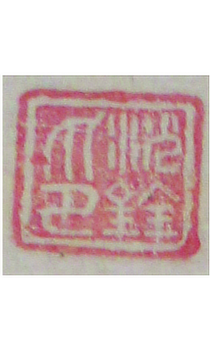
There is red seal fairly high up on the left which remains obstinately unread; I suspect it is an owner's seal. This is not by a great painter but it is a good picture and has been treasured.
The red chrysanthemum is a curious touch. It might symbolise love but the way it's been brushed over the tunic might suggest a blood stain. He could be gazing in adoration or he could be measuring whether he can reach that man's throat with a sharp blade.
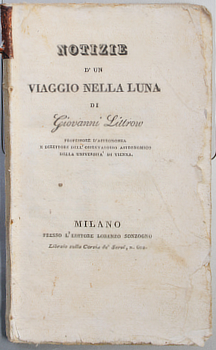
To the moon with no inns along the way
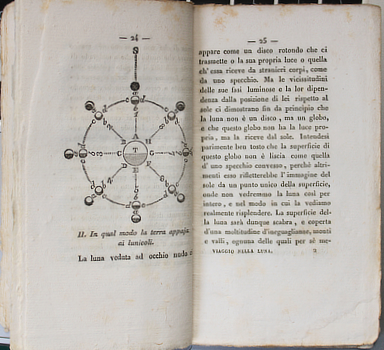
LITTROW, Giovanni [ie Joseph Johann von]. Notizie d'un Viaggio nella Luna. Milan, Lorenzo Sonzogno [1831? or 1836?]. 12mo disbound, untrimmed; 88pp, a diagram in the text. A little browning, no half title called for. Au$750
First edition? We are told this was compiled from a March to May 1831 series in the Biblioteca Italiano (did it exist?) in turn taken from the Gazzetta Vienese (did it exist?) and I can't find any other form of it until another Italian edition in 1872. We are promised this is a serious exposition on a trip to the moon by the distinguished astronomer, not fiction, but then, we were promised the same thing with Herschel's moon discoveries.
I wonder if this was worked up when the moon hoax hit Italy in 1836. It seems too good to be true that a distinguished astronomer had recently published speculations on a trip to the moon in a journal that I can't find. It may be that Sonzogno just looked around for anything to cash in and this is kosher. This and the moon hoax items that follow were obviously all in the same volume at one time. I doubly curse whoever pulled in apart.
Littrow begins with some of the difficulties: the time it will take to get there at the rate of the fastest carriage, or even a ship pushed by a hurricane; the lack of inns with decent food along the way; the lack of air.
Worldcat finds two locations in Italy and possibly one in America. The later edition is easier to find.
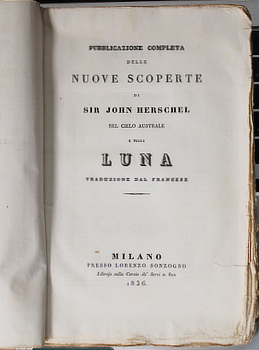
The great moon hoax in Italy
Herschel. [LOCKE, Richard Adams]. Pubblicazione Completa delle Nuove Scoperte di Sir John Herschel nel Cielo Australe e nella Luna. Traduzione dal Francese. Milan, Lorenzo Sonzogno 1836. Octavo disbound, untrimmed; 104pp. With half title. Au$750
This comes from the anonymous French version by Fourierist Victor Considerant and general hack Raymond Brucker. Their publishers, Masson & Duprey, tell us they have made a deal with Herschel's publisher Murray and promise that the full work in four volumes will be published on the same day as the London edition. When you're handed a delightful hoax run with it. All this is repeated here.
Locke's account in the New York Sun in August 1835 of Herschel's discovery with his revolutionary new telescope of life on the moon was the first definite report by a credible scientist and the news spread faster than a trip to the moon would take. The French might have been first with a translation - might have - but it seems to me that no-one took to this discovery with greater relish than Italy. Accounts of varying forms blossomed in cities all over Italy. This one is quite handsome, specially when compared with the plain Jane New York original.
Worldcat finds two locations outside Italy.
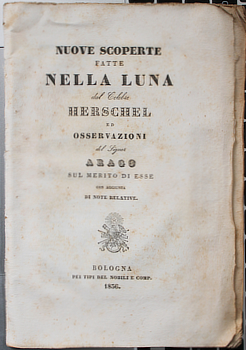
Herschel. [LOCKE, Richard Adams]. Nuove Scoperte Fatte nella Luna dal Celebre Herschel : ed Osservazioni del Signor Arago ... Bologna, Nobili e Comp 1836. Octavo disbound, untrimmed; 32pp (last blank). A little browning; no half title called for. Au$750
These Bologna publishers are thorough spoil sports and have based this around the expose address by Arago - if there was such a thing. On page 25 we read about the French versions (a rough translation): To make this deceptive mockery more complete, it ... now runs through the streets always with the name of the illustrious Herschel on the front. By page 25 the reader has presumably forgotten our title page.
Worldcat finds no entry for this, neither did a search of Italian union catalogues.
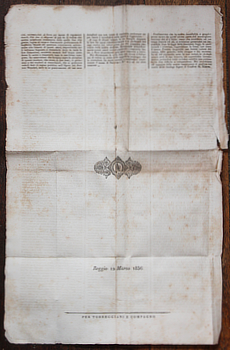
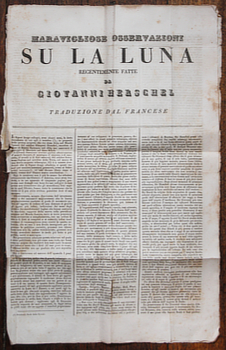
Herschel. [LOCKE, Richard Adams]. Maravigliose Osservazioni su la Luna Recentement Fatte da Giovanni Herschel. Traduzuione dal Francese. Reggio, Torreggiani e Compagno March 1836. 45x29; four pages, disbound with remant of binding tab. Folded; some browning, a tear in the centre fold and small holes and splits elsewhere. Au$750
This begins with the questions of Arago but shows that now that the whole account has been translated doubt has been banished. But the writer confesses at the end that they don't see how any creature can have arms, legs and wings. This is the same sort of half-baked criticism that was aimed at low budget alien invasion films a century later when we were told spiders and crabs twelve storeys high could not support themselves.
Worldcat finds no location, neither did my searches of Italian union catalogues. There is probably a copy in the Museo Galileo but I can't get the catalogue to work.
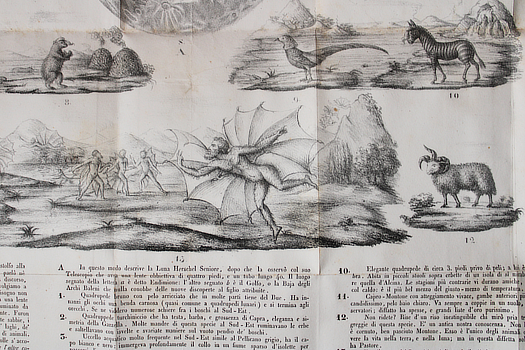
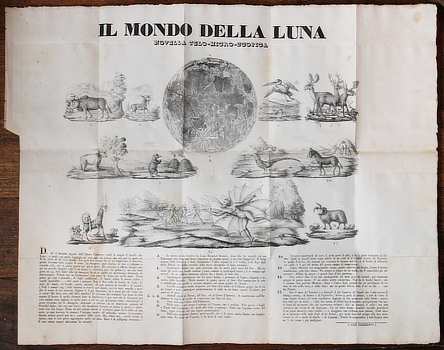
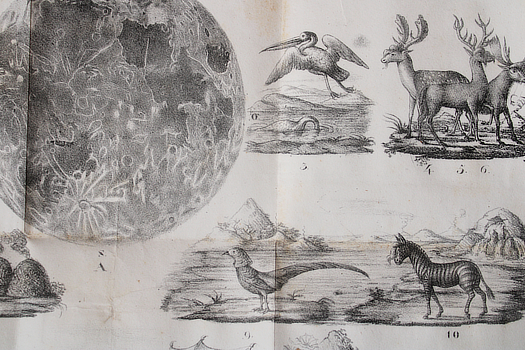
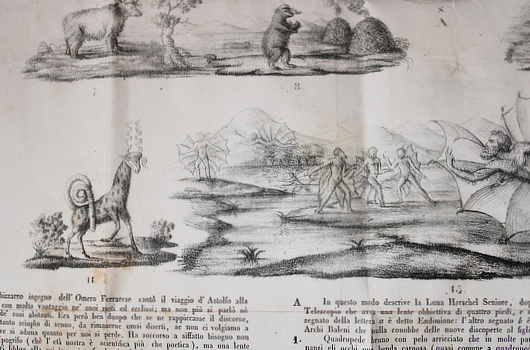
Herschel. [LOCKE, Richard Adams]. Il Mondo Della Luna Novella Telo-Micro-Scopica. n.p. n.d. [1836?]. 47x58cm broadside with lithograph illustrations over descriptive text. Folded, left margin trimmed to form a tab showing it was at sometime bound into a book. A little browning, rather good. Au$1500
Here we have handsome portraits on good heavy paper of what Herschel saw. We're told this was printed with permission but whose?
The New York Sun published one or two separate lithographs after the fact (one illustration I found credited to the Sun exists as a Milan lithograph - were there both?); one of the British pamphlets had a crude woodcut; Thierry Freres of Paris issued a lithograph; the most reproduced now are the views by Leopoldo Galluzzo in Naples which mixed in a trip by earthlings to the moon; no doubt there were others.
Our print remains mysterious. There might be a copy in a Milan collection but I'm not smart enough to find it.
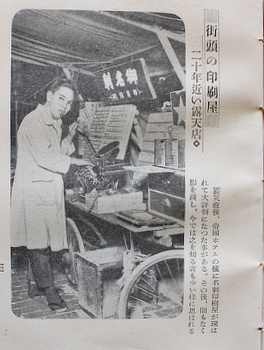
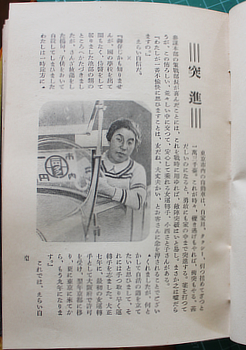
A weapon called a camera
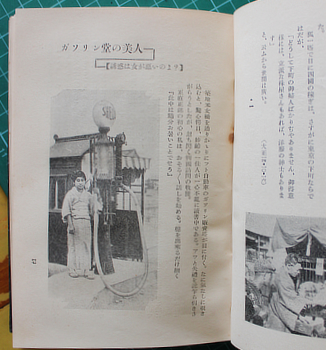
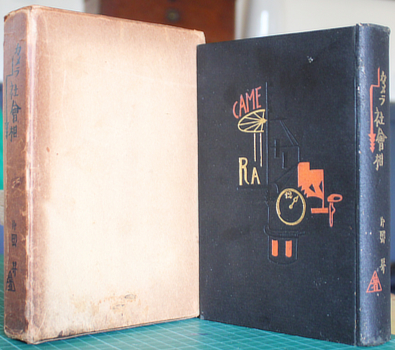
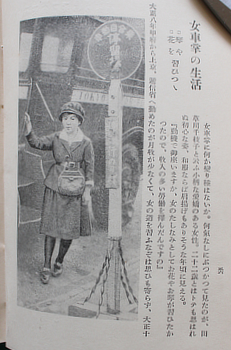
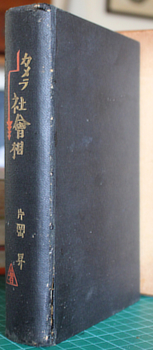
Kataoka Noboru. カメラ社会相 [Kamera Shakaiso]. Tokyo, Bungei Shijosha 1929 (Showa 4). 20x14cm publisher's cloth blocked in blind, red and gilt, card slipcase (some holes in the back hinge have been touched up by some wrong-headed owner; the box is quite browned); photo illustrations throughout. First and last couple of pages browned. An unnumbered copy of an edition of 500 copies. Au$200
I found a reference somewhere calling this a work of modernology, ie the study of ordinary people, their daily lives, what they do, what they use ... but I don't know that Kataoka had any connection to modernologist Kon Wajiro. I think it was a similar impulse from a different direction that sent Kataoka out on the street with his camera. He wrote, "I have a weapon called a camera. I snap a picture, and when I ask them to talk, most of them are soft-spoken and start talking about their lives, which is a real perk of being a photographer" (a crude translation). The first part photographs and interviews 93 people at work, including a woman bus conductor and gas pump attendant. After that it's not so interesting: celebrated worthies.
This was issued as an edition of 500 copies in a leather binding which might have been smart when new but the leather fell to pieces pretty fast. So it's not hard to find copies in ruin but not so easy to find a cloth binding in reasonable shape. My guess is that a few extra copies were put out in cloth.
The binding design is by Sakai Kiyoshi, I presume the writer credited with kick starting the ero-guro-nansu fad. Some of his books came from the same publisher.
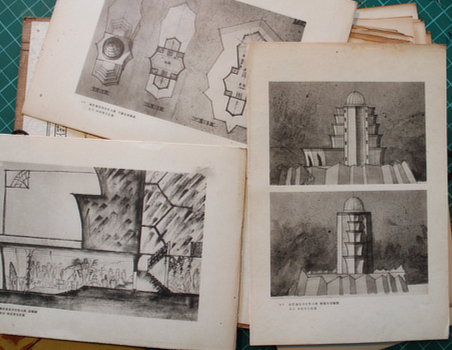
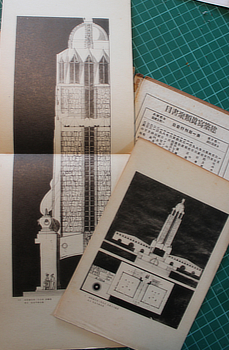
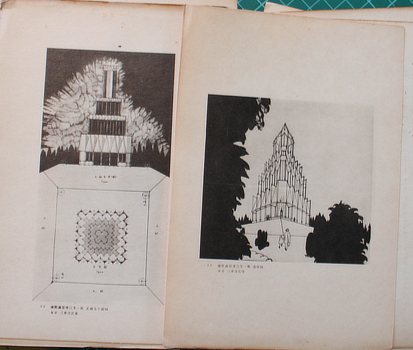
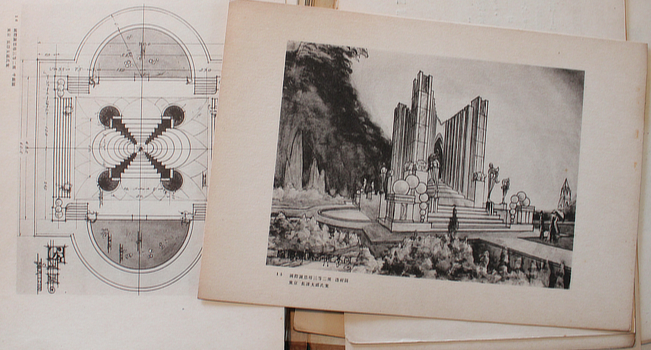
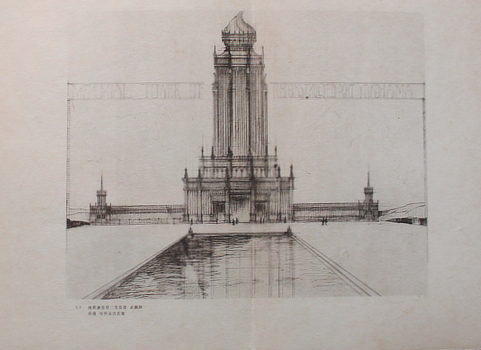
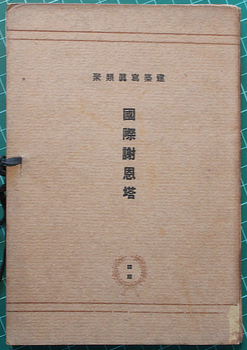
Architecture competition. 国際謝恩塔 [Kokusai Shaonto]. Tokyo, Koyosha 1924 (Taisho 13). 19x13cm, loose as issued in publisher's printed boards; 50 leaves, mostly plates printed on one side (actually 48 as two are double page carrying two numbers); renderings, elevations and plans. Wear to spine, dust marks or darkening to the very top edge of several plates, a decent secondhand copy. sold
Here are the winners and honourable mentions from a competition for a tower of gratitude for international aid after the 1923 earthquake. First and second prizes are graced with overwrought dramatics but are hardly radical. Things get more interesting after that.
One of the apparently endless series of small architecture monographs, Kenchiku Shashin Riuju. I wonder if anyone knows how many there were. Some are intriguing and some are pretty drab. Many require a dogged love of gateways and tea rooms. This one is up top.
Outside Japan, Worldcat finds an entry at Queensland University, dated 1929 for some reason, but the university's four entries for the title, including a microform, don't actually locate a copy.
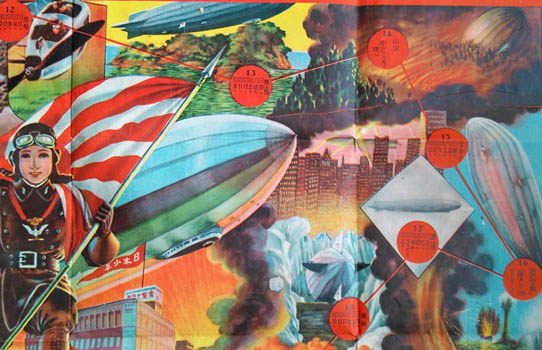
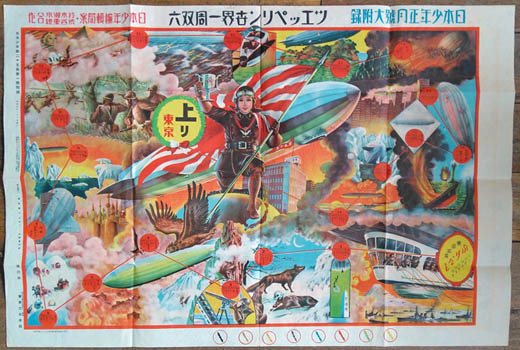
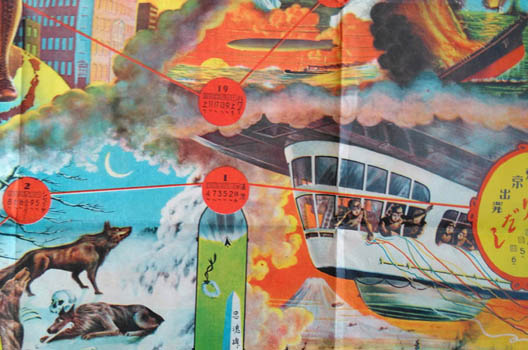
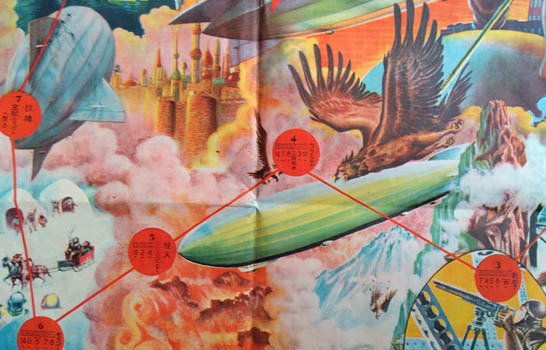
Shibuya Shigeo & Suzuki Gyosui. ツエッペリン世界一周双六 [Tsuepperin Sekai Isshu Sugoroku]. Tokyo, Nihon Shonen 1930 (Showa 5). Colour broadsheet 54x79cm. Minor signs of use; a rather good copy with playing pieces - propellors - in the bottom margin. On the back is a duller game about athletics in red, white and blue. Au$500
The new year gift from the boys' magazine Nihon Shonen, this is an heroic, an epic, zeppelin journey around a world that existed somewhere in the minds of writers and illustrators for boys. Every step, every part of nature, every being, is a peril, a hazard to be fought and beaten. Girls win by accepting, boys win by taking a cudgel, or even better a machine gun, to everything in their path.
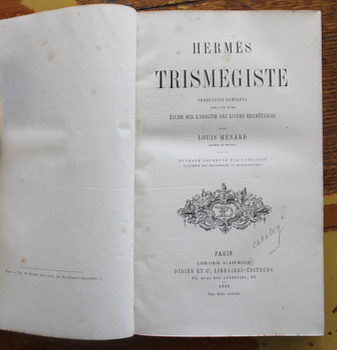
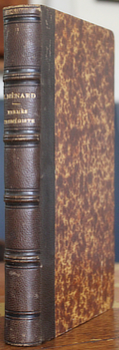
Hermes Trismegiste. Louis Menard. Hermes Trismegiste : traduction complete ... etude sur l'origine des livres hermetiques. Paris, Didier 1866. Octavo quarter morocco and mottled boards. Occasional patches of browning depending on paper stock. Rather good. Au$200
First edition; there were a few more over the next hundred years. Menard was another of those damn French socialists of the 1840s, fleeing to London after 1848 to escape a prison term. He settled down eventually into a life of respectable mystic paganism and pedagogy.
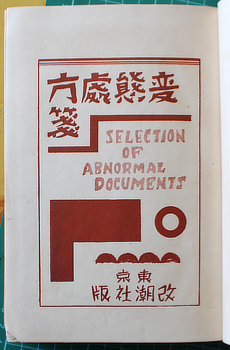
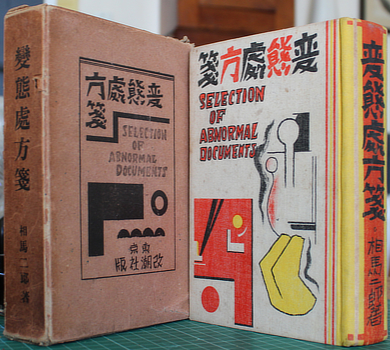
Soma Jiro. 変態処方箋 [Hentai Shohosen] Selection of Abnormal Documents. Tokyo, Kaichosha 1930 (Showa 5). 19x14cm publisher's illustrated fawn cloth printed in red, yellow and black, printed card slipcase (torn but all there). Browning and smudging of the cloth, edges browned and scattered light browning through the text. A read copy, I'm sorry, but pretty good for this book. Au$150
Maybe the first printing of this substantial classic of the ero-guro-nansensu (erotic grotesque nonsense). The colophon is dated 24th and 29th of June but the cloth and paper are different from another copy I've seen with the same dates.
According to Hakkin Hon (banned books): Bessatsu Taiyo, the book was banned four days before publication and 295 of the 1000 copies produced were seized.
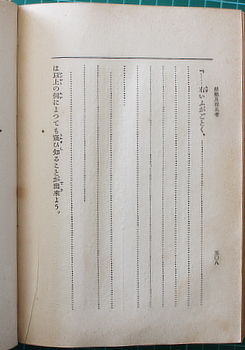
And I found another note on this book that tells us that 38 printings appeared within four months - with 25% of the text blanked out and at least one all blank page. That must be page 508, which in an August printing is columns of dots. But this is all a muddle. This copy is partly censored: page 508 is also columns of dots while the other pages I compared to that August 'first edition' are untouched here. I haven't done a page by page comparison.
I have traced, but not seen, a claimed 38th edition but nothing between one and 38. It makes sense now; they are all, however many there are, first editions without mention of earlier printings.
Hentai Shohosen might translate as 'A Prescription for Perverts'. Drugs, sex toys, punishment, cannibalism and a list of everyday items used by foreign women for masturbation appear among the chapters. So I'm told. Thank goodness I can't read it.
What I really want to know is who did the cheerful cover - one that could double for a book on Japanese motherhood - and box/title page. Designer's names are often tucked away in dim corners but I can't find it.
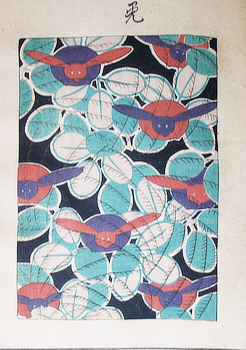
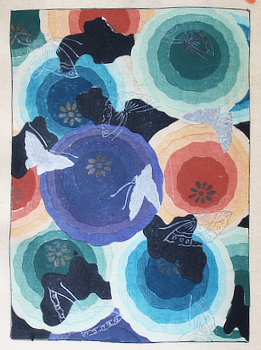
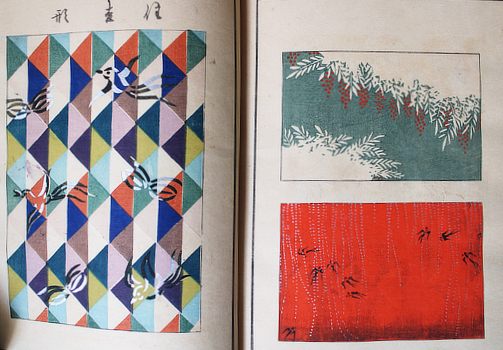
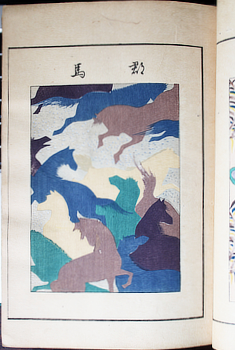
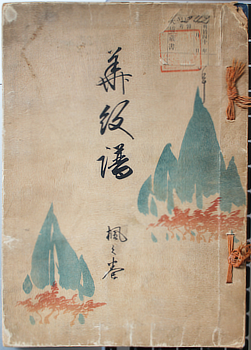
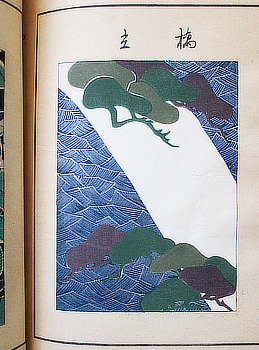
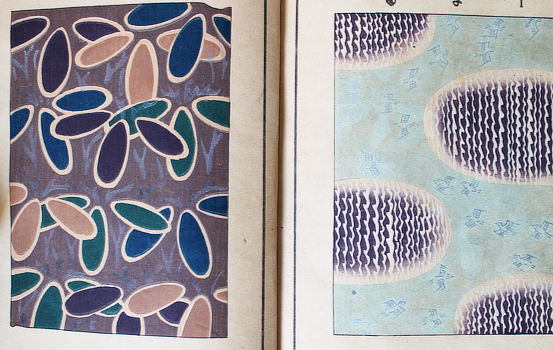
Tsuda Seifu. 華紋譜 : 楓之巻 [Kamonfu : Kaede no kan]. Kyoto, Honda Ichijiro 1900 (Meiji 33). 25x18cm publisher's colour printed wrapper, ribbon tied (cover marked, a bit worn, an old library label at the top of the front cover; colour woodcut designs on 40 pages (20 double leaves), two introductory leaves and one leaf of text and colophon at the end. Introductory leaves browned, final leaf stained at the top but the plate leaves all rather clean. Au$950
One of two volumes of this design album; the other was called flowers, this maple. I avoid incomplete design albums but sometimes even the firmest rule must be broken. The designs of the very young Tsuda Seifu are irrestistable. If you think that many of these designs are familiar that's because they have been copied decades later. Not all are free from the ruck of these textile pattern books that proliferated from the later 19th century on but more than enough are.
Tsuda Seifu was twenty when these were published and he lived long enough (97 or 98 years) to be reincarnated a few times as a western style painter, a Japanese painter, a proletarian artist ... I don't approve of quite a bit I've seen but I doubt he cares. Nor would anyone else once they've seen his early designs.
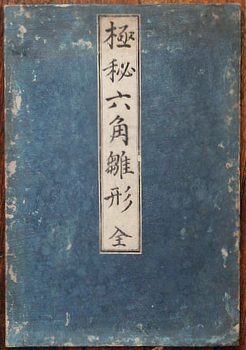
Top secret
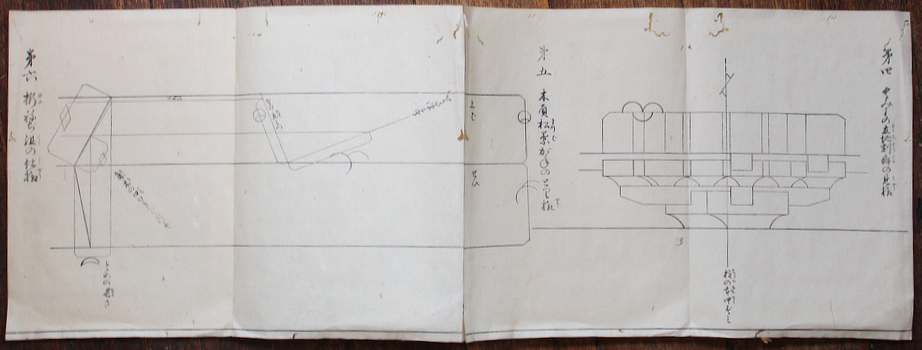
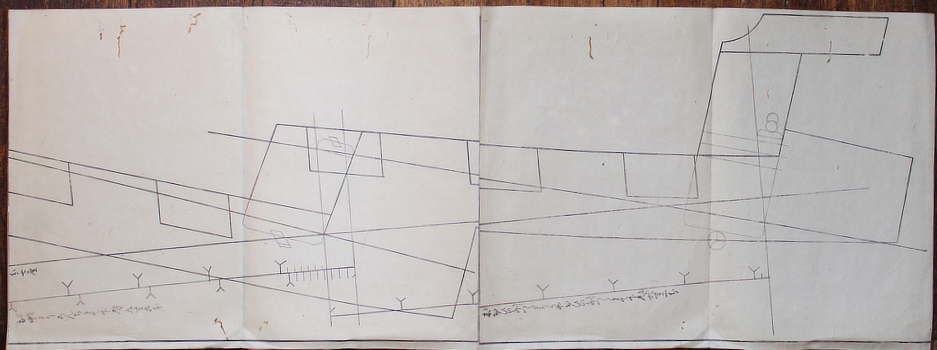
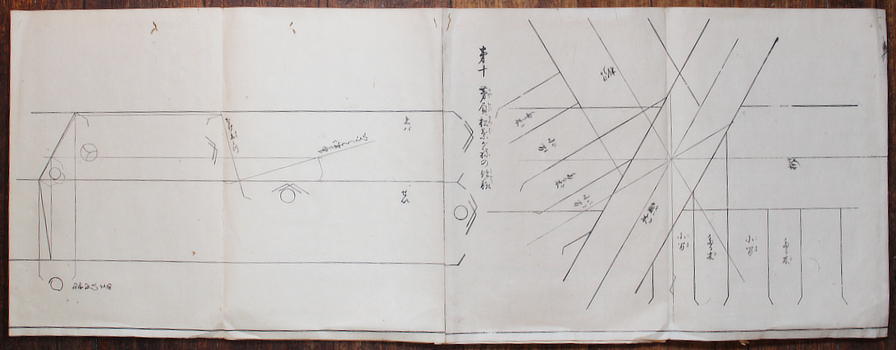
Akai Tsuneyoshi. 極秘六角雛形 [Gokuhi Rokkaku Hinagata]. Edo (Tokyo), Suharaya Mohei 1795 (Kansei 7). 29x20cm publisher's wrapper with printed title label (covers a little nibbled). 22 double leaves plus pastedowns accordian folding, all but two leaves are large working drawings that in several cases extend over a few leaves and can be opened out to long drawings (longer than I can illustrate here).. A bit of worming in the top margin of some leaves, nothing serious. Au$650
The title translates as 'Top secret hexagonal template'. According to the English abstract of a paper by Humoto Kazuyoshi (The Design of Eaves Camber in the Japanese Traditional Architecture, 2002) "Design of eaves has been considered to be very important to construct the exterior shape of the traditional Japanese architecture. While many Japanese architectural books were written in the Edo and Meiji eras, the book about eaves camber design was not found until 'Banshouke Kayaoisori Mitugousinri,' which was written by Tousai Kiko in 1864." Unfortunately the paper is in Korean and I can only find it as a photographic image. Our title does appear in the references but as a 1976 publication by a different author.
Worldcat finds only a manuscript copy in the Peabody Essex Museum.
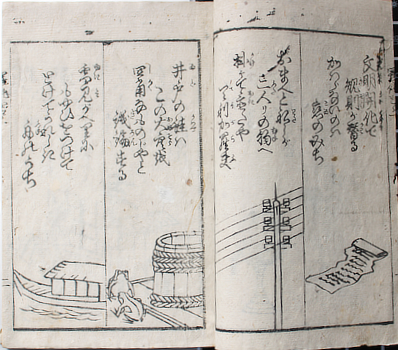
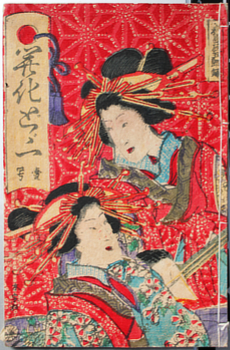
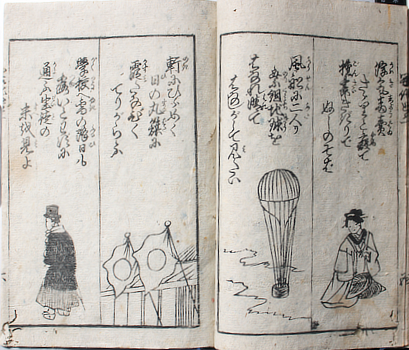
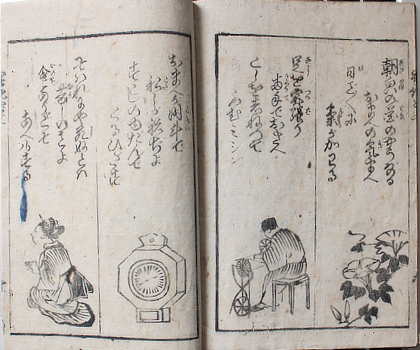
開化どどいつ [Kaika Dodoitsu]. n.p. (c1880?). 18x11cm publisher's colour woodcut wrapper; 10 double leaves (ie 20pp) with two verses and woodcuts per page. Modern looking stitching, some worming in the very corner of a few pages. Au$150
Enlightenment dodoitsu - that is, modern and up to date. Dodoitsu are popular verses or songs, often sort of the equivalent of vaudeville or music hall ditties. We have electricity, hot air balloons, oil lamps, the sewing machine, clocks among the subjects.
Cinii finds only one entry, at Kyushu University. They list the publisher as Sakurai Yasuichi but I can't get that indistinct small panel to read anything like that.
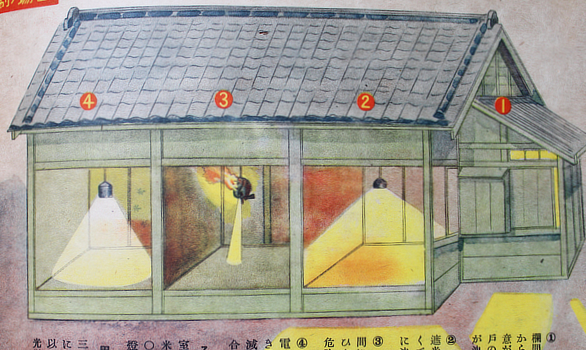
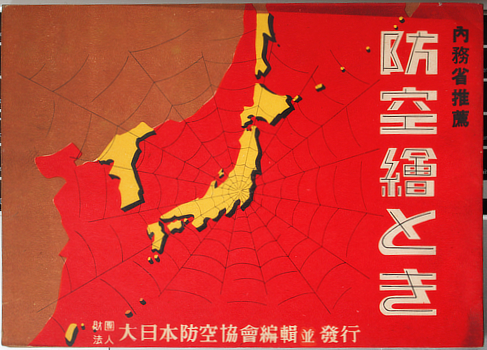
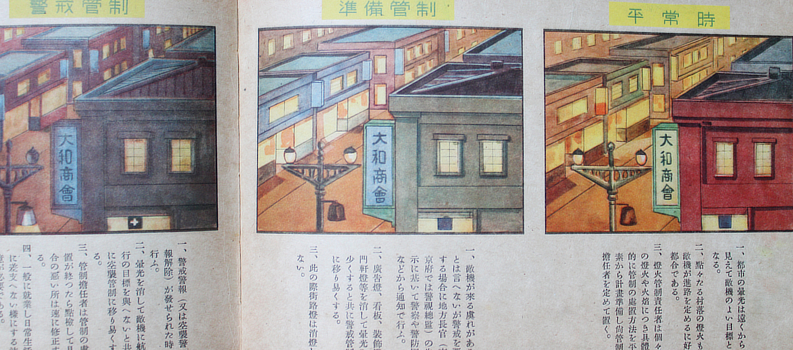
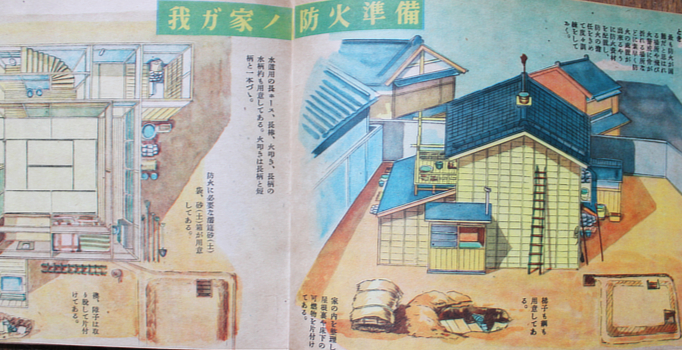
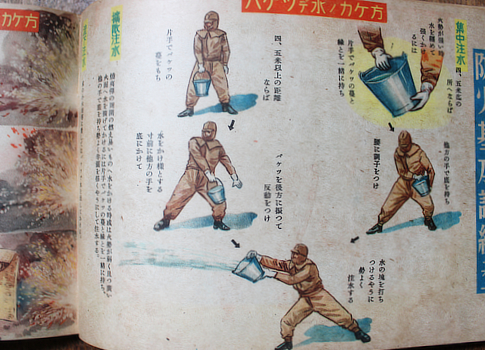
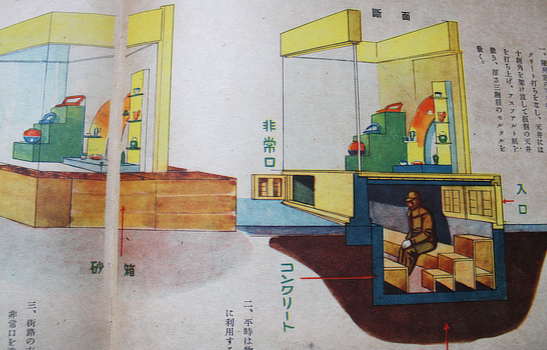
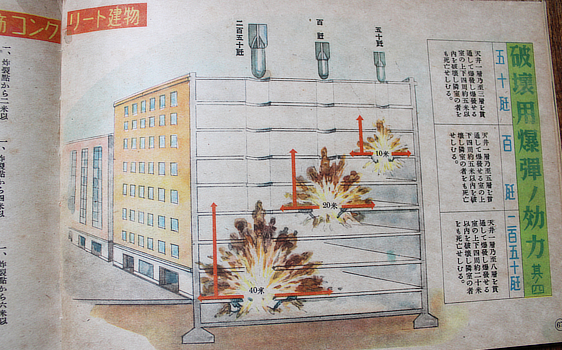
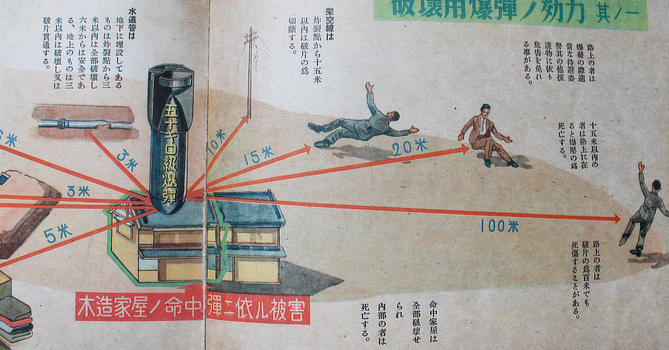
Air defence. 防空絵とき [Boku Etoki]. Dai Nihon Boku Kyokai (Greater Japan Air Defence Association) 1942 (Showa 17). 18x26cm publisher's colour illustrated card wrapper; [5],109pp and colophon leaf, profusely illustrated throughout in colour. A very good copy. Au$450
I've been looking for a decent copy of this for a while and was surprised by how substantial it is when this arrived. It is printed on heavy, smooth paper which looks browned but that's its nature. An immense amount of information is packed into the illustrations, some of which would not matter so much once the bombs start falling. It might be good to know how far away the landing of a range of bomb sizes should be before they flatten you but difficult to put to practical purpose.
I remain baffled by the spider web on the cover, spiders are not usually the heroes. Does it mean that Japan will catch bombs like webs catch flies?
Western hair
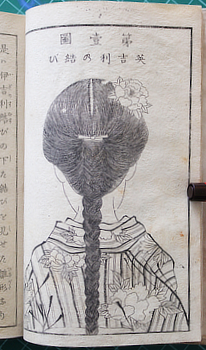
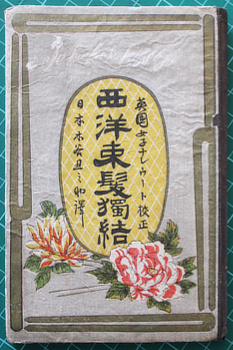
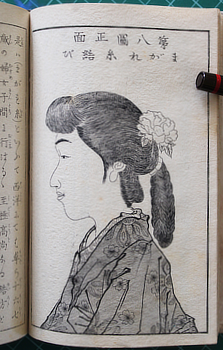
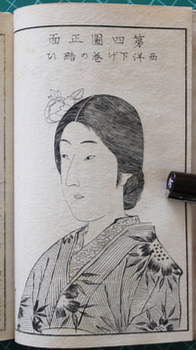
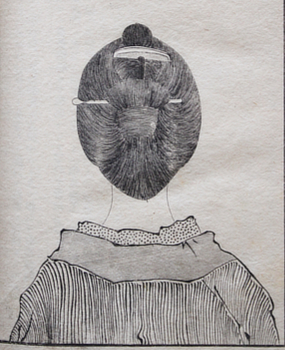
Horiguchi Otojiro. 西洋日本束髪獨結 (cover title 洋式婦人束髪法) [Seiyo Nihon Sokuhatsu Hitorimusubi]. Osaka, Horiguchi Otojiro 1885 (Meiji 18). 18x12cm publisher's colour illustrated boards and cloth spine; 22 double folded leaves, 17 full page engravings. Covers a bit rubbed, some natural browning of the paper here and there; rather good. Au$750
Maybe not the first book on western hairstyles in Japan - I found a record of a pamphlet published two months before this - but it's been a while since I opened a book new to me and was so surprised and delighted. The engravings are fine and well printed for a board cover book, often shoddy productions.
The western sokuhatsu hairstyle - various forms of plaited or loose buns drawn up on the head - was largely a sanitary and economic reform movement by a couple of distinguished medicos. Traditional hairstyles required a hairdresser and gallons of oil and tended to stay unwashed for quite some time. So in 1885 the Nihon Fujin Sokuhatsu-kai was founded and instructions began to appear.
Worldcat and NDL and Cinii find two later Tokyo editions - only in Japan - but I couldn't find any record of this one.
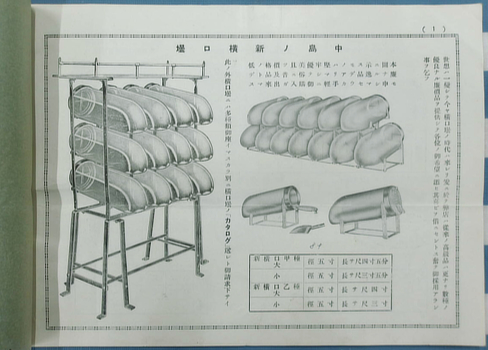
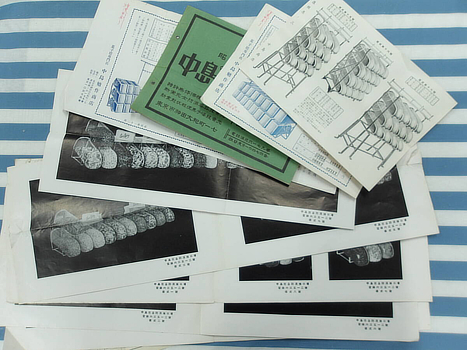
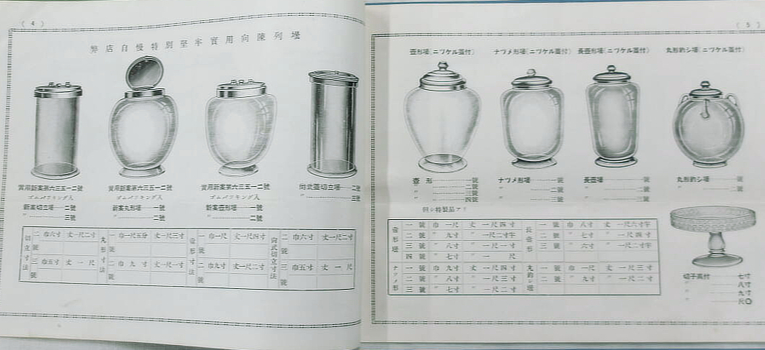
Lolly jars. A group: catalogue and brochures and flyers from Nakajima Bensaku Shoten of their sweet jars, display cases, and other jars and bottles for retailers. The company 1920s? 19x27cm publisher's printed wrapper with metal punch holes; 18pp, illustrated throughout. The other pieces are about the same size or larger. All have been folded at some time. Au$120
Nakajima Bensaku was founded around the beginning of the century and was until recently, may still be, in business and run by a Nakajima; though apparently no-one in Japan can blow the large globe jars anymore.
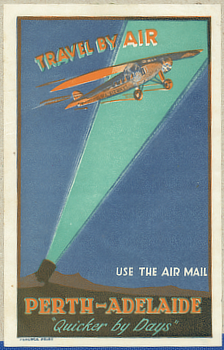
Aviation. Luggage label (?) for West Australian Airways. n.p. c1930. 135x88mm. Remnants of album paper on the back but plenty of the original adhesive coating still there if you want to use it. Au$50
Obviously looted from some album. WA Airways was eaten in 1936 by Adelaide Airways, in turn quickly eaten by ANA.
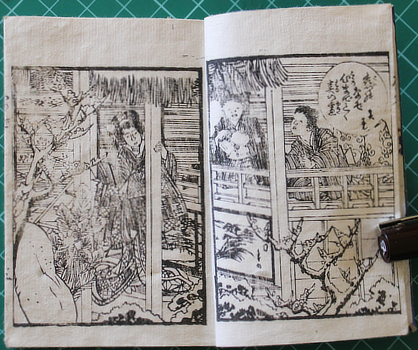
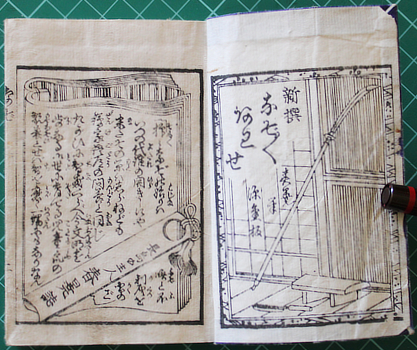
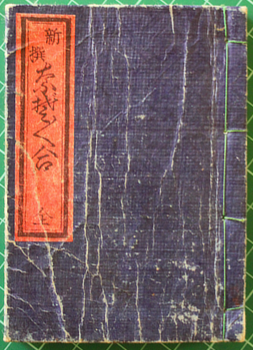
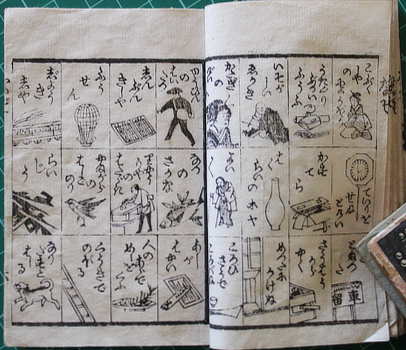
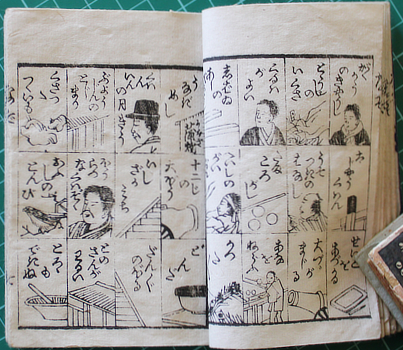
新撰 なぞなぞ合 [Shinsen Nazonazo Awase]. Maki Kin'nosuke 1885 (Meiji 18). 12x9cm publisher's wrapper with printed label; 20 double folded leaves (ie 40pp), illustrated title and introductory leaf, double page frontispiece and heaps of small illustrations everywhere else. The double folded leaves have an extra sheet inside for added durability. These extra leaves are recycled from some other work. Minor signs of use; a pleasing copy. Au$200
Visual riddles, usually involving torturous puns, have a long and brave history in Japan. In this cute little book the tradition has been brought right up to date: among the sake bottles and big noses I see a train, a hot air ballon, a wall clock, a postman, a steamship, and bearded westerners.
Worldcat found no copy. Cinii found one, at Tokyo University.
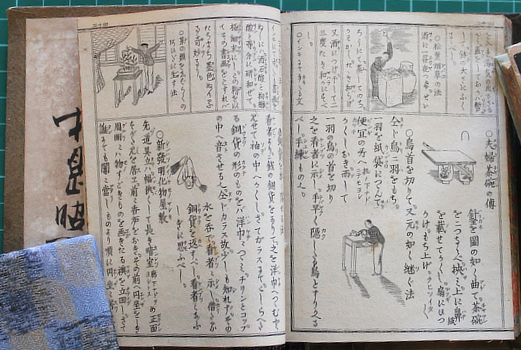
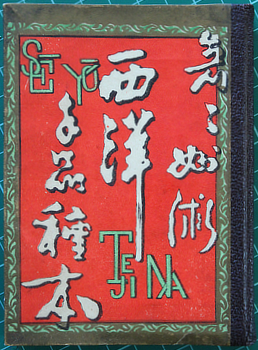
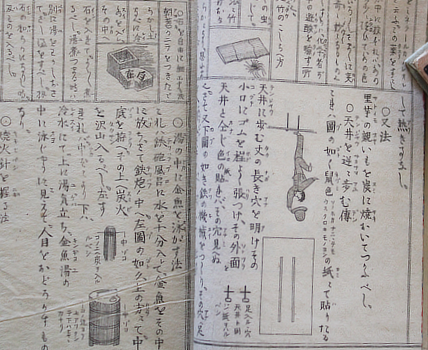
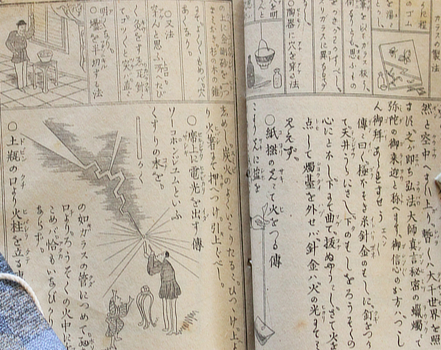
西洋手品種本 : 奇々妙術 [Seiyo Tejina Tanehon : Kiki Myojutsu]. Osaka, Odate Riichi 1887 (Meiji 20). 13x10cm publisher's colour illustrated boards; 48pp, numerous engraved illustrations thoughout. Double folded leaves with an extra sheet inside for added durability. These extra leaves are recycled from some other work. This copy has somehow escaped the plain paper applied to the back cover; it is as issued and an excellent copy. Au$425
First edition of this treasury of western pastimes, crafts, tricks and useful secrets though it's hard to see how some of them are western, judging from a crude translation of the contents. I guess washing tatami and heating sake without fire are adapted for the local market. Walking across the ceiling must be a secret everyone needs to know. With some, a crude literal translation makes them even more baffling to me.
Worldcat finds no copies outside Japan.
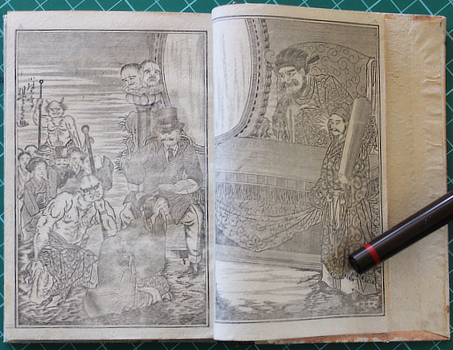
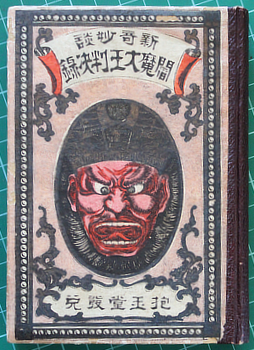
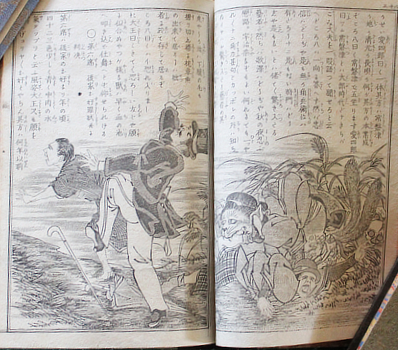
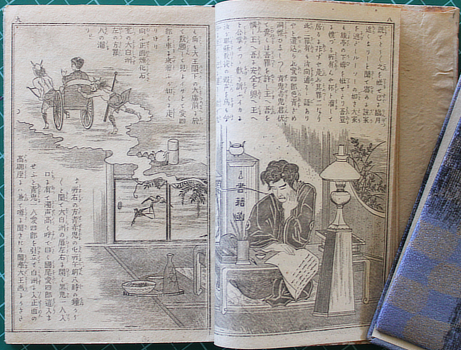
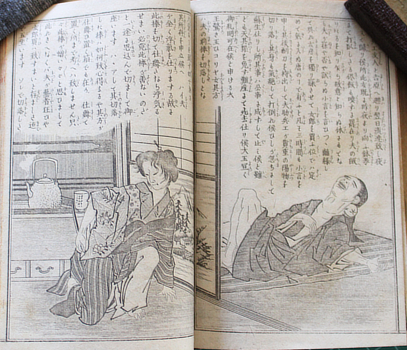
Shinkei Takashei (or Shiho Takase or Shizuka Kikusuitei). 新奇妙談 : 閻魔大王判決録 [Shin Kimyodan : Enma Daio Hanketsuroku]. Osaka, Hogyokudo 1887 (Meiji 20). 14x10cm publisher's colour illustrated boards; 94pp, numerous engraved illustrations throughout. Double folded leaves with an extra sheet inside for added durability. These extra leaves are recycled from some other work. A few insignificant flaws; a pleasing copy. Au$450
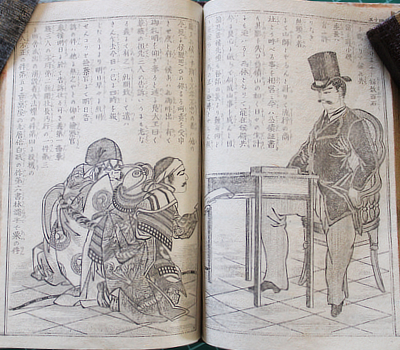
King Enma is the Japanese version of Yama, the king of hell and this is, the title tells us, a gathering of his judgments but who is that man in the top hat?
Leaving aside what is probably the first edition of this, published in 1883 in two volumes, it's easy to get lost in the 1887 printings of this intriguing little book. The other editions are not so little, they are the typical 46 size - 18 to 19cm high. The edition by Kikusuitei Shizukaetsu has a different cover and a frontispiece similar to ours but no sign of that sinister western gentleman. The edition by Kinsendo has an almost identical cover, a frontispiece without that sinister gentleman and no other illustrations. I don't know what the Suzuki Kinjiro edition looks like.
Also. It seems the 1883 edition has 17 chapters; the Kinsendo edition 18 chapters and ours 19 chapters. The extra chapter comes between four and five of the other version and seems to involve three men including our mystery man being savaged by a fox spiirit. The chapters leap from the present to the past and back again with what seems to be a lot of corruption and malfeasance on the part of the rich and powerful. I found a list of chapter headings and now I really want to be able to read it. So, to sum up: this is the best edition to have, with all those illustrations and the extra tale.
Takase was a troublemaking journalist and reformer who used a squillion pen names and did a couple of spells in prison. Later he turned to prison reform and founded Japan's first reformatory. This he turned into quite a large affair and apparently Kuroiwa Ruiko publicly damned him as a hypocrite with a lavish lifestyle and a string of ex-wives.
Worldcat finds no copy outside Japan. *In the last picture here that sleeping man is about to have his penis cut off by his wife. No, I don't know why or what happened next. If I did, I wouldn't tell you.
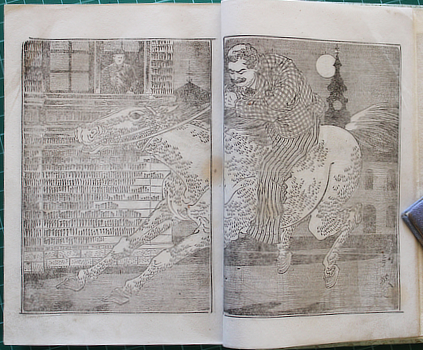
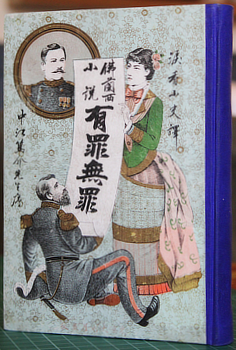
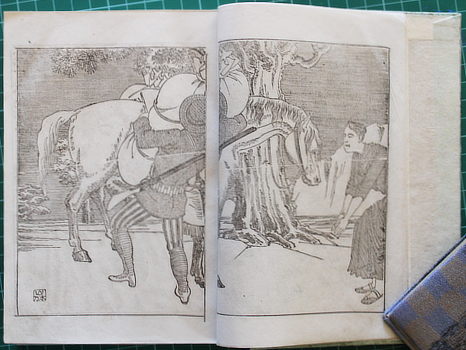
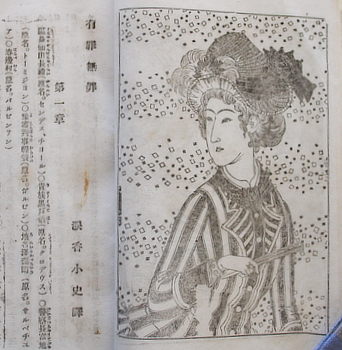
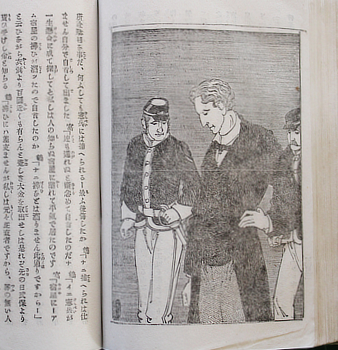
Emile Gaboriau & Kuroiwa Ruiko 有罪無罪 : 仏蘭西小說 [Yuzai Muzai : Furansu Shosetsu]. Tokyo, Okawaya 1889 (Meiji 22). 18x13cm publisher's colour illustrated boards; 17 full page and two double page illustrations. Minor signs of use and some near invisible repairs, it's hard to tell where. An excellent, bright copy in a case by binder, writer and fastidious collector Atsuo Ikuta. Au$325
A reprint, a month after the first printing of Ruiko's adaptation of Gaboriau's Le Corde au Cou. He usually worked from English translations and how much Gaboriau remains in Ruiko's version is for someone who can read it in all three languages to answer. Ruiko was open about slashing, expanding and rewriting his material to fit what he wanted the novel to say.
This is a 'ball cover' (boru hyoshi, apparently a corruption of 'board') book, a signal of modernity and the Japanese equivalent of a yellowback: flimsy western style bindings with lithograph covers that rarely survive in good shape.
I don't know why this is subtitled as a French novel rather than a courtroom novel (the precurser to 'detective novel') which had been used on a Gaboriau/Ruiko novel the year before. I guess publishers were still feeling out what sold best. Worldcat finds no copies outside Japan: that Ohio entry is a microfiche.
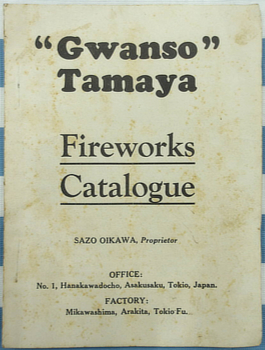
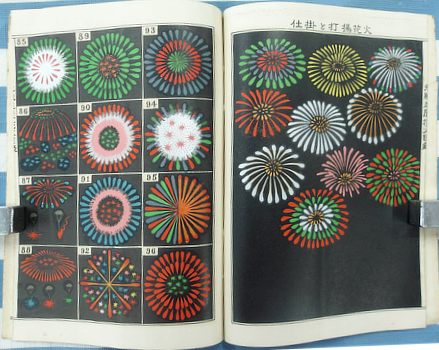
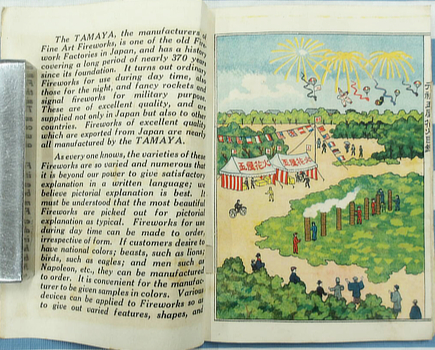
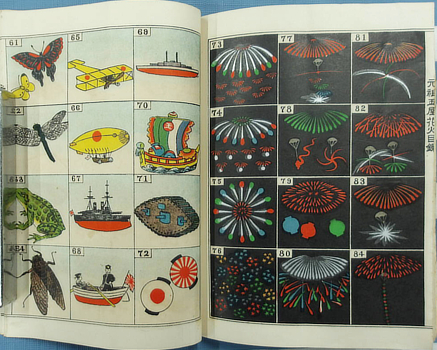
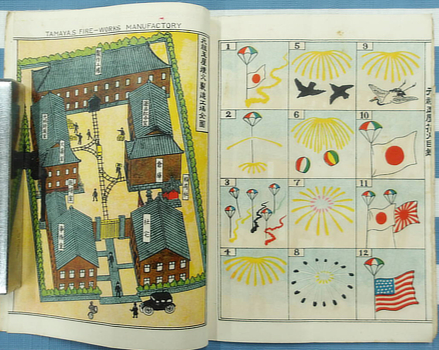
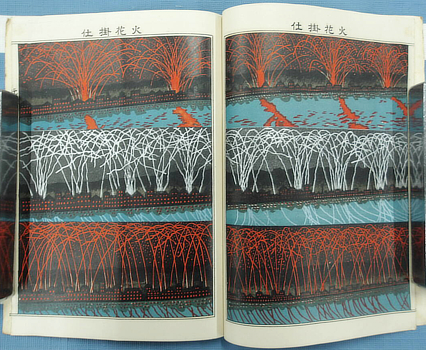
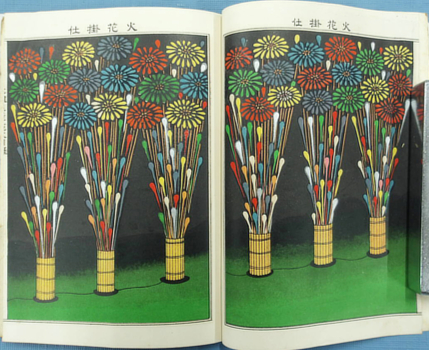
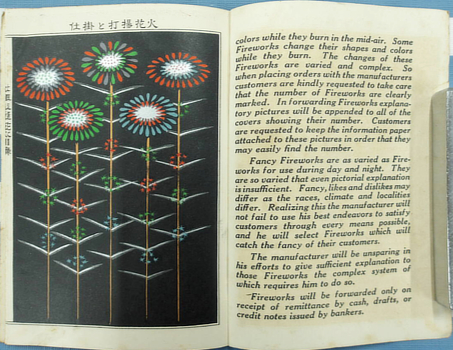
Catalogue - fireworks. Tamaya. "Gwanso" Tamaya. Fireworks Catalogue. Tokyo, Ganzo Tamaya (192-?). 19x14cm publisher's printed wrapper; eight double leaves (ie 16pp) of colour lithographs with added metallic inks. English text on the inside of both covers. Wrapper browned, mild signs of use. Au$1200
Rare, irresistable, and rare. Ganso Tamaya still make fireworks but I gather it's a modern company that took over the name while Tamaya, in this catalogue, claim a history of nearly 370 years. A view of daytime fireworks and a cute birds-eye of the works is followed by pictures of the treats that could go into daytime fireworks. Then come the eight pages of night fireworks with liberal splashes of silver ink.


Exhibition - Dunedin 1865. Official Catalogue of the New Zealand Industrial Exhibition, 1865. Dunedin, for the Commissioners 1865. Octavo publisher's printed wrappers (a bit marked and frayed); 156,viii + 20 pages of adverts, folding plan. A pencil list of plants on the back wrapper; used but most acceptable. sold
New Zealand's first international exhibition, well before any other in this part of the world. Admittedly not a lot came from elsewhere apart from Tasmania and Britain but come they did. Tasmania sent more than all the other colonies combined.
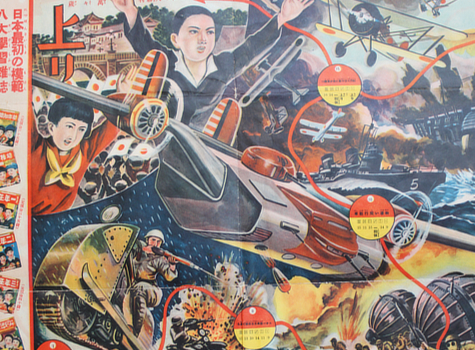
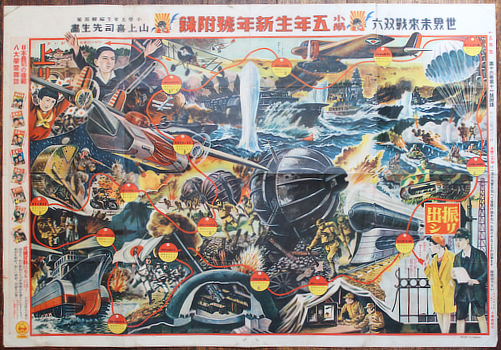
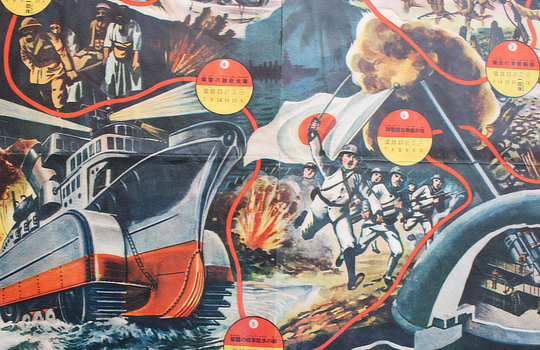
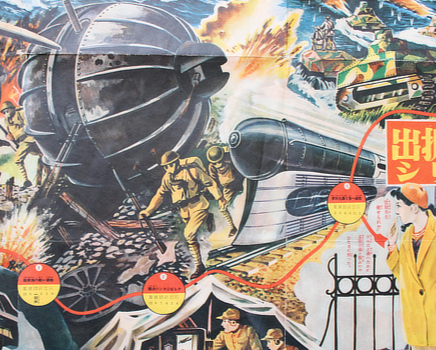
Yamagami Kishi. 世界未来戦双六 [Sekai Mirai-Sen Sugoroku]. Tokyo, Shogaku Gonensei 1937 (Showa 12). Colour broadside 54x789cm. Some browning and small holes in the folds, Au$300
Despite the grim colour scheme - a feature of the late thirties - and those terrifying children, this is a heart-racing view of future war. It was the new year gift from the elementary school magazine for 5th graders, Shogaku Gonensei.
