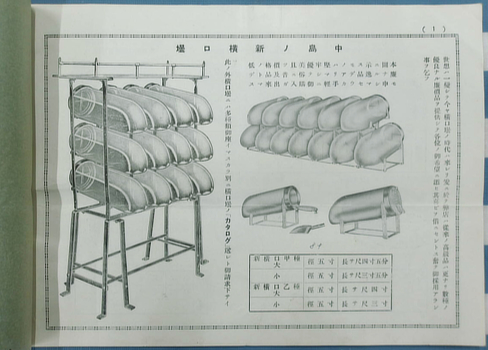
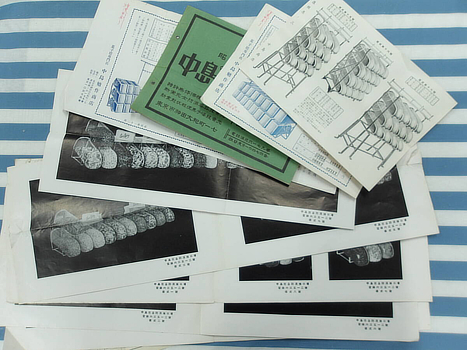
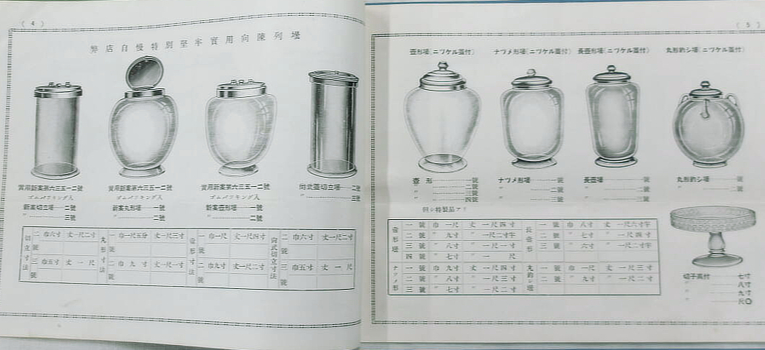
Lolly jars. A group: catalogue and brochures and flyers from Nakajima Bensaku Shoten of their sweet jars, display cases, and other jars and bottles for retailers. The company 1920s? 19x27cm publisher's printed wrapper with metal punch holes; 18pp, illustrated throughout. The other pieces are about the same size or larger. All have been folded at some time. Au$120

Nakajima Bensaku was founded around the beginning of the century  and was until recently, may still be, in business and run by a Nakajima; though apparently no-one in Japan can blow the large globe jars anymore.


You can email an inquiry or order securely through antiqbook

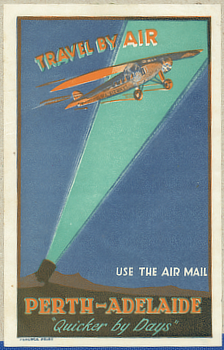
Aviation. Luggage label (?) for West Australian Airways. n.p. c1930. 135x88mm. Remnants of album paper on the back but plenty of the original adhesive coating still there if you want to use it. Au$50

Obviously looted from some album. WA Airways was eaten in 1936 by Adelaide Airways, in turn quickly eaten by ANA.


You can email an inquiry or order securely through antiqbook

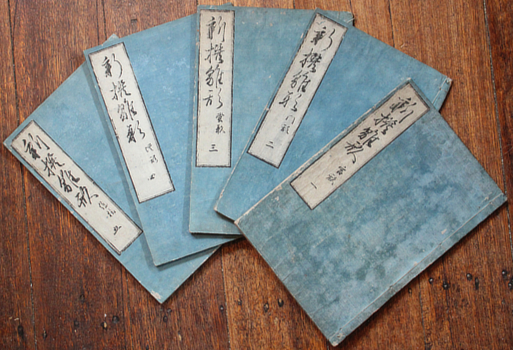
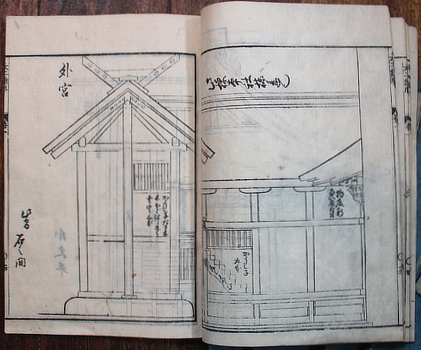
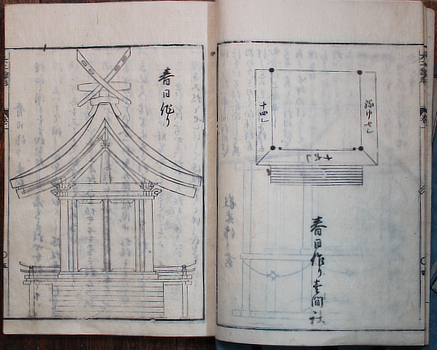
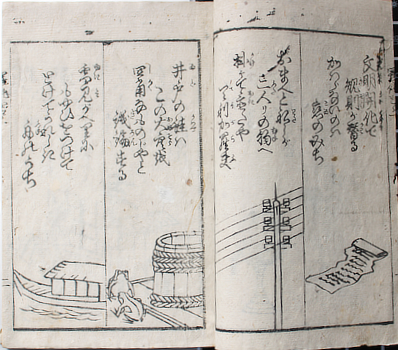
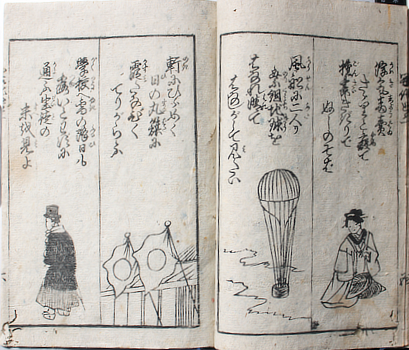
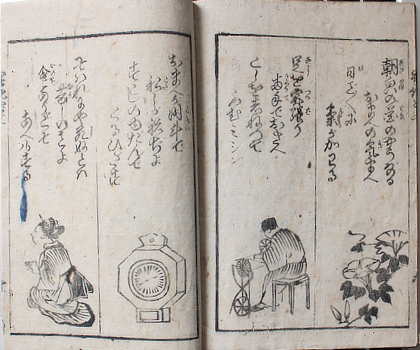
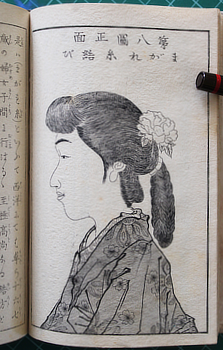
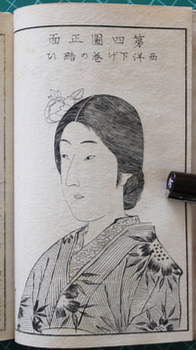
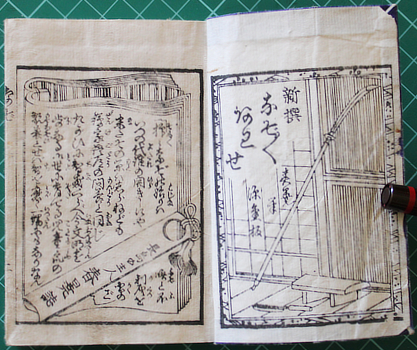
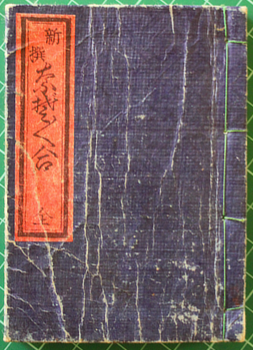
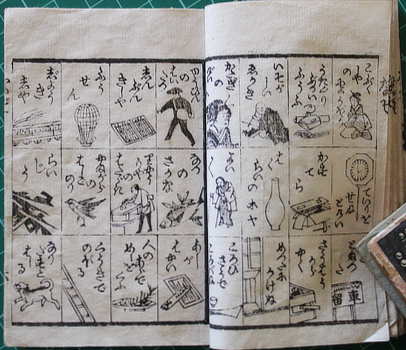
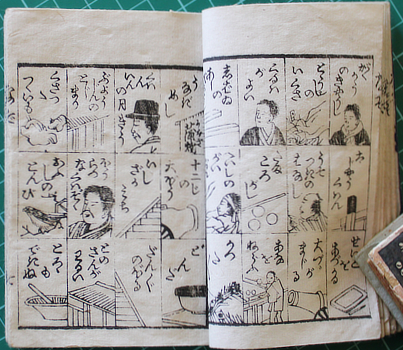
新撰 なぞなぞ合 [Shinsen Nazonazo Awase]. Maki Kin'nosuke 1885 (Meiji 18). 12x9cm publisher's wrapper with printed label; 20 double folded leaves (ie 40pp), illustrated title and introductory leaf, double page frontispiece and heaps of small illustrations everywhere else. The double folded leaves have an extra sheet inside for added durability. These extra leaves are recycled from some other work. Minor signs of use; a pleasing copy. Au$200

Visual riddles, usually involving torturous puns, have a long and brave history in Japan. In this cute little book the tradition has been brought right up to date: among the sake bottles and big noses I see a train, a hot air ballon, a wall clock, a postman, a steamship, and bearded westerners.
Worldcat found no copy. Cinii found one, at Tokyo University.


You can email an inquiry or order securely through antiqbook

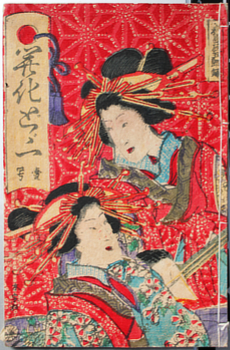
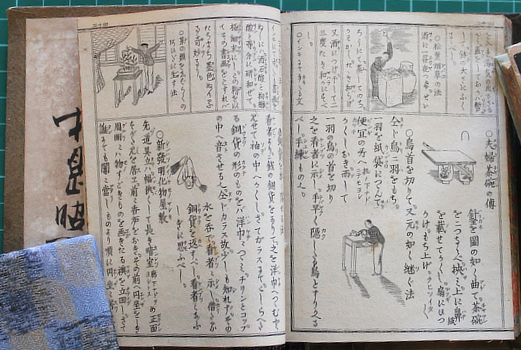
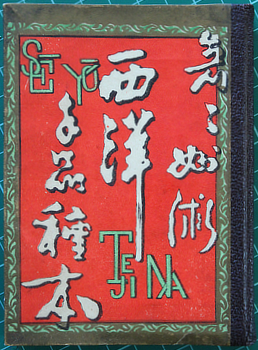
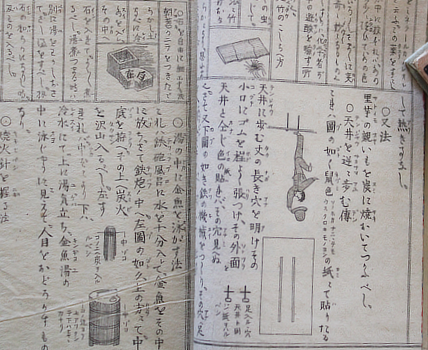
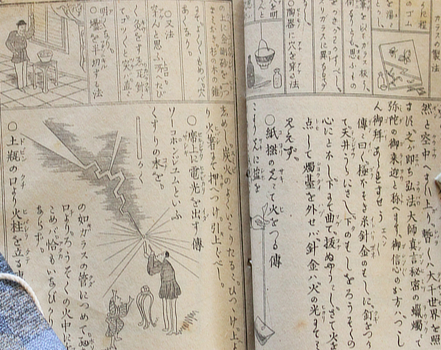
西洋手品種本 : 奇々妙術 [Seiyo Tejina Tanehon : Kiki Myojutsu]. Osaka, Odate Riichi 1887 (Meiji 20). 13x10cm publisher's colour illustrated boards; 48pp, numerous engraved illustrations thoughout. Double folded leaves with an extra sheet inside for added durability. These extra leaves are recycled from some other work. This copy has somehow escaped the plain paper applied to the back cover; it is as issued and an excellent copy. Au$425

First edition of this treasury of western pastimes, crafts, tricks and useful secrets though it's hard to see how some of them are western, judging from a crude translation of the contents. I guess washing tatami and heating sake without fire are adapted for the local market. Walking across the ceiling must be a secret everyone needs to know. With some, a crude literal translation makes them even more baffling to me.
Worldcat finds no copies outside Japan.


You can email an inquiry or order securely through antiqbook

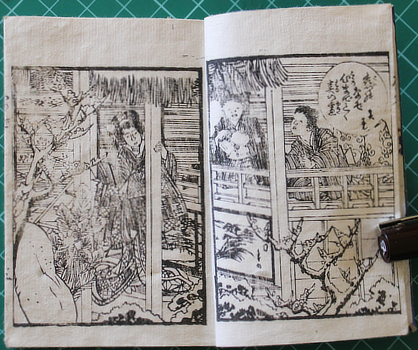
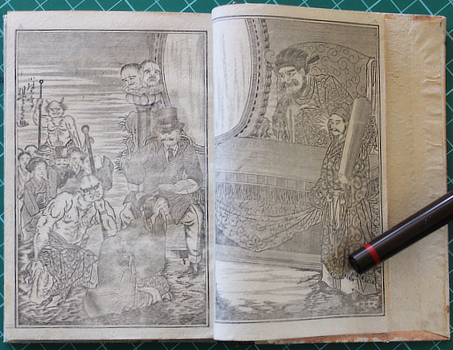
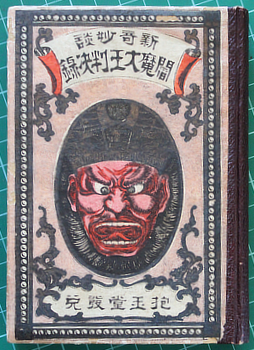
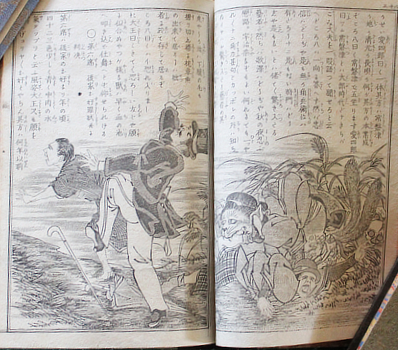
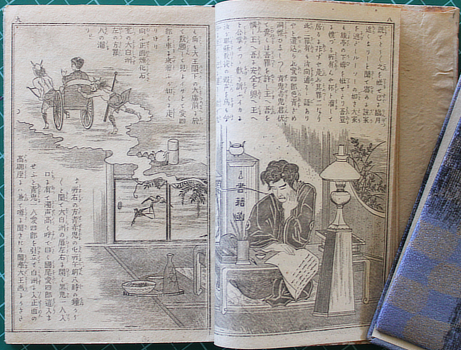
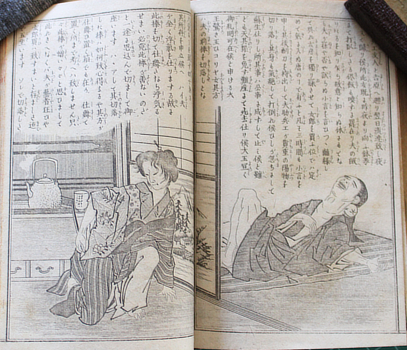
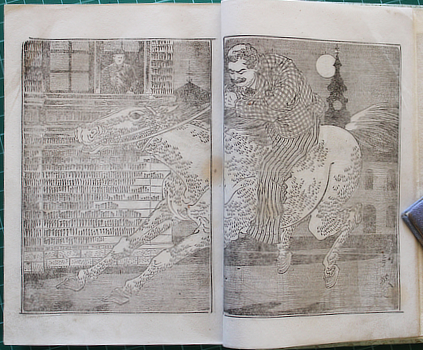
Shinkei Takashei (or Shiho Takase or Shizuka Kikusuitei). 新奇妙談 : 閻魔大王判決録 [Shin Kimyodan : Enma Daio Hanketsuroku]. Osaka, Hogyokudo 1887 (Meiji 20). 14x10cm publisher's colour illustrated boards; 94pp, numerous engraved illustrations throughout. Double folded leaves with an extra sheet inside for added durability. These extra leaves are recycled from some other work. A few insignificant flaws; a pleasing copy. Au$450

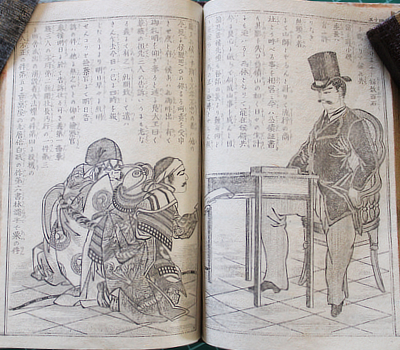
King Enma is the Japanese version of Yama, the king of hell and this is, the title tells us, a gathering of his judgments but who is that man in the top hat?
Leaving aside what is probably the first edition of this, published in 1883 in two volumes, it's easy to get lost in the 1887 printings of this intriguing little book. The other editions are not so little, they are the typical 46 size - 18 to 19cm high. The edition by Kikusuitei Shizukaetsu has a different cover and a frontispiece similar to ours but no sign of that sinister western gentleman. The edition by Kinsendo has an almost identical cover, a frontispiece without that sinister gentleman and no other illustrations. I don't know what the Suzuki Kinjiro edition looks like.
Also. It seems the 1883 edition has 17 chapters; the Kinsendo edition 18 chapters and ours 19 chapters. The extra chapter comes between four and five of the other version and seems to involve three men including our mystery man being savaged by a fox spiirit. The chapters leap from the present to the past and back again with what seems to be a lot of corruption and malfeasance on the part of the rich and powerful. I found a list of chapter headings and now I really want to be able to read it. So, to sum up: this is the best edition to have, with all those illustrations and the extra tale.
Takase was a troublemaking journalist and reformer who used a squillion pen names and did a couple of spells in prison. Later he turned to prison reform and founded Japan's first reformatory. This he turned into quite a large affair and apparently Kuroiwa Ruiko publicly damned him as a hypocrite with a lavish lifestyle and a string of ex-wives.
Worldcat finds no copy outside Japan.  *In the last picture here that sleeping man is about to have his penis cut off by his wife. No, I don't know why or what happened next.  If I did, I wouldn't tell you.


You can email an inquiry or order securely through antiqbook

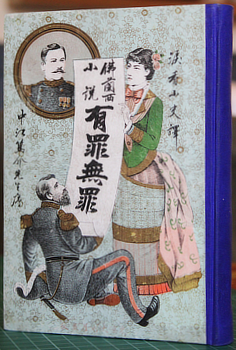
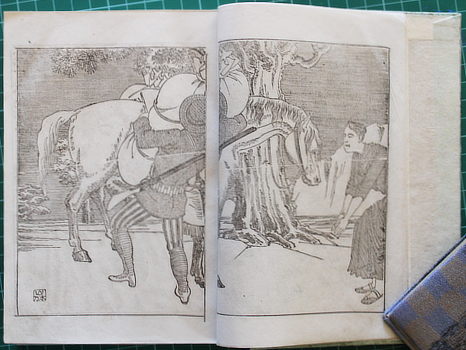
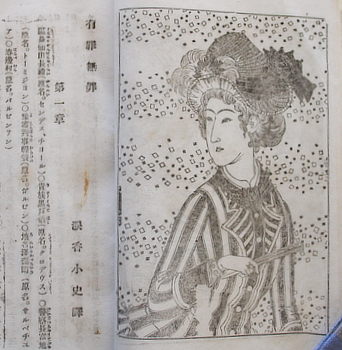
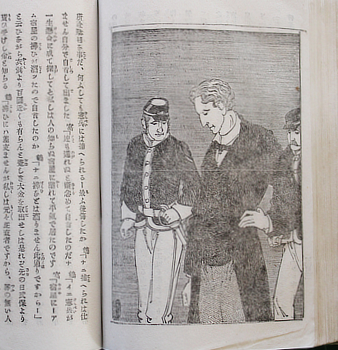
Emile Gaboriau & Kuroiwa Ruiko 有罪無罪 : 仏蘭西小說 [Yuzai Muzai : Furansu Shosetsu]. Tokyo, Okawaya 1889 (Meiji 22). 18x13cm publisher's colour illustrated boards; 17 full page and two double page illustrations. Minor signs of use and some near invisible repairs, it's hard to tell where. An excellent, bright copy in a case by binder, writer and fastidious collector Atsuo Ikuta. Au$325

A reprint, a month after the first printing of Ruiko's adaptation of Gaboriau's 'Le Corde au Cou'. He usually worked from English translations and how much Gaboriau remains in Ruiko's version is for someone who can read it in all three languages to answer. Ruiko was open about slashing, expanding and rewriting his material to fit what he wanted the novel to say.
This is a 'ball cover' (boru hyoshi, apparently a corruption of 'board') book, a signal of modernity and the Japanese equivalent of a yellowback: flimsy western style bindings with lithograph covers that rarely survive in good shape.
I don't know why this is subtitled as a French novel rather than a courtroom novel (the precurser to 'detective novel') which had been used on a Gaboriau/Ruiko novel the year before. I guess publishers were still feeling out what sold best. Worldcat finds no copies outside Japan: that Ohio entry is a microfiche.


You can email an inquiry or order securely through antiqbook

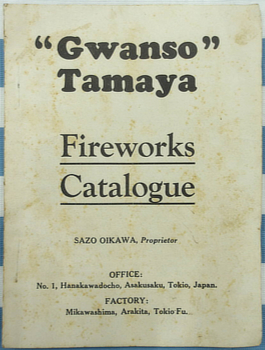
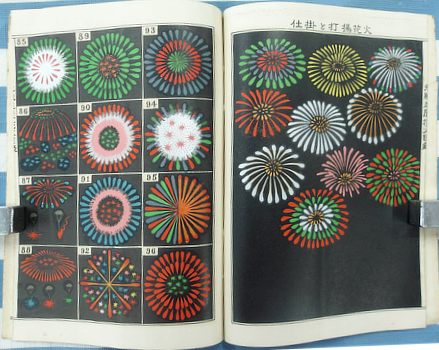
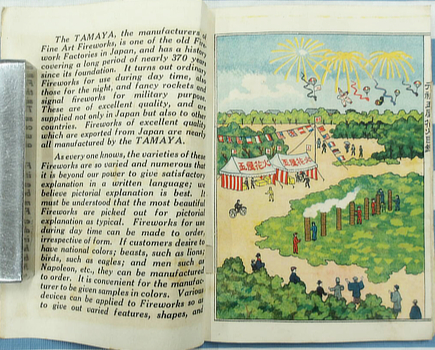
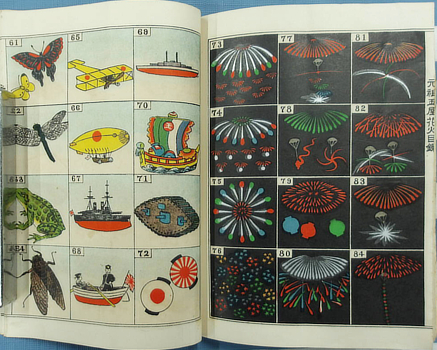
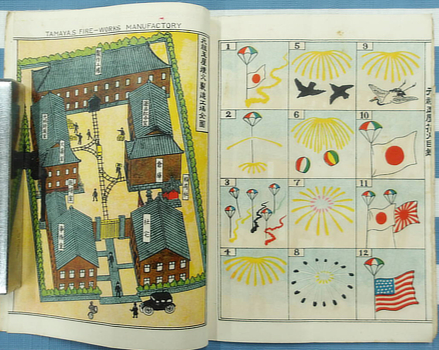
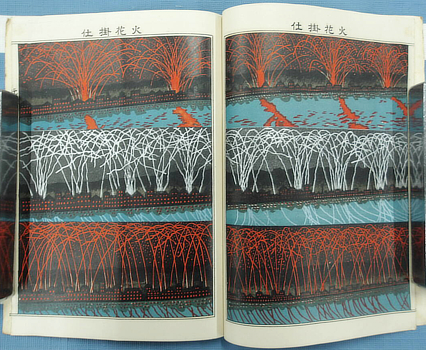
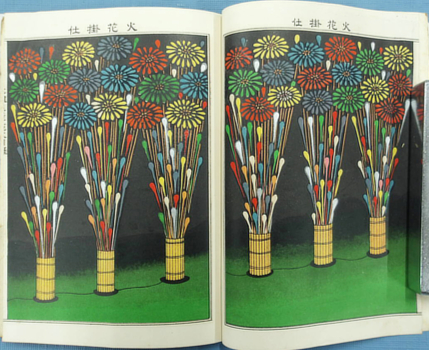
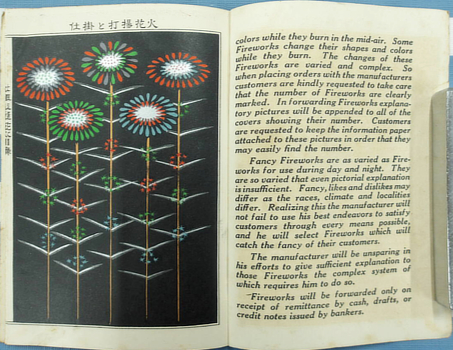
Catalogue - fireworks. Tamaya. "Gwanso" Tamaya. Fireworks Catalogue. Tokyo, Ganzo Tamaya (192-?). 19x14cm publisher's printed wrapper; eight double leaves (ie 16pp) of colour lithographs with added metallic inks. English text on the inside of both covers. Wrapper browned, mild signs of use. Au$1200

Rare, irresistable, and rare. Ganso Tamaya still make fireworks but I gather it's a modern company that took over the name while Tamaya, in this catalogue, claim a history of nearly 370 years. A view of daytime fireworks and a cute birds-eye of the works is followed by pictures of the treats that could go into daytime fireworks. Then come the eight pages of night fireworks with liberal slathering of silver ink.


You can email an inquiry or order securely through antiqbook

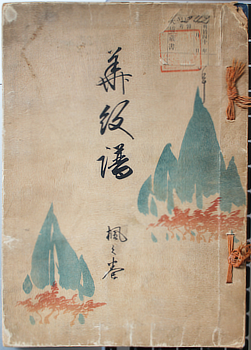
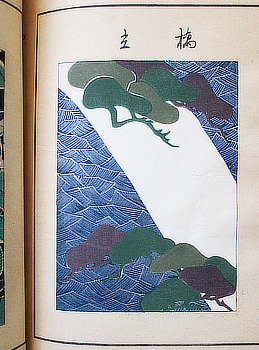
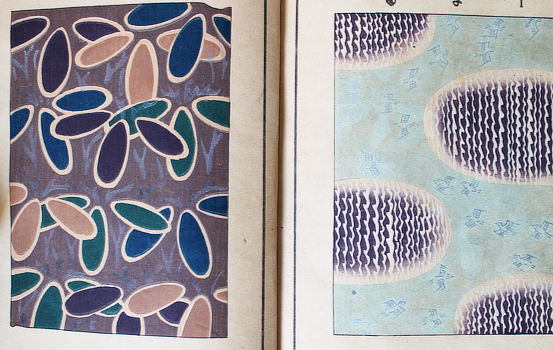
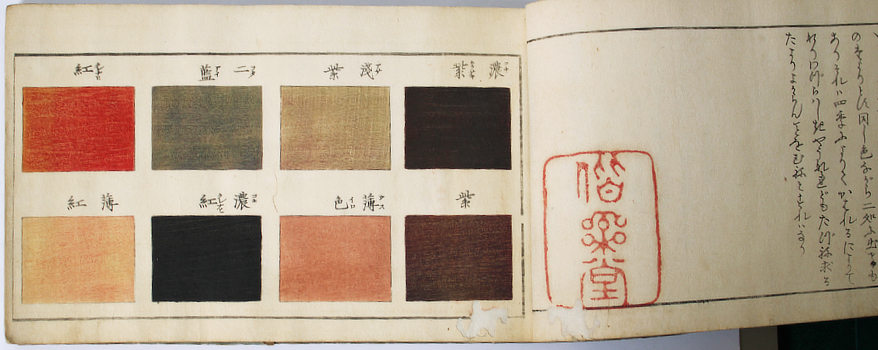
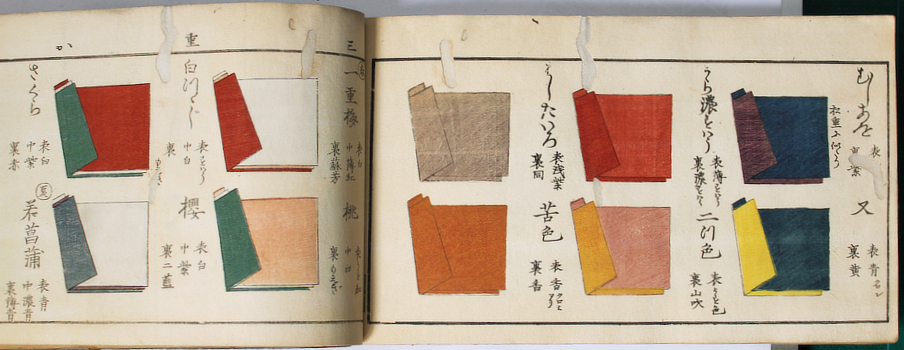
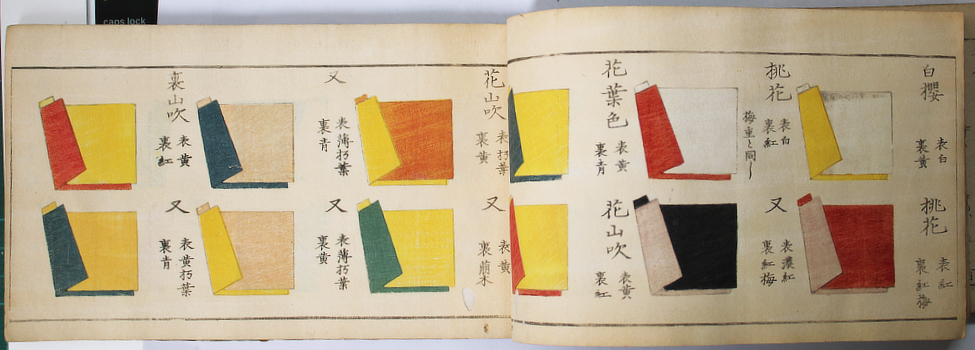
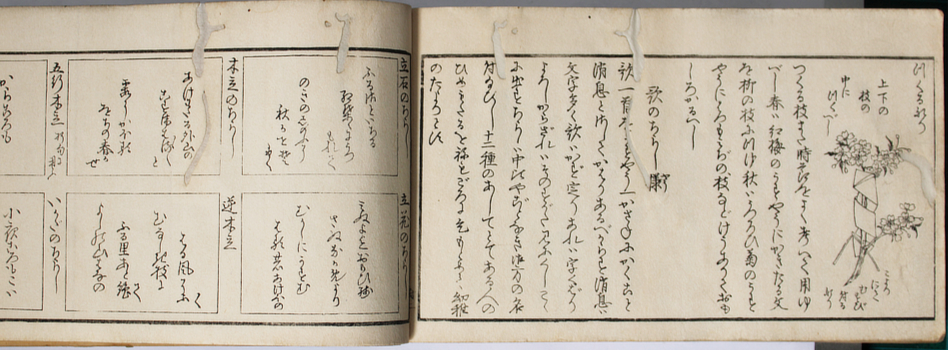
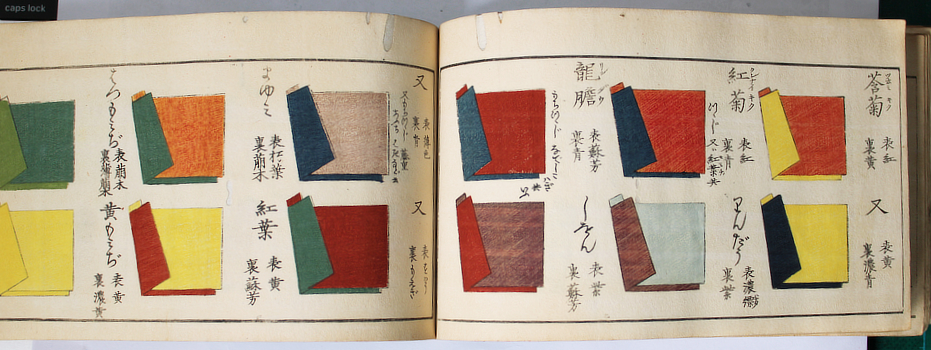
Nakamura Korenori. 薄様色目 [Usuyo Irome]. Tokyo? 1826 (Bunsei 9). 11x19cm original (?) wrapper with printed label (surface of the covers rubbed and scraped); 30 double folded leaves being text on 8 leaves, 32 block printed colour samples on two leaves, and 240 two colour samples on 20 leaves. Some worming in the very bottom margin at the beginning and in the top margin towards the end getting into the printed area in the last leaves of text; professionally repaired at some time. sold

There seems to have been a light flurry of these colour grammars - or taste manuals - around this time. By flurry I mean at least two. They are ostensibly historic recreations of layered colours from the Heiian period, the golden age of Japanese style, but as little effort was made to match the same colours from copy to copy they don't mean much except, as said, as colour grammars or taste manuals for their own time.
There are three known variants of this book, one with the colophon of Kinkado, one with Suharaya Sasuke added, and one with no colophon, like this copy. NDL Digital has a copy of the Kinkado issue on line and what is striking about that is how different the colours are, not just shades or hues, often completely different colours. Elsewhere I found a copy of the Suharaya issue online and here the binding looks the same as ours and the colours are more similar, sometimes near identical, but not always. It seems to have three leaves of colours missing. The copy of this issue I had a while ago had mostly similar by by no means identical colours and shades. It also had an extra leaf at the end which I think was publisher's advertising, it was not part of the book.
Worldcat finds only the Ryerson & Burnham copy outside Japan.


You can email an inquiry or order securely through antiqbook

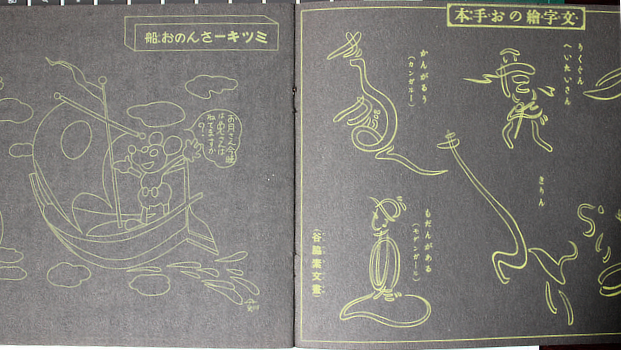
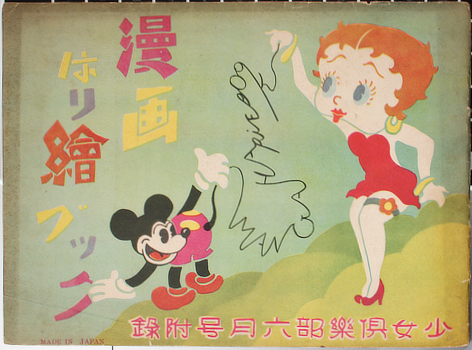
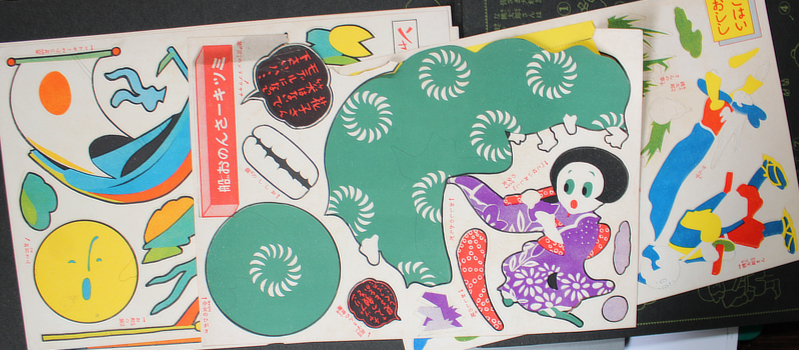
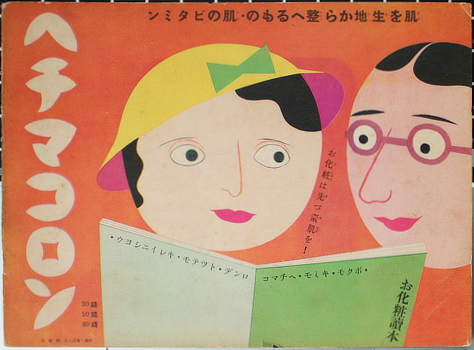
Manga. 漫画はり繪ブック [Manga Hari-e Bukku]. Tokyo, Shojo Kurabu 1933 (Showa 8). 19x27cm publisher's colour illustrated wrapper; 12pp printed in yellow on thick black paper and six loose sheets of colour pop-out figures to be stuck in. Minor signs of use, one loose sheet has lost some of the top margin but not the pop-out pictures. Au$250

Mickey and Betty co-star with other manga favourites in this cute toy book. Some pages are to be decorated with the pre-cut colour figures on the loose sheets, some pages show how to draw and some are just for fun. And all are for needle pictures.
Took me a while but I figured out Betty is spelling Manga Hari-e Book with Mickey's tail.


You can email an inquiry or order securely through antiqbook

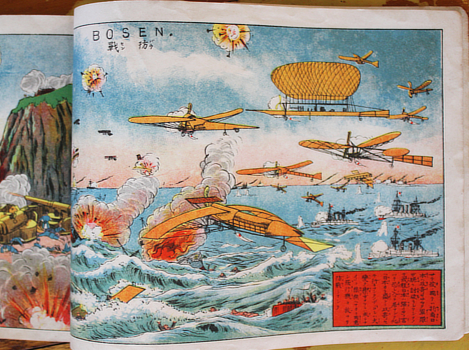
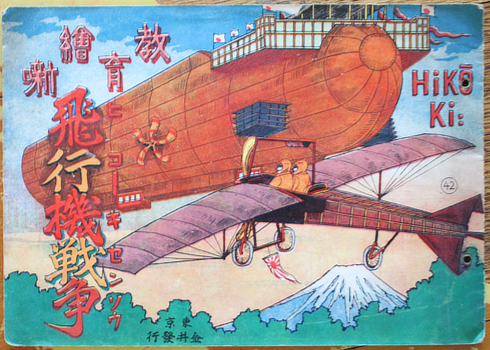
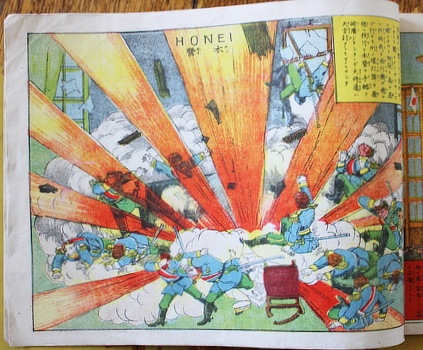
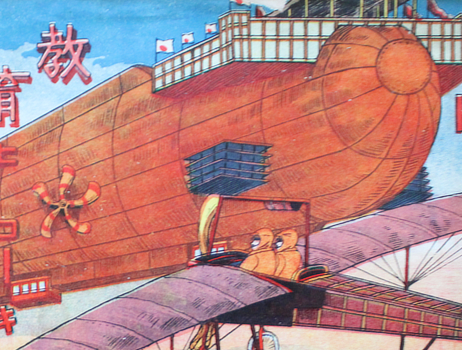
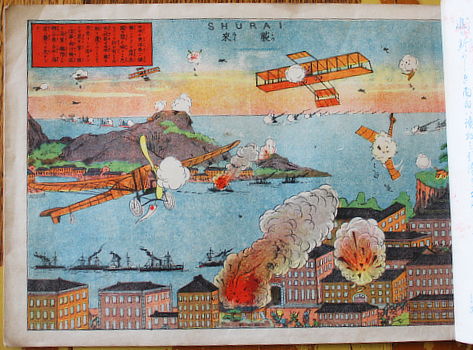
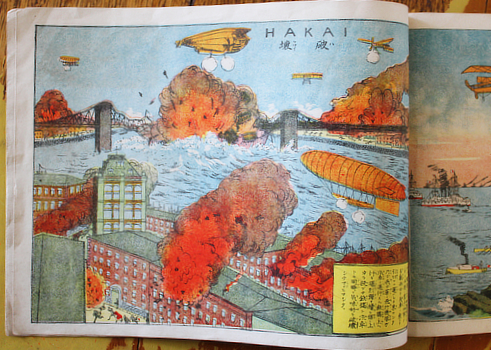
飛行機戦争 [Hikoki Senso]. Tokyo, Kanai Shinseido 1915 (Taisho 4). 19x26cm publisher's colour illustrated wrapper; two punched holes with metal grommets as published; six double folded leaves (ie 12 pages) and wrapper, each page a full page colour illustration. Chip from the top of the front wrapper; signs of use; pretty good. Au$500

Fourth printing according to the colophon; it first appeared in 1911 when airplanes could barely cross the channel and Japan's first aviators had only just got off the ground. I don't know who Japan is fighting here but they are westerners, often with red hair and beards. Quite like Russians.
This is no.42 of Kanai Shinseido's long series of educational picture stories. Hmmm. Was this edition rushed out as a training manual? Miyazaki is too young to have owned a copy of this when new but his work is a direct descendant. The double folded leaves are a lavish touch for a cheap kids' book like this; it's a big step up from the akahon (red books) coming out of Osaka.


You can email an inquiry or order securely through antiqbook

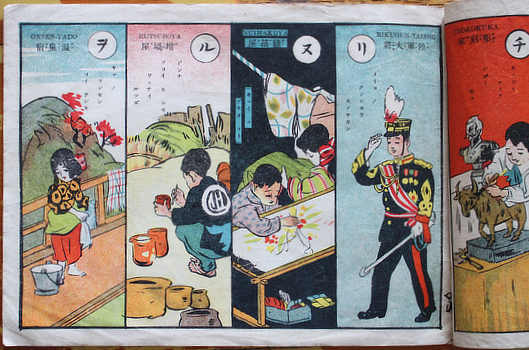
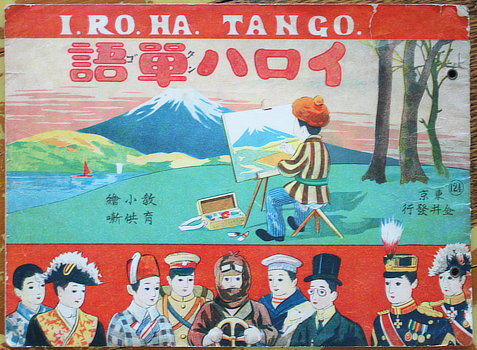
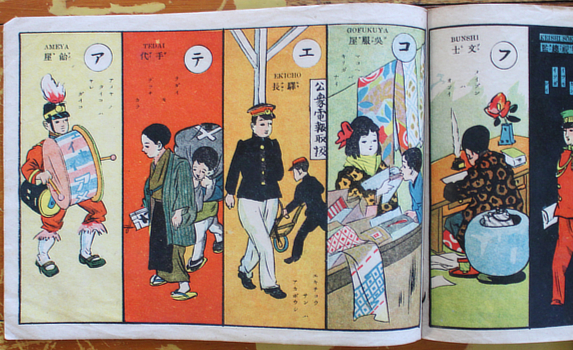
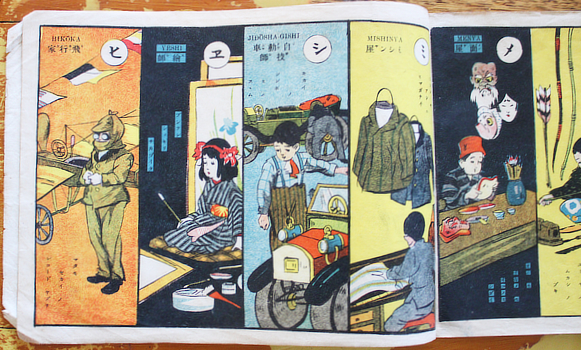
イロハ単語 I. Ro. Ha. Tango [cover titlle]. Tokyo, Kanai Shinseido 1917 (Taisho 6). 19x26cm publisher's colour illustrated wrapper; two punched holes with metal grommets as published; six double folded leaves (ie 12 pages) and wrapper, each page a full page colour illustration. Wrappers a bit torn and chipped; signs of use but acceptable. Au$225

An ABC of occupations. There are a couple of jobs for girls; they seem to involve cleaning. This is no 124 of Kanai Shinseido's long series of educational picture stories. The double folded leaves are a lavish touch for a cheap kids' book like this; it's a big step up from the akahon (red books) coming out of Osaka.
Those boys on the cover seem to be baffled by the strange kid clutching a wheel.


You can email an inquiry or order securely through antiqbook

Western education becomes Japanese furniture

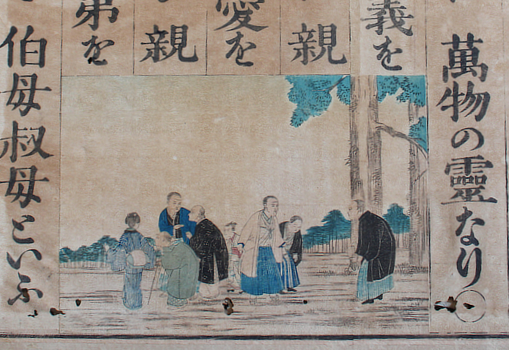
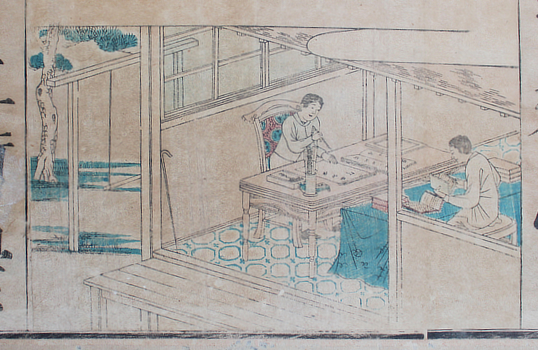
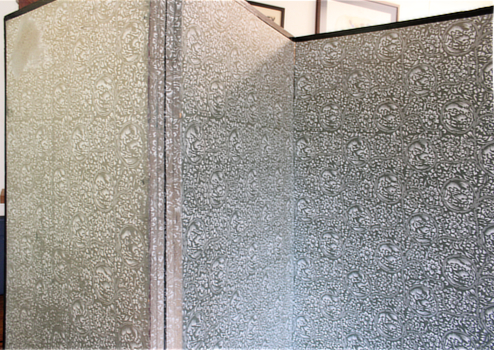
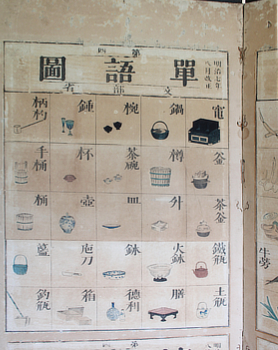
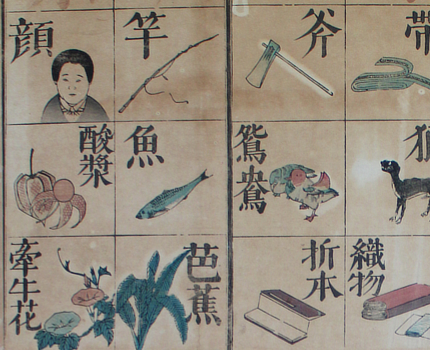
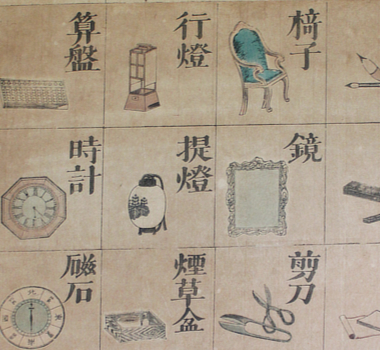
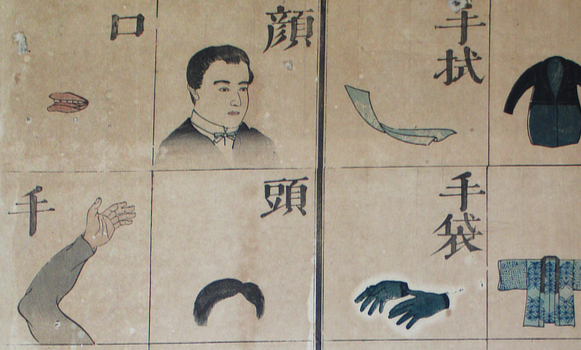
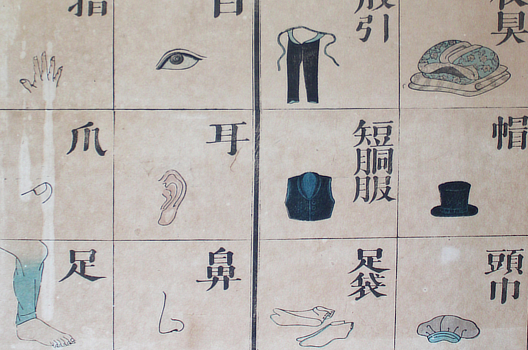
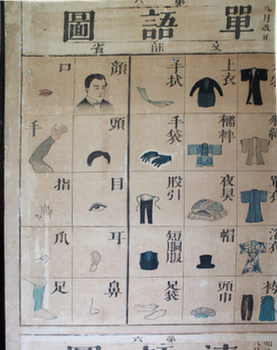
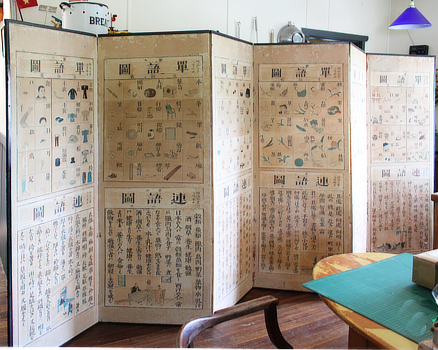
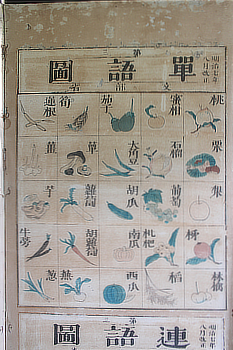
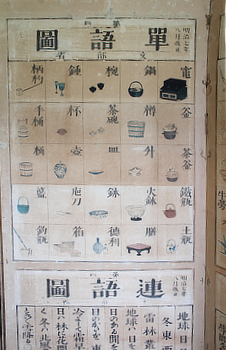
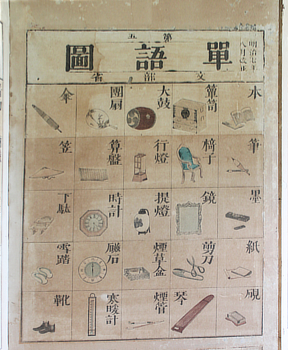
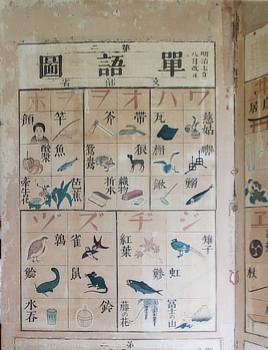
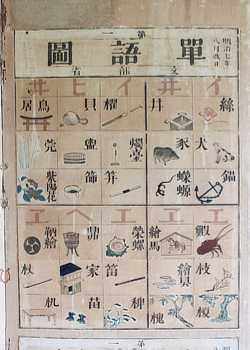
School screen. 單語圖 + 連語図 [Tangozu + Rengozu]. Tokyo, Monbusho1874 (Meiji 7). Folding screen, a byobu, of six panels; paper over a timber frame. Each panel is 176x64cm, ie it's close enough to four metres opened right out. Each panel has a Tangozu wall chart mounted above a Rengozu chart, with colour woodcuts, numbered one to six. Each chart is about 77x54cm, some a bit larger or smaller. The back is patterned green paper printed by stencil or block. Bugs have been busy in places but only in the mounting paper, not the charts. Some holes or bashes in the back of the first panel - what would be the front cover if you imagine this as a book - have been repaired with Japanese tissue. Browning. The holes are mostly down low, where small children or errant bits of furniture operate.
This was made as a six panel screen, it is complete with the black timber border strips at each end. And it was made by professionals. It's possible that whoever ordered it decided that the rest were a waste of time but it's more likely another panel would make it too large and cumbersome for the space they had.   Au$3600 delivered within Australia; Au$4500 delivered elsewhere.

When I bought this I thought the photos showed it sitting on a table and the dimensions were of the whole screen opened out. I realised I was wrong when I got the bill for shipping. What I thought was a table mat was a floor rug.
These are the elementary school wall word charts (Tangozu) and collocation or phrase charts (Rengozu) issued by the Ministry of Education. There were eight of each produced but six is what made it on to this extraordinary piece of furniture. I can only guess it was made to divide a classroom. Charts seven and eight of the Tangozu series were plants and animals.
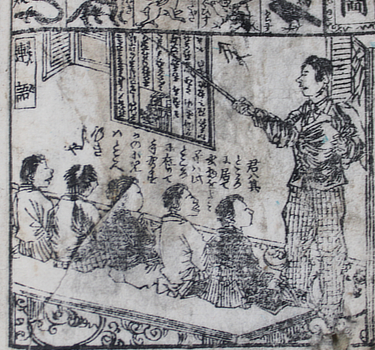
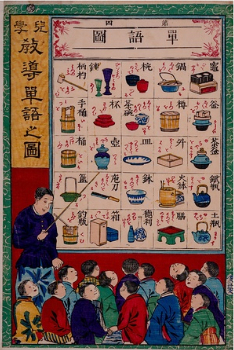
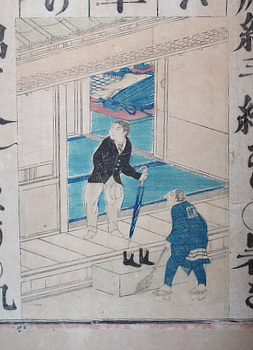
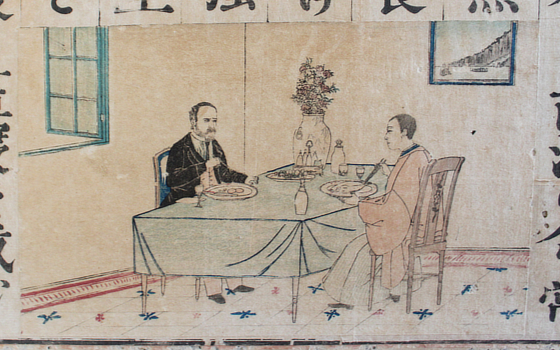
The various editions and versions of the Shogaku Nyumon and similar elementary primers show that these wall charts were used, revised and adapted for some years. The miniature versions in the books are changed and reorganised but these originals can still be recognised; who could mistake that hairpiece and nose? Included with the screen is an 1875 edition of the teachers' Shogaku Nyumon with a date stamp showing that it was still being used fifteen or twenty years later. Commercial colour woodcuts of the charts in use were also produced by canny publishers: teacher pointing and attentive kids on the floor. The charts were exaggerated so that they could still teach even in such reduced form. Kiyochika did at least three in 1874.
The lower elementary school curriculum established by the Normal School stipulated that students should first study vocabulary using wall charts such as word charts and collocation charts, as a prelude to learning materials like the Elementary School Reader ...
The eight word charts published in 1873 were created by the Normal School editorial office, a liberal faction that actively sought to absorb Western civilization. They incorporated Pestalozzi's educational philosophy and focused on illustrations to allow children to understand intuitively through their own eyes. The first and second word charts were designed to teach historical kana spelling, while the third through eighth word charts were written in kanji or katakana, allowing children to learn the properties and uses of familiar objects through a question-and-answer format.
However, the following year, 1874, a revised edition was published by the Ministry of Education, and the Normal School version was discontinued after just one year. Looking specifically at the revised sections, out of the 210 words, there are four changes to the word itself and 29 changes to spelling.
 (A rough translation from Dictionaries and Beyond published online by Sanseido. They illustrate it with images from an elementary book, not the charts).
Pretty much every reference I can find works from the books and prints rather than original charts. The Library of Congress has both sets of eight Department of Education charts. The Miyaki Library at Tsukuba University has six very similar but not identical Tangozu charts mounted on a scroll. Maybe the Normal School version?

The illustration top left is one of Kiyochika's prints. It is a good, if lurid, likeness of Tangozu chart four in the Miyaki collection; almost but not quite the same as chart four here. Next to it is from a horrible copy of a Shogaku Nyumon I have here showing the teacher with Rengozu chart three.
You can email an inquiry or order securely through antiqbook

Race integration?

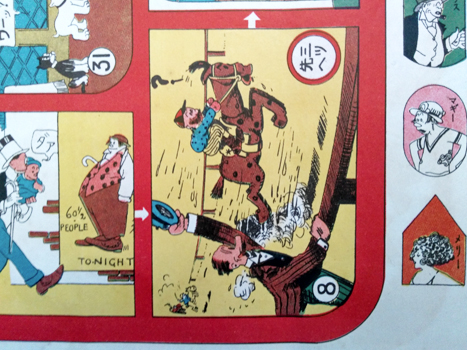
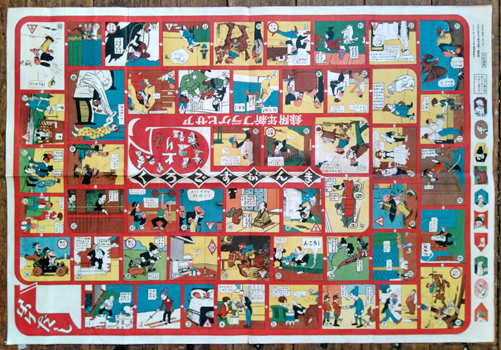
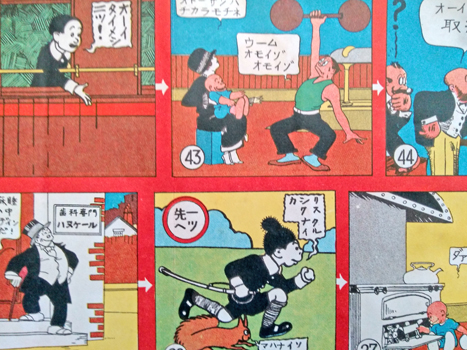
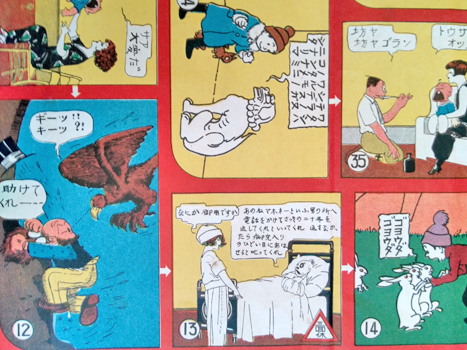
Manga Sugoroku. まんがすごろく [Manga Sugoroku]. Asahi Graph 1925 (Taisho 14). Colour broadsheet 54x79cm. On the back is a monochrome game that features Daikokuten and a map of Japan; it doesn't look very interesting. Some near invisible repairs to folds. With the playing pieces in the margin. Au$375

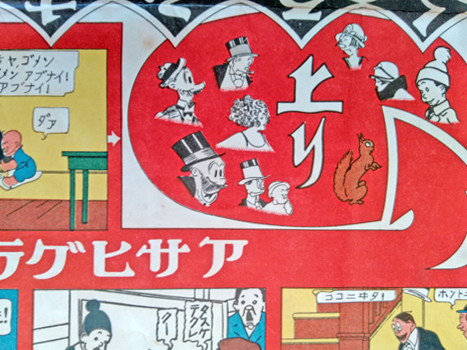
The new year gift from the magazine Asahi Graph celebrates the introduction and embrace of the American comic strip in Japan along with a couple of local heroes. Mutt, Jeff, Jinks, Maggie et al share the page with that pom-pom kid and his squirrel friend - or vice versa - I forget their names*. But I notice that everyone sticks to their own boxes; Jinks, Mutt and the squirrel play the same stage but not together. Such behavior came later.
It was Okamoto Ippei that convinced Asahi Graph and associated papers to publish Bringing Up Father and Mutt and Jeff. This is printed on good heavy paper and Asahi must have produced a squillion of them, so you'd expect it to be fairly easy to find. Not so.

*Sho-chan and Risu: the boy and the squirrel. I thought I better make an effort.


You can email an inquiry or order securely through antiqbook

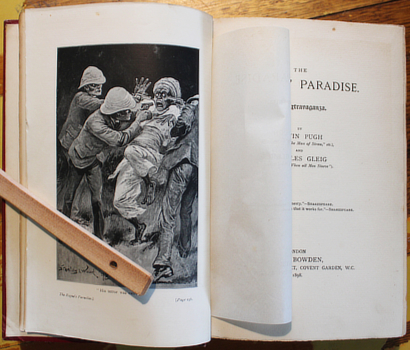
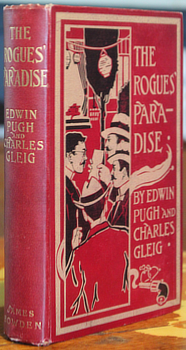
PUGH, Edwin & Charles Gleig. The Rogues' Paradise. An extravaganza. London, Bowden 1898. Octavo publisher's illustrated dark red cloth blocked in black and white; frontispiece by Stanley L. Wood. A pleasing copy. Au$225
First edition of this criminal romp set in the vaguely situated tropical country of Berona, a haven for Britons fleeing society or the police. This reads like it aimed to be a play or was worked from one, with a hefty dose of Oscar Wilde banter early on and finishes as farce with lightning fast entrances and exits, misdirection and sotto voce asides all over the place.


You can email an inquiry or order securely through antiqbook

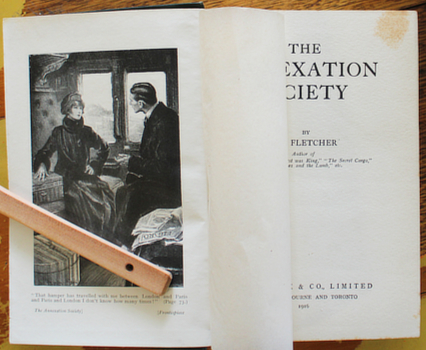
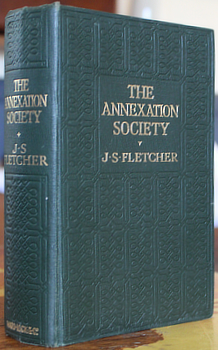
FLETCHER, J.S. The Annexation Society. London, Ward Lock 1916. Octavo publisher's elaborately blocked cloth; frontispiece. Smallish blot of foxing on title page corner; again, a bright and pleasing copy. Au$165

First edition. Just another typical English day: the Marquis of Scraye is woken as usual by his valet with tea quickly followed by his house-stewart with news that the Tsar's Cross has vanished from the Queen's Chamber. We're all familiar with this sort of start to the day.


You can email an inquiry or order securely through antiqbook

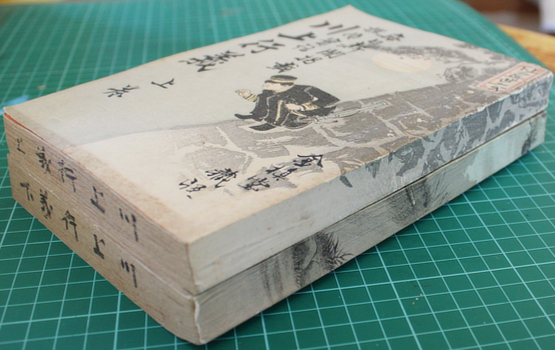
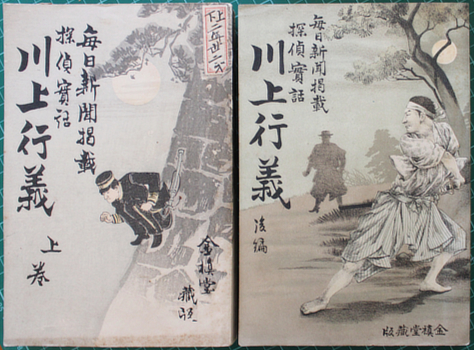
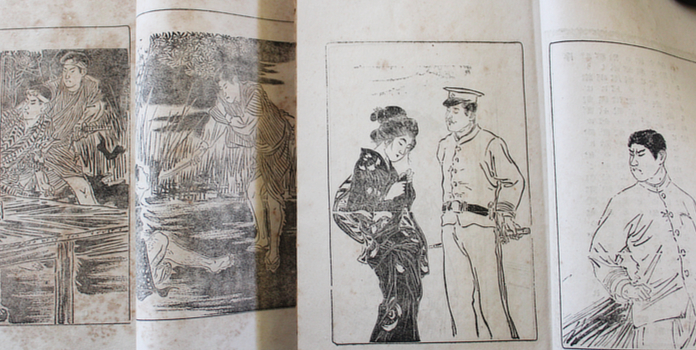
Aoba (ie Ihara Toshiro?). 川上行義 : 探偵実話 [Kawakami Yukiyoshi : Tantei Jitsuwa]. Tokyo, Kinshindo 1900 (Meiji 33). Two volumes 22x15cm publisher's colour woodcut wrappers; full page b/w illustrations in each volume, a couple double page. Browning of the cheap paper in the second volume, not so much in the first. A couple of owner's stamps; title written in ink on the bottom edges of each. Signs of use but pretty good. Au$250

First edition of this rare true detective story; that's what the title says it is (true detective, not the rare bit). This is the story of Kawakami Yukiyoshi, an army sergeant who deserted in 1880 in order to avenge his father. He became a hero and a six part novel called (more lor less), A new Story : Kawakami Yukiyoshi's Revenge by Okamoto Kisen appeared in 1881. That looks like it came came directly from a kabuki production or would soon be one.
Ihara did a run of true detective novels early in his career before he became a distinguished theatre critic and playwright.
Worldcat finds only the NDL entry and Cinii finds only two locations in Japan.


You can email an inquiry or order securely through antiqbook

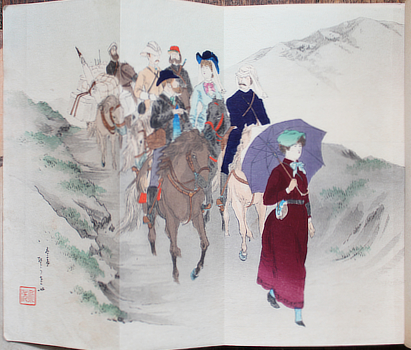
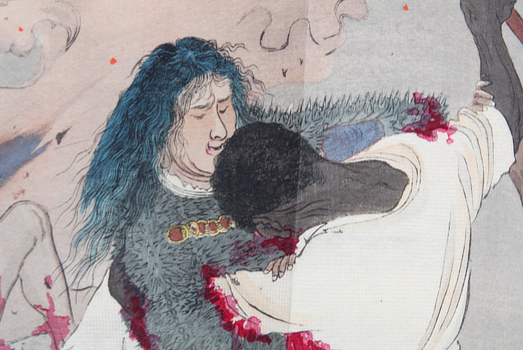
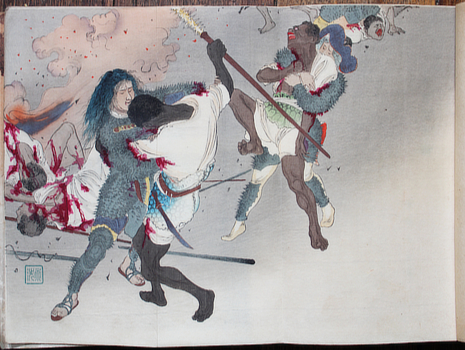
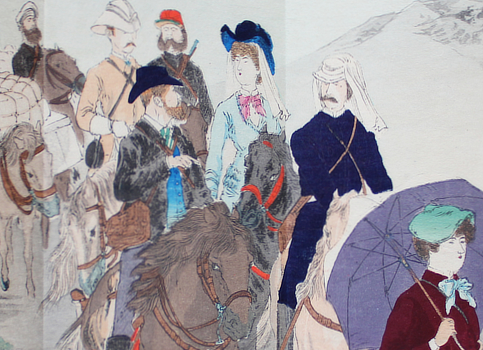
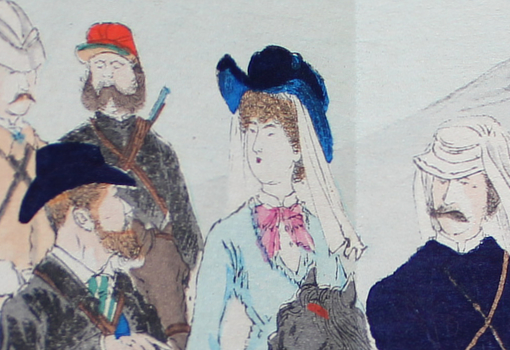
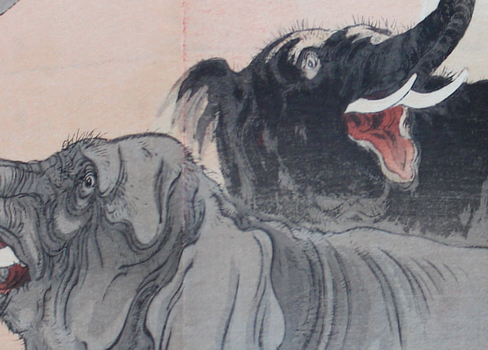
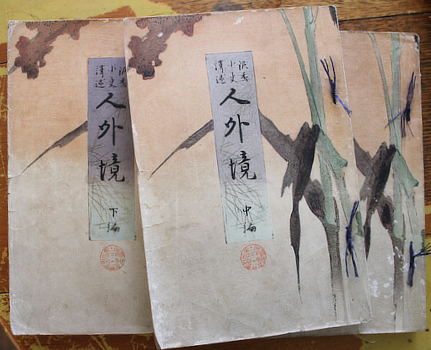
Adolphe Belot & Kuroiwa Ruiko. 人外境 [Ningaikyo]. Tokyo, Fusudo 1897 (Meiji 30). Three volumes 22x15cm publisher's colour woodcut wrappers, thread tied (some short tears and chips). Three folding colour woodcut frontispieces by Tomioka Eisen. A couple of owner's stamps in each, title written in ink on the bottom edges). Browning, smudges and signs of use. Certainly well read but still rather good copies for popular thrillers like this. And most important: those frontispieces are intact* and clean. They are the magic you don't get in the original or English translations. The third frontispiece shows those women warriors at work in their spiked armour. They liked to get in close and had no mercy. Au$500

First edition of Kuroiwa Ruiko's translation of Belot's trilogy La Sultane Parisienne, La Fievre de l'Inconnu, and La Venus Noire (1877), a prodigious potboiler with indominatable women explorers and a ferocious race of women warriors in the darkest of a dark Africa ruled by the black venus. An English translation was made in 1879 by H. Mainwaring Dunstan as 'A Parisian Sultana', Ruiko usually worked from English translation of French books.
I admit I skipped large hunks of Dunstan's translation but wherever I opened each book I usually had to go back several pages to understand how the current turmoil and drama had started. There's a lot of it. And a fair bit involves sex and jealousy. The dull parts are Belot proving the depth of his research. Just as Tolkein used maps and documentary contrivances to establish the reality of his middle earth, Belot used explorers like Livingstone, Baker, Speke, Grant, Schweinfurth et al, to buttress his hellish fantasia of Africa. An unpleasant place swarming with unpleasant people.
Ruiko was busy. Apart from journalism, running newspapers and writing what might be the first modern Japanese detective novel he kick-started Japanese detective fiction by publishing a squillion translations or adaptations of novels by authors like Jules Verne, Gaboriau, Hugh Conway, Anna Katherine Green, Marie Corelli, A.M. Williamson, George Griffith, H.G. Wells and most of all, Du Boisgobey. Translation is an approximate description of Ruiko's work; he was open about slashing, expanding and rewriting his material to fit what he wanted the novel to say.
Worldcat finds no copy outside Japan but *I'm sorry to say that the NLA has the three frontispieces minus the books. This is what happens to so many of these novels.


You can email an inquiry or order securely through antiqbook

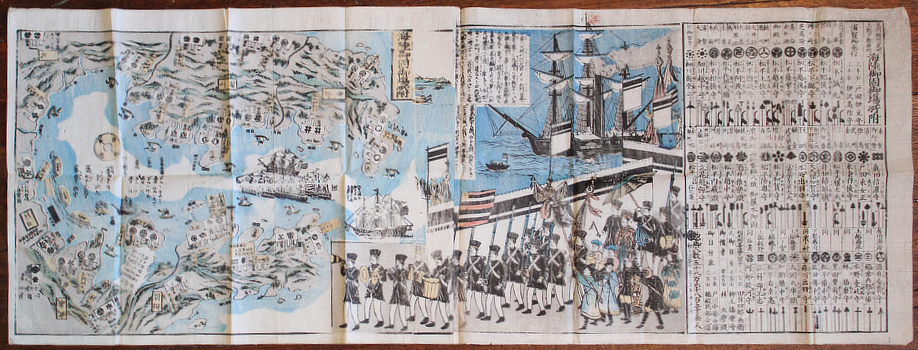
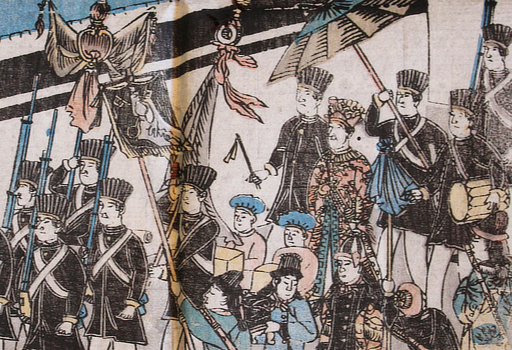
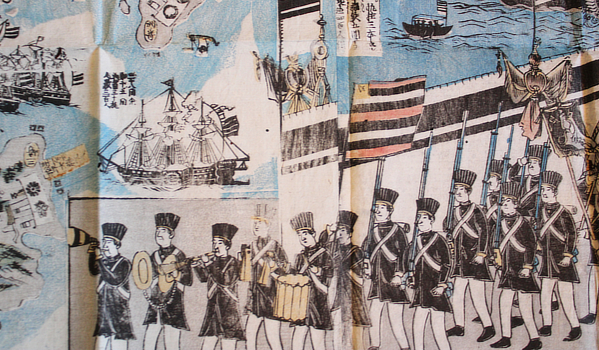
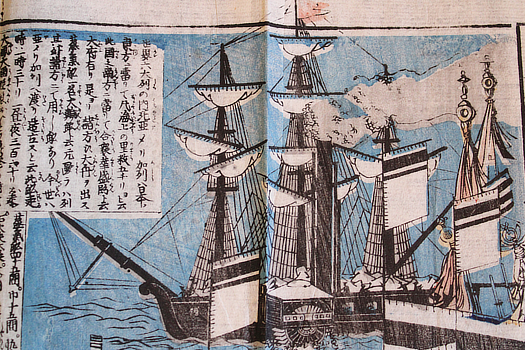
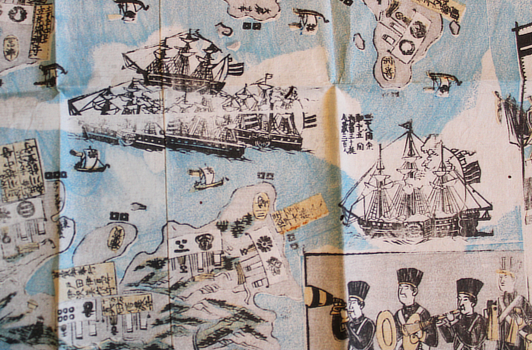
Kawaraban. Perry and the black ships. 海陸御固御場所附 [Kairiku Okatame Onbasho Tsuke]. n.p. (1854). 35x93cm colour woodcut on two joined sheets. A couple of small holes; a nice copy. Au$3600

Three in one: list of defences on the right; American procession in the middle; and American ships and defence in the harbour on the left. This must be among the most deluxe kawaraban ever produced: two large sheets and colour. Usually a print this size, not that I'd seen one this long, would be on four joined sheets. So even cheap illicit news sheets have a hierarchy. This strengthens my suspicion that there was already a market of collectors as well as the no longer slack-jawed peasantry.
There are other kawaraban with this title and a couple closely resemble this in parts. One has the first few musicians in the American procession but not the rest and not the majestic figure of, I presume, his royal highness Adams. The Sanada Treasures Museum has a copy of this and Brown University has a copy but not coloured. That's all I found.
These illicit illustrated news sheets - kawaraban - for the streets were produced by the million for a couple of hundred years so of course few survive. They were produced for anything more interesting than the drop of a hat and the arrival of the Black Ships, the American squadron commanded by Perry, in 1853 and 54 eclipsed any and all tiresome earthquakes, fires, plagues, famines, murders and scandals. For most Japanese this was the same as a squadron of alien space ships arriving on earth now. These prints are the kurofune (black ship) kawaraban.


You can email an inquiry or order securely through antiqbook

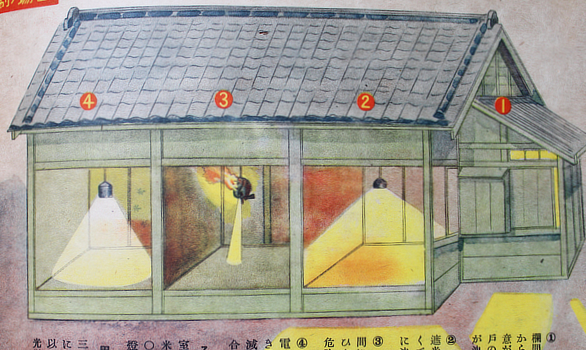
TEALE, T. Pridgin, Dangers to Health: a pictorial guide to domestic sanitary defects. London, Churchill &c 1879. Octavo publisher's gilt decorated illustrated cloth (a touch mottled); 55 plates, all but a couple in black and blue, one in three colours. Minor signs of use, quite good. Au$475

First edition of this charming and terrifying pictorial guide to the perils of Victorian home life. Three more editions and French, German and Spanish translations (at least) followed over the next few years. I recommend this to anyone wanting to restore old houses with absolute authenticity. And it's essential for time travellers.
"Having further traced illness amongst my own patients to scandalous carelessness and gross dishonesty ... I became indignantly alive to the fact that very few houses are safe to live in." A still useful warning. Teale, third generation Leeds surgeon, like so many eminent Victorians, can only have achieved so much by working hundred and sixty hour weeks. There was a deluge of obituaries at his death in 1923, all eulogistic, but the note in the British Medical Journal caught my eye: he had an "almost feminine sweetness of disposition."


You can email an inquiry or order securely through antiqbook

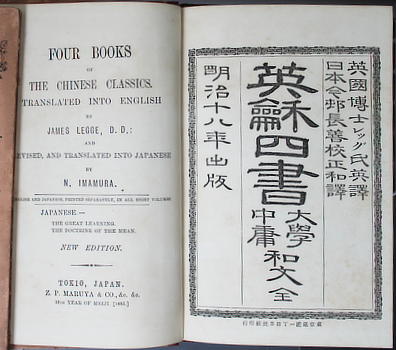
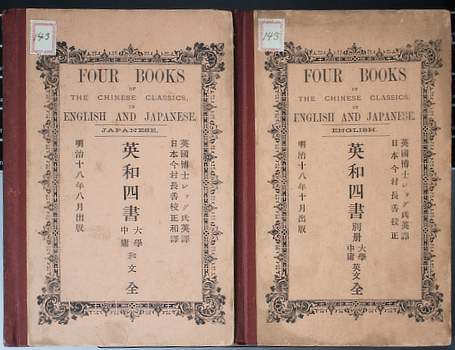
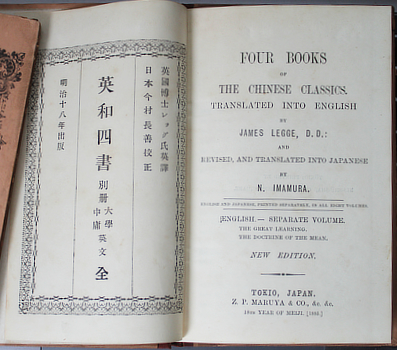
Confucius. James Legge & Imamura Nagayoshi. Four Books of the Chinese Classics. Translated into English by James Legge ... revised, and translated into Japanese by N. Imamura. Tokyo, Z.P. Maruya (ie Maruzen Shosha) 1885. Two volumes 19x13cm publisher's printed boards, cloth spines. Rather good. Note that they open right to left. Au$300

Most likely the first edition even if it is called a New Edition and the title page says that it is "printed separately, in all eight volumes." These two volumes, one English, one Japanese, are all I can trace. Worldcat finds only the Waseda entry; Cinii finds copies at 12 universities and all of them have two volumes and the same edition. I suspect Maruzen meant four books in English and four in Japanese. Likewise they use 'new edition' to mean new work rather than a revision.
If you had to learn English from foreign texts it must be welcome relief to learn it from from a comprehensible text with substance after all those drivelling mission led tracts.
This is a 'ball cover' (boru hyoshi, apparently a corruption of 'board') book, a signal of modernity and the Japanese equivalent of a yellowback: flimsy western style bindings with lithograph covers that rarely survive in good shape.


You can email an inquiry or order securely through antiqbook

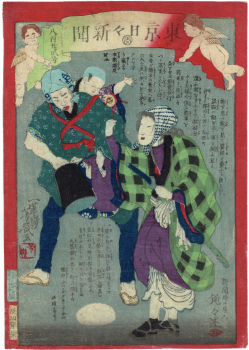
When your wife goes to work

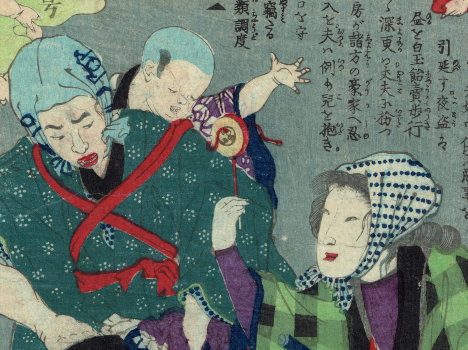
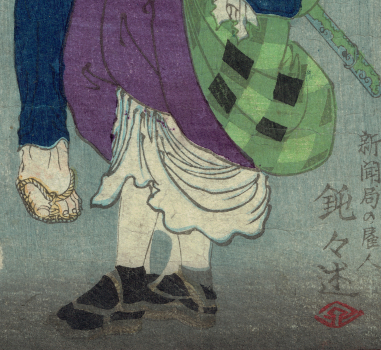
Utagawa Yoshiku. 東京日々新聞 822号 [Tokyo Nichinichi Shimbun no. 822]. Tokyo, Gusokuya 1874 (Meiji 7). 35x24 colour woodcut. A nice copy. Au$400

This is one radical family when it comes to gender equality and task sharing, way ahead of their time. Mother burgles while father minds the baby. Mother also brings back treats after work.
This is the colour supplement to the Tokyo Nichinichi Shimbun (Tokyo daily news). I can't decipher names of this pioneer couple and the references I've found don't help.


You can email an inquiry or order securely through antiqbook

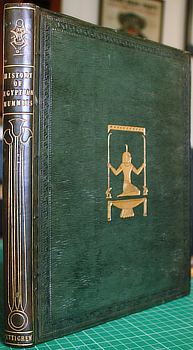
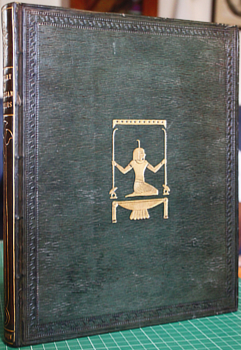
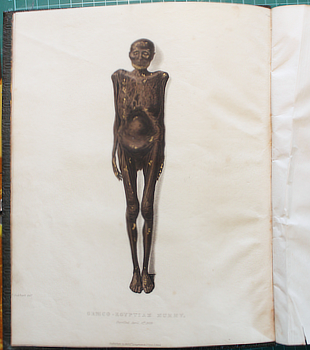
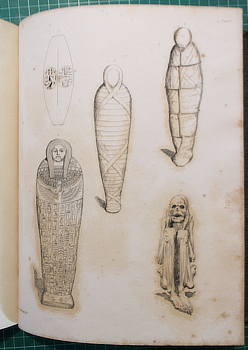
PETTIGREW, Thomas Joseph. A History of Egyptian Mummies, and account of the worship and embalming of the sacred animals by the Egyptians; ... London, Longman 1834. Quarto contemporary straight grain green calf decorated in gilt and blind; 13 plates, four coloured. Foxing or browning of the uncoloured plates, thanks to the paper: a bit of browning here and there; frontispiece tissue and gutter of the title creased.
20th century ticket of the bookshop Au Bouquiniste Oriental of Cairo on an endpaper and bookplate of medico and anatomy historian K.F. Russell. Au$2250

A pleasing copy in a wonderful Egyptian binding with the armorial bookplate of a Smith who may or may not be one of the three Smith subscribers. I'd like to think it's William James Smith the architect who later introduced neo-classical architecture to Constantinople, but all three subscriber Smiths, including William James, are Esq.s and I doubt any Esq. chose to be a working architect in the Office of Works. Or that any young architect in the Office of Works could afford this.
The binding uses what looks very much like the identical tool used on the cover of Gardner Wilkinson's Ancient Egyptians (1837) on the front and back and a matching design on the spine. Wilkinson's book was possibly bound by Remnant & Edmonds (it's known they bound the second edition), famous for show off publisher's bindings but not so much for single bespoke work. Wilkinson was a friend of Pettigrew and, of course, a subscriber to the book. So where does this Smith come in?
Wilkinson, along with the king and some other worthies, subscribed for a large paper copy which, from advertisements sent to Soane (who ignored him), we know cost three guineas against two for the standard. Seems to me they were had. It's scarcely larger, no extra colouring, nothing.
Why couldn't I have a friend like Pettigrew who would unwrap and dissect mummies as a party trick? I did have a friend who spontaneously performed all of Oklahoma from outside the kitchen window, playing every part within that tiny stage, but most of them just drowned guests in booze, food and loud music. Or was that me?


You can email an inquiry or order securely through antiqbook

WORCESTER, G.R.G. [George Raleigh Gray]. The Junks and Sampans of the Yangtze. A study in Chinese nautical research. Shanghai, Dept of Customs 1947-48. Two volumes quarto publisher's green cloth (different grained cloth on each volume); numerous photo illustrations, measured drawings & plans, several folding. A nice, bright pair. Au$1600

Worcester was by no means the only civil servant in China, or any exotic foreign spot, to devote large slabs of their life to collecting, collating and preserving disappearing arts, crafts, languages and customs, but his books on junks and sampans are remarkable for being exhaustive and well timed. They are references that can never be obsolete, recording as they do dozens of now vanished vessel types - their design, construction, peculiar use and all manner of social and personal history of their owners and crews.


You can email an inquiry or order securely through antiqbook

DYE, Daniel Sheets. A Grammar of Chinese Lattice. Harvard Univ Press 1937. Two volumes quarto, excellent in publisher's cloth and barely nicked dustwrappers; illustrated with some 2500 patterns. Harvard-Yenching Institute Monograph Series V. A pleasing pair. Au$750

First and best edition. A practical copybook and one of the great efforts of collection if not classification; the first on Chinese lattice the author thinks since 1631. The result of twenty years collecting, Dye called an end to his work with the death of his draughtsman Mr Yang Chi-shang in January 1936. He does comment that though there must be more examples he hasn't found, some three hundred patterns collected since 1933 but not included in this book contain no basic variants.


You can email an inquiry or order securely through antiqbook

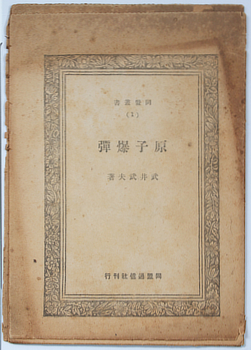
Takeo Takei. 原子爆彈 [Genshi Bakudan (ie: Atomic Bomb)]. Tokyo, Domei Tsushinsha September 1945. 20x14cm; 32pp including wrapper, mostly untrimmed and loose (apparently as issued). Rather browned and a bit frayed round the edges. Au$750

Published as Domei Sosho No.1 by Domei - the national news agency - on 20th September 1945, apparently the day before the US occupation censorship had time to be fully implemented.* Domei Sosho no.2 was on the Potsdam declaration and there, I think, the series ended. I have read that 200,000 copies of this were printed. Worldcat locates one copy outside Japan - in Australia - and it doesn't appear in the catalogue of the Prange collection - the world's largest collection of occupation era documents, collected by the official historian to the occupation.
There is still nothing much to be found in English on Takeo or his pamphlet. As I can best figure, the story is that Takeo was a scientific and/or political correspondent for Domei and spoke English. He and a colleague listened in to allied broadcasts, translated Truman's statement on the bombing of Hiroshima and were the first to tell the Japanese government that the "new bomb" was an atomic bomb. Takeo's widow and son published a memorial book in 1995 with background and contemporary papers which doesn't seem to have worked its way to writers in English. From my stumbling through a review of that book I get the impression that Takeo was seen as an apologist for the US and their use of the bomb which was unfair. He was attempting to give as objectively as possible as much information as he could and what information he had came only from what could he could scrape together from radio broadcasts. How much of this view of him was long after the fact I don't know. He had been or became - I'm not clear on this - a communist journalist which can't have endeared him to any authorities.
There is a modern facsimile of this which may be related to the book published by Mrs Takeo - it seems likely. That should not be mistaken for this. Neither should Takeo Takei the journalist be confused with Takeo Takei the illustrator.
*Nuclear physicist Sagane Ryokichi's Genshi Bakudan published in October had two sections removed by the censor from every copy.


You can email an inquiry or order securely through antiqbook