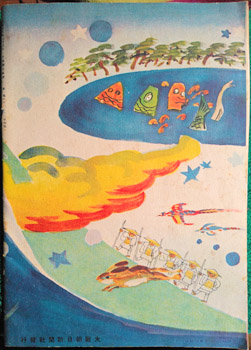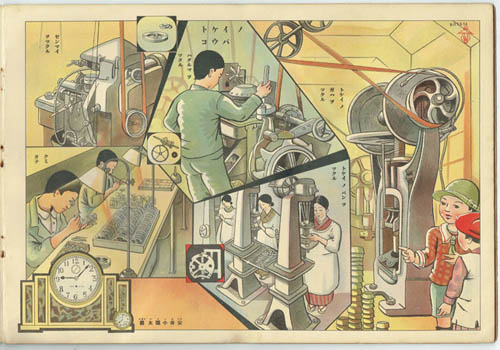
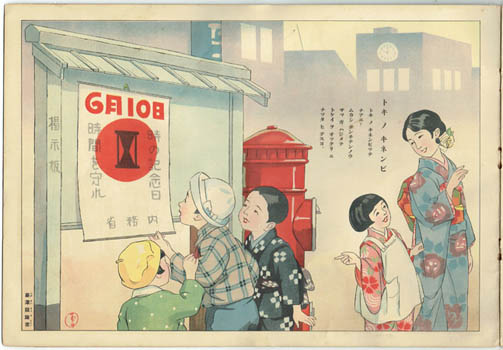
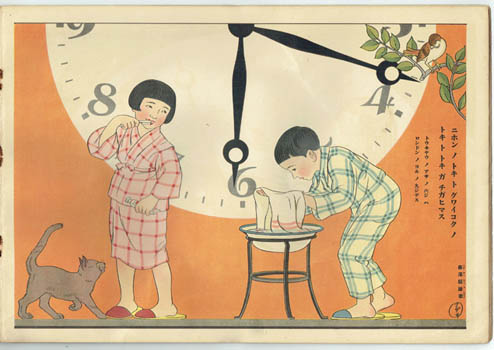
Takeo Takei & others 観察絵本 - キンダーブック [卜ケイ] [Kansatsu ehon - Kinda bukku - boku kei]. Tokyo, Fureberukan 1932 (Showa 7). Oblong folio, 26x38cm; 16pp including covers, all colour lithographs on light card. Covers dusty with some smallish flaws to the back cover; used but a very acceptable copy. The publisher's colophon, in a corner of the back cover, is framed in a small clock face and an owner has neatly numbered the clock and put hands in at 3 o'clock. Au$300
Telling the time for kids, one in a series of "observation" books begun in 1927 by the now named Froebel-kan - based on the principles of educator Friedrich Froebel. I've found images of a few of these early books and this is the most stylish by miles. The Fureberukan has published magazines and squillions of worthy books since then, still does, and they look pretty revolting. This one steps into nauseating cuteness here and there but the good plates more than make up for it. A number of artists contributed and in the early thirties the best were still doing imaginative work for kids' books and magazines. I can't find a record of this anywhere outside Japan.

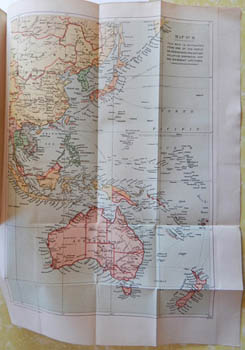
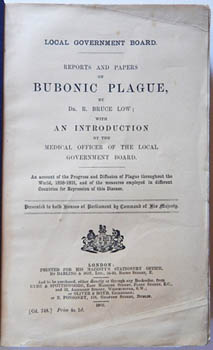
LOW, R. Bruce Reports and Papers on Bubonic Plague, ... progress and diffusion of plague throughout the world, 1898-1901 ... measures employed in different countries for repression of this disease. London, HMSO 1902. Quarto, modern wrapper with printed title; xii,466pp, ten colour maps, some folding, numerous tables. Title page with some creases. Au$250
Historians of the plague have been busy in recent years and in browsing a few of them it becomes clear that Low's report is essential. The best admit that Low is the only source for some aspects of the flurry of epidemics that rushed round the world and the less than best copied Low wholesale only pausing to point out where they think he was wrong.
Australians can congratulate themselves that they weren't the only people to immediately fly into a yellow peril panic and blame the whole thing on the Chinese or some other coloured race. So did the South Africans and Americans in San Francisco and Honolulu. Elsewhere it was more pragmatic to deny that there was plague.

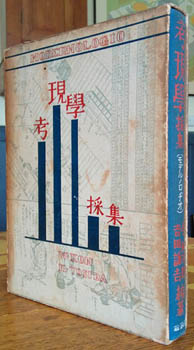
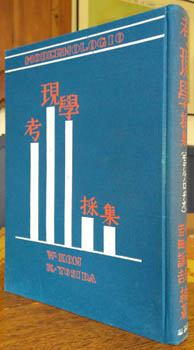
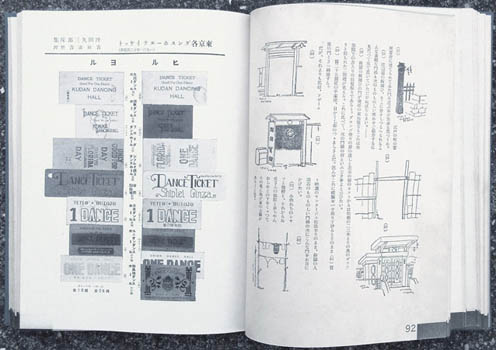
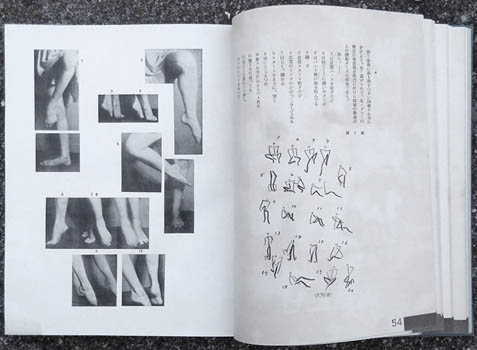
Kon Wajiro & Yoshida Kenkichi. 考現学採集 (モデルノロヂオ). [Kogengaku Saishu (Moderunorojio)]. Tokyo, Shun'yudo 1931 (Showa 6). Quarto publisher's cloth blocked in red and white, rather browned but solid illustrated slipcase; [2],323pp, photo illustrations, hundreds of line drawings and diagrams (one with colours added), endpaper map. Au$750
First edition of the companion to the 'Modernologio' of the previous year - together they are the gospel of Modernology. Kon and Yoshida here collect data to extend their extraordinary encyclopaedia of the people of modern Tokyo. Their thesis was that those who do the planning, designing and building know nothing of what people actually do, what they own and how they use those things - how they live and who they are. I can't imagine anything you might ever think about and a lot you would never think about that isn't collected here. How you walk, where you walk, what you carry, how you carry it, where you dance, how you dance, how you sit, where your shelves are and what's on them, in your cupboards ...

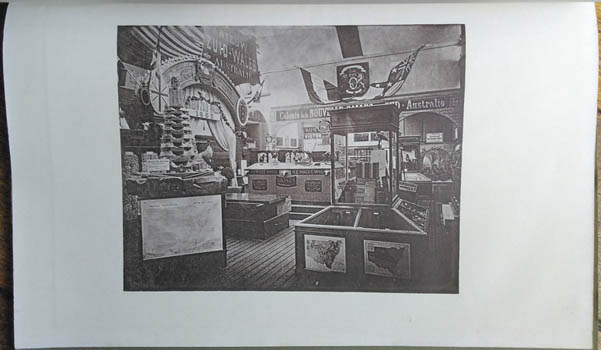
Exhibition - Amsterdam 1883. Report of the Executive Secretary on the Amsterdam International Exhibition, 1883. Sydney, Govt Printer 1884. Foolscap modern wrapper; 53p, four photo plates and a folding colour plan. Some browning. Au$200
Amsterdam seems pretty much forgotten among the cavalcade of international exhibitions thronging the later 19th century. Even the Smithsonian collection - recorded in Books of the Fairs - has a scant gathering. This is a useful report on the fair, on everything New South Wales sent and how they fared. More than once Bonnard, who wrote the report, remarks on how carelessly some exhibitors packed their goods. These arrived unfit for display.

Specimen Hikifuda. 萬領乾物砂糖石油? [Yorozu to Kanbutsu Sato Sekiyu ...] n.p. [c1900?]. Colour woodcut 26x38cm. Rumpled with a couple of small repairs to the edges; quite decent. Stab holes in the right margin showing it was once in an album. Au$200
A bustling handsome print produced for merchants of imported goods. These hikifuda - small posters or handbills - were usually produced with the text panel blank. The customer had their own details over printed. In some cases, like this, samples were were produced with generic text to show the finished product.

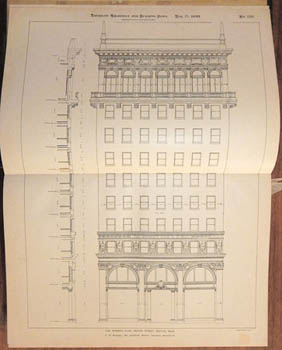
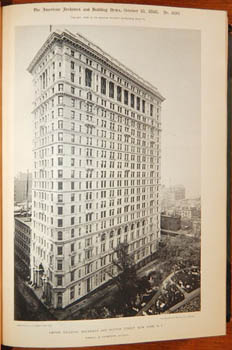
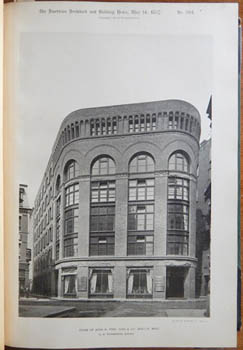
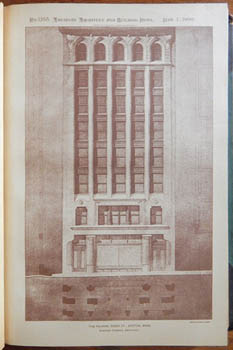
Architecture. Office Buildings [cover title]. A compilation of plates from the American Architect & Building News and some from the Architectural Review. n.p. [1885-1901]. Folio (34x24cm) contemporary half morocco (scuffed, front hinge cracking but solid enough); 146 plates mounted on stubs, some double page, a couple colour. Au$1500
A marvellous collection of high class plates from high class journals of new and planned buildings at the time America was busy inventing the modern city. The first plate is an 1899 elevation of the Boston Woman's Club designed by pioneer woman architect Josephine Wright Chapman in collaboration with her former boss, Charles Blackall. This was never built but the Worcester Woman's Club designed a couple of years later by Chapman is a truncated, refined version.
I'm near convinced this is a publisher's or bookseller's compilation, particularly since these are Boston plates in a Boston binding by Holzer. These plates were never disinterred from some pile of magazines. Plates could be bought singly or by subject from good journals, and publishers and proper booksellers offered compilations to order. What is special here is the office. I've never seen another like this and a run through the illustration lists of the journals through this period show that office buildings - despite transforming cities - were under represented compared with things like churches and country houses.

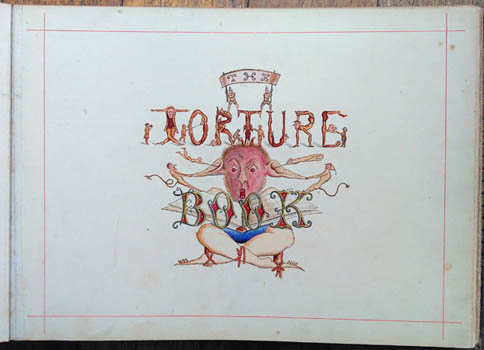
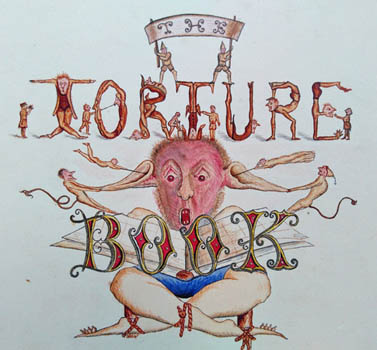
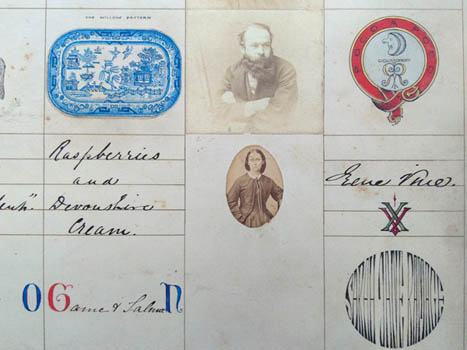
John Ramage. The Torture Book. n.p. [c1880?]. Oblong folio, 28x39cm, morocco album decorated and titled in gilt (a bit worn at the base of the spine, sometime recased); 29 heavy card leaves, with a handpainted title page; printed forms of which 21 pages have been filled in with ink, pencil and watercolour. Minor signs of use, smudges and browning. Loosely inserted a two page note by Mrs D. Ibbetson written in 1962 explaining that album was made by her grandfather - London bookbinder John Ramage - and filled in by members of the family. Au$900
An elaborate hunk of Victorian whimsy that was embraced with enthusiasm and diligence by all that tackled it. I suspect that - even given that every educated gentleman and lady of Britain was handy with a pen and pencil - one didn't touch this album without confidence and plenty of spare time. Mrs Ibbetson wrote that her father could never be persuaded to make an entry. Each double page opening is ruled out so that contributors could write or draw their favourite motto, quality, hero, writers, food ... their least favourite quality and persons in history.
Ramage was a binder to the gentry, among the handful of high class London binders of the second half of the 19th century. Talking about the difficulties of book collectors - "no harder people to please" - in The British Bookmaker, Ramage said that if he was asked to trim a book he saved and labelled the shavings so that disputes about over-trimming would not get out of hand. Ramage did the title page and the entry with the blue willow plate.

Catalogue - hearses. Merts & Riddle, Ravenna, Ohio. Merts & Riddle, Coach and Hearse Builders. Ravenna, printed by S.D. Harris [188-?]. Oblong octavo publisher's illustrated wrapper; 50pp, full page wood engraved illustrations throughout. A remarkably good copy. Au$250
Ravenna was clearly a hearse town in the later 19th and early 20th centuries. Merts and Riddle bought their employer's coach building company in 1861 and expanded into hearses a decade or so later. When Merts left in 1891 the company became Riddle Coach & Hearse Co. This is the earliest catalogue - dated "1880 or so" - in the collection of Thomas Riddle, descendant and company historian. The catalogues at the Huntington with a conjectured date of 1875 aren't. Romaine did not see any Merts & Riddle catalogues.

Catalogue - Circus wagons. Beggs Wagon Co. Kansas City, Mo. Beggs Wagon Co. Manufacturers of Circus Wagons, Band Wagons, Ticket Wagons, Cages, Calliopes, Racing Chariots ... Kansas City, Mo [c1910]. 14x20cm publisher's illustrated wrapper; 16pp, illustrated throughout. Insignificant signs of use. Signed on the back by J.W. Begg. Au$600
Fabulous and rare. I didn't know there was such a thing as a circus wagon catalogue until I saw this. There was a reprint of this done in the seventies but I can't find another copy of the original anywhere. Beggs started in the wagon business in 1875, expanded into show business around the time of this catalogue then turned to automobiles which took them into the twenties but no further.

[ERSKINE, Thomas]. Armata. A fragment. [with] The Second Part of Armata. London, John Murray 1817. Two volumes octavo, together in 19th century half calf, spine elaborately gilded. A bit of browning, a handsome pleasing copy. Au$750
Second editions of both parts. This now obscure Antarctic imaginary voyage to another world connected to ours at the south pole might have been popular, in a mild and genteel way: there were supposedly five editions of the first part in 1817 and the second part likewise reached five editions by 1819. It is possible they were manufactured as part of Erskine’s joke in the preface of part two that histories such as this were doomed to obscurity whereas if he called it a romance it was guaranteed two editions at least by the lending libraries alone. While the first and second edition of the first part are different settings, the second and fourth editions are from the same setting. The first and second editions of part two are from the same setting, as is the fourth edition up until signature K which is where Erskine added some footnotes.
Erskine's Armata is dystopian in intent but he is too polite and good natured to go overboard about it and although a couple of hundred or so sailors, from earth and from Armata, are obliterated at each end of the book they are dispatched in a sentence each. Even the narrator's beloved Morvina, who is literally killed by her induction into society, is done to death in a quiet half page, the narrator apologetic for being tactless enough to mention it. But, skimming past the legal religious stuff - I couldn't follow the outrageous fraud the clergy put over the government and justice system - there are some delightful scenes of bone crunching mayhem once Armata society sets off for an evening out.
Erskine, also now obscure, was once described as the "greatest advocate as well as the first forensic orator who ever appeared in any age" (James High as quoted in Patterson's 'Nobody's Perfect'). He remained all his life a fierce defender of freedom of speech and the liberty of the press with one startling lapse: after defending Thomas Paine at the cost of his own position he prosecuted a bookseller for distributing Paine's writing. Apparently he later returned the retainer in remorse but he remained open to accusations of self interest in that case.

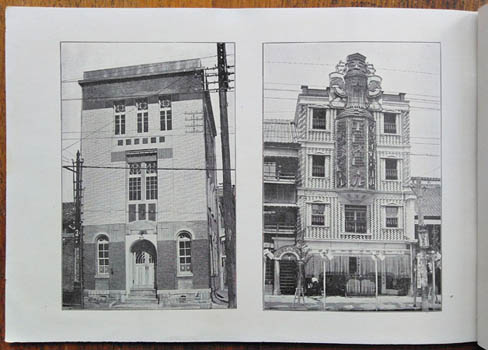
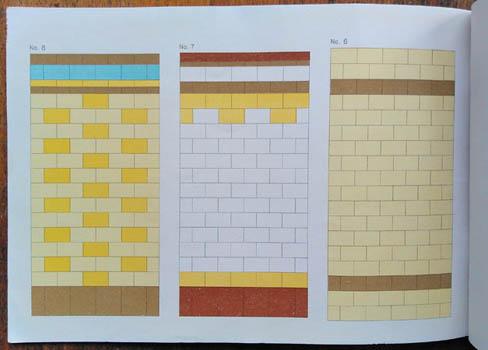
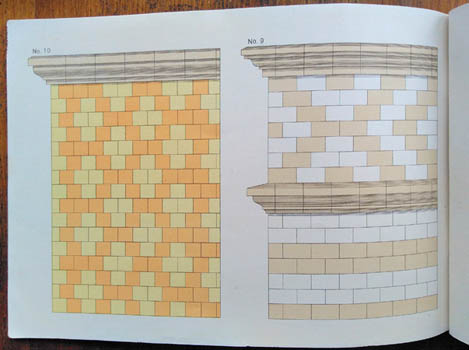
Catalogue - tiles. 拍木式 . ウォール板 . エムアイ商會 [Haku ki-shiki - Uoruban - MI Shokai?]. Tokyo 1914 (Taisho 3). 15x23cm publisher's decorated wrapper; 12 leaves printed on one side being three pages of text, two photo illustrations, a small colour chart and 18 colour designs on eight leaves, plate of cornice profiles. A nice copy. Au$175
A nifty catalogue of architectural ceramics - tiles, mouldings and cornices - for building exteriors produced by, I think, a manufacturing co-operative.

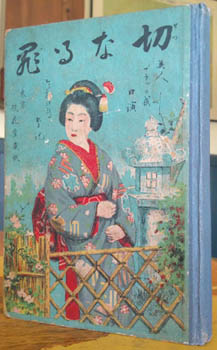
Henry James Black. (Burakku Kairakutei). 切なる罪 [Setsunaru Tsumi]. Tokyo, Ginkado 1891 (Meiji 24). 19x13cm publisher's cloth backed colour illustrated boards (mildly rubbed and worn at edges); one single page (I think a portrait of Black) and 15 double page illustrations three of which are in the text and repeated as frontispieces. Apparently reglued into its cover at some time. Signs of use but quite a good copy. Au$2600
First edition of this detective story told as a serial to an audience by a gay Australian who became a professional Japanese story teller and actor, taken down in shorthand and published as this book.
Black was born in Adelaide and arrived in Japan in 1865 at the age of almost seven - his father, up until now a singer, had bought into the Japan Herald. Henry seems to have grown into something of a no-hoper in the eyes of some of his family at least and rather than settle to respectable work became first a proponent of progressive reform, like his father, then a professional rakugoka - story teller - and even a kabuki actor playing women. His reaction to his siblings' disapproval was to change his name to Burakku Kairakutei (Pleasure Black), marry a Japanese woman and become a Japanese citizen.
Ian McArthur, Black's biographer, quotes from a police report made at this time that he was living in "virtually a husband and wife relationship" with a young Japanese man but otherwise there was nothing untoward to worry about. At the height of his fame - 1891 and 92 - maybe six or seven of these stenographic novels were published and other stories appeared in newspapers. It's a bit hard to unravel as a couple appeared more than once with different titles. Even the concise and acerbic Edogawa Rampo gets muddled and misled trying to work out a bibliography at the end of his 1951 essay translated as 'Fingerprint Novels of the Meiji Era'. This handful of detective stories or thrillers was bracketed by two translations or adaptations of novels: Mrs Braddon's Flower and Weed in 1886 and Dickens' Oliver Twist in 1895. Of the thrillers from these two boom years, two are known to be adapted from stories by Mrs Braddon and one from a story by Fortune du Boisgobey.
Macarthur offered synopses of some of Black's works in his 2002 Phd. thesis - presumably those works he could find. For the rest he relied on second hand information. The account of this book - which has no known antecedent - is brief and confusing but probably no more confusing than any murder mystery of the period. For now we need only know that it involves a double love triangle - or maybe a square - and that the murder weapon is powdered glass.
The illustrations might baffle anyone expecting the characters to be in England where the story is set but Black made it a point to give his characters Japanese names and to digress with explanations of strange customs and laws for his audience. These stenographic books - sokkibon - were hugely popular, distributed largely through lending libraries and have a pitiful survival rate. They are credited with playing a large part in transforming Japanese literature from the classical and formal to colloquial.
This is also a 'ball cover' (boru hyoshi) book - a symbol of modernity and the Japanese equivalent of a yellowback: flimsy western style bindings with lithograph covers that rarely survive in decent shape. The comparative plethora of pictures and the good quality paper indicate the publishers thought this was better than the usual run of the mill thriller. Worldcat finds no copy of this outside Japan.

Catalogue - bicycles. Leonard Gundle Motor Co. Carrier Cycles [cover title]. Birmingham [c1936]. 15x23cm publisher's printed wrapper with split pins; 29 illustrated sheets printed on one side, numbered to 25 with a couple of gaps and some bis and clearly complete. Rather good in a ragged but complete printed envelope postmarked February 1936 and addressed to a Birmingham recipient. Au$100
Working bikes for the most part - milk floats and ice cream carts are the most elaborate - with carriers and fittings for all trades needing to shift things with pedal power.

Fujiwara Ritsuta. 空界征服双六 [Sorakai Seifuku Sugoroku]. Tokyo, Shonen 1918 (Taisho 7). Colour broadside 79x55cm. A nice copy. Au$600
A delight - the rigours of flying school explained with the careful attention to truth and detail of a Heath Robinson. This was the new year gift from the magazine Shonen.

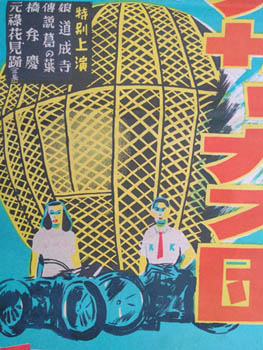
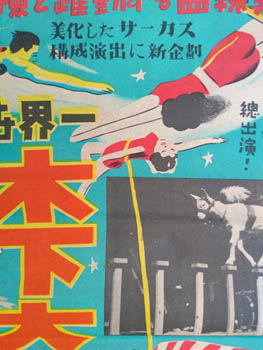
Kinoshita Circus. 木下大サーカス団 [Kinoshita Dai Sakasu Dan]. n.p. [194-?]. Colour lithograph poster 76x52cm. Au$300
The advertising tax stamp - lower right - dates this between 1942 and 1946; so I'm told. As does the replacement of lions and elephants with a goat. The Kinoshita circus started with the 20th century and is now one of the world's biggest.

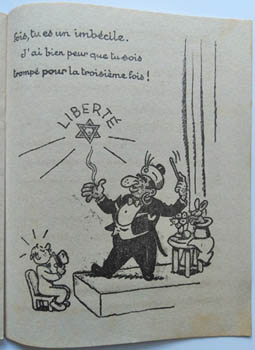
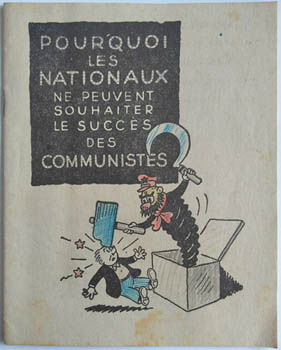
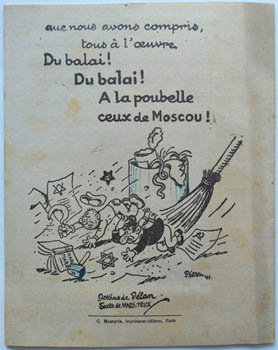
Anti-Semitic anti-communism. 'Mars-Trick'. Pourquoi les Nationaux ne Peuvent Souhaiter le Succes des Communistes. Paris, printed by Mazeyrie [1941]. Octavo publisher's illustrated wrapper; 16pp including cover, cartoon illustrations throughout by "Pelan". Cover and a couple of illustrations neatly enhanced with some color shading. Au$125
I learn from this that the real danger to France - to us all, I guess - from communism is not so much traitorous red thugs, nor even the masons, but the hideous Jews (juif hideux) pulling their strings. There is not a mention of Germany here but a call for Europe at peace; do not listen to hypocritical English radio and the Gaullistes. Remember who is behind them.

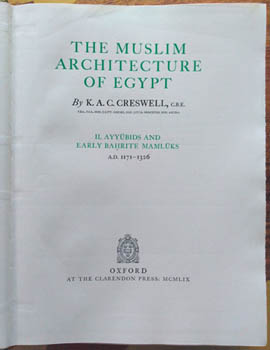
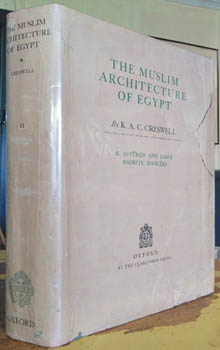
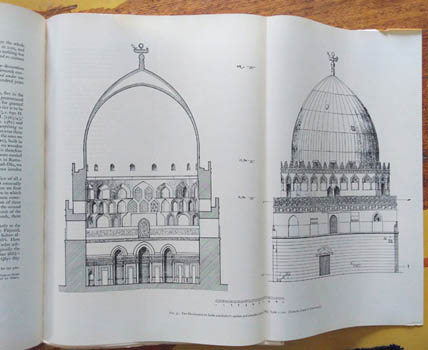
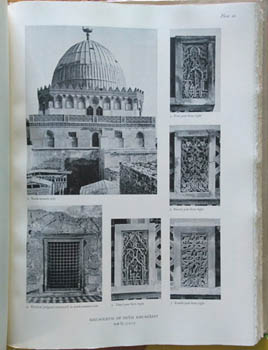
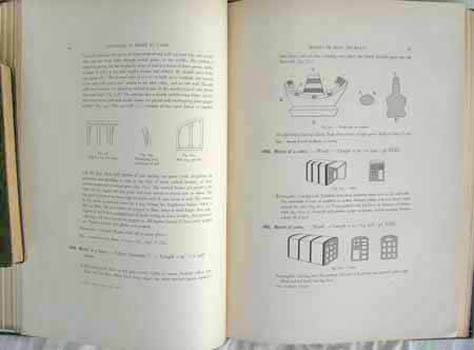
CRESWELL, K.A.C. The Muslim Architecture of Egypt. II: Ayyubids and Early Bahrite Mamluks A.D. 1171 - 1326. Oxford Univ Press, 1959. Hefty folio (46x36cm) publisher's cloth and torn but complete dustwrapper; photo plates, floor plans and elevations (some folding). A rather good copy. Edition of 550 copies. Au$1500
Creswell managed to finish four volumes of his lifetime work, recording the Islamic architecture of Egypt. The earliest period was covered in his two volume Early Muslim Architecture (1932-40, with a revised edition of volume I in 1969 - a new work in itself really); the next couple of hundred years in Muslim Architecture of Egypt I (1952); and this.
In volume 8 of the annual Muqarnas (1991), which is devoted to Creswell, there is a photo of an elderly Creswell carrying two volumes of his work - this and the 1952 volume - plus a copy of his bibliography. This is as much a rooster-like display of strength and vigour as a boast of scholarly achievement. After all, no-one less than Olympian could carry all his books. In the same annual is a review by Julian Raby of the reviewers of Creswell. At times I thought I was reading a Beerbohm parody with added footnotes by Flann O'Brien.

REISNER, G.A. [George Andrew]. Models of Ships and Boats. Cairo, Institut Francaise d'Archeologie 1913. Largish quarto later quarter cloth with the front wrapper mounted; xxviii,171pp, 33 photo plates, 389 illustrations through the text. A rather good copy. Catalogue General des Antiquites Egyptiennes du Musee du Caire 4798-4976 et 5034-5200. Au$200
An exemplary study of the boat models found in Egyptian tombs, in turn the starting point in any investigation into the design and construction of real boats and ships in ancient Egypt. Reisner was at the forefront of the new generation of American archeologists. According to the Dictionary of Art Historians he "devised his own method of documentation, more elaborate than that of Sir Flinders Petrie [and] his method became the most methodical used in Egyptian excavations". He "died, almost idyllically, in his sleep at the Giza site, in the shadow of the great Pyramid" in 1942.

Richard Burton. PENZLER, Norman M. An Annotated Bibliography of Sir Richard Francis Burton. London, Philpot 1923. Large octavo publisher's cloth (marked); 351pp, 24 plates. Au$200
Edition of 500 copies, signed by Penzler.

Nakazawa Hiromitsu, Kobayashi Shokichi & Okano Sakae. 東洋未来雙六 [Toyo Mirai Sugoroku]. Tokyo, Hakubunkan 1907 (Meiji 40). Colour printed broadside, 55x78cm. Minor flaws and signs of use, some ink splodges on the back. Au$650
A view, or a panoply of views, of a future Asia. Some of these vignettes of what's to come are obvious enough - schoolgirls at rifle drill and sumo wrestlers in striped bathers - but a few seem fairly recondite to me. I'm not sure how much is optimistic, how much is dire warning and how much is wearily stoic.
Nakazawa, Kobayashi and Okano, still young, had been fellow students at the Tokyo School of Fine Arts, and of Kuroda Seiki, and collaborated on the five volume Nihon Meisho Shasei Kiko, issued over several years.

Catalogue - musical instruments. Beare & Son. London. Beare & Son 1927 Nett Wholesale Export Catalogue. London, Beare 1927. Quarto old binders cloth (rubbed); 162pp, illustrated throughout including 10 colour plates of violins. Library marks inside front cover, used but solid and decent. Au$200
Beare & Son still exist as dealers in stringed instruments but in their heyday - like 1927 - they flooded the dominions with low to medium price instruments of every kind. Many were made for Beare under various house brands or their own, so for those wondering about that ancient Francois Barzoni violin this catalogue will tell you that it was made for Beare by some anonymous maker in the 1920s. Their range covers accordeons to zither banjos, fittings and accessories and includes quite a few jazz instruments.

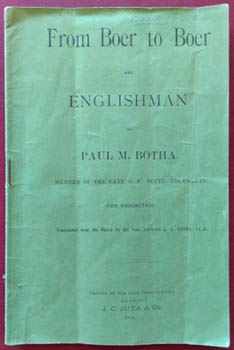
BOTHA, Paul M. From Boer to Boer to Englishman. Captetown, Juta 1900. Octavo publisher's printed wrapper; 30,[2]pp. Vertical folds (rather than creases) - this looks exactly like it was rolled up and put in a pocket and flattened a bit. Still not a bad copy. Au$50
Published in Dutch and in English - translated by Botha's son C.L. - at the same time. This has the pencil inscription "Boyes c/ [W.A.F?]" on the front cover. Since it turned up in Tasmania I think it's more likely this belonged to Alexander Boyes of the Second Tasmanian Bushmen than to the British General Boyes of the 17th Brigade. Alexander Boyes was later owner of Clarendon, described by the National Trust as Australia’s grandest rural colonial estate.

HILBERT, D. and W. ACKERMANN. Grunzuge der Theoretischen Logik. Berlin, Springer 1928. Octavo publisher's yellow cloth blocked in black. A rather good copy. Au$50
First edition.

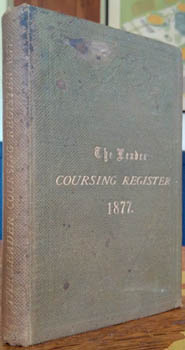
Greyhounds. The Leader Coursing Register for Season 1877 ... all coursing meetings held in Victoria, New South Wales, South Australia and New Zealand ... pedigrees ... compiled by "Cumloden". Melbourne, The Leader Office 1877. Octavo publisher's cloth; xx,198 and 16 pages of adverts. Cloth a bit faded and marked but a good copy, fresh inside. Au$90
The first and apparently only annual.

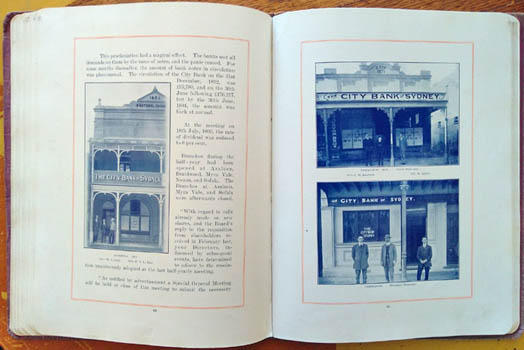
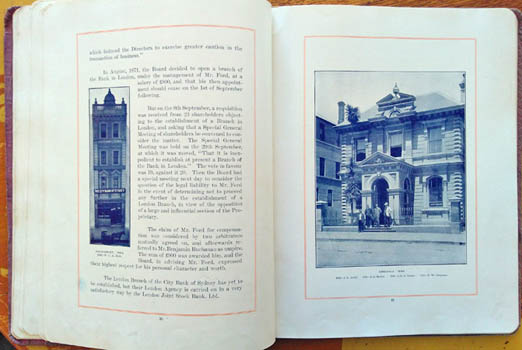
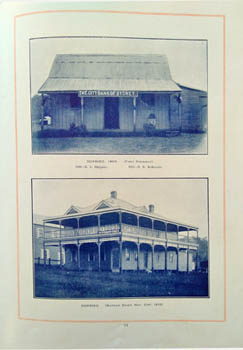
City Bank of Sydney. Jubilee Souvenir - the City Bank of Sydney 1863 - 1913. Sydney, Websdale, Shoosmith 1913. Quarto publisher's crocodile cloth (faded, spine top a little worn); 94pp, numerous illustrations. Mild signs of use, pretty good. Au$250
The City Bank of Sydney did not live - in name at least - much beyond their jubilee. In 1916 it was absorbed by the Australian Bank of Commerce. Despite the name the city bank had regional branches all over the state. Grand or humble depending on town and the times, these are illustrated.

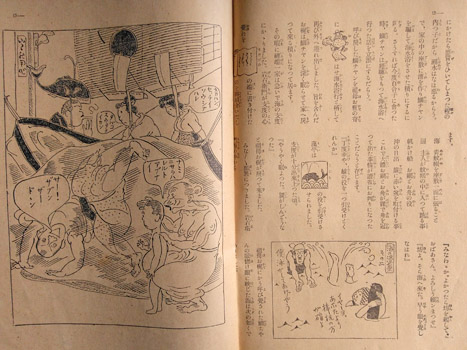
Okamoto Ippei. 山と海 [Yama to Umi] (Mountain & Sea). Osaka, Asahi Shimbun 1926 [Taisho 15]. Quarto publisher's colour illustrated wrapper; 40pp, b/w illustrations throughout. Natural browning of the paper; a rather good copy. Au$100
A comic commentary on the Japanese out and about on holiday and I suspect many other things beyond me. There is a cast of recurring characters and it's evident from the cover that class wars are at play - there is a drawing inside of a plutocrat mugging a beggar - but there's a lot going on in these busy pages that are fun to look at but incomprehensible to me.
Ippei, radical and scallywag, was the king of newspaper cartooning as Rakuten ruled the magazines in Taisho and early Showa Japan. It was Ippei that brought the American comic strip to Japan and he heads, with Rakuten, the lists of idols and inspiration of many modern manga artists.
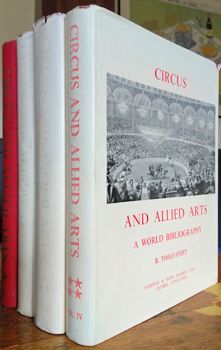
TOOLE-STOTT, R. Circus and Allied Arts. A World Bibliography 1500 - 1970. Derby, Harper & Sons 1958-71. Four volumes quarto publisher's cloth, dustwrappers on three. Minor blemishes: fading here, a few spots there ... Au$200
Apparently dustwrappers for volume one ran out long before the set was finished. I figure, having nothing better to do, the published price - £32 - was about two weeks wages for me in 1971. Today it would be ... about two weeks wages.

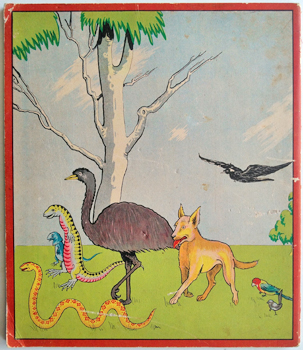
[STEELE, John V]. The Bush Pets' Party. n.p. [c1938-39]. Largish quarto (320x270mm); eight leaves stiff card, all printed in colour. A little used, quite good. Au$85
Four of these large colourful cardboard books, three illustrated by John V. Steele, are known. This is one of three socially acceptable these days, they are about bush animals. The other is an Australian version of Ten Little Niggers.
Having them printed in Japan and saying so on the front cover maybe wasn't great timing. Of the surviving handful of copies known, of all four, a high percentage are missing their front covers. Presumably the rest of the copies went straight into the fire or paper drive bins after Pearl Harbour and Singapore.

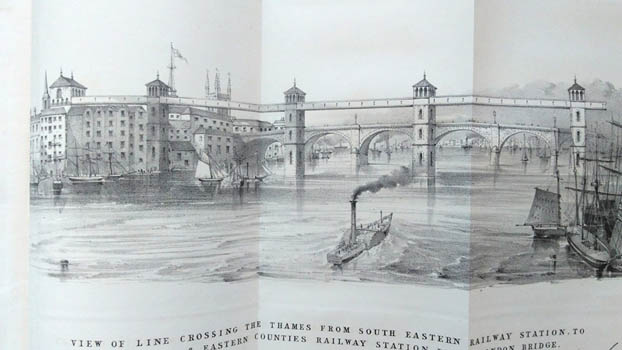
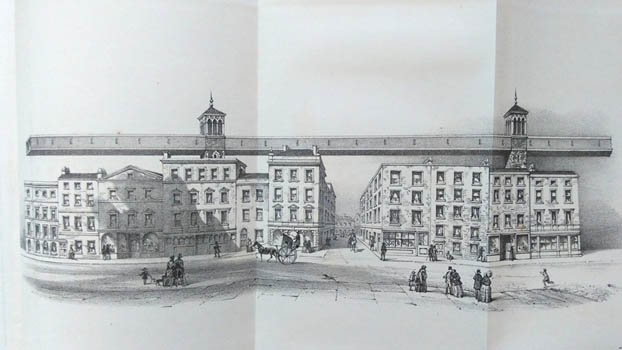
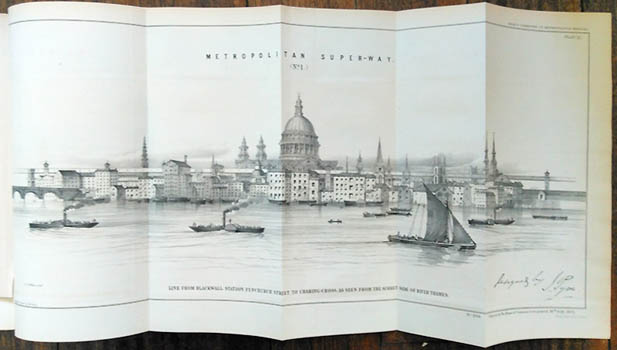
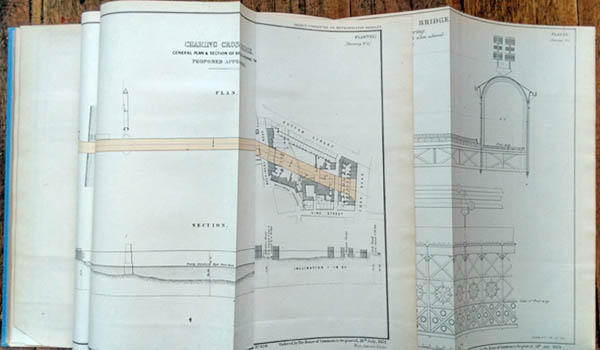
Report From the Select Committee on Metropolitan Bridges; together with proceedings of the committee. London, ordered to be printed 1854. Foolscap modern cloth backed boards, printed label; xii,xii,195pp and 11 plans, views and elevations (10 folding). Au$800
London struggling with a population doubled in forty years, the railway boom and a goldrush of schemes and proposals by do-gooders, busybodies and chancers made for committee after committee looking at any number of plans, some dull some fabulous. The dull stuff, like tolls, is easy to recognise and skip. The main contender here is pretty damn good: John Pym's Super-Way, an elevated tube that looks something like the Britannia Tubular Bridge and spanned London high above the buildings. Brunel was called in for advice on opening his still unfinished Thames Tunnel for heavy traffic and titans like Rennie were asked to report on the condition and capability of existing bridges for heavy traffic.

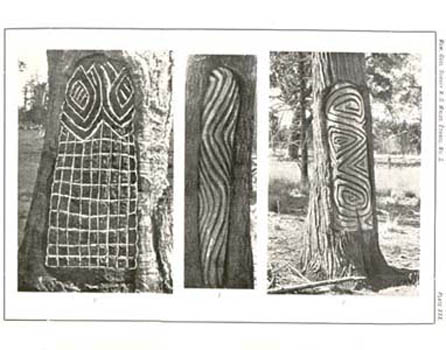
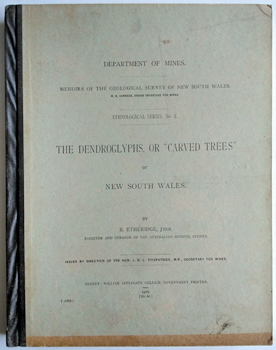
ETHERIDGE, R. The Dendroglyphs, or "Carved Trees" of New South Wales. Sydney, Govt Printer 1918. Quarto publisher's cloth backed printed boards; viii,104pp, frontispiece & numerous illustrations & photos on 29 plates, the last a folding map. A corner a bit bumped, minor browning, rather good. Mem. Geol. Surv. NSW. Ethnological Series, No.3. Au$750
Still the essential work and now quite hard to find. Etheridge was convinced that "at no distant date dendroglyphs will have ceased to exist," as was E.S. Hartland in his review of this book: "In years to come it will remain as the only record of these efforts of native art, beyond the few specimens preserved in museums" (Folklore; v31p4). Indeed some of the specimens here were already in museums.
While it is true that further examples have been discovered much of what is recorded here has perished and, so I was told by a central west grazier a few years ago, the average property owner who found carved trees on their land days would often destroy them as quickly as possible before word got out, the authorities moved in and they lost control of their land.

Homoeopathy. The Medical Telephone: containing hints on the preservation of health. Notes on nursing ... Plain directions for treating diseases. Ambulance lectures ... Hobart, The Homoeopathic Pharmacy 1883. Small octavo publisher's flushcut printed limp cloth (a hint of flecking); 116pp, a fair amount are advertisements. An excellent copy. Au$165
A neat little book with a neat title. When I first came across a copy of this, many years ago, I wondered whether there were any telephones in Hobart in 1883 but now, with online research, I find that Tasmania embraced the telephone early and 1883 saw telephone exchanges opened in Hobart and Launceston. In fact, according to Tourism Tasmania, Australia's first phone call was a long distance call made in Tasmania two years before Bell got his telephone working. A remarkable bit of neglected history.
This was a rare book for a long time; Ferguson missed it though it fitted his specifications for inclusion and Ford cited three copies, all in Tasmania. Then it became temporarily unscarce when a small cache of copies was discovered some years ago but now it's on its way back up the scarcity scale.

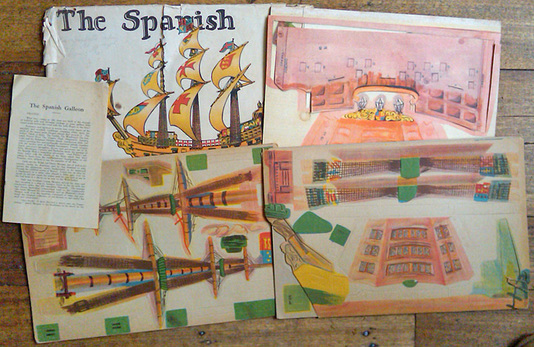
Paper Toy. John Sands, Sydney. The Spanish Galleon. Sydney, Sands [194-?]. Colour printed perforated card sheets in a ragged but essentially complete colour printed envelope (27x40cm); with 16pp octavo leaflet including instructions. Au$125
War time production by the look of it. Designed and produced by Sands for lovers of things piratic and pretty complicated - 97 pieces according to the instructions. I can't find any record of another copy.

McGLOIN, Frank. Norodom, King of Cambodia. A romance of the east. NY, Appleton 1882. Octavo publisher's decorated ochre cloth blocked in black and gilt. A nice bright copy. Au$175
Only edition of this Asian fantasia, surely an early entrant into modern Cambodian fiction. Lots of warfare, sorcery, demons, and a final great explosion that blasts Norodom and his wicked consort Almeta to the moon means that this should be in the bibliographies of fantastic literature but most seem to have missed it. It's an odd excursion for McGloin whose habitual topics were law and religion in Louisiana.

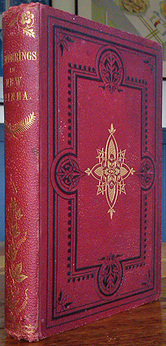
LAWSON, Captain J.A. Wanderings in New Guinea. London, Chapman & Hall 1875. Octavo very good in a commercial red cloth prize binding decorated in gilt and black; tinted litho frontispiece and a folding map. A bright copy, interesting as an example of the school prize industry. This has a large colourful prize plate - dated 1883 - inside the front cover printed by the London Scholastic Co. who may well have been one of the companies that made their business buying up unsold sheets of books and preparing them for prizes. In this case the binding is attractive enough, if anodyne, and the edges, untrimmed when originally issued by the publishers, have been trimmed and gilded all round. Au$300
Only edition. Like many of the best travel books, completely - from this distance ridiculously - imaginary. It sparked a fair few tight-lipped letters to the editor from both sides of the fact-fiction divide. Even Moresby, in the appendix to his book, printed a long and detailed letter to the Athenaeum refuting many claims made by Lawson. Given the furor it is surprising that not only did the book never reach a second edition but sheets were sold off as remainders. This may say something about embarrassment at Chapman and Hall.
The authorship of this has occupied generations of bibliographers; it has been ascribed to Lieut. Robert Henry Armit - plausible until we consider the other books associated with Lawson - and Ingleton advanced the cause of Lieut. Dawson who accompanied Moresby to New Guinea and wrote this as an act of revenge, though how it's vengeful is not clear. Captain Lawson was the author of at least one more book - The Wandering Naturalists (1880) - where he also claimed authorship of Travel and Sport in Burmah which seems to be the book that appeared as written by John Bradley in 1876. The Library of Congress links the two authors, confidently gives Lawson the christian name John and suggests that Bradley is the pseudonym. Carrying on we find that Travel and Sport in Burmah has been attributed to James Anthony Lawson by Cushing and to Captain John A. Lawson by Kirk. Here is where I'm ready to give up.

FORCE, Roland W. & Maryanne. The Fuller Collection of Pacific Artifacts. NY, Praeger 1971. Quarto publisher's cloth; 360pp, hundreds of photo illustrations. Loosely inserted is an article on the ethnographic forger and thief James Little. Au$150
The dedication copy inscribed by Roland Force to "Estelle Fuller with enduring gratitude". Fuller's collection went to the Field Museum in 1958 and by the time this book appeared Fuller himself was a decade dead.
I suppose Estelle Cleverly knew what she was getting herself into when Alfred Fuller "proposed to his wife beside his favorite object in the British Museum". But you wonder how she felt when he "cut their honeymoon short to attend an ethnographic auction" and then "every day from noon until three o’clock in the morning, Fuller arranged and rearranged his items" (from notes about Fuller on the Field Museum site). Was he so anxious to find a permanent home for his collection to save it from the well known 'widow's revenge' that often sees a husband's first love go into the bonfire?

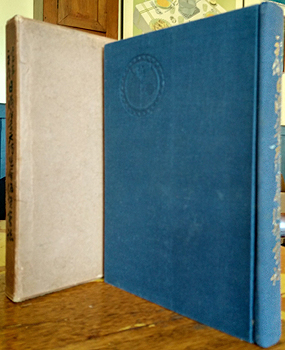
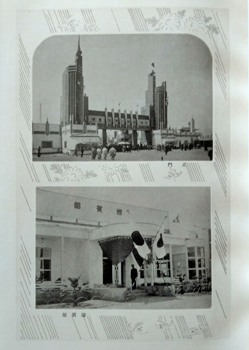
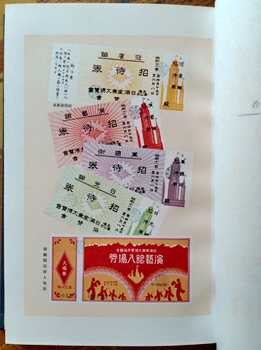
Exhibition - Toyama 1936. 富山市主催日満産業大博覧会協賛会誌 [Toyamashi Shusai Nichiman Sangyo Daihakurankai Kyosankai Shi]. Toyama 1938 (Showa 13). 23x16cm publisher's cloth and card box; numerous photo illustrations, colour plates, folding plans and elevations. A nice copy. Au$650
The official report on the 1936 Japan-Manchuria Great Industrial Exhibition. Though blighted with too many portraits of personages, this is still an excellent record of thirties Japanese expo architecture and design with coloured pictures of posters, advertising, tickets and so on, plans and elevations of buildings, lighting, and photo views. There is also the obligatory Hatsusaburo colour folding birds-eye panorama.
Worldcat finds two copies outside Japan, both in California.

HANDS, Joseph. Beauty, and the Laws Governing its Development; with suggestions on education, relative to the attainment of beauty. London, E.W. Allen [1882?]. Slender octavo, very good in publisher's decorated ochre cloth blocked in black and gilt; 88pp. Au$475
Only edition and elusive, just like describing Hands' writings in a simple and clear way. Hands was a London physician cum homeopath, apparently still respectable - viz his membership of the Royal College of Surgeons presuming his claim is true - and wrote works best, or most easily, described as thoroughly Victorian lunatic fringe: on will-ability and mind-energy, on the laws of matter and motion, and here, on aesthetics.
Hands begins with seven aphorisms, one of which was Hogarth's, all sensible enough; the last is quite noble. But from there he leaps from the ideal human form (5'10" tall for man; 5'6'' for woman) to electro-polar action to colour to the lapse of time like an ibex in the high alps and following him leaves us breathless and bewildered.

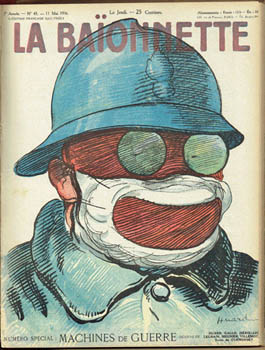
Iribe &c. La Baionnette. Volume 4. Nouvelle Serie. No.40 [... to No.52]. Paris, April to June 1916. Thirteen issues, quarto together in publisher's illustrated boards (knocked and rubbed); illustrated throughout in colour (some double page) and b/w, all covers preserved. Au$100
Each number of La Baionnette, successor to L'Assiette au Beurre, is a special number with one theme. Number 41 is Iribe's Danse Macabre, 42 is devoted to war time fashion, 45 to machines of war, 51 ('Les Pirates') to the U-boats ... Almost a surfeit of savage feats of satire by Iribe, Sem, Wegener, Capiello ...

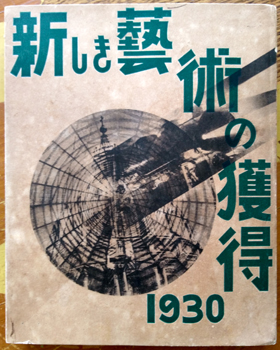
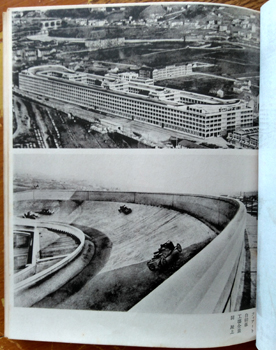
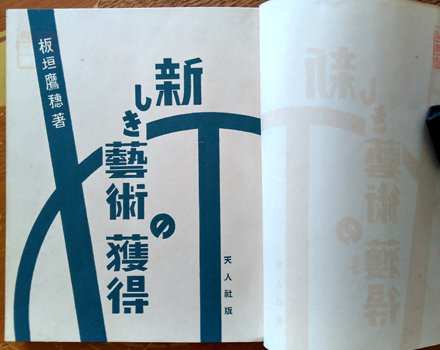
Itagaki Takao. 新しき芸術の獲得 [Atarashiki Geijutsu no Kakutoku]. Tokyo, Tenjinsha 1930. 10x15cm publisher's illustrated wrapper and printed card case; 10,246pp including photo illustrations on 16 plates. Some browning and minor signs of use; quite good. Au$750
First edition of this essay on the machine and new architecture and design, by the champion of modernism in Japan. This was a theme Itagaki pursued through a few books between 1929 and 1933.

PORNY, Mark Anthony. The Elements of Heraldry. Containing, a clear definition, and concise historical account of that ancient, useful, and entertaining science ... annexed a dictionary of the technical terms made use of in heraldry. London, Printed for J.Newbery, 1765. Octavo contemporary speckled calf (rebacked, corners worn); xx,199,[4]pp, engraved frontispiece and 23 plates. Some spotting or browning but nothing serious. A charming copy with twelve plates neatly and correctly handcoloured. Au$125
First edition, at least four more appeared over the next few decades.

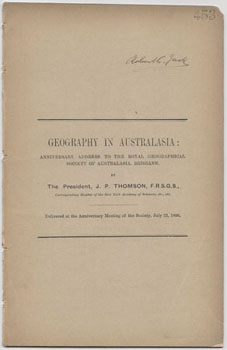
THOMSON, J.P. Geography in Australia. Anniversary address to the Royal Geographical Society of Australasia, Brisbane. Offprint from the Proceedings and Transactions Vol XI, 1896. Octavo publisher's printed wrapper (extracted from a binding); 21pp. A nick from the top corner. Robert Logan Jack's copy with his signature. Au$45

MacDONALD, Rev. J. Middleton. Thunderbolt. An Australian Story. London, Hurst and Blackett [1894]. Octavo publisher's dark green cloth. A rather good, bright copy. Au$225
Only edition of this thriller - a somewhat sticky novel mixing history into the bushranging thrills - in which we meet the chivalrous and dashing Thunderbolt and equally dashing Major in pursuit, the well bred but unspoilt young ladies, and the rough but true bushmen and diggers. Appended is a short glossary of Australianisms.

BROOKS, Detective James J. Whiskey Drips. A series of interesting sketches illustrating the operations of the whiskey thieves in their evasion of the law ... to which is added, a circumstantial account of his attempted murder by the Philadelphia Whiskey Ring ... the only authenticated instance of hired assassins in the United States. Philadelphia, Evans [1873]. Octavo publisher's decorated brown cloth blocked in gilt and black (spine tips worn); 349,[3]pp and four wood engraved plates. Inner front hinge cracked but firm. Au$120
First edition, it was reprinted or re-issued in 1876 with the duller title 'The Adventures of a United States Detective'. Quite uncommon, unlikely as it seems for this type of American book of this period. Usually there are plenty of shabby copies of such books around.
Unlike many of these true stories Detective Brooks did exist, he was famous for his Whiskey Ring exploits. He became head of the American Secret Service and died in 1895 of heart trouble - apparently exacerbated by having a bullet imbedded in it for 16 years. Whether or not he wrote this, it is pacy and readable and as much of his investigations involved corruption within the service as illicit distilling.

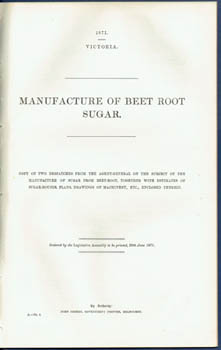
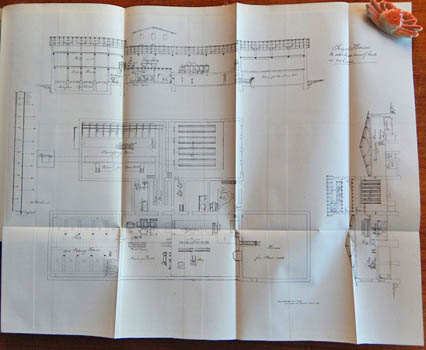
Sugar. Manufacture of Beet Root Sugar. Copy of two despatches from the Agent-General ... with estimates of sugar-houses, plans, drawings of machinery, etc. Melbourne, Govt Printer 1871. Foolscap, disbound in a modern plain wrapper; 15pp and eight litho plates (three folding). Au$165
The foundation of a sugar industry in Victoria, an attempt to match the rapidly burgeoning cane sugar industry of NSW and Queensland, was no great success. The Victorian Beetroot Sugar Company was registered in November, crops were planted near Geelong, a mill built nearby and plants built in Melbourne. By 1874 the mill was closed. The fault lay with the quantity and quality of crop and seems to have remained so in later attempts to create a southern sugar industry.
This report contains information gathered for the Warnambool Beet-root Sugar Manufactory giving plans and estimates of plants for works of two capacities. Pretty appealing and useful for the student of industrial architecture, manufactures and machinery. And sugar.

HUNTER, W.W. [William Wilson]. The Imperial Gazetteer of India. London, Trubner 1881. Nine volumes octavo contemporary half morocco (scuffed); each volume with a folding map mounted on linen. Parliamentary library gilt crest on spines and front boards, no other marking. Some wrinkling of paper in volume five but no staining, a bit of foxing, not much; in all a rather good and handsome set. Au$950
First edition of this monument of persistence. "For the first time in the history of our rule, an opportunity has fallen to me of finding out the truth about the Indian people, and of honestly telling it" (preface).

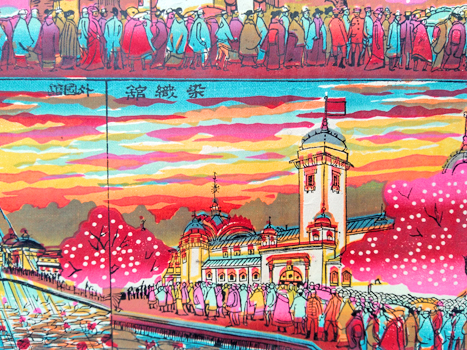
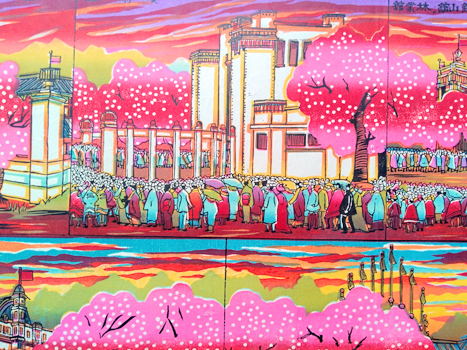
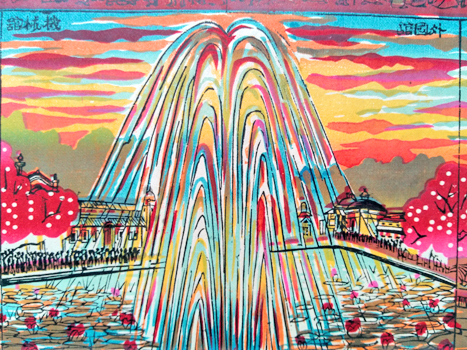
Exhibition - Tokyo 1914. 東京大正博覧会各館之光景 [Tokyo Taisho Hakurankai Kaku Kan no Kokei] Tokyo, Shobundo March 1914 (Taisho 3). Colour lithograph 39x55cm. A bit rumpled along the bottom edge with a couple of short tears in the margins. Rather good. Au$150
Fine views of the psychedelic Taisho exposition - to celebrate the enthronement of the emperor - held in Ueno Park, which introduced any number of technical advances to the Japanese, including an escalator and a cable car. Once the eyes stop watering these acid trip views of late Meiji and Taisho Japan start to make sense. They may have started as a cynical grab at attention for cheap, often nasty, prints but after a while they become a celebration of being in a place and time so exciting that no portrait can be too brightly, too impossibly, coloured.
Photographs may be in some way a more reliable record but no photographer could so capture the thrill of being out and about in Tokyo on a Taisho afternoon.

BEST, Elsdon. The Maori Canoe. An acount of various types of vessels used by the Maori of New Zealand in former times, with some description of those of the isles of the Pacific ... Wellington, Govt Printer 1925. Quarto contemporary cloth (lightly flecked) with the original printed wrapper mounted on the front board; vi,312pp, map, some 170 photo illustrations, line drawings and diagrams. Dominion Museum Bulletin No.7. Au$200
The definitive work, it isn't superceded by Haddon's 'Canoes of Oceania' but forms a good companion. Best covers everything from tree felling to decoration and investigates the history of Polynesian migration.

GLASGOW, Ellen. The Voice of the People. NY, Doubleday 1900. Octavo publisher's decorated tan cloth blocked in green. The front fly has a crease; a remarkably bright copy. Au$85
First edition. Class conflict in the south.

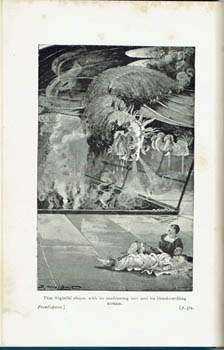
AUBREY, Frank [ie Francis Henry Atkins]. A Queen of Atlantis. A romance of the Caribbean Sea. Philadelphia, Lippincott 1900. Octavo publisher's gilt decorated blue cloth (light signs of use); eight plates by D. Murray Smith. A touch of browning at the very beginning; quite a good copy. Au$185
First American edition, using the London sheets. Most desirable, all the expected thrills of an Atlantean thriller plus some: flying damsels; immortals; a satisfying variety of monsters including the "frightful shape, with its maddening leer and its blood-curdling scream" that welcomes us to the book, towering over the insensate maiden in the frontispiece; giant cuttle or devil-fish; even a vampire.

Bawden. FLAUBERT, Gustave. Salammbo. Cambridge Univ Press for the Limited Editions Club 1960. Quarto publisher's cloth and slipcase; eight double page colour, smaller b/w ills by Edward Bawden. Edition of 1500 copies signed by Bawden. Au$50