Western education becomes Japanese furniture

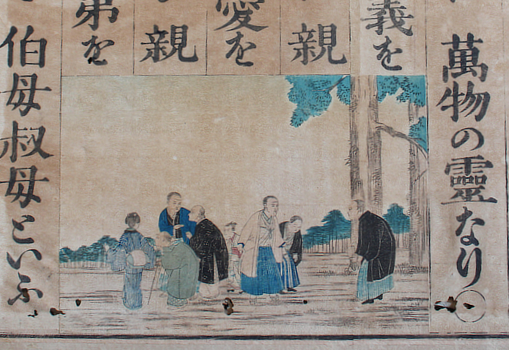
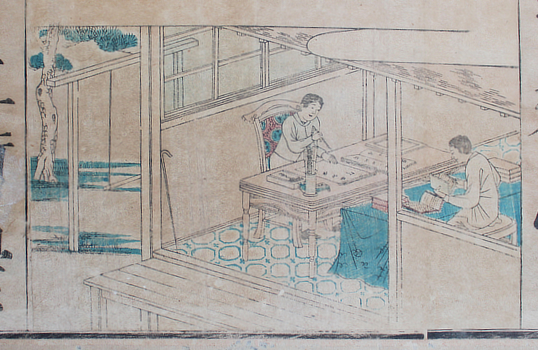
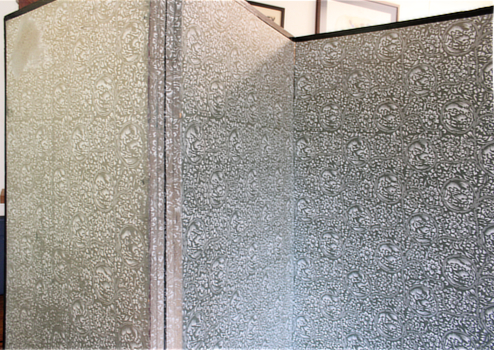
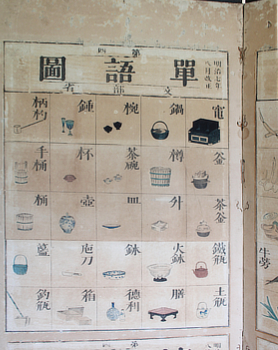
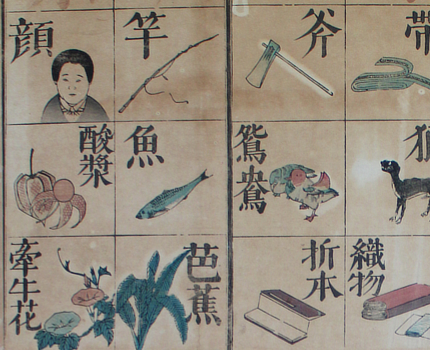
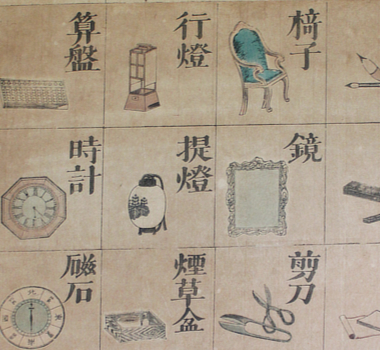
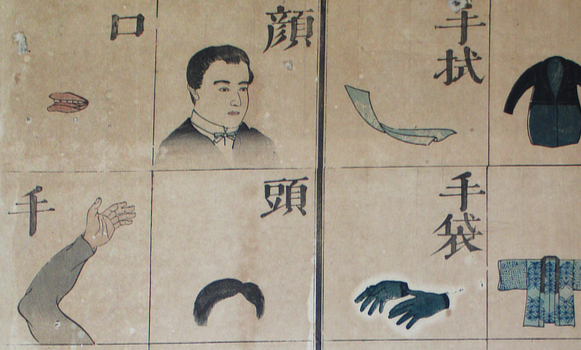
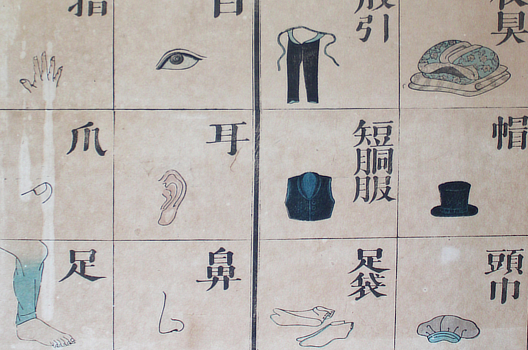
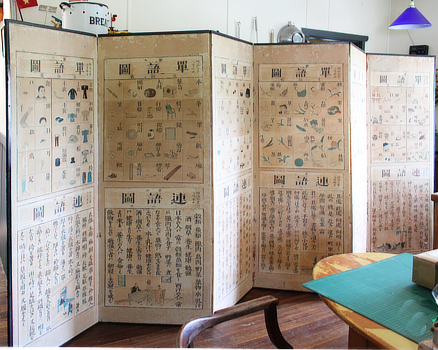
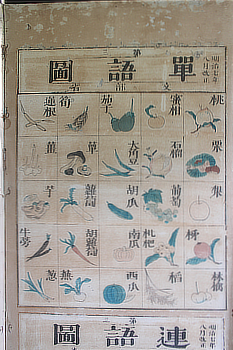
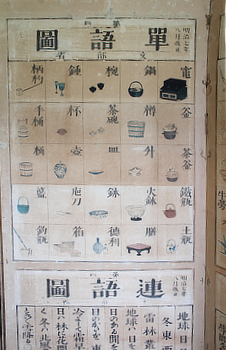
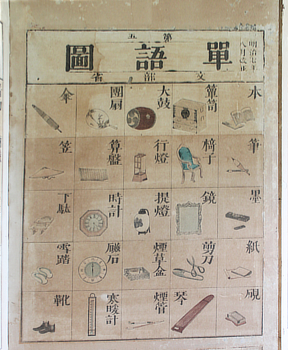
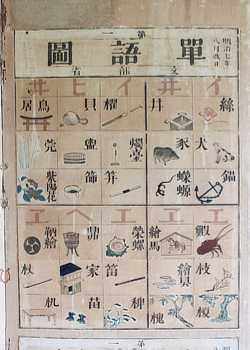
School screen. 單語圖 + 連語図 [Tangozu + Rengozu]. Tokyo, Monbusho1874 (Meiji 7). Folding screen, a byobu, of six panels; paper over a timber frame. Each panel is 176x64cm, ie it's close enough to four metres opened right out. Each panel has a Tangozu wall chart mounted above a Rengozu chart, with colour woodcuts, numbered one to six. Each chart is about 77x54cm, some a bit larger or smaller. The back is patterned green paper printed by stencil or block. Bugs have been busy in places but only in the mounting paper, not the charts. Some holes or bashes in the back of the first panel - what would be the front cover if you imagine this as a book - have been repaired with Japanese tissue. Browning. The holes are mostly down low, where small children or errant bits of furniture operate.
This was made as a six panel screen, it is complete with the black timber border strips at each end. And it was made by professionals. It's possible that whoever ordered it decided that the rest were a waste of time but it's more likely another panel would make it too large and cumbersome for the space they had.   Au$3600 delivered within Australia; Au$4500 delivered elsewhere.

When I bought this I thought the photos showed it sitting on a table and the dimensions were of the whole screen opened out. I realised I was wrong when I got the bill for shipping. What I thought was a table mat was a floor rug.
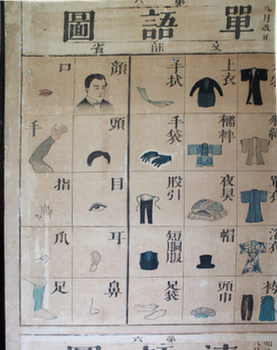
These are the elementary school wall word charts (Tangozu) and collocation or phrase charts (Rengozu) issued by the Ministry of Education. There were eight of each produced but six is what made it on to this extraordinary piece of furniture. I can only guess it was made to divide a classroom. Charts seven and eight of the Tangozu series were plants and animals.
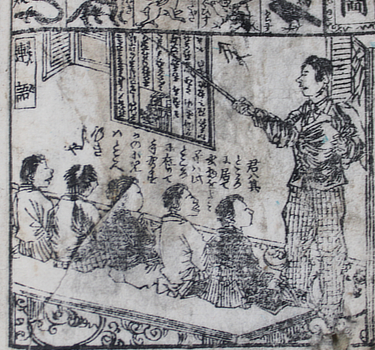
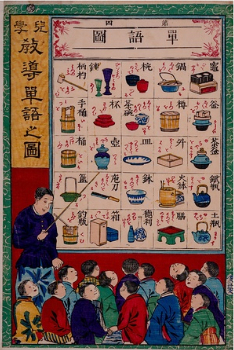
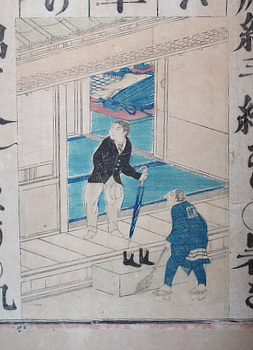
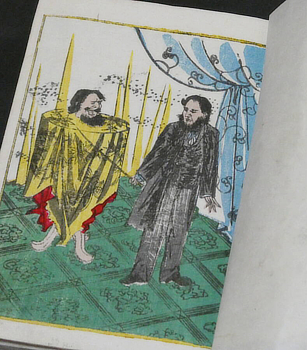
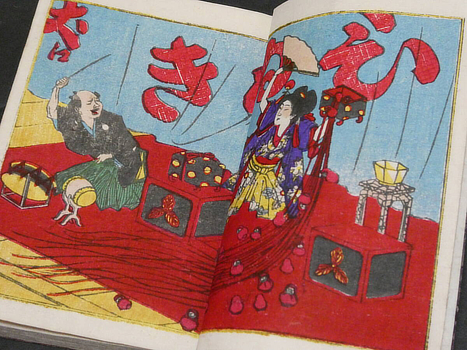
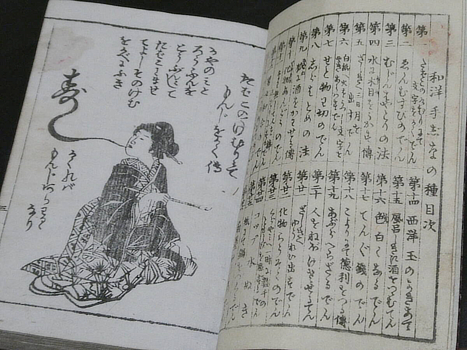
The various editions and versions of the Shogaku Nyumon and similar elementary primers show that these wall charts were revised and adapted for some years. The miniature versions in the books are changed and reorganised but these originals can still be recognised; who could mistake that hairpiece and nose? Commercial colour woodcuts of the charts in use were also produced by canny publishers: teacher pointing and attentive kids on the floor. The charts were exaggerated so that they could still teach even in such reduced form. Kiyochika did at least three in 1874.
The lower elementary school curriculum established by the Normal School stipulated that students should first study vocabulary using wall charts such as word charts and collocation charts, as a prelude to learning materials like the Elementary School Reader ...
The eight word charts published in 1873 were created by the Normal School editorial office, a liberal faction that actively sought to absorb Western civilization. They incorporated Pestalozzi's educational philosophy and focused on illustrations to allow children to understand intuitively through their own eyes. The first and second word charts were designed to teach historical kana spelling, while the third through eighth word charts were written in kanji or katakana, allowing children to learn the properties and uses of familiar objects through a question-and-answer format.
However, the following year, 1874, a revised edition was published by the Ministry of Education, and the Normal School version was discontinued after just one year. Looking specifically at the revised sections, out of the 210 words, there are four changes to the word itself and 29 changes to spelling.
 (A rough translation from Dictionaries and Beyond published online by Sanseido. They illustrate it with images from an elementary book, not the charts).
Pretty much every reference I can find works from the books and prints rather than original charts. The Library of Congress has both sets of eight Department of Education charts. The Miyaki Library at Tsukuba University has six very similar but not identical Tangozu charts mounted on a scroll. Maybe the Normal School version?

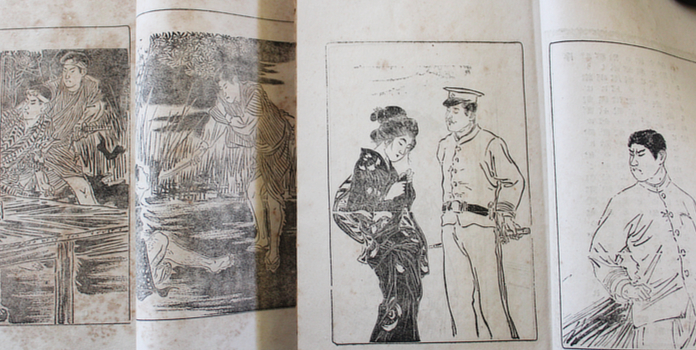
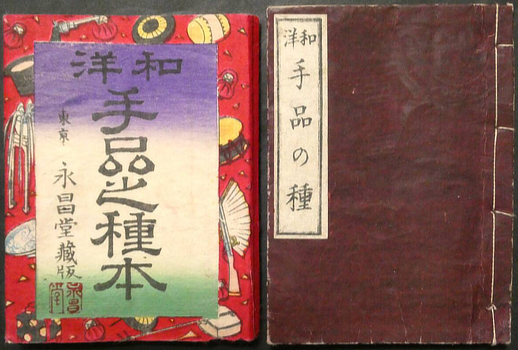
The illustration top left is one of Kiyochika's prints. It is a good, if lurid, likeness of Tangozu chart four in the Miyaki collection; almost but not quite the same as chart four here. Next to it is from a horrible copy of a Shogaku Nyumon I have here showing the teacher with Rengozu chart three.
You can email an inquiry or order securely through antiqbook

Race integration?

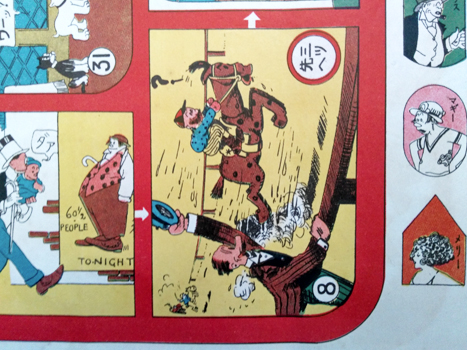
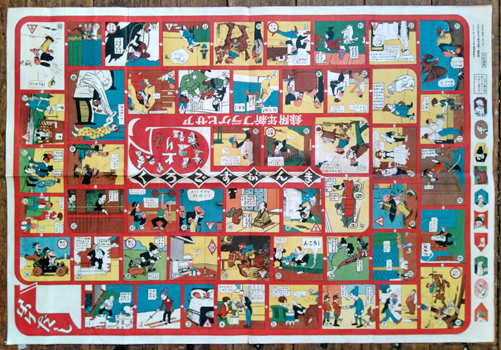
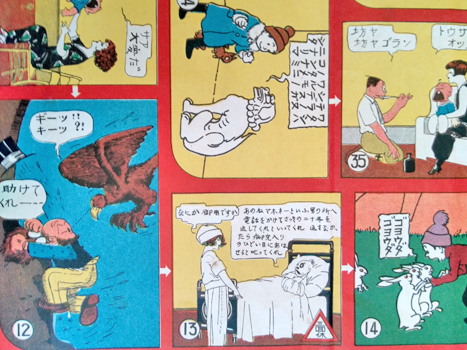
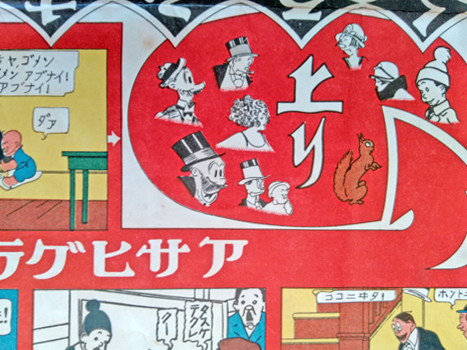
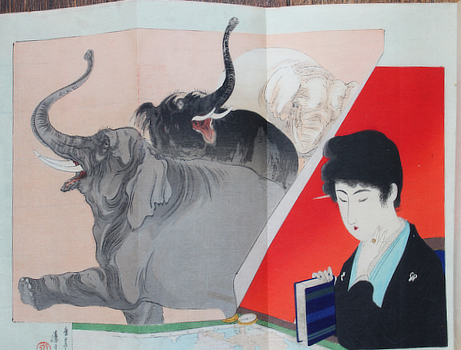
Manga Sugoroku. まんがすごろく [Manga Sugoroku]. Asahi Graph 1925 (Taisho 14). Colour broadsheet 54x79cm. On the back is a monochrome game that features Daikokuten and a map of Japan; it doesn't look very interesting. Some near invisible repairs to folds. With the playing pieces in the margin. Au$375

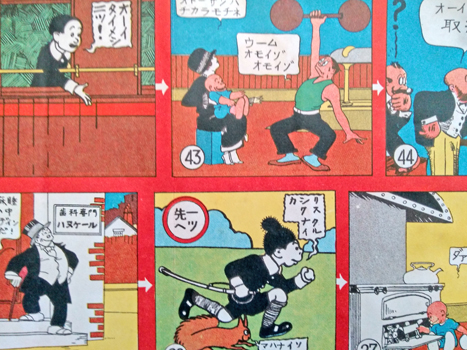
The new year gift from the magazine Asahi Graph celebrates the introduction and embrace of the American comic strip in Japan along with a couple of local heroes. Mutt, Jeff, Jinks, Maggie et al share the page with that pom-pom kid and his squirrel friend - or vice versa - I forget their names*. But I notice that everyone sticks to their own boxes; Jinks, Mutt and the squirrel play the same stage but not together. Such behavior came later.
It was Okamoto Ippei that convinced Asahi Graph and associated papers to publish Bringing Up Father and Mutt and Jeff. This is printed on good heavy paper and Asahi must have produced a squillion of them, so you'd expect it to be fairly easy to find. Not so.

*Sho-chan and Risu: the boy and the squirrel. I thought I better make an effort.


You can email an inquiry or order securely through antiqbook

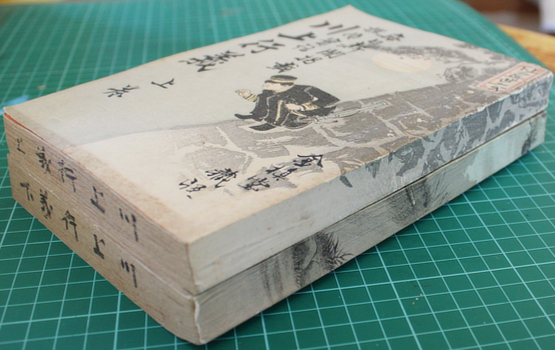
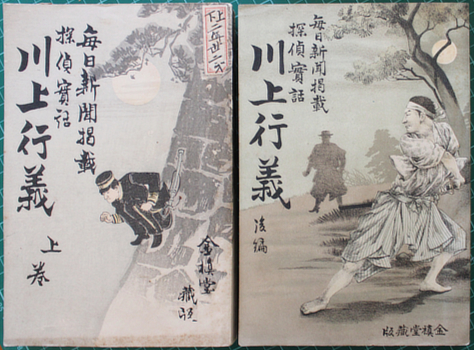
Aoba (ie Ihara Toshiro?). 川上行義 : 探偵実話 [Kawakami Yukiyoshi : Tantei Jitsuwa]. Tokyo, Kinshindo 1900 (Meiji 33). Two volumes 22x15cm publisher's colour woodcut wrappers; full page b/w illustrations in each volume, a couple double page. Browning of the cheap paper in the second volume, not so much in the first. A couple of owner's stamps; title written in ink on the bottom edges of each. Signs of use but pretty good. Au$250
First edition of this true detective story; that's what the title says it is. This is the story of Kawakami Yukiyoshi, an army sergeant who deserted in 1880 in order to avenge his father. He became a hero and a six part novel called (more lor less), A new Story : Kawakami Yukiyoshi's Revenge by Okamoto Kisen appeared in 1881. It looks like it came came directly from a kabuki production or would soon be one.
Ihara did a run of true detective novels early in his career before he became a distinguished theatre critic and playwright.
Worldcat finds only the NDL entry and Cinii finds only two locations in Japan.


You can email an inquiry or order securely through antiqbook

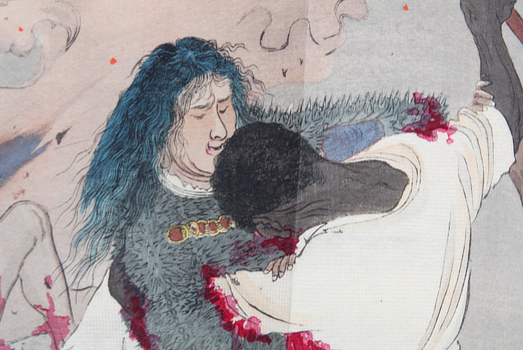
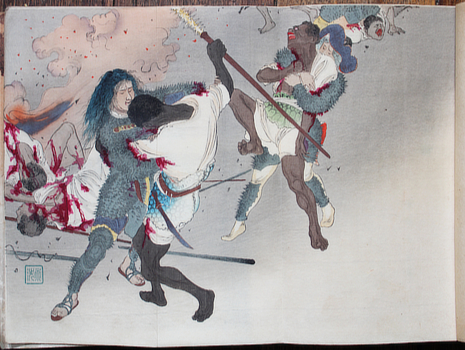
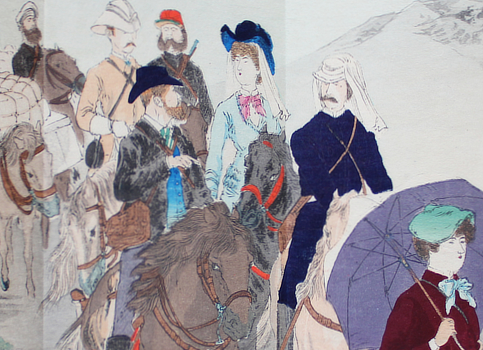
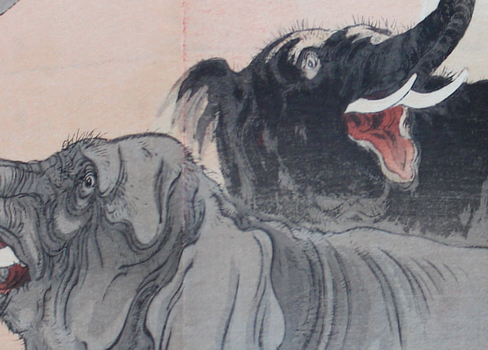
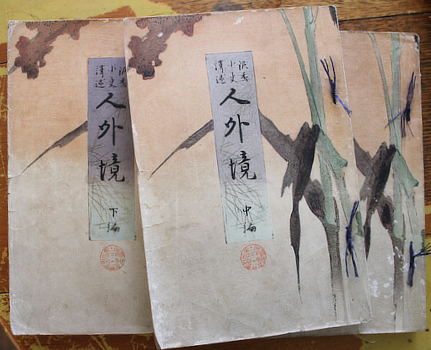
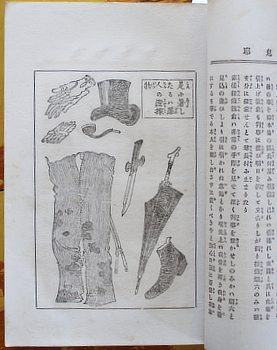
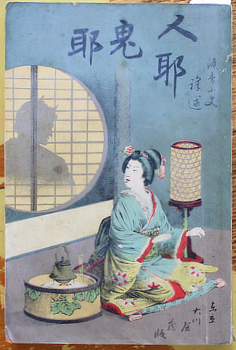
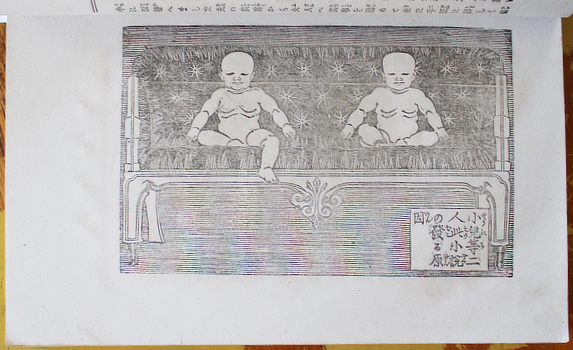
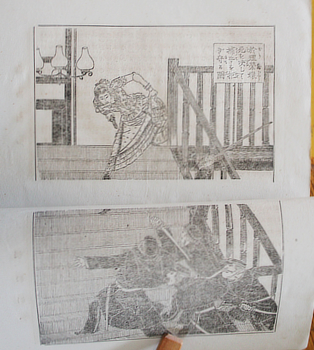
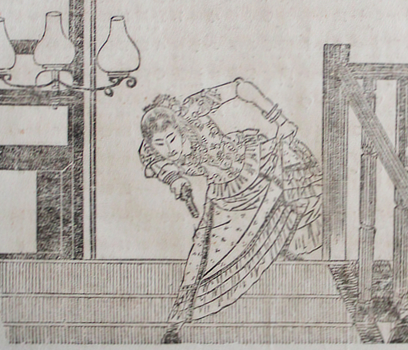
Adolphe Belot & Kuroiwa Ruiko. 人外境 [Ningaikyo]. Tokyo, Fusudo 1897 (Meiji 30). Three volumes 22x15cm publisher's colour woodcut wrappers, thread tied (some short tears and chips). Three folding colour woodcut frontispieces by Tomioka Eisen. A couple of owner's stamps in each, title written in ink on the bottom edges). Browning, smudges and signs of use. Certainly well read but still rather good copies for popular thrillers like this. And most important: those frontispieces are intact* and clean. They are the magic you don't get in the original or English translations. The third frontispiece shows those women warriors at work in their spiked armour. They liked to get in close and had no mercy. Au$500

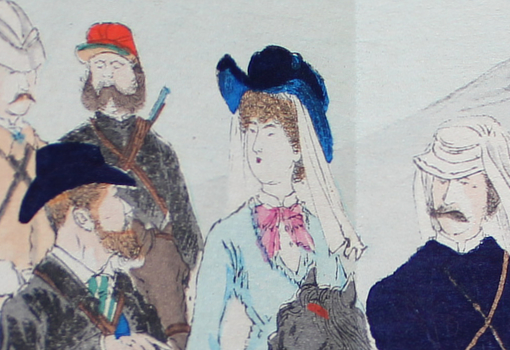
First edition of Kuroiwa Ruiko's translation of Belot's trilogy La Sultane Parisienne, La Fievre de l'Inconnu, and La Venus Noire (1877), a prodigious potboiler with indominatable women explorers and a ferocious race of women warriors in the darkest of a dark Africa ruled by the black venus. An English translation was made in 1879 by H. Mainwaring Dunstan as 'A Parisian Sultana', Ruiko usually worked from English translation of French books.
I admit I skipped large hunks of Dunstan's translation but wherever I opened each book I usually had to go back several pages to understand how the current turmoil and drama had started. There's a lot of it. And a fair bit involves sex and jealousy. The dull parts are Belot proving the depth of his research. Just as Tolkein used maps and documentary contrivances to establish the reality of his middle earth, Belot used explorers like Livingstone, Baker, Speke, Grant, Schweinfurth et al, to buttress his hellish fantasia of Africa. An unpleasant place swarming with unpleasant people.
Ruiko was busy. Apart from journalism, running newspapers and writing what might be the first modern Japanese detective novel he kick-started Japanese detective fiction by publishing a squillion translations or adaptations of novels by authors like Jules Verne, Gaboriau, Hugh Conway, Anna Katherine Green, Marie Corelli, A.M. Williamson, George Griffith, H.G. Wells and most of all, Du Boisgobey. Translation is an approximate description of Ruiko's work; he was open about slashing, expanding and rewriting his material to fit what he wanted the novel to say.
Worldcat finds no copy outside Japan but *I'm sorry to say that the NLA has the three frontispieces minus the books. This is what happens to so many of these novels.


You can email an inquiry or order securely through antiqbook

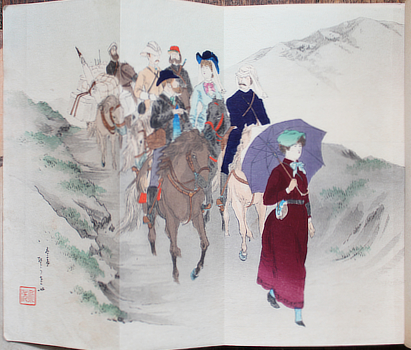
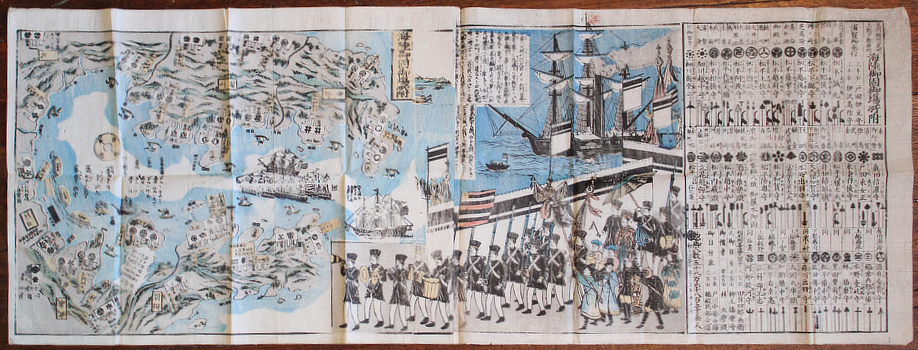
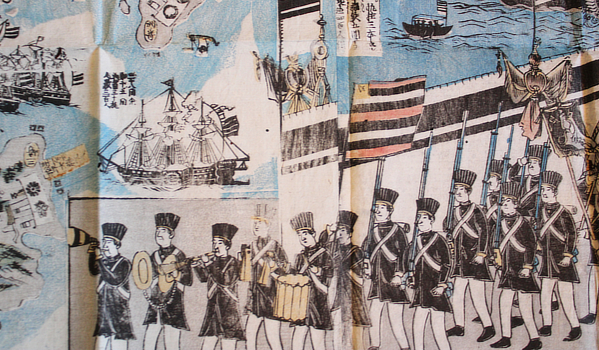
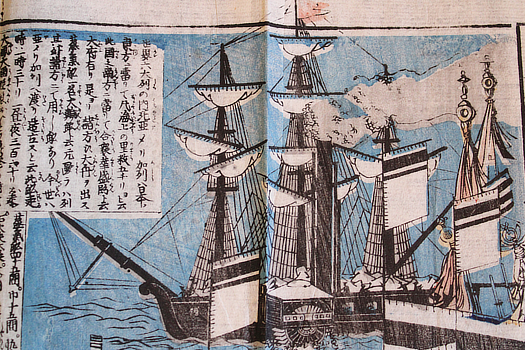
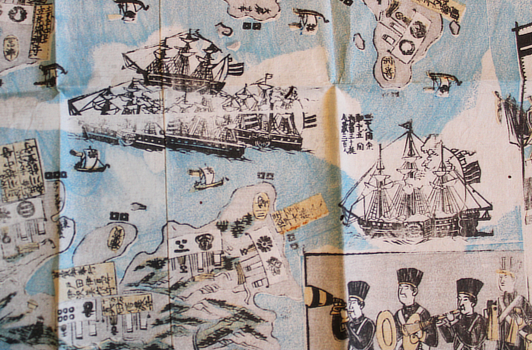
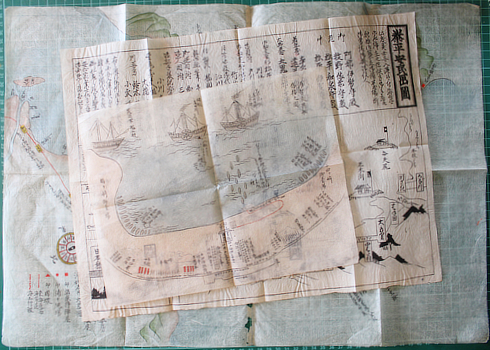
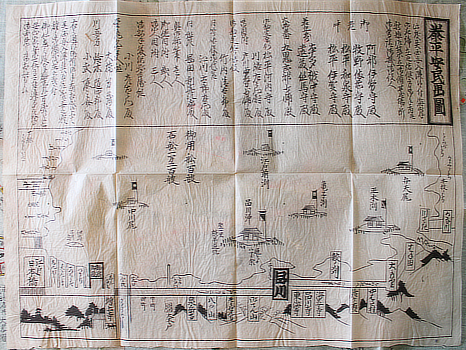
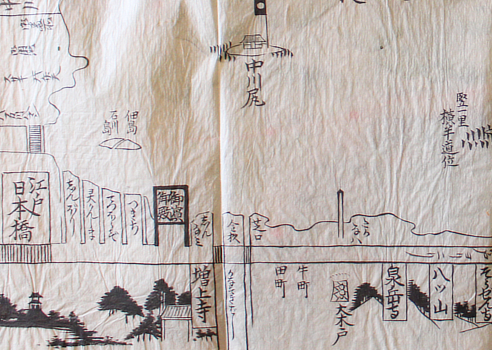
Kawaraban. Perry and the black ships. 海陸御固御場所附 [Kairiku Okatame Onbasho Tsuke]. n.p. (1854). 35x93cm colour woodcut on two joined sheets. A couple of small holes; a nice copy. Au$3600

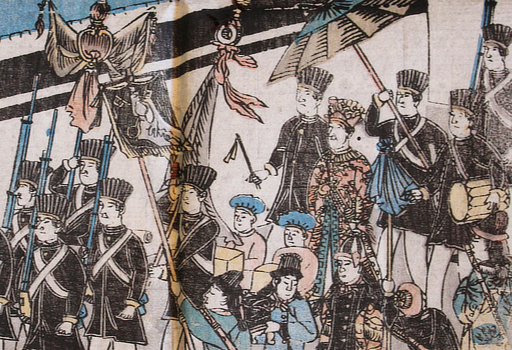
Three in one: list of defences on the right; American procession in the middle; and American ships and defence in the harbour on the left. This must be among the most deluxe kawaraban ever produced: two large sheets and colour. Usually a print this size, not that I'd seen one this long, would be on four joined sheets. So even cheap illicit news sheets have a hierarchy. This strengthens my suspicion that there was already a market of collectors as well as the no longer slack-jawed peasantry.
There are other kawaraban with this title and a couple closely resemble this in parts. One has the first few musicians in the American procession but not the rest and not the majestic figure of, I presume, his royal highness Adams. The Sanada Treasures Museum has a copy of this and Brown University has a copy but not coloured. That's all I found.
These illicit illustrated news sheets - kawaraban - for the streets were produced by the million for a couple of hundred years so of course few survive. They were produced for anything more interesting than the drop of a hat and the arrival of the Black Ships, the American squadron commanded by Perry, in 1853 and 54 eclipsed any and all tiresome earthquakes, fires, plagues, famines, murders and scandals. For most Japanese this was the same as a squadron of alien space ships arriving on earth now. These prints are the kurofune (black ship) kawaraban.


You can email an inquiry or order securely through antiqbook

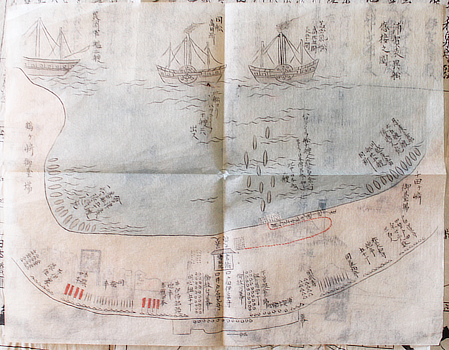
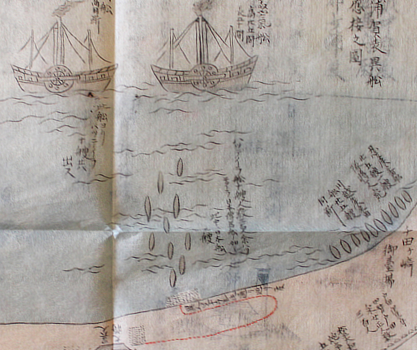
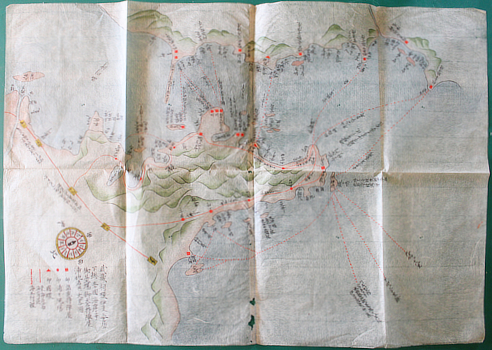
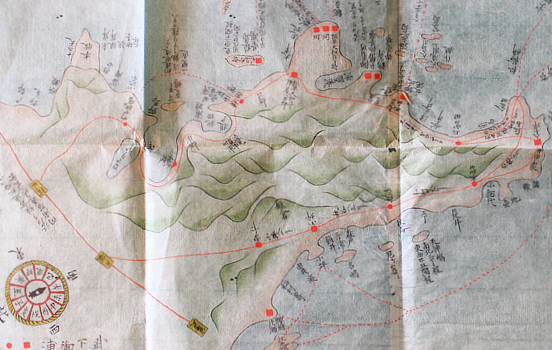
Perry and the black ships. Three ink drawings, plans or maps, of Perry's first visit in 1853 and the defences of Tokyo Bay. n.p. [1853-54] [1] Ink drawing with colour, 22x28cm. [2] Ink drawing, 30x41cm. A couple of holes in the large map. [3] Ink drawing with colour, 38x55cm. All in excellent shape. Au$950

[1] Perry's black ships anchored off Uraga during the first visit in June 1853. The dotted red line shows the American march to the tent. I thought the snake line was so that all troops could form a parade on the short stretch from the shore to the tent but I have seen a drawing with, instead of an empty beach, a fabric barricade between the landing point and the tent. Think demeaning airport queue control. Did that barrier exist or was that one artist's invention?
[2] Plan of the defences There are at least three, maybe more, quite different kawaraban with this title. Yokohama City Library has a print that is almost but not quite identical to this. The execution of the print is, of course, much more crude, and there are changes to the text and other details.
[3] A large scale map of the five countries, Musashi, Sagami, Izu, Awa, Shimosa, and their defences.


You can email an inquiry or order securely through antiqbook

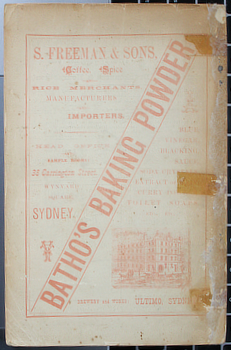
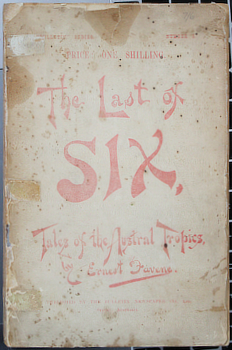
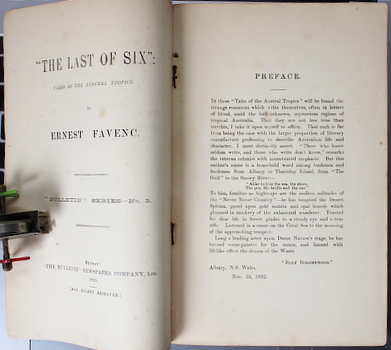
FAVENC, Ernest. The Last of Six: tales of the Austral tropics. Sydney, the Bulletin 1893. Octavo publisher's printed wrapper (the red printing faded away as usual). Quite good in a scrappy cover: the front wrapper is quite chipped, spotted, stained, and was at some time secured by sticky tape; the back has a couple of small chips and those tape marks. The front has been lined with Japanese tissue which doesn't obscure the advertisement on the inside and refastened to the spine. Au$350

First edition. I was surprised to find Lloyd Currey describing this as a major rarity of Australian speculative fiction but, looking at my own records, I found it thinner on the ground than my crumbling memory told me: this is the fourth copy in as many decades.
Explorer cum writer Favenc's first book is a gathering of mostly nasty, often brutal, tales of crime and the supernatural. I haven't found many contemporary reviews but I was astonished - I always am by such a rare occurrence - to find the Spectator gave it a quite enthusiastic notice. I rely on them for vitriol and condescension.


You can email an inquiry or order securely through antiqbook

TEALE, T. Pridgin, Dangers to Health: a pictorial guide to domestic sanitary defects. London, Churchill &c 1879. Octavo publisher's gilt decorated illustrated cloth (a touch mottled); 55 plates, all but a couple in black and blue, one in three colours. Minor signs of use, quite good. Au$475

First edition of this charming and terrifying pictorial guide to the perils of Victorian home life. Three more editions and French, German and Spanish translations (at least) followed over the next few years. I recommend this to anyone wanting to restore old houses with absolute authenticity. And it's essential for time travellers.
"Having further traced illness amongst my own patients to scandalous carelessness and gross dishonesty ... I became indignantly alive to the fact that very few houses are safe to live in." A still useful warning. Teale, third generation Leeds surgeon, like so many eminent Victorians, can only have achieved so much by working hundred and sixty hour weeks. There was a deluge of obituaries at his death in 1923, all eulogistic, but the note in the British Medical Journal caught my eye: he had an "almost feminine sweetness of disposition."


You can email an inquiry or order securely through antiqbook

How to travel

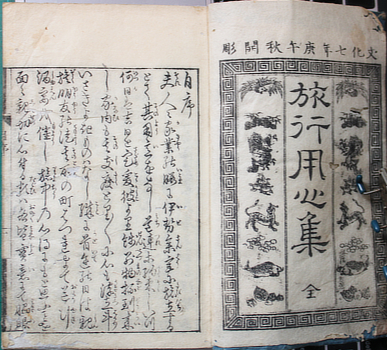
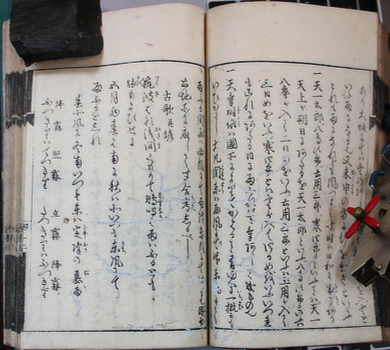
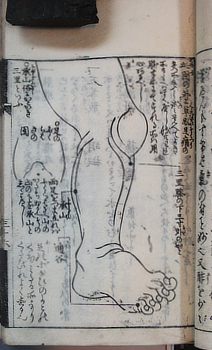
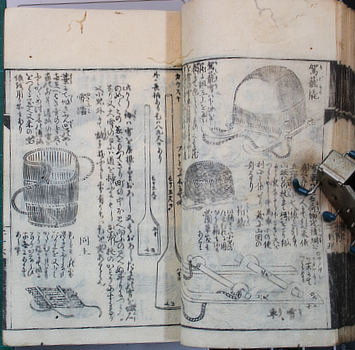
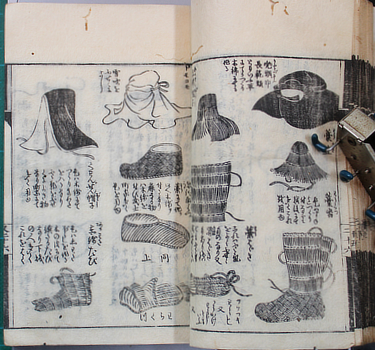
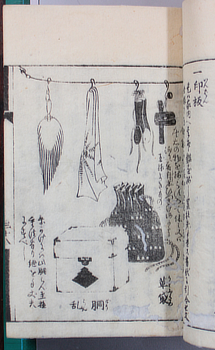
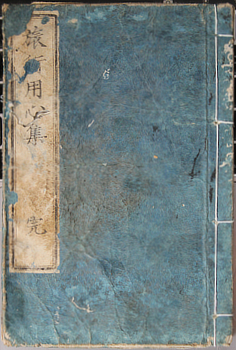
Yasumi Roan. 旅行用心集 [Ryoko Yojinshu]. Toto (ie Tokyo), Suharaya 1810 (Bunka 7). 18x12cm original wrapper with printed title label (chipped or nibbled), recently resewn; illustrations on 27 pages. Worms have been at work and several pages have been properly repaired with tissue lining on the inside of the double leaves; a couple of less expert repairs to margins. Nothing fatal and loss is limited to a few characters here and there. Au$750

First edition. This singular book has no parallel in Japan and nothing much elsewhere until mid century with writers like Francis Galton and Thomas Baines. There were plenty of guide books in Japan and the west, unhelpful vocabularies in many languages for Europe; but nothing like detailed instructions on how to travel.
It's difficult to choose an example or two from the 61 introductory precautions, they are all jewels of experience from an expert traveller. A lot of useful advice on health and medications, as well as Yasumi's three books on medical matters, led Constantine Vaporis to guess that Yasumi was a physician of some sort (Caveat Viator; Monumenta Nipponica 44; 1989).
What to wear; what to take; how to behave; what to do when arriving at an inn: find the toilet and check all exits; what to avoid: too much cheap booze (drink none in winter), poisonous insects, inn prostitutes; how to find your way again if bewitched by foxes or badgers; how to wear in your essential straw sandals and how to treat blisters; how to avoid sea sickness (first, don't get on a boat unless there's no other choice) and motion sickness if riding in a palanquin ... there is too much to list here. In any case, there is now an English translation in print.


You can email an inquiry or order securely through antiqbook

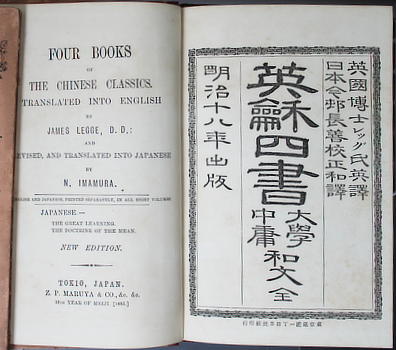
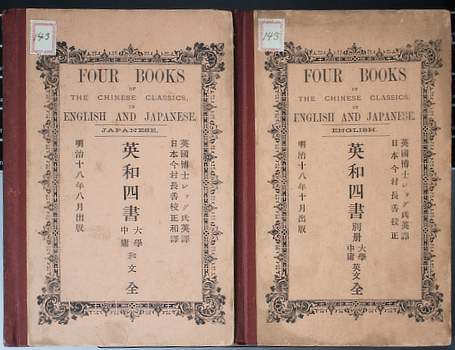
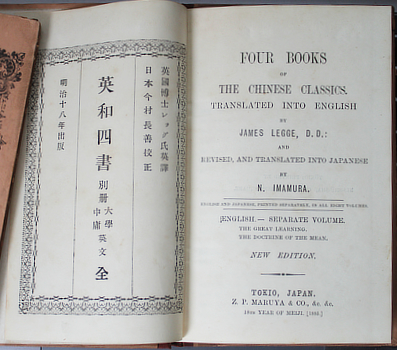
Confucius. James Legge & Imamura Nagayoshi. Four Books of the Chinese Classics. Translated into English by James Legge ... revised, and translated into Japanese by N. Imamura. Tokyo, Z.P. Maruya (ie Maruzen Shosha) 1885. Two volumes 19x13cm publisher's printed boards, cloth spines. Rather good. Note that they open right to left. Au$300

Most likely the first edition even if it is called a New Edition and the title page says that it is "printed separately, in all eight volumes." These two volumes, one English, one Japanese, are all I can trace. Worldcat finds only the Waseda entry; Cinii finds copies at 12 universities and all of them have two volumes and the same edition. I suspect Maruzen meant four books in English and four in Japanese. Likewise they use 'new edition' to mean new work rather than a revision.
If you had to learn English from foreign texts it must be welcome relief to learn it from from a comprehensible text with substance after all those drivelling mission led tracts.
This is a 'ball cover' (boru hyoshi, apparently a corruption of 'board') book, a signal of modernity and the Japanese equivalent of a yellowback: flimsy western style bindings with lithograph covers that rarely survive in good shape.


You can email an inquiry or order securely through antiqbook

When your wife goes to work

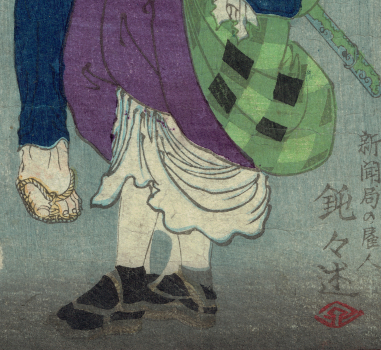
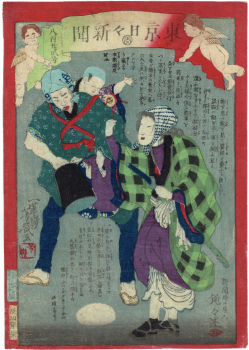
Utagawa Yoshiku. 東京日々新聞 822号 [Tokyo Nichinichi Shimbun no. 822]. Tokyo, Gusokuya 1874 (Meiji 7). 35x24 colour woodcut. A nice copy. Au$400

This is one radical family when it comes to gender equality and task sharing, way ahead of their time. Mother burgles while father minds the baby. Mother also brings back treats after work.
This is the colour supplement to the Tokyo Nichinichi Shimbun (Tokyo daily news). I can't decipher names of this pioneer couple and the references I've found don't help.


You can email an inquiry or order securely through antiqbook

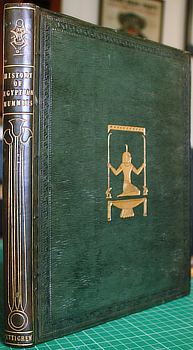
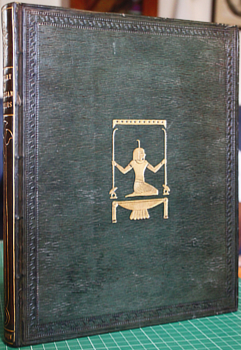
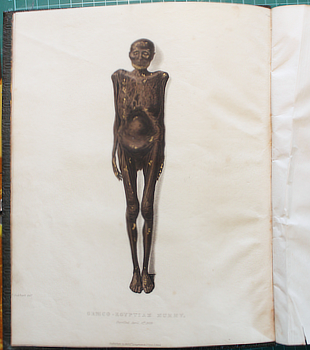
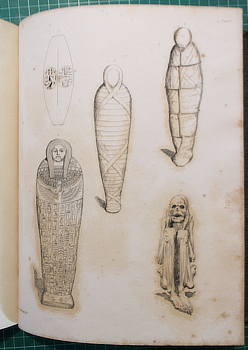
PETTIGREW, Thomas Joseph. A History of Egyptian Mummies, and account of the worship and embalming of the sacred animals by the Egyptians; ... London, Longman 1834. Quarto contemporary straight grain green calf decorated in gilt and blind; 13 plates, four coloured. Foxing or browning of the uncoloured plates, thanks to the paper: a bit of browning here and there; frontispiece tissue and gutter of the title creased.
20th century ticket of the bookshop Au Bouquiniste Oriental of Cairo on an endpaper and bookplate of medico and anatomy historian K.F. Russell. Au$2250

A pleasing copy in a wonderful Egyptian binding with the armorial bookplate of a Smith who may or may not be one of the three Smith subscribers. I'd like to think it's William James Smith the architect who later introduced neo-classical architecture to Constantinople, but all three subscriber Smiths, including William James, are Esq.s and I doubt any Esq. chose to be a working architect in the Office of Works. Or that any young architect in the Office of Works could afford this.
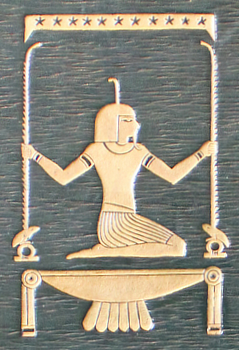
The binding uses what looks very much like the identical tool used on the cover of Gardner Wilkinson's Ancient Egyptians (1837) on the front and back and a matching design on the spine. Wilkinson's book was possibly bound by Remnant & Edmonds (it's known they bound the second edition), famous for show off publisher's bindings but not so much for single bespoke work. Wilkinson was a friend of Pettigrew and, of course, a subscriber to the book. So where does this Smith come in?
Wilkinson, along with the king and some other worthies, subscribed for a large paper copy which, from advertisements sent to Soane (who ignored him), we know cost three guineas against two for the standard. Seems to me they were had. It's scarcely larger, no extra colouring, nothing.
Why couldn't I have a friend like Pettigrew who would unwrap and dissect mummies as a party trick? I did have a friend who spontaneously performed all of Oklahoma from outside the kitchen window, playing every part within that tiny stage, but most of them just drowned guests in booze, food and loud music. Or was that me?


You can email an inquiry or order securely through antiqbook

WORCESTER, G.R.G. [George Raleigh Gray]. The Junks and Sampans of the Yangtze. A study in Chinese nautical research. Shanghai, Dept of Customs 1947-48. Two volumes quarto publisher's green cloth (different grained cloth on each volume); numerous photo illustrations, measured drawings & plans, several folding. A nice, bright pair. Au$1600

Worcester was by no means the only civil servant in China, or any exotic foreign spot, to devote large slabs of their life to collecting, collating and preserving disappearing arts, crafts, languages and customs, but his books on junks and sampans are remarkable for being exhaustive and well timed. They are references that can never be obsolete, recording as they do dozens of now vanished vessel types - their design, construction, peculiar use and all manner of social and personal history of their owners and crews.


You can email an inquiry or order securely through antiqbook

DYE, Daniel Sheets. A Grammar of Chinese Lattice. Harvard Univ Press 1937. Two volumes quarto, excellent in publisher's cloth and barely nicked dustwrappers; illustrated with some 2500 patterns. Harvard-Yenching Institute Monograph Series V. A pleasing pair. Au$750

First and best edition. A practical copybook and one of the great efforts of collection if not classification; the first on Chinese lattice the author thinks since 1631. The result of twenty years collecting, Dye called an end to his work with the death of his draughtsman Mr Yang Chi-shang in January 1936. He does comment that though there must be more examples he hasn't found, some three hundred patterns collected since 1933 but not included in this book contain no basic variants.


You can email an inquiry or order securely through antiqbook

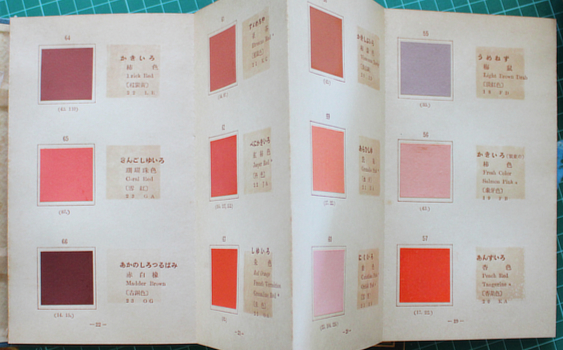
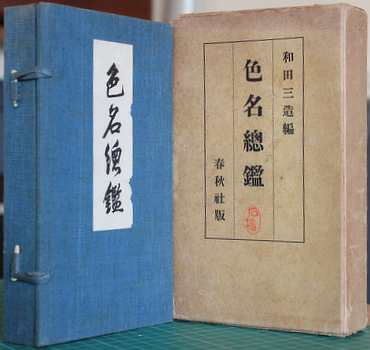
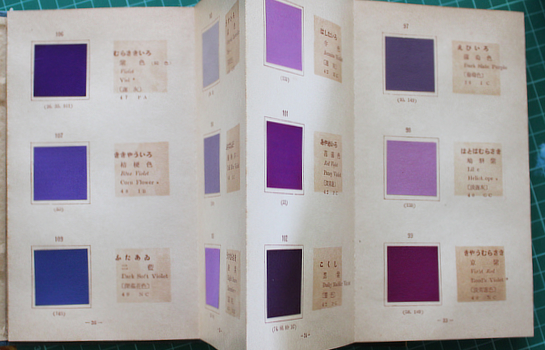
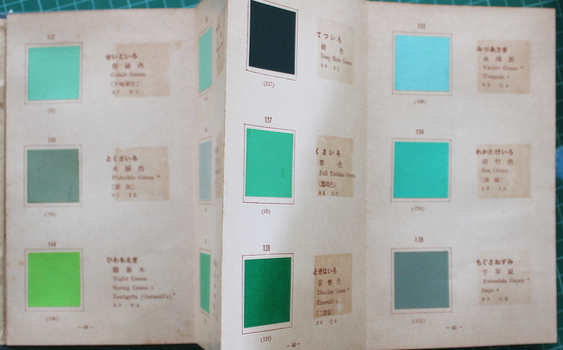
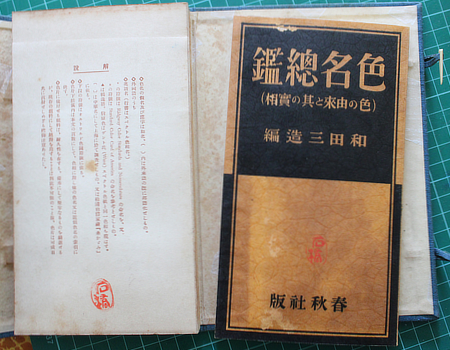
Wada Sanzo. 色名総鑑 [Shikimei Sokan]. Tokyo, Shunjusha 1931 (Showa 6). 20x12cm publisher's cloth case with title label with 160 mounted colour samples on 56 accordian folding card leaves; and wrappered book; 178pp and some tables (two folding). Browning and the usual offsetting of the card; still a good enough copy in the original printed card outer folding case (this browned and dusty). Colour samples named in Japanese, English and occasionally French or German; two of the tables are multi language lists of colour names. Au$600

First edition of Wada's first serious attempt at colour nomenclature. Wada, though at the top of the art ladder in Japan, insisted on pursuing new directions and founded the Japan Standard Color Association, now the Japan Color Research Institute, in 1927. In these early years science, art and aesthetics went hand in hand.


You can email an inquiry or order securely through antiqbook

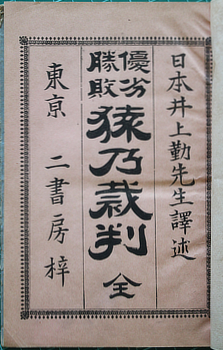
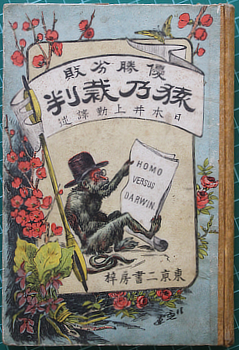
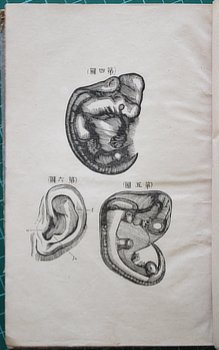
Darwin. William Penman Lyon & Inoue Tsutomu. 猿乃裁判 : 優勝劣敗 [Saru no Saiban : Yusho Reppai] 'Homo versus Darwin' incorporated into the cover illustration. Tokyo, Nishimura Tomijiro 1888. 19x13cm publisher's colour illustrated boards (by Kiyochika), cloth spine (covers marked and scraped around the edges, spine with a smallish hole in the back hinge); three full pages illustrations. Some insignificant browning; rather good for one of these boru hyoshi books. Small woodcut bookplate of writer Nagao Momoro. Au$3500

First edition and the introduction of anti-Darwinism to Japan. Darwin, in the figurative sense, arrived in Japan in 1881 with Kozu Senzaburo's Jinsoron, a translation of bits of The Descent of Man, an addendum to Origin of Species and maybe Huxley.
This is a translation of Lyon's Homo Versus Darwin 1871, a transcription of the six day trial before Lord C. with Homo as the plaintiff and Darwin as the defendant, brought about by The Descent of Man. After demolishing Darwin's notions, I gather that Lyon's, or rather Lord C.'s conclusion is that if there has been any evolutionary development in humans it is backwards among other races, leaving only the Englishman as God's true creation.
Inoue was a translator by trade and it's not easy, for this illiterate at least, to discern much political or philosophical purpose in his list of works. There is Herbert Spencer and Thomas More, but there is also Jules Verne, Bulwer Lytton, Wilkie Collins, and Shakespeare.
Japanese translators during this period may well have been exact about important things like technology and the applied sciences but like the rest of us they rightly judged theory and what we laughingly call the social sciences as polemic. This could be adapted as necessary. Darwinism was, and still is in certain quarters, for social engineering. It was a fair while before a complete translation of Origin of Species by a biologist appeared in Japan, but the same applies to most countries.
What's important here is the subtitle, Yusho Reppai. This might translate literally as 'winners and losers' but it passes into language as 'survival of the fittest' - the phrase appears often enough in Lyon's book to make it clear that Darwin is not the fittest. To take it out of the text and put it on the cover with 'Monkey Trial' (Saru no Saiban) ... now that's clever.
This is a 'ball cover' (boru hyoshi, apparently a corruption of 'board') book, a signal of modernity and the Japanese equivalent of a yellowback: flimsy western style bindings with lithograph covers that rarely survive in good shape.
Worldcat finds three locations, two outside Japan: the Huntington and National Library of Medicine.


You can email an inquiry or order securely through antiqbook

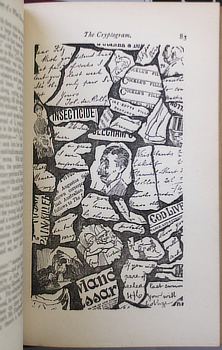
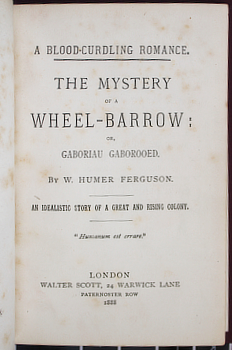
Hume. FERGUSON, W. Humer. The Mystery of a Wheel-Barrow: or Gaboriau Gaborooed. An idealistic story of a great and rising colony. [headed: A Blood-Curdling Romance]. London, Walter Scott 1888. Octavo, without wrapper in neat modern cloth; one full page illustration, "The Cryptogram", in the text. Preliminary blanks spotted, virtually gone by the title page and clean and bright from there on. There is a professional looking proof reader's pencil correction in one margin. Unremarkable maybe but, why would anyone read this so carefully? Au$950

First edition, desirable and very uncommon. This parody, if read in short bursts, is amusing - one advantage over its forebear - and is about as readable. But that didn't help where it counts. The Mystery of a Hansom Cab went through dozens of editions but there are only two known editions of this and they are both the same edition. There exists, as well as this, a New Edition published in the same year in Sydney - not Melbourne where both books are set - by Edwards Dunlop, but it is the same sheets with the imprint changed.
One mystery still unsolved is who wrote this. It exudes a malicious glee and while its greatest flaw is that it lampoons the Hansom Cab too closely, it exuberantly targets detective fiction in general. The cornered villain, about to scarper, suddenly remembers that "his escape might involve another volume of mysteries" and obligingly agrees that the "exigencies" of the novel require his suicide. For today's stylistic detective, what may be an important clue is how wet this novel is - a lot of boozing goes on - and the author is adept at writing funny drunks; that should narrow the field.
An online site called bookbeat seems to know something. They write: "W. Humer Ferguson, a scholar with a deep appreciation for the intricacies of human experience and the philosophy of the ordinary, draws inspiration from his own explorations in various urban landscapes. His academic background in sociology and literature informs his narrative style ..." This insight is repeated on at least four other sites offering to sell you what is a free download of the book. What do they know that I don't? And how did they find out?
Me, I offer George Augustus Sala as a candidate. This is based on one of the scraps in the cryptogram. He was in Melbourne not long before; he could well have drawn the cryptogram; and I'm not going to read Sala to compare style. You can.


You can email an inquiry or order securely through antiqbook

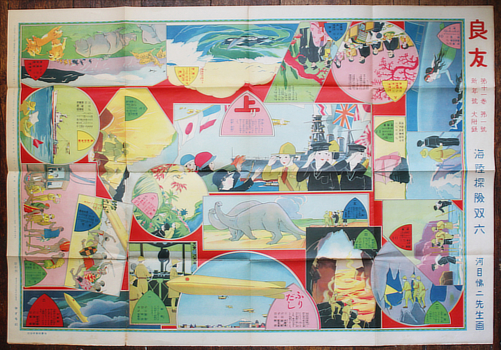
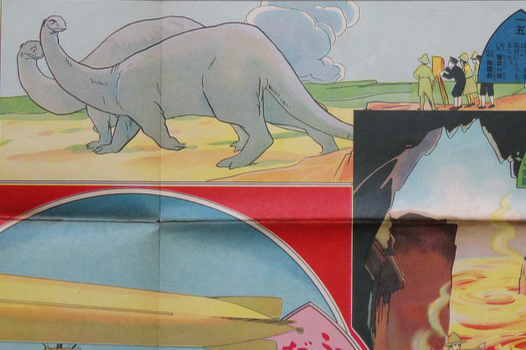
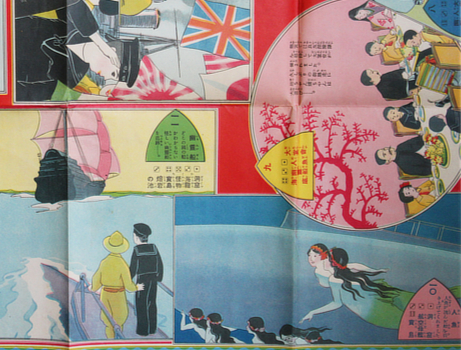
Kawame Teiji. 海底探検双六 [Takei Tanken Sugoroku]. Kodomosha 1926 (Taisho 15). 55x78cm colour illustrated broadside. Some small holes in folds; pretty good. Au$375

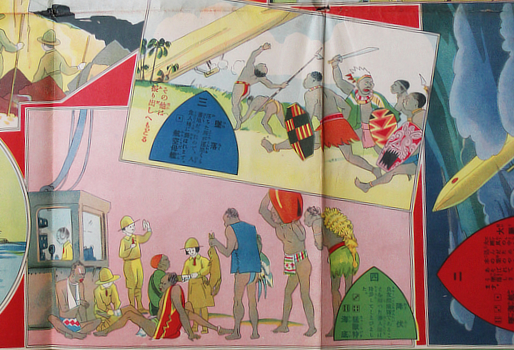
The new year gift from the magazine Ryoyu. Not to be confused with the comparatively common sugoroku drawn by Okamoto Kiichi and published in 1918 which is just submarines and diving suits. This is proper perilous undersea and aerial expedition through lost worlds. Like all sensible Japanese children they traveled well armed and a few judicious shots quickly sort out some truculent tribesmen. The dinosaurs might owe a lot to Winsor McCay but all dinosaurs after 1914 have some Gertie in them.
Kawame Teiji was responsible for the same magazine's 1925 gift: a plan to reconstruct Tokyo as a city of as yet uninvented wonders, one of the best visionary city plans ever.


You can email an inquiry or order securely through antiqbook

Baido Kunimasa [Utagawa Kunimasa IV]. 明治貴顕鑑 [Meiji Kiken Kagami]. Tokyo, Hoeidi 1888 (Meiji 21). 12x9cm publisher's wrapper with title label (ink inscription on the back cover); 15 double folded leaves giving one single page, one gatefold quadruple page, and 15 double page engravings. Actually all but a couple of leaves are quadruple folded - the printed leaves around double folded leaves of heavier paper making the book tougher, made to be handled often. Au$300

A nifty little book, a portrait gallery of eminent figures of the Meiji. But captured in action, not the studio poses of so many Eminent Men galleries. Worldcat finds only the NDL entry.


You can email an inquiry or order securely through antiqbook

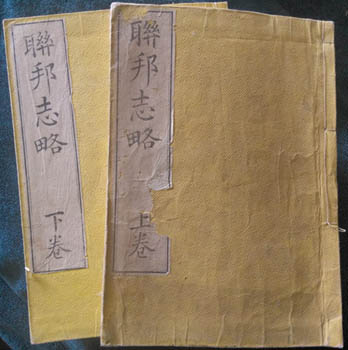
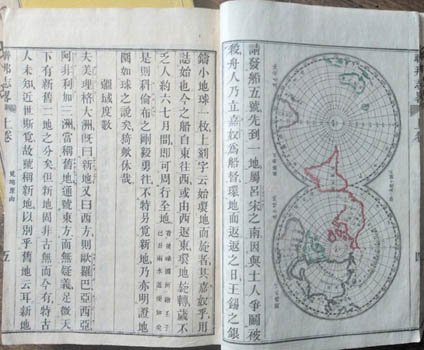
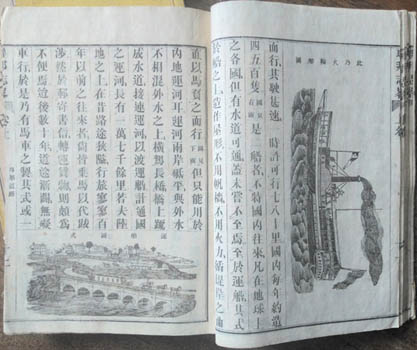
[BRIDGMAN, Elijah Coleman.] Mitsukuri Genpo. 聨邦志畧 [Renpo Shiryaku]. Tokyo, Rokyukan 1864 (Genji 1). Two volumes 26x18cm publisher's embossed yellow wrappers with printed labels (front cover of the first volume marked or dusty, the label incomplete); 56 & 48 leaves (ie 208pp in all); five full page maps with colour and a fair quantity of small maps, some with colours; woodcut illustrations. A rather good copy, quite fresh inside. Au$1800

First edition of the adaptation by Mitsukuri Genpo of the American missionary Bridgman's Da Mei lian bang zhi lue published in Shanghai in 1861 or 62; this was reprinted in 1871. The Shanghai version has been wrongly claimed as the first account of the United States in Chinese - but it's sort of true as it is a revision of Meilige heshengguo zhilue published by Bridgman in Singapore in 1838. For the Japanese this is their first thorough and ostensibly trustworthy account, written as it is by an actual American.
I should make it clear that this is an account of the United States, not of the Americas. The first volume is general, covering history, government, education, culture ... and the second volume zooms in on individual states illustrated by a number of small local maps. It is the first account of American democratic government for the Japanese.
I can't tell you how Mitsukuri dealt with Bridgman's reformist proselytising but anything produced by Mitsukuri carried a lot of weight. A physician by early training he was a scholar of the west and pioneered the introduction of western science, medicine and technology (like the first description of a steam engine) into Japan, usually via the Dutch or Chinese, and served as translator for the Perry mission in 1853.


You can email an inquiry or order securely through antiqbook

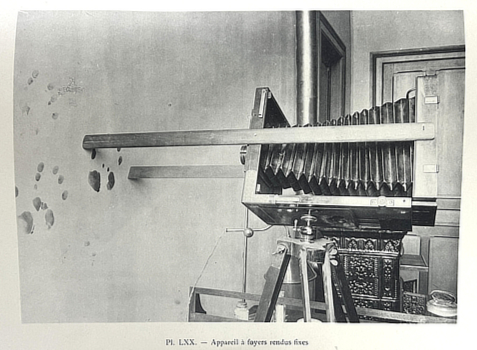
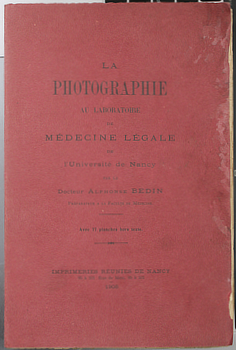
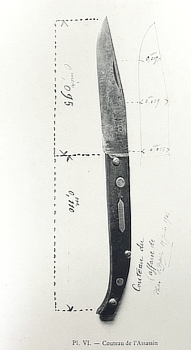
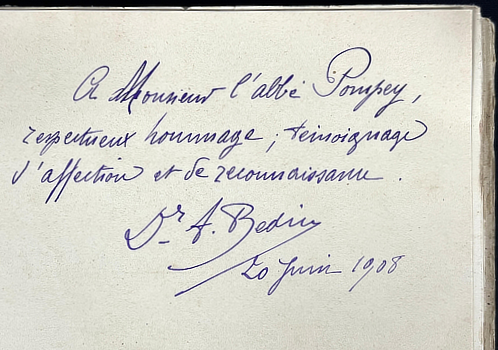
BEDIN, Alphonse. La Photographie au Laboratoire de Medecine Legale de l'Universite de Nancy. Nancy, Imprimeries Reunies 1908. 25x17cm publisher's printed wrapper (front edge of the front wrapper a bit stained with a small chip); 132pp, errata leaf and 77 photo plates. Rather good. Inscribed and signed by Bedin to l'Abbe Pompey. Au$750

First edition of this gruesome pioneering work on forensic photography. I, a delicate soul, tried to check the plates without seeing them. I cleverly decided to do it without my glasses but arriving at an impossible count I had to do it again with glasses. This thesis by Pierre Parisot's assistant at the University of Nancy is in two parts: the first a history and bibliography of the subject; the second their work from 1905 on at Nancy.
Jeremy Norman, cataloguing this same copy a few years ago, pointed out how lavishly it was produced for a thesis - usually a self funded thing. He wrote that it "is about the most expensively produced one I have ever seen".


You can email an inquiry or order securely through antiqbook

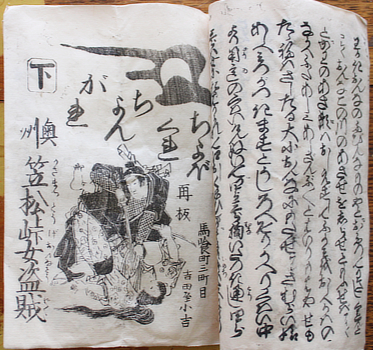
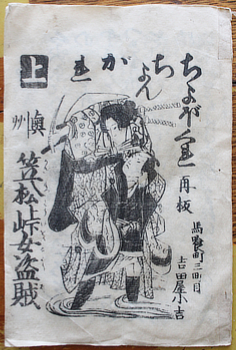
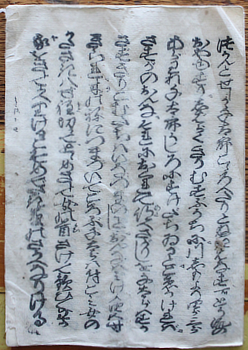
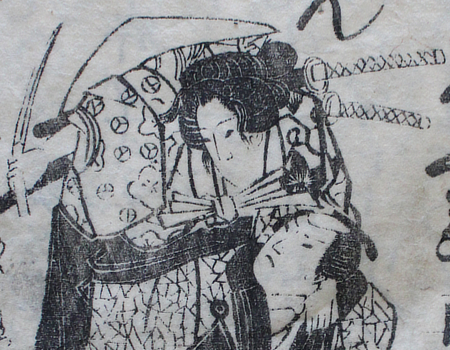
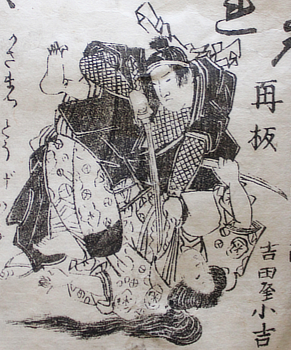
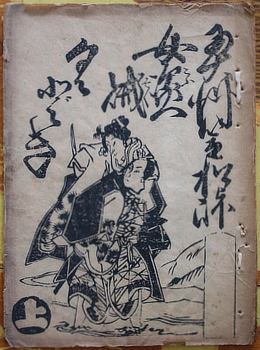
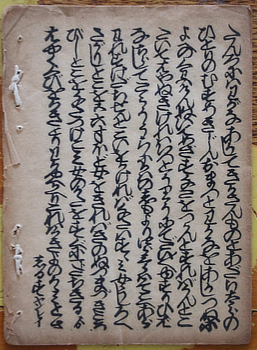
Dokufu. 奥州笠松峠女盗賊 [Oshu Kasamatsu Toge On'na Tozoku]. Bakurocho (Edo, ie Tokyo), Yoshidaya Shokichi [second quarter of the 19th century?]. 17x13cm, two parts together; each eight pages; illustrated titles for each. Au$200

This particular version of the story of Omatsu, the woman thief and killer of Kasamatsu Pass, exists in at least four different versions. The illustrations were redrawn and with the text was recut for each. Since all the copies I've traced were published by Yoshidaya Shokichi it suggests a lot of blocks were worn out printing a lot of copies. This one seems early and is labelled a reprint (再板) on the titles; it matches Waseda's copy.
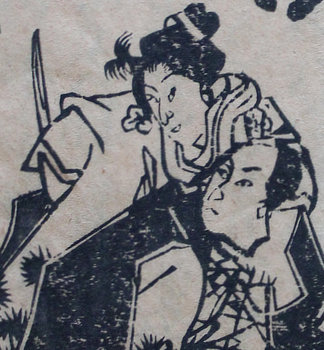
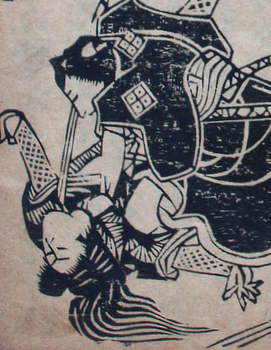
The story of our dokufu (poisonous woman) is a tangle of contradictions depending on whether it came from song - like this one - kabuki, or rakugo (story telling). However she became a thief, the important bit is that she avenged her father's murder and in turn was killed by her victim's son. The two illustrations make that plain enough. I did come across mention of a version in which her daughter avenged her killing without realising her mother had killed his father. That one has the makings of a long running soap opera.


You can email an inquiry or order securely through antiqbook

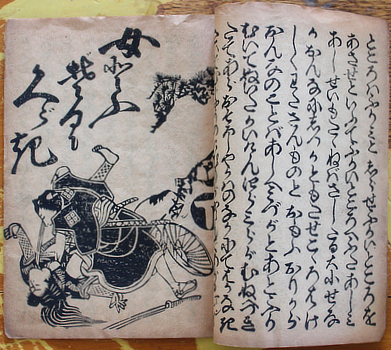
Dokufu. 奥州笠松峠女盗賊 :くどき [Oshu Kasamatsu Toge On'na Tozoku : Kudoki]. n.p. n.d (later 19th century). 17x13cm, two parts together; each eight pages; illustrated titles for each. Cheap paper browned; apparently disbound with old stab holes, recently restitched. Au$100

I think this a lithographic printing of the last version but it's sometimes hard to tell the difference between a poor lithograph and a poor woodcut. Certainly the paper looks like wood pulp. That blank panel, bottom right, has Yoshidaya's name in it on other printings.


You can email an inquiry or order securely through antiqbook

Papua the Marvellous. The country of chances. [Melbourne, Govt Printer [1910?]. Octavo publisher's flush cut cloth; 52pp and 10 photo plates. A read but decent enough copy. Au$175

A superbly concise lesson in how to pillage a country and exploit a people, with little capital and a healthy profit. No more exterminating the natives "as a simple matter of ordinary routine," nor even are tribes now "spared, but enslaved". The modern ruler civilizes, reforms and uses them for "honestly developing the country." It won't be long before the "cannibals of the west will be almost worth their weight in gold."
Australia was still the new owner of its very own colony. A few more years brought German New Guinea as a war prize and proper large scale corruption but in the meantime, with a few hundred quid and a bit of nous, a bloke could do pretty well.


You can email an inquiry or order securely through antiqbook

Giichi Akita. [var. Hodo Akita]. 算法地方大成 [Sanpo Jikata Taisei]. Tokyo, Kitajima Junshiro &c 1837 (Tenpo 8). Five volumes (25x18cm) publisher's wrappers; 4,156 double folded leaves, numerous woodcut illustrations. A very good set. Au$350

First edition of this manual of land management and surveying, published at a troublesome time in Japanese history: the 1830s brought a movement, fiercely resisted by the authorities, towards the adoption of western science and technology and, relevant to this book in particular, a period of horrendous drought, famine and unrest in rural Japan. Land surveying was primarily concerned with taxation and, before the Meiji reforms, accurate measurement was not only unimportant but unwanted. The extent and value of land was a matter for negotiation.
The intricacies of Japanese land surveying in the early modern period demand long learned essays - and after reading a couple I'm none the wiser - but what is clear is that this book is a major work in the history of rural engineering, survey and management. It was also problematic for the authorities: "problems in surveyor education were aggravated by government censorship. Bakufu officials did not want administrative uses of survey techniques discussed in public. Under the guise of 'respect authority; despise the people (kanson minpi),' the mysteries of official practice were not to be released to the public domain." (Brown: A Case of Failed Technology Transfer - Land Survey Technology in Early Modern Japan; 1998).
The authorities did suppress or attempt to suppress the Sanpo Jikata Taisei; Brown refers us to the preface of the 1976 reprint of this book for details and I came across another reference that claimed the woodblocks were destroyed. This seems fairly scarce outside Japan; the title is well represented in western libraries but once we discard the 1976 reprint I found only two libraries with originals through Worldcat.


You can email an inquiry or order securely through antiqbook