These books haven't necessarily been uploaded to antiqbook yet. So, if you order through antiqbook and get a message claiming the book has been sold, email in case that isn't true.

These books haven't necessarily been uploaded to antiqbook yet. So, if you order through antiqbook and get a message claiming the book has been sold, email in case that isn't true.

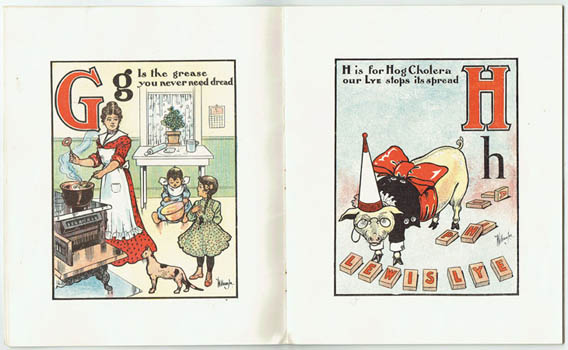
H is for Hog Cholera
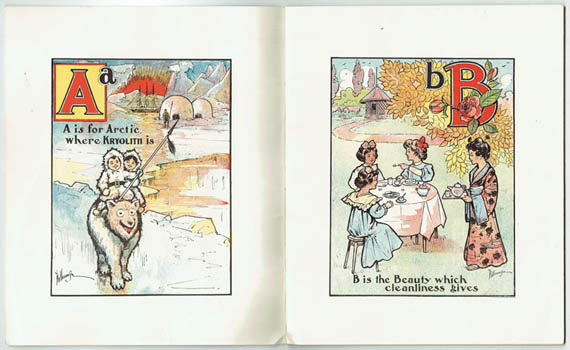
Advertising ABC. Kryolith. Kryolith Kids Alphabet. Pennsylvania Salt Manufacturing Co [Chicago printed]. 1907. 21x18cm colour illustrated publisher's wrapper; 28pp, colour illustrations throughout by Art Williamson. A short marginal tear in the last leaf, a nice copy. Au$275
A charming ABC extolling Kryolith - made into lye, caustic soda, sold as Lewis Lye - and the multitude of ways it makes life easier, healthier, more beautiful. Cryolite seems to have come from one source, a deposit on the Greenland coast which, once that load was turned into lye or used in the production of aluminium, pretty much vanished from our lives.
Worldcat finds no copies.

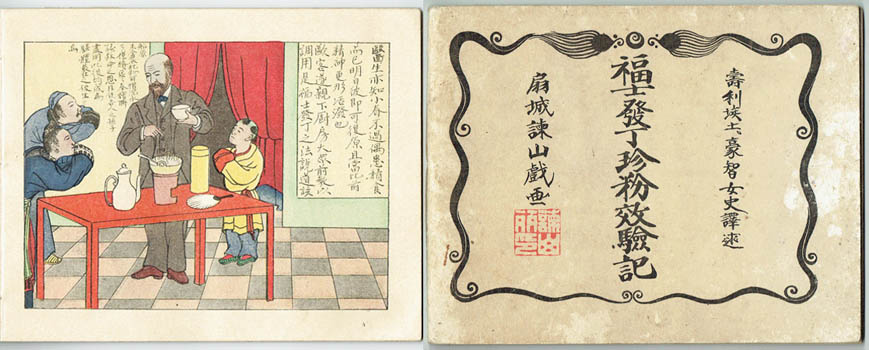
GAUTIER, Judith & R. Isayama. La Source d'Or de la Sante. Paris, Phosphatine Falieres [c190-?]. Oblong octavo publisher's printed wrapper (a bit browned or mottled); [28]pp with 12 colour illustrations by Isayama. A bit used, a very decent copy. Au$150
A chaming bit of fakery. The makers of Phosphatine - the patent baby food - enlisted the distinguished scholar and translator of things Chinese and Japanese, Judith Gautier, to create a traditional Chinese folktale in which the survivor of a shipwreck manages to get off with some of the cargo and is rescued and nursed by a local Mandarin and his family. Pausing only to change into a suit which must have been in his uniform pocket he repays the family by introducing them to Phosphatine. This golden source of health soon works its magic among the neighbours, word spreads and by the end a whole generation of healthy Chinese babies is made possible.
The illustrator is a supposed Japanese artist in Paris. The new Asian Benezit cites a Reikichti - which is surely a mispelling - Isayama exhibiting at the 1900 Exposition but I can't find any work other than the couple of books done with Gautier.
A search of all likely catalogues found one copy of this - in Italy, not France.
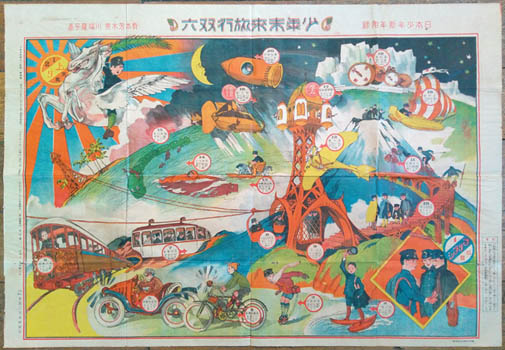
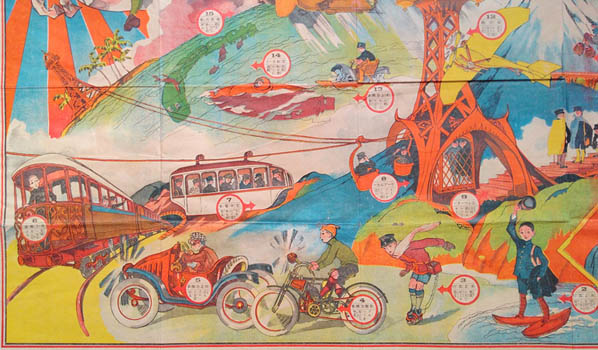
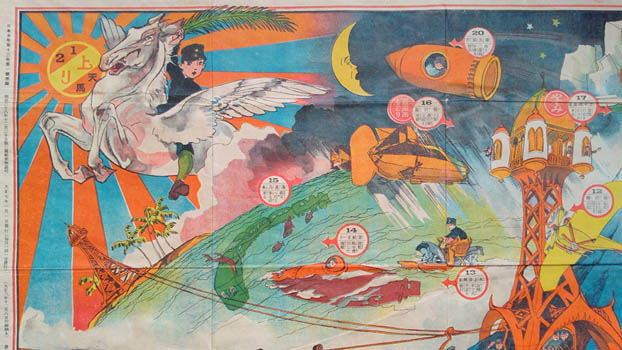
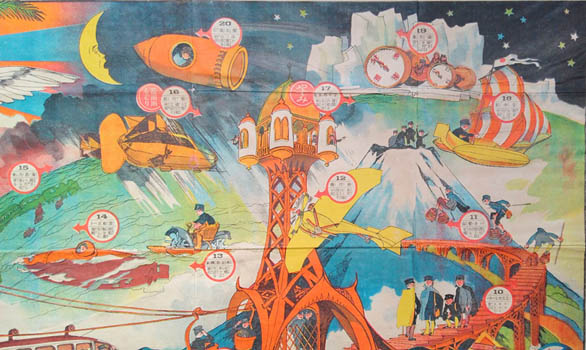
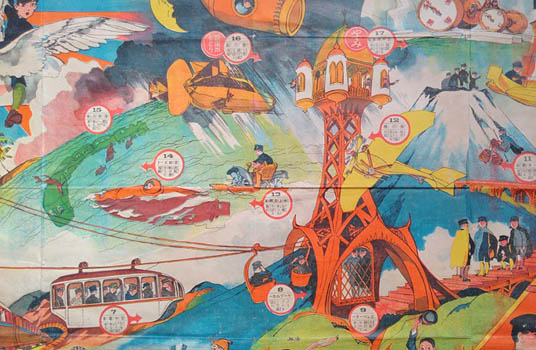
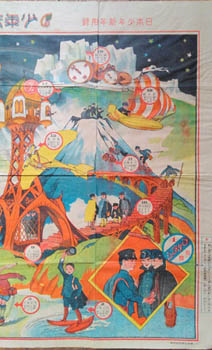
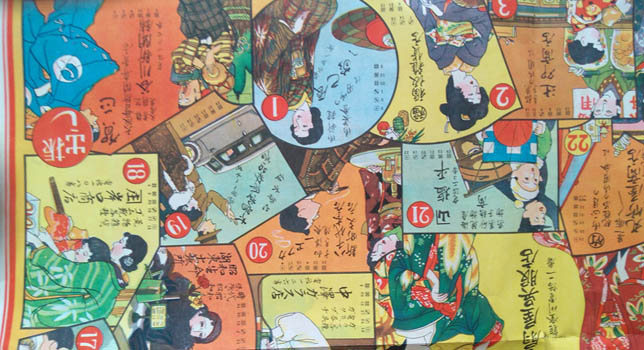
Sugoroku. Kawabata Ryushi. 少年未来旅行双六 [Shonen Mirai Ryoko Sugoroku]. Tokyo, Nihon Soonen 1918 (Taisho 7). Colour broadside 78x54cm. Some repaired tears and small holes. Not bad for a sugoroku printed on less than robust paper.
Forgive the patch of sunlight on the first picture. It went unnoticed until everything had been packed away and I'm too lazy to start again.
Au$750
The New Year gift from the boy's magazine Nihon Shonen. A view of travel in the future, this is among my favourites of the travel adventure sugoroku and hard to find in anything like one piece. Doubtless it was a favourite with many others too.
Kawabata did several of the best, most captivating sugoroku of the period. His career took a curious turn during a 1913 stay in America to study western painting. Apparently he was so impressed with the Japanese art he saw in Boston he switched to being a Nihonga painter. Still, he remained being an illustrator for magazines for quite some time. As did most of the early to mid 20th century artists now revered.
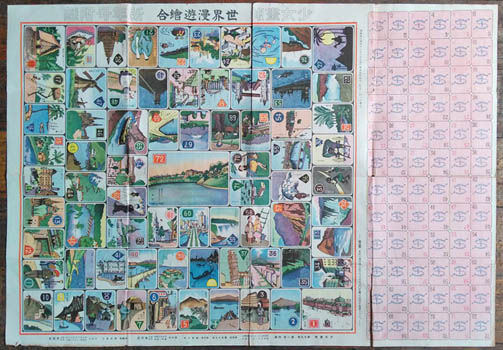
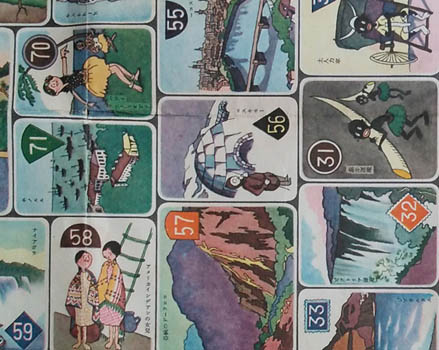
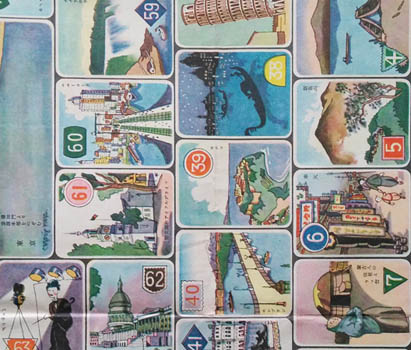
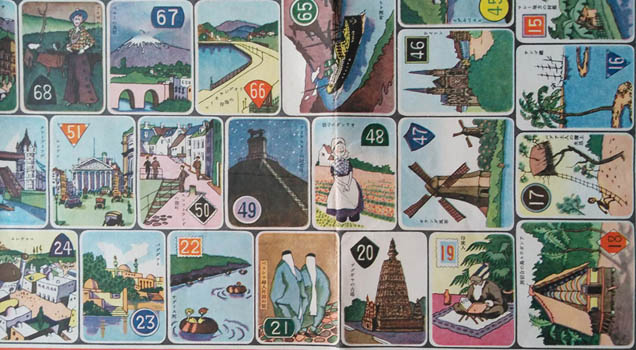
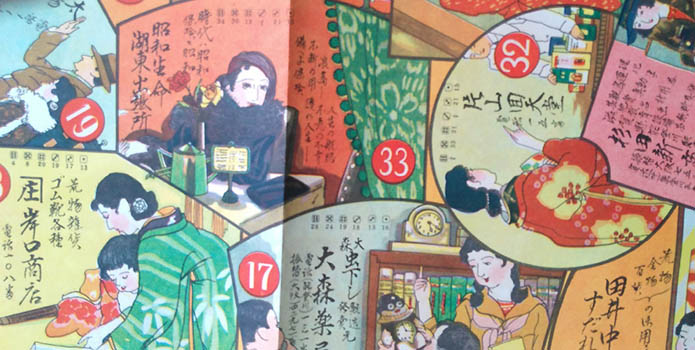
Sugoroku 世界漫遊繪合 [Sekai Man'yue Go]. Tokyo, Shojo Gaho 1930 (Showa 5). Colour illustrated broadside 55x79cm. Used with some old repairs to folds, not a bad copy. Au$250
Maybe not a sugoruku proper - is there a rule? - this game is played with cards, all 72 still on the sheet. This round the world game was the 1930 New Year gift from the magazine Shojo Gaho - Girls Illustrated.
Not the most vivid game of the period but quite fun with more than a touch of Herge or maybe Hemard, or even Okamoto Ippei, cartoon charm. Naturally Hollywood - that is, Charlie Chaplin - is essential on any world tour. Some mysterious robed white radishes puzzled me until I worked out they were veiled women of the middle east.
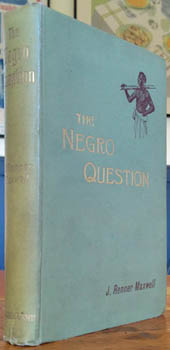
MAXWELL, Joseph Renner. The Negro Question or, hints for the physical improvement of the negro race, with special reference to West Africa. London, Fisher Unwin 1892. Octavo publisher's green cloth (spine a little faded); [8],188pp. Publisher's review slip loosely inserted and cancelled bookplate of Selwyn College, Cambridge. Au$3,000
Much stranger than you might think, specially after scanning the chapter titles: Negro Hideousness the Principle Curse of the Race; Divine Discontent; Miscegenation; West African Half-Castes; Relation of Races. So far just another racial diatribe of the period ... but on page 41 we read: "I am a Negro of pure descent, I have travelled .. been educated at Oxford .. but I must confess with regret that, except the Chinese, I have never seen another race approaching, even within a measurable distance, the Negro in ugliness." Surely one of the most extraordinary documents of the century by a black writer.
Maxwell, while a devout anglophile and Christian, cedes no inferiority on the part of the negro except aesthetically - and a developed appreciation of beauty is intrinsic to all civilized people. His solution is breeding out black ugliness and as a black man propounding miscegenation he must have been pretty isolated.
Maxwell is circumspect with personal history; he practiced as a barrister in the Gold Coast (he appears in the roll book of what is now Ghana in 1881) and was a member of the legislative assembly. He was, he tells us, a descendant of two tribes, the Bornous and the Eboes; the former being "fairly civilized", the latter "out and out savages". I found no other specific detail in his book and an astonishing lack of attention given to him anywhere else.
He was perhaps the first African graduate of Oxford; in an 1881 lecture on relations between Europe and west Africa - his only other publication I can trace - he describes himself as "a native of west Africa, of Merton College .. and of Lincoln's Inn".

ANSTEY, F. [ie Thomas Anstey Guthrie]. A Bayard From Bengal. Being some account of the magnificent and spanking career of Chunder Bindabun Bhosh, Esq. B.A., Cambridge, by Hurry Bungsho Jabberjee, B.A., Calcutta University, ... London, Methuen 1902. Octavo publisher's cloth with mounted illustration; eight plates by Bernard Partridge, 40pp publisher's list dated August 1902. A touch of browning and minor signs of use, a rather good copy. Au$150
First edition of this spanking example of comedy that can no longer be funny; a slur from the caption on the frontispiece to the very last word. Anstey specialised in fish out of water - or stranger in a strange land - situation comedy, often fantastic, and I get him mixed up with his imitator with a parallel pseudonym, R. Andom who specialised in identity exchange.
Here we follow the adventures of our Indian hero in Oxford and highish society as portrayed by a fellow Anglophile and drawn by a last minute stand in for the desired Royal Academician, whose ignorance of things British needs constant correction. All this sparked a letter to the Spectator from an Andra Singha in September 1902 complaining that Anstey's mockery of Indian writings in English was too easy a target, tired and misguided. Anstey's mockery of Indians themselves went unnoticed.

KELLY, Hugh. The Romance of An Hour, a comedy of two acts, as it is performed, with universal applause, at the Theatre Royal in Covent-Garden. London, for Kearsley 1774. Octavo modern plain wrapper; [4,8],44pp with publisher's advert on the last page for four other Kelly plays. A rather good copy. Au$800
First edition of this up to the minute Anglo-Indian farce by the literary hack, virulent anti-American independence critic and ministry mouthpiece. Kelly's biographer, Robert Bataille, was surprised that Kelly announced his authorship so early - the first production was on December 2 and this printed edition was on the street by the 17th - given that an earlier play had been disrupted by rioting Wilkites. I suggest it was hope for riotous publicity that made Kelly put his name on the title. The play got a lot of poor, a few warm reviews and not much attention despite being, as I said, filled with current fads.
The only truly admirable character is the Indian servant who is made, poor thing, to sound to us more like an American Indian in an old cowboy film than any Indian. He says everything but "heap big wampum". The heroine is a charming Anglo-Indian aristocrat who has two well bred Englishmen competing for her hand despite her tint and Tahiti is thrown in - the latest chart is introduced and Bataille suggests that Kelly was capitalising with his noble native servant, on Omai, then in England.

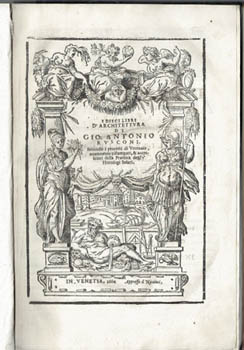
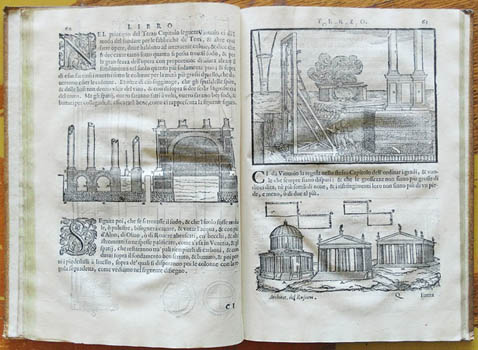
RUSCONI, Gio. Antonio. I Dieci Libri d'Architettura. Venice, Nicoloni 1660. Small folio (18th century?) roan backed speckled boards (neatly recased); [6],148pp, allegorical title page and a plethora of bold wood engravings throughout. A crisp, fresh copy. Au$2,500
Second edition of this chic rendering of Vitruvius - the first (1590) was titled 'Della Architettura' - using the original wood blocks. The blocks show the occasional sign of being knocked or nibbled by worms in the intervening years but definitely not over use. A couple had gone astray and been replaced by new blocks but the only significant one I noticed is one of the astronomical charts. A brief exposition on sundials has been added to this edition.

[HEINE, Johann August]. Traite des Batiments Propres a Loger les Animaux, qui sont necessaires a l'economie rurale;... Lepizig, Voss 1802. Folio (38x27cm) contemporary quarter calf and mottled boards (rebacked with the original spine preserved); xii,72pp and 50 engraved plates including the frontispiece - plans, elevations etc. Foxing, still a crisp copy. Au$1,975
First edition - a German translation appeared a couple of years later - of this handsome, thorough, expert treatise on the architecture of animal husbandry. Heine wrote with an even hand on architecture and rural economy or, as here, both.
The book begins with a plan and elevation for a house and estate and continues in sections: stables and all the other varied structures for horses; cows; pigs; sheep; birds, ducks and geese; bees; silkworms; and dogs. The bee and silkworm sections go well beyond architecture and could be self contained monographs on apiculture and sericulture.
These are no rustic sheds. These are substantial and considered - quite severe - neo-classical buildings, any one of which would be desirable real estate now. I don't remember another farm building pattern book which insists on applying rules of proportion.
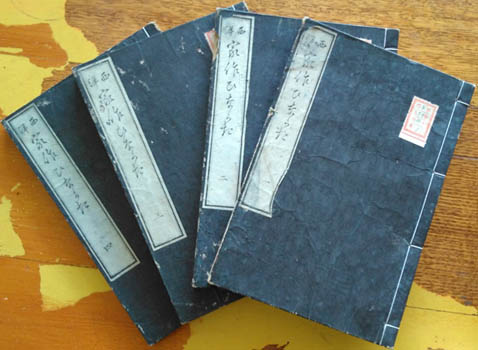
ALLEN, Charles Bruce; Murata Fumio & Yamada Koichiro. 西洋家作ひながた [Seiyo Kasaku Hinagata]. Tokyo, Gyokuzando 1872 (Meiji 5). Four volumes 23x15cm publisher's wrappers with printed title labels. Illustrations through the text and full page plates - copper engravings. A most restrained nibble to the very edge of the cover and first few pages of one volume; a rather good copy. Au$1,250
The first western architecture book published in Japan. I'm intrigued by the choice of the modest Cottage Building, or hints for improving the dwellings of the labouring classes - one of Weale's utilitarian Rudimentary Treatises. Why not European grandeur? American mass production?
Allen's small book first appeared in 1849-50 and remained in print, progressively updated, into the 20th century. This translation was made from the 1867, sixth edition. A sensible enough choice I guess but when has sense played any part in the introduction of new ideas?
Murata Fumio edited Seiyo Bunkenroku (1869 &c) - based on the reports of the Takenouchi mission of 1862 - which focused on England so the connection is clear enough. That there was any significant group pushing for philanthropic reform this early in the Meiji restoration comes as a surprise to me; perhaps this book was chosen as a slap in the face to the opponents of westernisation and modernisation.
Ostensibly it was a response to the 1872 Tokyo fire. Allen's book was given by an Englishman to the translator as useful for information on fire-proof buildings. Could it be that simple?
Worldcat finds no copies outside Japan, a search of the specialist libraries I can think of found no more.

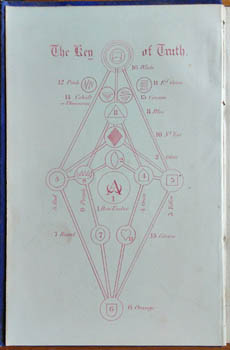
WILSON, Frederick J. The Philosophy of Classification; being a base for thought, a measure for morality, and a key to truth. London, Pitman 1866. Slender octavo blue cloth; viii,35pp, lithograph diagram of the Key of Truth and nine leaves of Tabulations printed on rectos. Inscription trimmed from the head of the title page, title and last page browned by the endpapers; still, a rather good copy. Au$400
I don't believe that anyone else, ever, has so used the words 'comprehension' and 'comprehensive' in all their forms and been so incomprehensible. In the first of the prefatory paragraphs of this book appear 'comprehension', 'comprehensions', 'comprehensible' and 'comprehensiveness' (he also uses 'intelligible' twice). In later years he called himself a 'Comprehensionist' , issued three numbers of a journal called 'The Comprehensionist' (which may be what was collected and published under the title of 'The House That Jack Built' in 1889) and some of his works were published by or for the 'Comprehensional Association' - which I suspect consisted only of Mr Wilson.
Frederick Wilson may well remain an impenetrable mystery - the scant notices I have traced are all uniform in their bewildered defeat; I have yet to come across anyone who had any clue as to what Wilson was on about. This is, I'm fairly sure, his first book and while his simplest statements are unclear I gather from his preface that only 200 copies were printed (in Leamington, then, it seems, his home) - he had no expectations of a large audience.
The diagram (the Key of Truth) is purposely on paper that can be coloured and the colours are given; likewise the tabulations can be removed, mounted in order, and coloured. Colour and, to a lesser extent, geometry and numbers play a large part in all this. All the laws of nature and all human ideas are classified so that a 'base may be formed for the expansion of thought [and] a rule laid down for the mathematical measurement of moral sentiments'.
Simple enough it seems but I defy you to make sense of it when given directions like this: 'The columns are printed in deductive succession, but as all reasoning should be by a succession of flights, you must therefore read it backwards'. As I said, this is his first book but he had been at work on this for some time - he exhibited two large diagrams painted in oil in the 1862 International Exhibition (which 'did not excite either attention or remark') and tracking his publications indicates that he was still trying some forty years later.
The only other book of his I have been able to find (the afore mentioned 'House That Jack Built') makes me think that he became less intelligible as the years went on - so this book may well be his high point in terms of clarity and it is the obvious starting point for any serious study of Comprehensionalism.

Cholera. A gathering of five Italian pamphlets on Cholera dating from 1849 to 1884: Intorno al Colera-Morbus Prima Istruzione Popolare ... [and] Regolamento Sovranamenve Approvato per Guarentire le Provincie del Regno dalla Diffusione del Colera Asiatico qualore vi penetrasse ... [and] Pratiche per l'Espurgo dei Luoghi e Degli Oggetti che Hanno Servito a Colerosi [and] Nota ed Avertenze Pratiche del Consiglio Superiore di Sanita ... sulla Colera [and] Istruzioni Pratiche del Consiglio Superiore di Sanita sul Colera. Avellino 1849; Avellino 1854; Firenze 1865; Firenze 1865; Rome 1884. Five items octavo and large octavo original plain or printed wrappers. Rather good copies of all. Au$400
Instructions for dealing with cholera through four outbreaks in Italy that each killed by the tens or hundreds of thousands. These should record remarkable developments in the handling and treatment of cholera as the century moved on. In 1854 Italian scientist Filippo Pacini announced his discovery of the cholera bug and was soundly and roundly ignored by everyone. Snow's 1854 discovery of the transmission of cholera though contaminated water should have been noted by the Italian authorities by 1865 and by 1884 Koch's rediscovery of the bug was known and it's infectious nature was known. The authorities went with the miasma reactionaries of earlier generations. What they did learn was hugely important for governments everywhere: come the 1911 outbreak the whole thing was covered up.
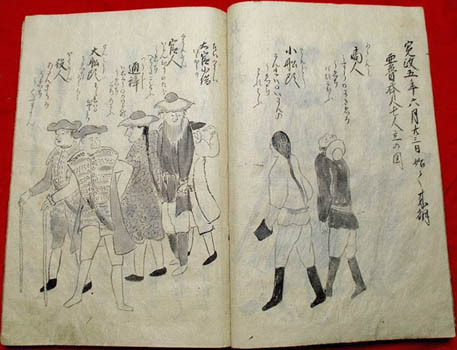
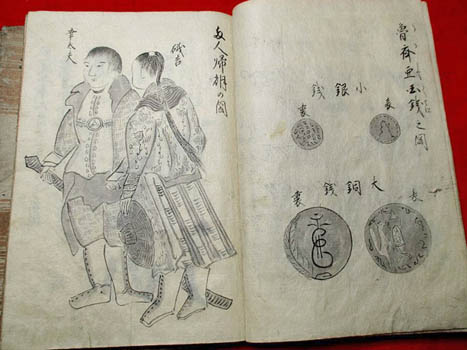
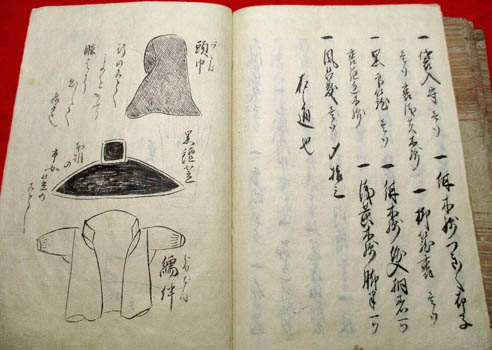
Daikokuya Kodayu. Katsuragawa Hoshu. 北漂記 [Hokuhyoki]. n.p. earlyish 19th century? Manuscript in ink. Eight books written and bound in four volumes 23x17cm, patterned wrappers titled in ink. Illustrations on 12 pages. Covers smudged and dusty, a definitely read but well preserved, rather good copy. Au$3,200
A famous drift account, as far as any of the Japanese drift accounts are famous, this is the story of Daikokya Kodayu and his fellow crew, swept off course and wrecked in the Aleutians in 1782, and his decade or so in Russia before, thanks to Erik Laxmann, he got to hang out with Catherine the Great which won him aid to return to Japan. The portrait of a stately Daikokuya here shows him with Nagao Isokichi who accompanied him back to Japan but obviously didn't make the same impression Daikokuya did.
Of course returning to Japan from anywhere not Japan was a capital crime and any lost sailors foolhardy enough to come home needed a good story to save them from the chopper. Lucky for Daikokuya he had a lot to say about Russia and a report was prepared for the Shogun by his physician Katsuragawa Hoshu in 1794.
These accounts of the outside world by returned involuntary travellers - drift accounts they are usually called, the title here more or less translates as 'north drift record' - were almost never published but were circulated in manuscript copies until the middle of the 19th century when the outside world forced itself on Japan. Not many were published then. They were, after all, mostly old news and had to wait for modern scholarly editions to become available again.
Comparatively famous as I said, there are several modern editions, studies and biographies of Daikokuya but early manuscript copies are hard, very hard, to trace. The National Archives of Japan illustrates their Hokusa Bunryaku - Katsugawara's title for his study of Russia - two handsome coloured scrolls with illustrations of the objects and costume - some in our copy - but not the text volumes. This copy I would guess, from the wrapper pattern, dates toward 1840.

Murayama Tomoyoshi. プロレタリア映画入門 [Puroretaria Eiga Nyumon]. Tokyo, Zen'ei Shobo 1928 (Showa 3), 19x13cm publisher's red wrapper with mounted label (wrapper colour patchy); [8],276pp, loose photo frontispiece, photo illustrations through the text. A nice copy in the original card slipcase. Au$600
First edition of Murayama's introduction to proletarian film - a literal translation of the title. By 1928 Mavo founder Murayama had already had one play banned and soon enough began the first of a series of arrests for troublemaking.
Mavo, a determined regrounding of constructivism - which Murayama had brought back from Germany - in the concerns of real life, was both progenitor and, for a while, companion of specifically proletarian branches of the avant-garde: the Proletarian Art Academy and the Proletarian Art Federation, the Proletarian Film League ... . You will find Murayama's name in the histories of them all. He made films of course; infuriated architects by designing buildings; designed, wrote and directed plays; wrote novels, theory and criticism like this; painted and made collage constructions; and like many radical, or just outstanding, artists of his generation, made his living illustrating children's books and magazines.
It may seem trivial but even the title of this book, using the phonetic transcription of 'proletarian' was a modern typographic departure from the usual three character Kanji - musansha. Worldcat finds no copy of this outside Japan.

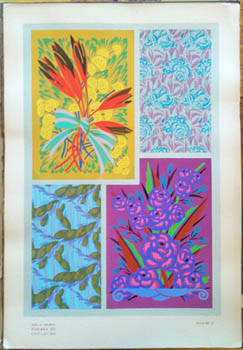
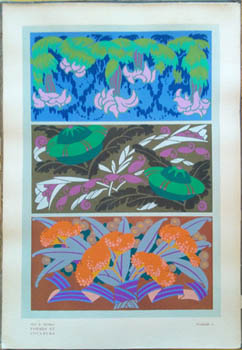
THOMAS, Aug. H. Formes et Couleurs. Paris, Librairie Centrale des Beaux-Arts [1921]. Folio, loose as issued in publisher's portfolio with a colour printed label (edges a bit knocked or worn); title and 20 pochoir plates with 67 designs. Au$1,650
Vivid and captivating high deco designs. Thomas, as far as I can discern, was imaginative and competent but, as far as I can discover, never murdered his wife, slept with Dali and Gertrude Stein - perhaps with Nijinsky but didn't everyone? - nor cross Andre Breton. So he remains largely neglected by everyone but print dealers.
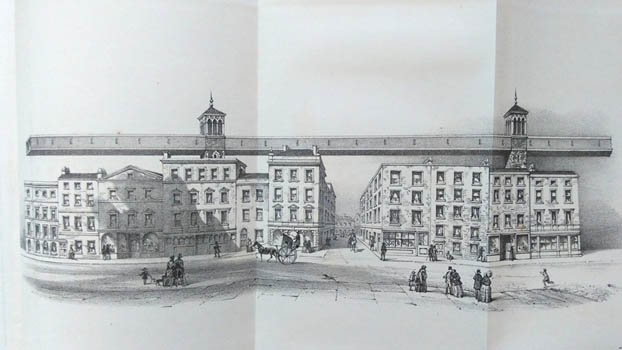
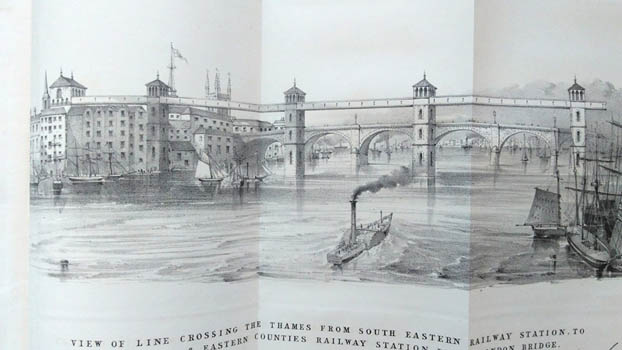
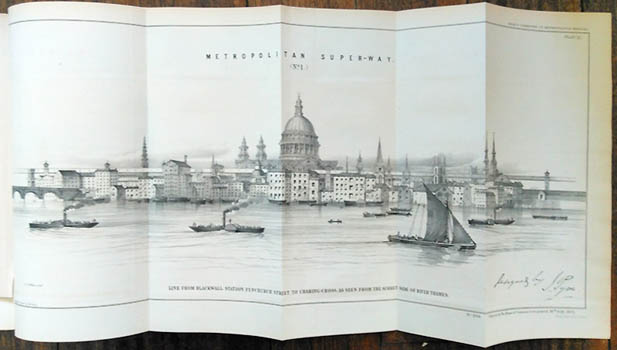
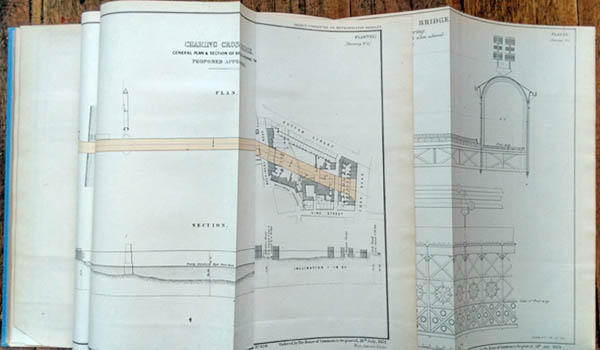
Bridges. Report From the Select Committee on Metropolitan Bridges; together with proceedings of the committee. London, ordered to be printed 1854. Foolscap modern cloth backed boards, printed label; xii,xii,195pp and 11 plans, views and elevations (10 folding). Au$800
London struggling with a population doubled in forty years, the railway boom and a goldrush of schemes and proposals by do-gooders, busybodies and chancers made for committee after committee looking at any number of plans, some dull some fabulous. The dull stuff, like tolls, is easy to recognise and skip.
The main contender here is pretty damn good: John Pym's Super-Way, an elevated tube that looks something like the Britannia Tubular Bridge and spanned London high above the buildings. Brunel was called in for advice on opening his still unfinished Thames Tunnel for heavy traffic and titans like Rennie were asked to report on the condition and capability of existing bridges for heavy traffic.

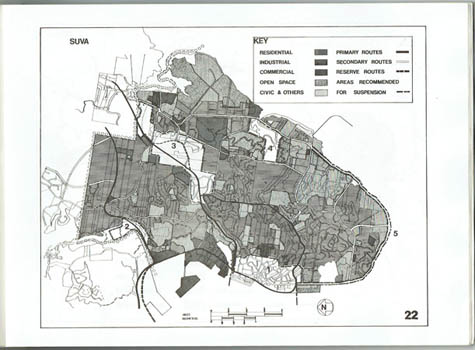
Town Planning - Suva. Greater Suva Urban Structure Plan December 1975. Suva, Director of Town & Country Planning 1975. 21x30cm publisher's printed wrapper; iv,115pp and 28 plans. Au$250
A substantial professional working document that grapples with the problems of an unbridled city sprawling outwards too fast. Predictions about the future population weren't far wrong. Much of what is in here are still the problems current planners would like to solve; in much the same way from what I can see.
One curious thing I noticed is that Fiji is still called 'the Dominion' - this five years after independence. This is an inhouse production, I'd say a determined display of the expertise of a department based on the British model, unequivocally anonymous throughout. Any reports by hired consultants, and there have been some since, never appear unbranded. Trove and Worldcat find only the National Library copy.
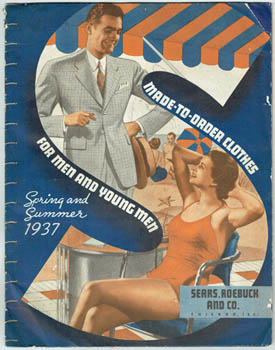
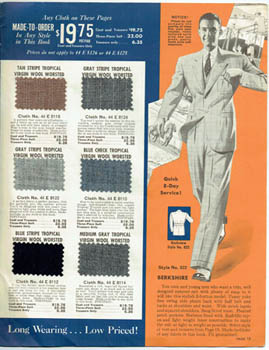
Catalogue - Men's suits. Sears Roebuck & Co. Made to Order Clothes for Men and Young Men. Spring and Summer 1937. The company 1937. Quarto publisher's illustrated wrappers (corner gone from the top corner of the front); 16pp, illustrated throughout and with some 60 mounted fabric swatches. A pretty good copy complete with the order forms and the four page brochure on how to measure yourself. Au$90
Clifton Webb, Robert Montgomery and Edward Arnold never looked so smart and you can be sure they didn't wear Sears Roebuck suits. I'm almost sure one of the models here is a young John Wayne. One of Wayne's biographers writes of the unhappy poor boy reading Sears Roebuck catalogues cover to cover and dreaming of being able to afford everything in them. A dream shared by countless Americans, young and old, for decades.

Catalogue - hearses. Merts & Riddle, Ravenna, Ohio. Merts & Riddle, Coach and Hearse Builders. Ravenna, printed by S.D. Harris [188-?]. Oblong octavo publisher's illustrated wrapper; 50pp, full page wood engraved illustrations throughout. A remarkably good copy. Au$250
Ravenna was clearly a hearse town in the later 19th and early 20th centuries. Merts and Riddle bought their employer's coach building company in 1861 and expanded into hearses a decade or so later. When Merts left in 1891 the company became Riddle Coach & Hearse Co.
This is the earliest catalogue - dated "1880 or so" - in the collection of Thomas Riddle, descendant and company historian. The catalogues at the Huntington with a conjectured date of 1875 aren't.
Romaine did not see any Merts & Riddle catalogues.
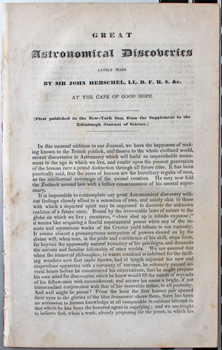
The first scientific discovery of aliens
[LOCKE, Richard Adams]. Great Astronomical Discoveries Lately Made by Sir John Herschel ... at the Cape of Good Hope. (First published in the New-York Sun, from the supplement to the Edinburgh Journal of Science.) [NY, the New York Sun 1835]. Octavo disbound; 28pp, drop title. A little browning, a rather good copy. Au$4,000
I believe this is the first definite report of life on the moon by a scientist with irreproachable credentials. A number of more or less respectable scientists had announced sighting forms that suggested life but Herschel's close observation of both plant and animal life - from strange bovine creatures to near humans with wings - put the matter beyond doubt; at least for many thousand Americans in August 1835.
Herschel himself was indignant when news - and a welter of letters demanding further details - of his great discovery reached him in South Africa but his wife Margaret was delighted, writing to her husband's aunt Caroline about this "very clever piece of imagination" that it was "a great pity that it is not true". Poe was more put out than Herschel. He wrote to friends in September that he believed this had been stolen from his account of Hans Phaall's balloon voyage to the moon published in the Richmond Messenger in early July but all his remarks smack of sour grapes. More recently Crowe (The Extraterrestrial Life Debate) posited that Locke's aim was satire rather than hoax, targeted at the plurality of worlds debate fanned by popular writers like Thomas Dick.
Whatever bubble of credulity existed in New York, it was burst by the time Locke's series of articles reached its week long run but that hardly seemed to matter. Tens of thousands of copies of the New York Sun were sold, who knows how many thousand other papers that began reprinting the series almost immediately and, it was reported, maybe 60,000 copies of this separate edition of the complete work.
Lloyd Currey has, I gather, traced 13 surviving copies including this one.

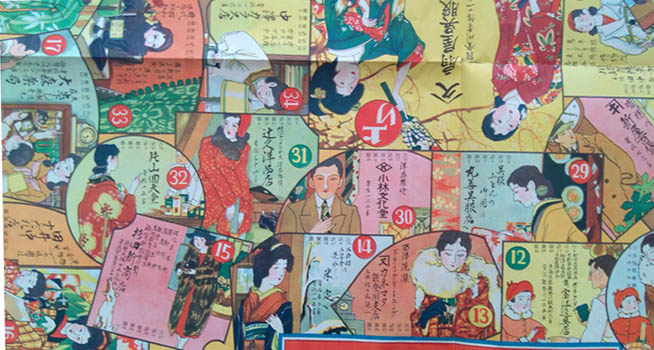
Sugoroku. 商賣繁榮雙六 [Shobai Hanei Sugoroku]. Tokyo, Sankosha 1935 (Showa 10). Colour broadside 80x56cm, folded as issued. Minimal signs of use, a pretty good copy. Au$500
A proper aspirational sugoroku for girls and young women. Prosperity is the reward for the perfect modern girl: good husband, handsome family and shopping, shopping shopping.
This was the New Year gift for readers in the Shiga area. A very similar - a few panels the same - but not so modern game - more kimonos, fewer cars, furs and bobbed or marcelled heads - with the same title was issued the year before by the newspaper Tokyo Nichinichi Shinbun for readers in the Iwamurata-machi area. And I think there were other games with the same or near same title.

Sugar & alcohol. Report From the Committee on the Distillation of Sugar and Molasses. [Second ... Third ... Fourth Report ... ]. [London], Ordered to be Printed 1808. Foolscap folio, very good in later cloth (marked and a bit stained); [4],420,[2]pp. With printed title and leaves at the front and end stating this to be the Home Office copy. Titles for each report but continuously paginated. Au$450
Is there any part of the world that in modern times has not been steered by drugs? Here we have two of the biggies - sugar and alcohol - and the dire effect a dramatic drop in the price of sugar had on Britain's wealthiest - the billionaire class - the owners of West Indian sugar plantations. Add to that the possibly rational fear of a grain shortage due to the situation in Europe and you have the makings of a governnment sponsored monopoly on alchohol production for the sugar industry.
I say possibly rational fear of a grain shortage; that was the approach taken by the majority of this Committee but it was fiercely disputed by the corn and barley growers of Britain and their representatives who claimed that the Committee had been rigged and MPs from the barley counties purposely excluded. Maybe the two most powerful influences on government are at work here: very rich men and tax. I've read that nearly 40% of Britain's taxation then came from alcohol and its ingredients and there are some fearsomely abstruse pages here calculating the adjustments needed to maintain revenue without forcing up the price of drink enough to affect consumption.
Until the end of the 18th century sugar and alcohol ran a global perpetual motion machine. Ships carried slaves to America and the West Indies and returned with rum and sugar, then shipped on to Britain's other colonies and markets. Alcohol distilled in India could be shipped further east - even to Sydney by the end of the 18th century. And where ready-made drink couldn't be had, sugar was even more essential. So, to many, the sugar crisis and the newly enacted abolition of the slave trade (the trade, not slavery itself) was a threat greater than any invasion by Napoleon.
Most of this weighty report is evidence; from lofty experts like Arthur Young and from barley farmers who almost always flatly contradict the experts; from highland distillers and the Irish equivalent of The Untouchables - Major Bellingham Swan tells us that in one night he seized 101 illicit distilleries and barely scratched the surface in that area. Merchants explain how the import of French brandy continues, the war is barely an impediment; West Indian merchants and planters explain why trade with the United States should cease and why it should be expanded; all planters are positive that their sugar and rum are superior and still unprofitable while a London merchant tells us that falling prices and the glut are due to a drop in quality; a Jamaican planter explains that you need to run in your new negroes carefully, don't push them hard until they are "seasoned". The best run estates have the highest number of "negroes and stock" - ie cattle.

HANDS, Joseph. Beauty, and the Laws Governing its Development; with suggestions on education, relative to the attainment of beauty. London, E.W. Allen [1882?]. Slender octavo, very good in publisher's decorated ochre cloth blocked in black and gilt; 88pp. Au$475
Only edition and elusive, just like describing Hand's writings in a simple and clear way. Hands was a London physician cum homeopath, apparently still respectable - viz his membership of the Royal College of Surgeons presuming his claim is true - and wrote works best, or most easily, described as thoroughly Victorian lunatic fringe: on will-ability and mind-energy, on the laws of matter and motion, and here, on aesthetics.
Hands begins with seven aphorisms, one of which was Hogarth's, all sensible enough; the last is quite noble. But from there he leaps from the ideal human form (5'10" tall for man; 5'6'' for woman) to electro-polar action to colour to the lapse of time like an ibex in the high alps and following him leaves us breathless and bewildered.
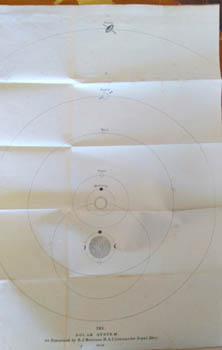
MORRISON, R.J. [Richard James]. The New Principia: or, True System of Astronomy. In which the earth is proved to be the stationary centre of the solar system, and the sun is shewn to be only 365,006.5 miles from the earth. Second edition. London, J.G. Berger [1872]. Octavo contemporary half roan; [4],iv,72pp and four plates (three folding). A scattering of spots; an appealingly used copy with some inoffensive marginalia and a pencil note on an endpaper explaining the vanishing point (which puts Venus closer to its accepted distance from us than Morrison does). The binder has made a fairly glaring error with the title but that seems only fitting. Au$425
Morrison aka Zadkiel, had an early career as a naval hero and made, sometimes successfully, many plans for naval improvements before turning to astrology. His Zadkiels' Almanacs were huge, selling tens and hundreds of thousands of copies. His first open defiance of Newtonian physics appeared in 1857 and reached its fullest development in this work, first published in 1868.
This didn't sell like his almanacs: "The sale of the first edition of this work has been slow but steady'"but the David and Goliath battle against the "monstrous follies" and "mad doctrine" of Newton and his shills must continue. And so it does, armed with but common sense, bellicose language and a set of log tables. But not for much longer. It never reached a third edition and Morrison died in 1874.

Euthanasia Or Turf, Tent and Tomb. London, Routledge 1893. Octavo publisher's illustrated glazed boards (rubbed with wear to edges and hinges). Certainly read but a very decent, even proper, copy. Au$250
First edition, yellowback issue. It was also issued in cloth at a higher price. A title for every reader, the cover of this romantic thriller might convince us that is a book for the horsey set - but what is that monk doing on the field?
Newcastle University attributes this to E.W. Hornung; what did their librarian know that no-one else does? If true then Hornung has masterfully assumed the style of a less polished author who seems expert in the daily routine of an English officer in the Austrian cavalry.
What shines through here is that the aristocracy must be judged by different standards to the rest of us. The hero, the poor younger brother Lord George, is seen as the "soul of honour and loyalty and truth" by all around him while he behaves appallingly by lower class standards. The Euthanasia of the title is indirect, by way of expiation, but I guess it is there. The rest of the title takes place in England, Hungary and Naples. Despite its inclusion in Hubin this is not crime fiction, there is no murder here except of ethics.
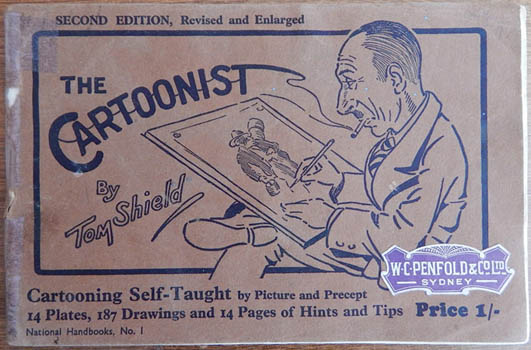
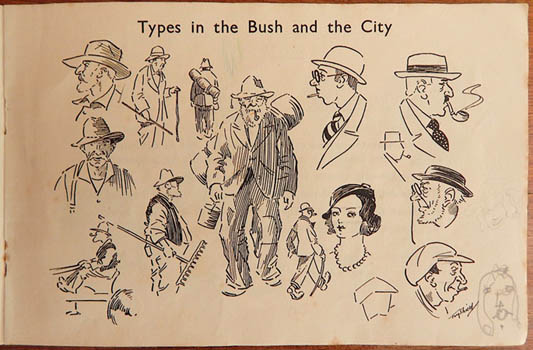
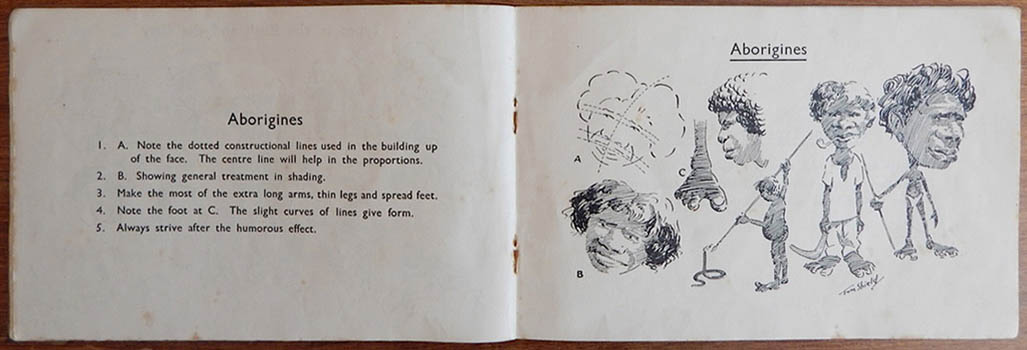
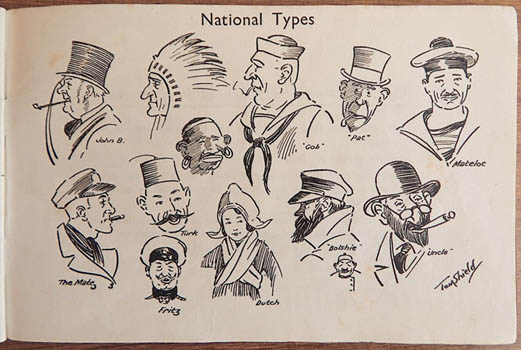
SHIELD, Tom. The Cartoonist. Cartooning self taught by picture and precept. Second edition revised and enlarged. Melbourne, Robertson & Mullens (193-?). 12x19cm publisher's illustrated wrapper (spine taped with what is doubtless archival tape); 32pp illustrated throughout. Mildly and properly used with some light pencil sketching. Au$425
The second and so best edition with the addition of the centrefold plate in which Shield extends - or refines - his racial stereotypes from the usual suspects - the Jewish Uncle, the half-hearted Bolshie. He wasn't even trying. But he excels with Aborigines. Barely an offensive cliche left out in his swift pen strokes. Trove finds two copies, both in Melbourne.
This is number one of the National Handbooks. Shield followed this up with a book on cartoon expressions which is number seven in the series. The series itself is an idiosyncratic array that may well be an informative guide to the preoccupations of the buyers of self-improvement books in the thirties: how to dance, how to find gold, how to fish, how to understand music, and a guide to radio stations.
Psychic Sydney
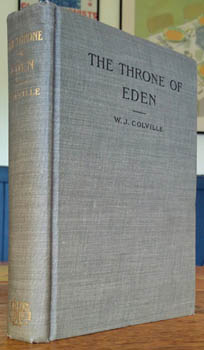
COLVILLE, W.J. [William Juvenal]. The Throne of Eden. A psychical romance. Boston, Banner of Light 1902. Octavo publisher's cloth. A very good copy. Au$165
First edition, it was reprinted or re-issued the next year and an extract called Miss Catte's Impressions of Australia appeared separately in 1903. Colville, American spiritualist, wrote most of this in Sydney in 1901. He describes Australasia as "veritable hot-bed of Spiritualism and Occultism" and the book opens in Sydney with our introduction to Miss Cynthia Catte and Miss Julia Panther. After a preface peppered with Psycho-Therapeutics, Spirit Communion, Etiopathy, heirophants, hypnotism, magnetism, Initiates and Anastasian Occults I was tired and left Miss Panther on the Watsons Bay ferry on page six.

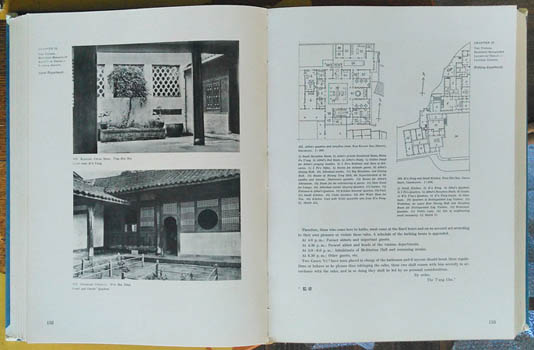
PRIP-MOLLER, J. Chinese Buddhist Monasteries. Their plan and its function as a setting for Buddhist monastic life. Copenhagen, Gads 1937. Folio publisher's half gilt vellum; numerous photo ills, plans & measured drawings (a couple folding, four folding plans in the pocket at end). A splendid copy in the original card slipcase. Au$2,400
Original and best edition by miles. One of the great scholarly studies in architecture in which Prip-Moller's modesty of style and scrupulous research - devoted to setting exact measurement of the material with historical documentation and spiritual purpose - is set in a scrupulous and stylish design, producing a large and solid book outwardly very elegant and inwardly complex. Almost the embodiment of its subject. "A monumental work which, in its own sphere, has no rival at the present time, and is hardly likely to encounter one in the future." said a prescient Gosta Montell ('Geografisk Tidsskrift', b.42; 1939).
Prip-Moller preached this intensity of purpose, function and meaning in his architectural polemic and practised it in his own buildings - the best known now is probably the Christian church he designed for Reichelt in Hong Kong in 1930 - and his direct influence doesn't pass unnoticed in buildings like Utzon's Bagsvaerd Church.

TAUT, Bruno. Fundamentals of Japanese Architecture. Tokyo, Kokusai Bunka Shinkokai 1936. Slender quarto patterned stiff wrapper with mounted label; 36pp (12 pages of photo illustrations, plans, &c). The cover paper is Torinoko from Echizen and the paper inside is Shigarami-gami, a traditional mulberry paper bleached on the snow in winter. An outstanding copy. Au$500
Here Taut criticises the Japanese for being too influenced by western opinion in valuing their own architecture. An earlier generation accepted the outsider verdict that the debased kitsch of Nikko was the pinnacle of Japanese architecture so Taut has debunked this notion and pointed them towards the simple, truly vernacular, beauty of Ise and Katsura. Aware of the irony, still he hasn't tiptoed through the paradox - he dismisses it in a couple of passages.
His illustrations include a couple of recent examples of successful Japanese modernism including Yoshida's Central Post office which I believe is now destroyed.
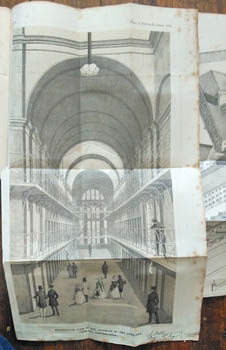
[JEBB, Joshua.] Report of the Surveyor-General of Prisons on the Construction, Ventilation and Details of Pentonville Prison, 1844. London, HMSO 1844. Large octavo modern cloth backed boards; 30pp and 22 folding plans, elevations and views. Spots and signs of use - a couple of closed tears - to the plates, a rather good copy. Au$950
A good account of the planning and construction of Jebb's prison, the model for modern prisons for the rest of the century. Pentonville was planned, built and run as an experimental model; six years later Jebb announced the experiment satisfactorily concluded. The plates range from a large and handsome isometric view of the prison through to details of the cell doors and windows, a hammock, the toilet, the prison's gong ... and a charming large tinted litho view of the main hall.
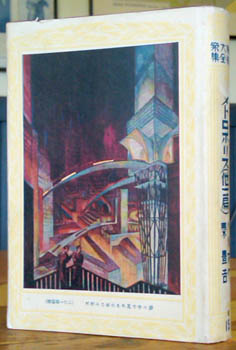
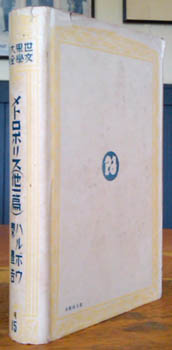
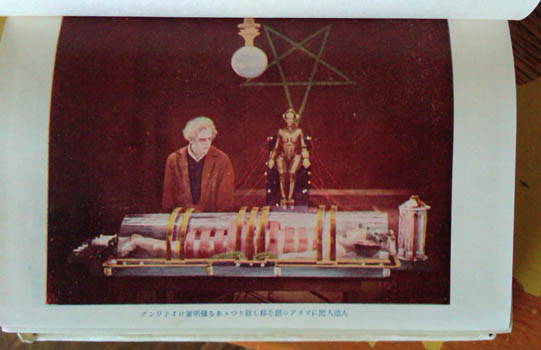
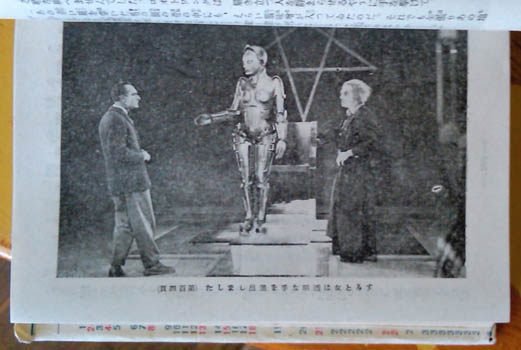
von HARBOU, Thea; Anita Loos & Hata Toyokichi. メトロポリス - 殿方は金髪がお好き [Metoroporisu - ie Metropolis] and [Tonogata Wa Kinpatsu Ga Osuki - Gentlemen Prefer Blondes]. Tokyo, Kaizosha 1928 (Showa 3) Small octavo (15x11cm) publisher's cloth and illustrated dustwrapper (this with a couple of very short closed tears); 560,[2]pp, colour frontispiece and 10 full page b/w photo illustrations - stills from the film. A hint of dustiness, a little browning to endpapers, a remarkable copy. Au$2,500
First Japanese edition of Metropolis and doubtless the first of Gentlemen Prefer Blondes which starts at p401, both translated by Hata Toyokichi. This is volume 15 of a series called Sekai Taishu Bungaku Zenshu - a library of Popular World Literature - which ran to 80 volumes between 1928 and 1931. It's a mishmash of contemporary thrillers, bestsellers, old potboilers and classics.
These are way better made books than the toilet roll quality British series Reader's Library which included the first English edition of Metropolis in their list but I doubt that it's any easier to find a copy as good as this than it is for the Readers Library edition. Certainly my searches through the series turn up tired, grubby, thumbed books that can't remember when they last saw their dustwrapper. The wrapper uses the illustration from the original 1926 German wrapper.
Worldcat finds two part sets outside Japan, one of which includes this title; no single copies.
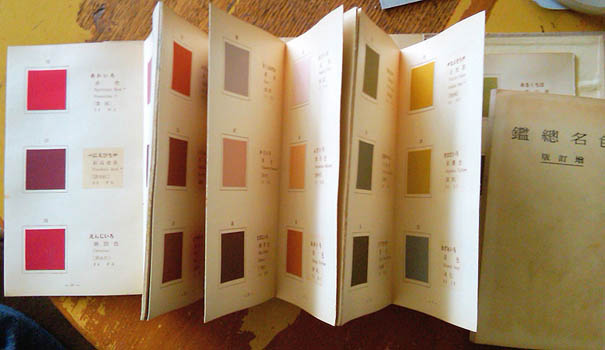
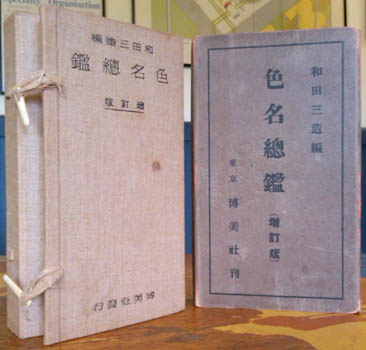
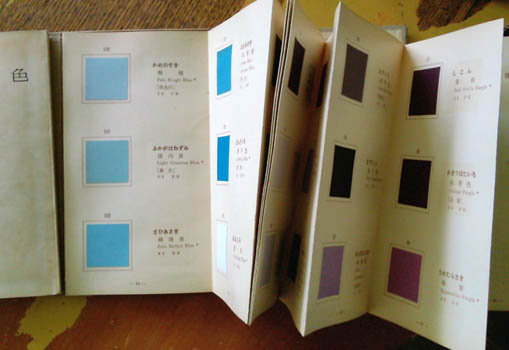
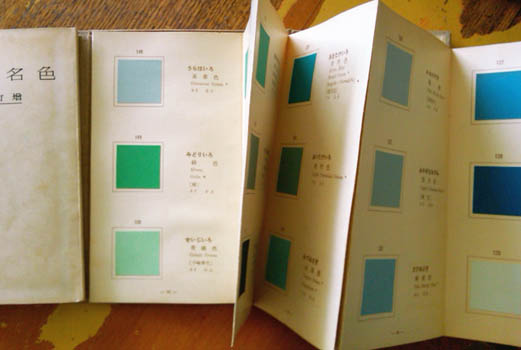
Wada Sanzo. 色名総鑑 (増訂版) [Shikimei Sokan (Zoteiban)]. Tokyo, Hakubish 1935 (Showa 10). 19x11mm publisher's cloth case with 171 mounted colour samples on 57 accordian folding leaves and card bound book; 182,8pp and a folding tables. Colour samples named in Japanese, English and occasionally French or German; table of multi language lists of colour names. A little browning, minor signs of use, and still a very good copy in a mildly worn original printed card folding case. Au$475
Second edition, enlarged and revised, of Wada's first serious attempt at colour nomenclature published in 1931. I can tell you there are a few more pages and eleven more colour chips in this edition but what changes and revisions there are I have no clue.
Wada, though at the top of the art ladder in Japan, insisted on pursuing new directions and founded the Japan Standard Color Association - now the Japan Color Research Institute - in 1927; in these early years science, art and aesthetics went hand in hand.
Yet another significant book missed by the peurile Osborne 'Books on Colour Since 1500'.
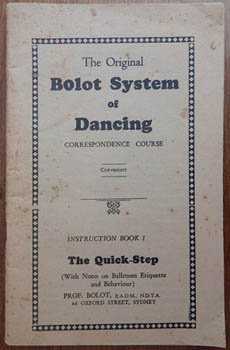
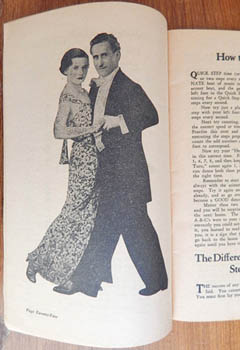
BOLOT, Prof. [John]. The Original Bolot System of Dancing Sydney, Bolot [193-?]. 19x14cm publisher's printed wrapper; 76pp, photo illustrations and step diagrams. A touch used and browned. Au$165
Three books together taking us through the quick step, fox trot, rumba and waltz. Bolot opened his French Dancing Academy in 1910 and I believe maintained it almost until his death in 1951. He died a Professor - his death notice is clear about that. Trove finds two copies.

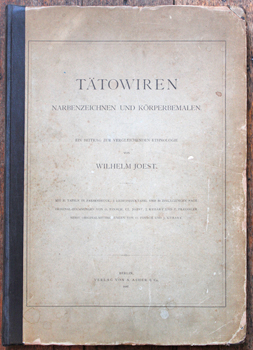
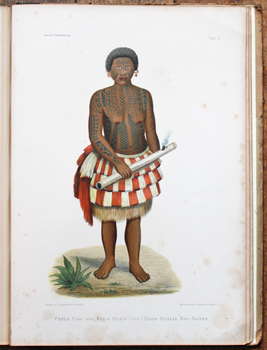
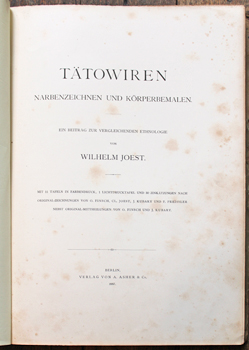
JOEST, Wilhelm. Tatowiren. Narbenzeichnen und Korperbemalen. Ein beittrag zur vergleichenden ethnologie. Berlin, Asher 1887. Folio publisher's cloth backed printed boards (recased and rebacked preserving the original spine, edges somewhat rubbed and scraped); [2],viii,128pp, one plain and 11 coloured lithograph plates, illustrations through the text. Some browning and spotting but a very presentable copy. Au$4,000
There are no common tattoo books of any age or consequence and this ranks high among the most desirable and hard to find. Born a rich kid, Joest was a fieldworker - a traveller, collector and ethnologist of enormous range - and quite properly he died of some fever in the New Hebrides at the age of 45. His collections form the core of the Rautenstrauch Joest Museum in Cologne.
His thesis, that despite whatever religious rituals surround tattooing the wellspring is vanity and sexual preening, was discounted by later researchers who reached absurd levels of Freudian gobbledygook by the nineteen sixties, but his research - historical, from other travellers and ethnologists, and first hand - remains impecable. New Zealand, Melanesia and New Guinea, south-east Asia and Japan are particularly well covered.

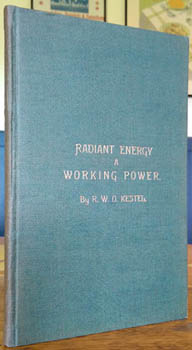
KESTEL, R.W.O. Radiant Energy, a Working Power in the Mechanism of the Universe. Port Adelaide [printed by F. Cockington] 1898. Slender octavo, excellent in publisher's cloth, front lettered in gilt; iv,99pp & errata slip, 6 plates. Au$450
The frontispiece of experimental apparatus must be one of the best examples in the history of Australian scientific illustration: a new theory explaining the workings of the universe can be tested with a decapitated corrugated iron water tank, two rules and a ball on a string. It also, just in graphic terms, has a radiant energy of its own.
This is a stylish little book and has a stylish and reasoned generosity not always present in such works: "the difference in the two theories does not at all effect the accepted laws of the force of gravity, as given us by Newton". As to considerations of a Newtonian universe he points out that "of two theories, if one can be demonstrated by .. experiment and the other cannot, I prefer the former." An humane execution.
Kestel was an Adelaide builder, sometime mayor of Port Adelaide, and determined autodidact astrophysicist. I don't think he published any more but he did lecture, with demonstration, a belligerent South Australian Astronomical Society - apparently he had to elicit a promise that his audience would not interrupt again - in 1901. This book was belatedly reviewed in Nature, in 1903 where our condescending reviewer, after pulling the rug out from under Kestel's credentials -"none but a discerning reader will profit by its perusal" - allows that a couple of his intriguing notions that may be useful to real scientists. Kestel didn't live long enough to see the review. (Thanks to Pioneer Books for their diligent note on Kestel).
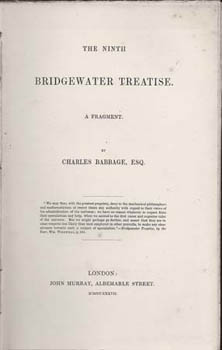
BABBAGE, Charles. The Ninth Bridgewater Treatise. A fragment. London, Murray 1837. Octavo publisher's cloth with paper spine label (the bottom of the spine and the front edge of the top board neatly repaired, some insect nibbling around the edges of the cloth and of the label); ppxxii,xxiii-240,241-244*, (H3 numbered 101 on recto as is H4), and single page publisher's list. Front endpaper foxed, diminishing to a few spots on the title, inside a very good fresh copy). The label with the price 9s6d. Au$1,250
First edition. I doubt that anything ever came to Babbage's notice that didn't enrage him. This, the unoffical and uninvited Bridgewater Treatise, Babbage was forced to write by Whewell's attack, in his official Bridgewater Treatise, on the compatibility of science and religion, a "prejudice which I had believed to have been long eradicated from every cultured mind".
First among the 'relative positions' of the subjects under discussion is pure mathematics (whose truths are necessary truths) and he brings his Calculating Engine into use early in the book - and we end up with a mechanical universe with God as the writer of evolutionary programs.
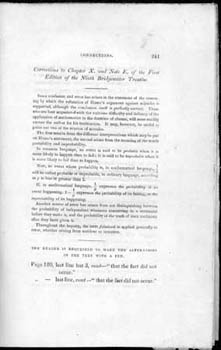
*This copy has the extra four pages of corrections that appears to exist in very few copies. These correct his chapter and appended note on Hume's argument against miracles. These pages are on a much lighter paper than the rest and have been bound in this copy - unlike those in the copy catalogued by Roger Gaskell which called attention to the existence of these pages.